
A lukewarm shower and a water heater that pops or rumbles from the garage are familiar warnings in Las Vegas homes. Hard water may be the reason. Las Vegas water is consistently classified as very hard, with reported averages around 274 to 304 parts per million, or roughly 16 to 17.5 grains per gallon (Rainwater Harvesting Las Vegas explains local hardness levels). That mineral load gives calcium and magnesium plenty of opportunity to form scale inside a tank, on an electric element, or across a tankless heat exchanger.
So, does Las Vegas hard water shorten the life of your water heater? Yes, but the damage depends on the heater type, the failure point, and how consistently you maintain it. A tankless unit doesn't fail the same way as an electric storage tank, and flushing may rescue a younger heater while doing little for a tank that's already leaking.
What Las Vegas Hard Water Actually Does Inside a Water Heater
A homeowner in Sun City Summerlin may notice the trouble during a morning shower. Hot water turns lukewarm early, the garage heater pops or rumbles, and pale grit collects in a faucet aerator. Those signs fit mineral buildup, but the heater still needs a proper inspection before anyone assumes the cause.
Las Vegas water commonly falls in the very hard range, as noted earlier. Calcium and magnesium remain dissolved more easily in cold water. Heating changes that balance, allowing minerals to settle on the hottest surfaces inside the equipment.
Four places scale causes trouble
- Anode rod channel: Deposits can coat the sacrificial magnesium anode rod. Once the rod is heavily consumed or buried, it provides less protection against corrosion inside the steel tank.
- Lower electric element or gas burner area: Scale and sediment insulate the heat source. The heater takes longer to recover, while the element or burner works under greater strain.
- Dip tube and cold-water inlet: Crystals can form a crust that restricts incoming water and reduces hot-side flow.
- Tankless heat exchanger: Deposits interfere with heat transfer through the exchanger. As the passages become restricted, the unit may struggle to maintain temperature or meet its required flow.
Gas storage heaters often collect sediment at the tank bottom, where trapped water contacts the burner and produces popping or rumbling. Electric heaters commonly develop sediment around the lower element, causing it to overheat. Tankless equipment shows a different pattern, including delayed hot water, fluctuating temperature, or error codes.
Field rule: Popping, ticking, delayed hot water, white flecks at showerheads, and sand-like grit at aerators justify an inspection. Do not treat them as harmless operating noise.
The practical effect is reduced heat transfer and greater wear. Technical research reports that mineral deposits can cut water-heater efficiency by up to 50%. The same cited research associates approximately 4% efficiency loss for every 5 grains per gallon of hardness, though actual results depend on heater design and deposit location. Pacific Northwest National Laboratory research reports that scale can reduce equipment life by 25% to 40% in some cases and reduce efficiency by up to 10% in extreme conditions (PNNL technical research examines scale on water-heating equipment).
The right response depends on the failure mode. A younger tank may benefit from inspection, flushing, and anode-rod service. A tankless unit usually needs attention to its heat exchanger and flow path. A leaking tank cannot be repaired by descaling, and a restricted connection or combustion problem calls for water heater repair in Las Vegas.
Review how to descale a water heater before attempting maintenance. Shut off fuel or power, follow the manufacturer's instructions, and stop if the heater leaks or the connections are severely restricted.
Why Scale Forms Faster in Las Vegas Than Most Other Cities
A Las Vegas water heater can look clean at the connections while scale is already restricting heat transfer inside. Local water supplies are commonly reported around 16 to 18 grains per gallon, or roughly 275 to 310 milligrams per liter as calcium carbonate (Enviro-Membranes provides Las Vegas hardness and water-treatment context). Water above 180 parts per million is classified as very hard, placing local homes well beyond a minor-hardness concern.
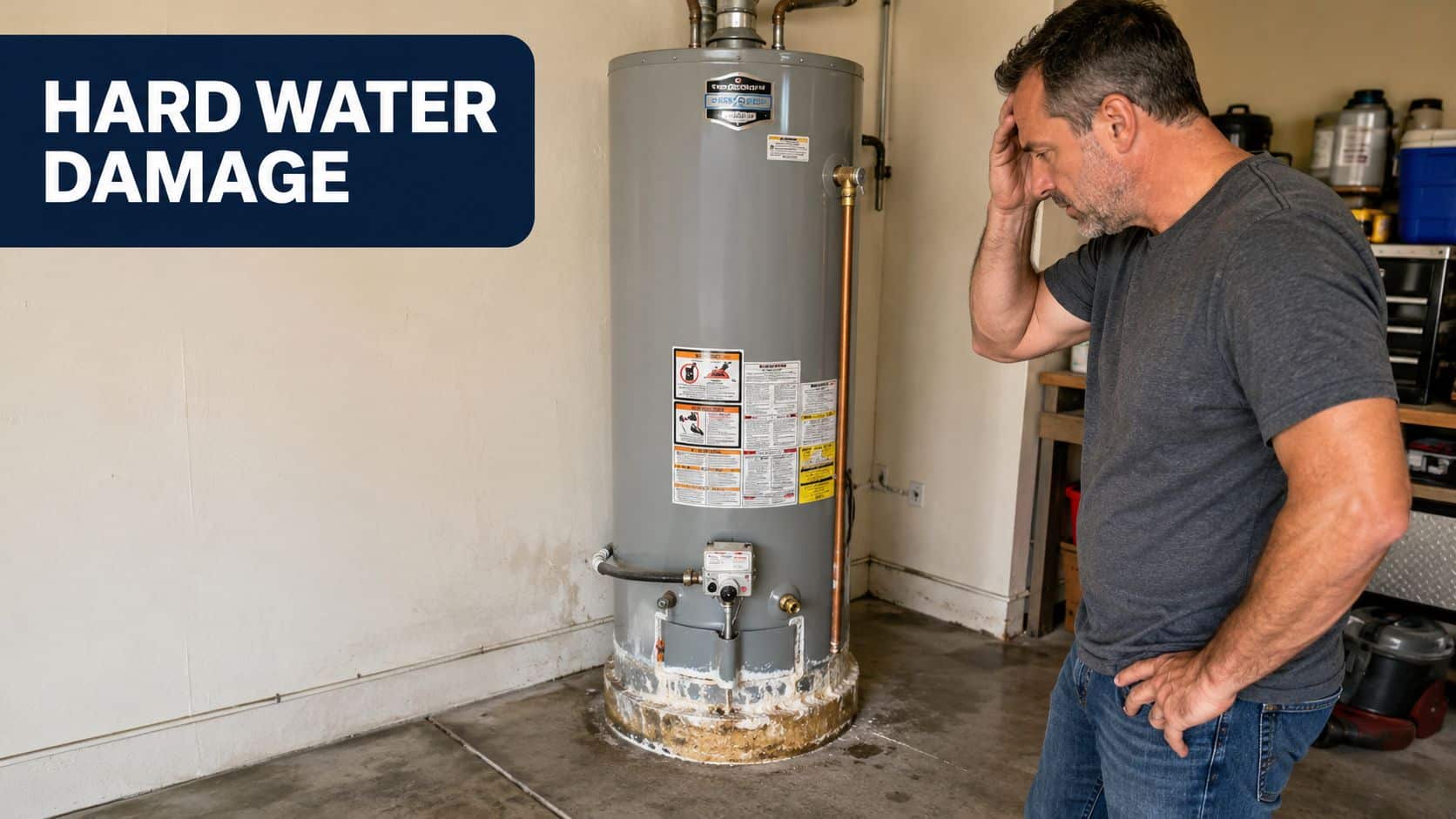
Heating changes how dissolved minerals behave. Calcium and magnesium compounds leave the water and attach to the hottest surfaces. In a storage tank, deposits commonly collect across the bottom, around the lower electric element, and on nearby steel. In a tankless heater, the heat exchanger receives the greatest exposure because water moves through narrow, heated passages.
Why gas and electric heaters respond differently
An electric element transfers heat through its metal surface. Sediment around the lower element insulates it, so the element runs hotter while the water heats more slowly. That condition can turn a sediment problem into an element replacement, even when the tank has not begun leaking.
A gas heater moves heat through the burner and flue path. Scale on heat-transfer surfaces, along with soot or restricted venting, can reduce recovery and affect combustion. Gas equipment therefore needs inspection beyond a simple tank flush.
Tankless units avoid a tank bottom where sediment can settle, but their heat exchangers have narrower water passages. Scale reduces heat transfer and water flow. The heater may cycle, deliver unstable temperatures, or shut down when the flow sensor no longer detects the expected movement. Descaling the heat exchanger and cleaning the inlet screen address a different failure path than flushing a storage tank.
The buildup rate depends on water chemistry, temperature, household demand, heater design, and maintenance. A single scaling rate or temperature multiplier would give homeowners false precision. The practical conclusion is clear: very hard water plus repeated heating creates a high-scaling environment, with deposits forming most aggressively on hotter surfaces.
| City or region | Hardness | Average summer inlet temperature | Relative scale risk |
|---|---|---|---|
| Las Vegas Valley | 16 to 18 gpg | Varies by home and season | Very high |
| Typical national-average supply | Lower than Las Vegas | Varies | Lower than Las Vegas |
| Phoenix and parts of Scottsdale | Similar hardness may occur | Varies by location and season | High, but not identical |
Water conditions can also differ across the valley. Reported readings range from 12 to 25 grains per gallon by area (Rainwater Harvesting Las Vegas discusses neighborhood-level variation). A schedule suitable for average water may be too relaxed for a high-use home in Henderson, Summerlin, or North Las Vegas, particularly without softening equipment. Tank owners should prioritize sediment and element inspection, while tankless owners should plan for heat-exchanger descaling.
Tank vs Tankless vs Gas vs Electric How Lifespan Really Compares
A Las Vegas homeowner choosing a replacement should compare failure points, not rely on one lifespan number. Heater design determines where minerals collect, which component fails first, and whether maintenance can recover performance.
These ranges are practical planning figures for local hard-water conditions, not guarantees. Installation quality, household demand, water treatment, temperature settings, and service history all affect results.
| Heater type | Expected lifespan | Primary failure mode | Annual maintenance needed |
|---|---|---|---|
| Standard electric tank | 6 to 9 years | Lower element buried in sediment, anode depletion, tank corrosion | Flush and inspect components |
| Standard gas tank | 8 to 12 years | Burner or flue scale, sediment, anode depletion | Flush and inspect burner and venting |
| High-efficiency gas tank | 10 to 14 years | Scale on heat-transfer surfaces and component wear | Flush and inspect combustion system |
| Tankless gas | 12 to 18 years | Heat-exchanger scale, restricted flow, sensor errors | Descale and clean inlet screen |
| Electric point-of-use tankless | 8 to 12 years | Element scale and flow-related performance loss | Descale and inspect flow path |
Storage tanks
Electric tank owners should watch the lower element first. Sediment can bury it, causing overheating and failure while the tank shell remains usable. Technical guidance explains that cleaning or replacing the element can restore efficiency in many cases, so an element failure does not automatically mean replacing the entire heater (California Energy Commission technical documentation discusses hard-water effects on electric storage heaters).
That creates a practical repair decision. If the tank is dry, the anode has not been exhausted, and the element is the problem, component service may be reasonable. A leaking or heavily corroded tank is a replacement case, regardless of the element's condition.
Gas tanks have a different exposure. Sediment still collects at the bottom, while deposits around the flue and burner area interfere with heat transfer. Under tested conditions described in the same technical material, gas storage-heater efficiency declined from 70.4% to 67.4% over an equivalent of two years (the California Energy Commission document reports the gas-heater efficiency benchmark). A gas tank that needs burner or venting work should receive a combustion-focused inspection before continued operation.
Tankless systems
Tankless heaters avoid tank corrosion and bottom sediment, but their heat exchanger has narrow passages where scale can restrict flow. Skipped descaling can produce temperature swings, lower flow, sensor errors, or shutdowns. The maintenance decision is specific: schedule heat-exchanger descaling and clean the inlet screen rather than treating the unit like a storage tank.
Tankless gas can suit a household that values continuous hot water and accepts a higher installation cost. It is a weaker choice without a softening or descaling plan. Neglected scale can turn a long-lived appliance into an expensive heat-exchanger repair.
Electric point-of-use tankless units face similar mineral exposure at the elements and flow path. Descaling may restore performance when the housing and controls remain sound. Warranty terms also matter. Manufacturers may cover component failures while excluding scale damage or neglected maintenance, so keep service records and follow the equipment manual.
What a Plumber Looks at First on a Las Vegas Service Call
A heater may still look fine while scale is restricting heat transfer inside it. On a service call, the useful clues are the unit's age, hot-water quality, flow, leak location, and the type of heater installed. Homeowners can safely read the age sticker and compare hot-side flow with cold-side flow at the same fixture. Do not remove covers, disconnect gas piping, or open an electrical compartment unless you are qualified and the power or fuel has been safely isolated.
The initial inspection
The technician identifies the heater type, fuel source, age, capacity, venting, temperature setting, and visible leak points. After shutting off the cold-water supply, the technician drains a controlled amount into a container.
Sediment's appearance and texture help determine the next repair. Fine, pale material points to mineral accumulation. Heavy, granular deposits suggest a larger restriction or a long-overdue service. A plumber uses that sample, along with the heater's age and symptoms, to judge whether flushing is reasonable or whether the drain, element, burner area, or tank has deteriorated too far.
What homeowners often miss: A heater can look clean from the outside while the lower element, burner chamber, or heat exchanger is already coated internally.
Gas and electric heaters require different checks. On a gas unit, the technician examines the burner chamber, ignition behavior, flame pattern, venting, yellow flame tips, and delayed ignition. These findings can point to combustion or venting problems that flushing will not correct.
An electric unit is inspected after power isolation. The lower element may be removed to check for calcium crust on its threads and heating surface. The technician also checks thermostats, wiring, the anode rod, drain valve, and accessible areas of the tank interior. A heavily scaled element may justify replacement, while sound controls and a serviceable tank may support cleaning.
Thermal readings at the outlet pipe can show unstable recovery or inadequate heating. A combustion check on a gas model can identify performance problems before they become a safety concern. Water around the base, persistent rust-colored hot water, repeated relief-valve discharge, or a damaged tank usually shifts the recommendation from repair to replacement.
Moisture with no obvious source needs separate testing. Professional water leak detection can distinguish a heater leak from a supply line, slab, or nearby plumbing problem.
A Practical Maintenance Routine for Very Hard Water
Very hard water calls for a deliberate schedule. Annual flushing and descaling are a practical minimum, while homes without a softener or with high hot-water use may need service every six months (Enviro-Membranes recommends annual maintenance and shorter intervals in harder-use conditions).
Annual work
A storage tank flush should remove settled sediment rather than draining a small amount from the valve. The complete process may involve a hose, a submersible pump, and a descaler when deposits have hardened. Shut off the energy source first, confirm the discharge water can drain safely, and never operate an electric heater with the tank empty.
Inspect the anode rod during service. In aggressive water, the rod can be consumed before a homeowner expects. Replace it when inspection shows substantial depletion, and keep the model and date in a maintenance log.
Check the temperature and pressure relief assembly and look for leaks at the drain valve, supply connections, expansion equipment, and discharge piping. A pressure problem can create symptoms that resemble a heater failure.
Every six months for tankless units
Tankless systems need a descaling loop with a circulating pump and an approved solution. Food-grade vinegar or a manufacturer-approved citric-acid product may be appropriate, but always follow the unit's instructions because some heat exchangers and seals have specific requirements.
Clean the cold-water inlet screen at the same interval. A plugged screen can restrict flow and mimic a failing heat exchanger. Record the service date, solution used, error codes, and any parts cleaned or replaced.
A homeowner with the right tools may spend 60 to 90 minutes on a DIY flush, based on the maintenance method and heater condition. Professional service often takes 45 to 60 minutes of labor, plus the descaling solution, although access and buildup can change the time required. For a broader explanation of why service your water heater regularly, look for guidance that covers flushing, component inspection, and corrosion prevention together.
When Flushing Helps, When Softening Helps, When to Replace
Flushing is not a cure for every water-heater problem. It works best when the heater is relatively young, the tank is not leaking, hot-side flow remains normal, and the sediment has not permanently damaged a component.
A heater under five years old with mild or moderate buildup is often a reasonable flushing candidate. A new anode rod may also help protect the tank if the existing rod has been consumed. If the lower element is heavily coated, cleaning or replacement may be necessary before the electric heater returns to normal operation.
Choose treatment when the water is the root problem
A softener or suitable conditioner addresses the water entering the heater. That matters most for tankless equipment because the heat exchanger sees every gallon passing through its passages. Treatment won't remove scale already bonded to a component, so existing heaters still need flushing or descaling.
A traditional softener exchanges hardness minerals and requires salt management. Salt-free conditioning systems work differently and shouldn't be described as identical replacements for softening. Ask a plumber or water-treatment professional to test the supply and match the equipment to household demand.
Replace when the heater has crossed the repair threshold
Replacement is usually the responsible path when the storage tank itself leaks, corrosion has advanced, or a heater has repeated failures after maintenance. A tank over 10 years old in this environment deserves a serious replacement discussion, particularly if it has lost recovery speed or shows rust around the base.
For tankless units, recurring error codes, reduced flow, and neglected descaling can justify replacement when the heat exchanger or control system is no longer economical to repair. The repair decision should consider the appliance's age, parts availability, installation condition, and the cost of correcting the hard-water cause.
| Option | Best when | Typical cost | Result |
|---|---|---|---|
| Flush and inspect | Younger tank with manageable sediment and no tank leak | Varies by scope and provider | Removes loose buildup and identifies component damage |
| Descale tankless unit | Flow and temperature problems come from heat-exchanger deposits | Varies by equipment and service | Restores heat transfer when scale hasn't caused permanent damage |
| Add water treatment | Repeated scale affects the heater and other fixtures | Varies by system and installation | Reduces hardness exposure going forward |
| Replace heater | Leaking tank, advanced corrosion, or uneconomical repairs | Varies by heater and installation | Restarts the system with a better maintenance plan |
Avoid relying on an invented payback calculation. The right comparison is the cost of treatment and maintenance against the cost of repeated repairs and premature replacement. For general maintenance considerations, this water-heater guide by EZ Plumbing offers another practical reference. For a property-specific estimate, use the MG Drain Services cost estimate page and ask what the inspection includes.
Preventing the Next Early Replacement in a Las Vegas Home
A homeowner with a six-year-old tankless heater may not notice a problem until the unit begins shutting down during high demand. By then, scale may have restricted the heat exchanger, the inlet screen may be dirty, and the home may be relying on an appliance that has never received regular descaling.
The prevention plan is straightforward, but it has to be repeated:
- Treat the incoming water: A dedicated softener sized for a household of 4 to 5 people can reduce the mineral load reaching the heater. A salt-free conditioner may help control deposit behavior, but it doesn't perform the same hardness removal as a conventional softener.
- Schedule spring service: A 45-minute descaling flush every April prepares the heater for the higher hot-water demand that often accompanies summer conditions. The exact interval should follow the equipment manual and service findings.
- Inspect the anode rod: Plan an anode-rod inspection around year 4 for storage tanks, then replace it when its condition calls for it. The rod protects the tank, but it is a consumable component.
- Watch low-flow fixtures: Low-flow showerheads and aerators can expose a restricted heater more quickly because a small change in available flow affects temperature stability, especially on tankless systems.
Some homeowners compare maintenance with replacement only after the heater fails. One plan note sometimes quoted a local flush at $800 and a tankless replacement at $4,500, but those figures aren't supported by the verified data available for this article, so they shouldn't be used as universal prices. Get a written, equipment-specific estimate instead.
MG Drain Services LLC is a licensed and insured, family-owned, owner-operated residential plumbing company serving Las Vegas, Henderson, North Las Vegas, Summerlin, and nearby communities. Its plumbers evaluate tank and tankless heaters, hard-water buildup, leaks, water pressure, and treatment options rather than assuming every cold shower requires the same repair. Homeowners looking for plumbers in Las Vegas can request residential service and discuss whether flushing, descaling, treatment, repair, or replacement fits the condition of the heater.
Prevention isn't a one-time fix. Keep a simple log of flushes, descaling, anode-rod inspections, error codes, and repairs. That record gives the next plumber a useful service history and helps you replace the unit on your terms instead of during a leak or a sudden loss of hot water.
If hard water is leaving your Las Vegas water heater noisy, slow, or unreliable, MG Drain Services LLC can inspect the heater, identify the actual failure mode, and explain the repair, maintenance, or replacement options. Call 702-480-8070 or visit MG Drain Services LLC to schedule residential water-heater service in Las Vegas, Henderson, or North Las Vegas.