You clear the main line, the tub drains again, and for a while everything feels normal. Then a toilet flushes, the shower slows, and you're back to watching water rise where it shouldn't. That pattern, relief followed by the same backup, is often what sends Las Vegas Valley homeowners looking for answers about a belly in sewer line problems.
Table of Contents
- Why a Sewer Line Belly Causes Recurring Backups
- Understanding the Mechanics of a Sewer Line Belly
- Recognizing Symptoms and Contributing Causes
- How a Sewer Camera Inspection Reveals the Problem
- Examples That Show When Repair Matters
- Comparing Repair Approaches for a Confirmed Belly
- Making an Evidence-Based Repair Decision
- Key Takeaways for Las Vegas Valley Homeowners
Why a Sewer Line Belly Causes Recurring Backups
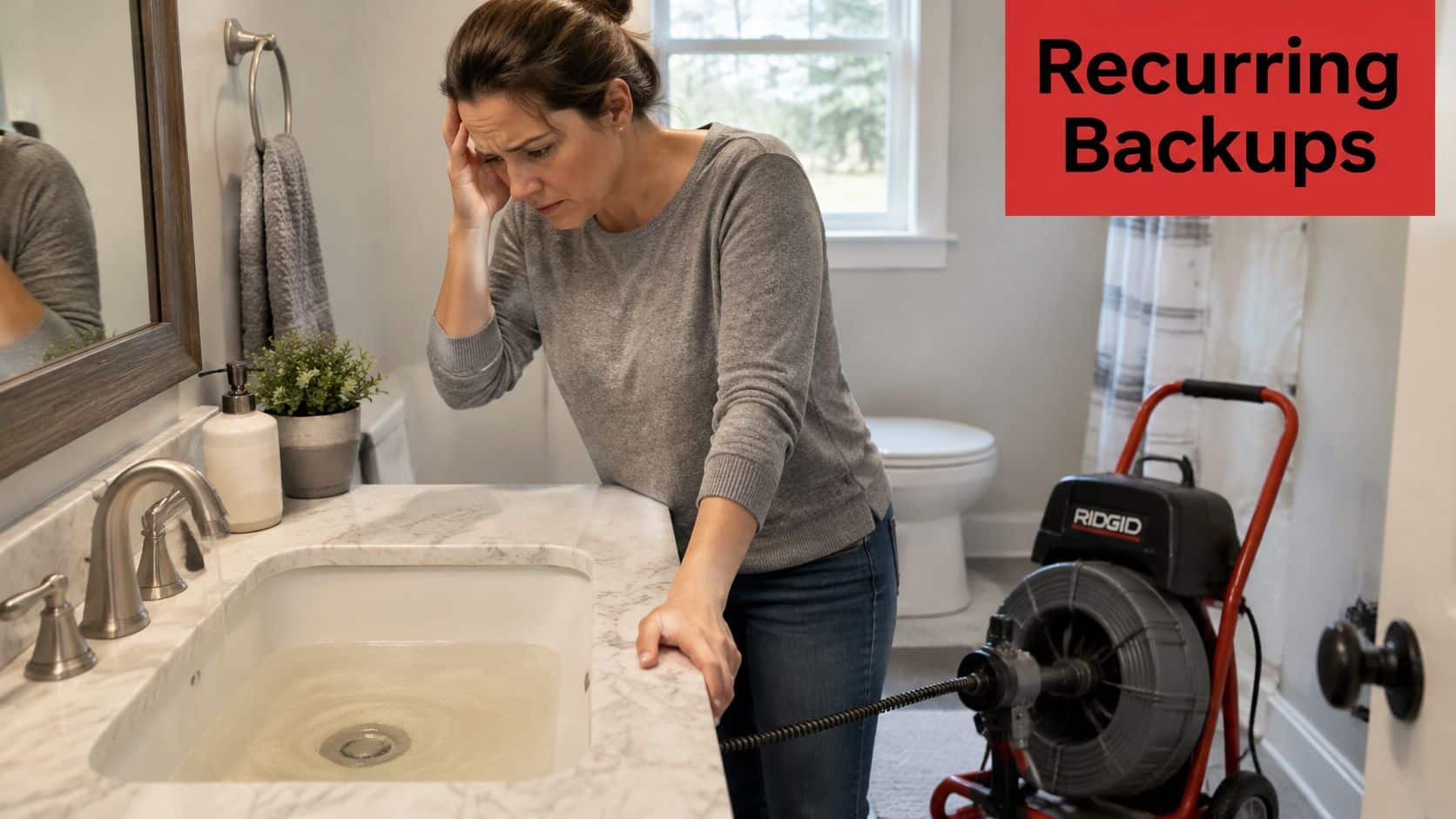
A Henderson homeowner might first notice it in one bathroom. The toilet drains, the sink seems fine, and nobody thinks much of it. Weeks later, several fixtures slow down on the same day, and a cable cleaning gets the house working again.
Then the next heavy round of laundry, showers, and flushes brings the problem back. That rhythm matters. A single clog can come from what went down the drain that week, but a backup that keeps returning to the same part of the system can point to a localized low section where water and solids collect after every discharge.
What the pattern can and cannot tell you
Recurring backups alone don't prove you have a belly. Roots, grease, scale, a cracked pipe, or an offset joint can produce similar symptoms, and cleaning can temporarily improve all of them. That's why it's a mistake to jump from "it backed up again" straight to "the whole sewer has failed."
What you can do before anyone runs a camera is keep a simple record. Note which fixtures are affected, whether the lowest fixtures in the home back up first, and how long cleaning helps. If a cable restores flow but the improvement fades after normal household use, that history gives the inspection something specific to test.
- Where it shows up: One fixture suggests a branch problem, while several fixtures suggest the main line.
- How often it returns: A repeating cycle carries more weight than one isolated stoppage.
- What changes after cleaning: Lasting relief and brief relief point toward different causes.
From a Las Vegas Valley service perspective, those observations shape the next step. They help separate a removable obstruction from a possible grade defect before anyone talks about excavation, replacement, or any other repair. The goal at this stage isn't a verdict. It's a clear question for the camera to answer, is something blocking this pipe, or is the pipe itself sitting low?
Understanding the Mechanics of a Sewer Line Belly
Your sewer lateral doesn't use pressure to move waste. It relies on gravity, which means the pipe needs a continuous downhill grade from the house toward the outlet. When that grade stays consistent, water carries paper and solids with it instead of leaving them behind.
The diagram below shows the basic contrast between a line that keeps falling and a line that dips and climbs again.
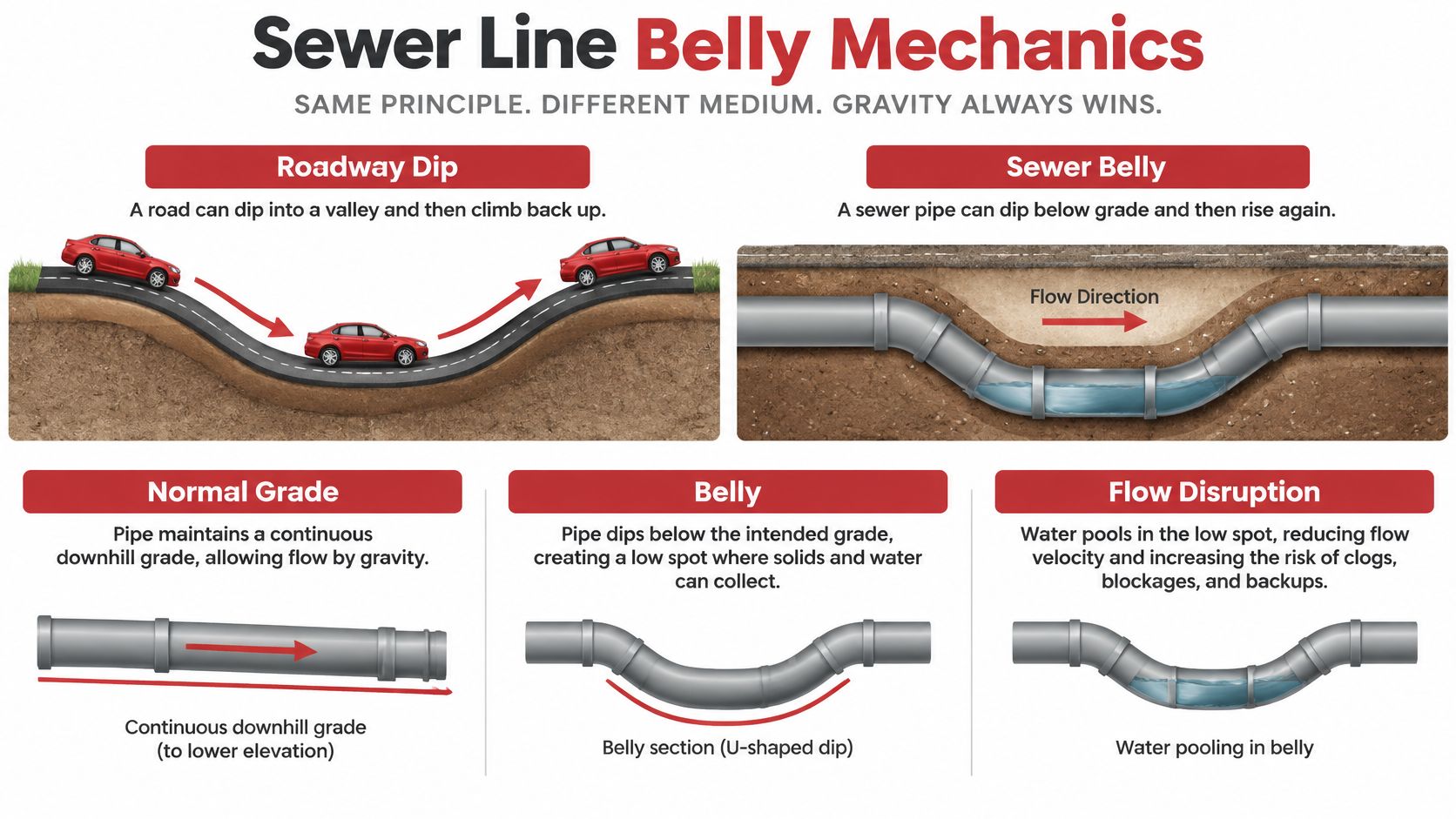
Think of a road that generally runs downhill but has one dip in the middle. Cars can still drive through it, and water can still reach the far side, yet rain collects in the low spot every time. A sewer belly works in much the same way, because a localized section drops below the intended grade and rises again, leaving a permanent low point where wastewater and solids can remain even when the rest of the line continues downhill.
Why water moves but solids stay behind
Here's where homeowners often get confused. If the pipe is sagging, why does the toilet still flush most days? Because liquid can spill over the far lip of the dip and continue downstream, while heavier material loses momentum in the pooled water.
Paper softens and settles. Grease cools and sticks. Mineral solids and grit sink instead of scouring through. Over repeated discharges, that retained material shrinks the effective flow area, so each new flush has less open pipe to move through. Eventually the accumulated mass, not a single new object, triggers the backup.
Residential drainage standards reflect why uniform slope matters. The 2024 IRC specifies at least 1/4 inch per foot for horizontal drains 3 inches or smaller and permits 1/8 inch per foot for pipes 4 inches and larger when the required self-scouring velocity is achieved, so an isolated dip interrupts the condition the design depends on.
The amount of water visible on a camera screen is only one part of the diagnosis.
That caution matters because standing water has more than one possible explanation. A blockage downstream can pond water upstream. Scale or channeling can hold water inside a damaged pipe floor. Roots can slow flow enough to mimic a sag. A true belly is different, it's primarily a grade and support problem, not necessarily a hole, a crack, or a complete collapse.
The short video below gives you a visual sense of how a low section behaves compared with pipe that maintains its fall.
Once you see the geometry, the symptom cycle makes sense. Cleaning empties the dip, the dip refills, and the line returns to the same restricted condition. Nothing about that cycle tells you how deep or long the sag is, which is why measurement comes before repair.
Recognizing Symptoms and Contributing Causes
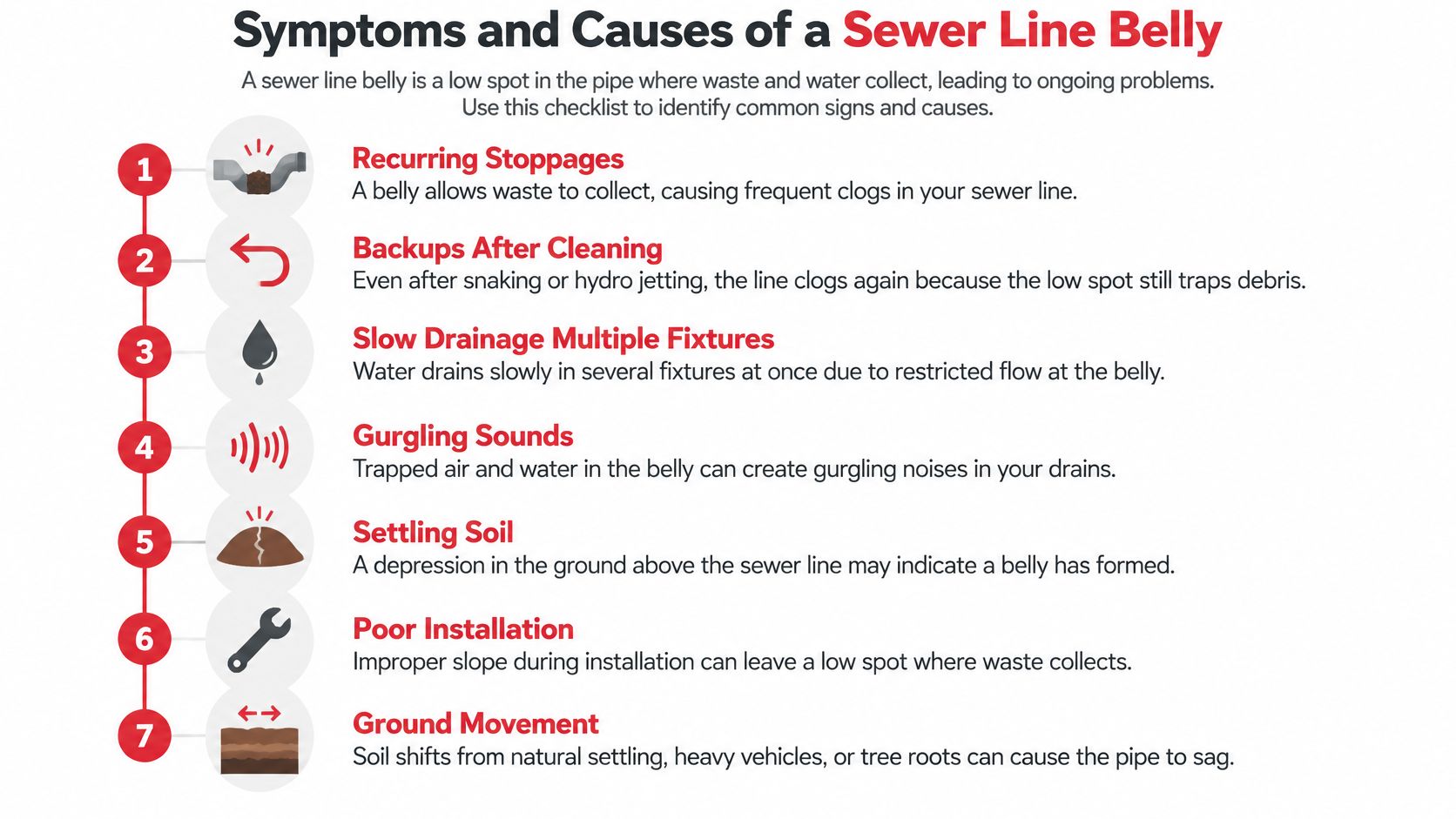
A belly usually reveals itself through repetition rather than one dramatic event. You might see slow drainage at several fixtures, gurgling as air moves through trapped water, or backups that return after cable cleaning or jetting. During an inspection, standing water in the same stretch of pipe adds another piece of evidence.
None of those signs works alone. Gurgling can come from venting or partial blockage, and slow drains can come from grease or roots. What strengthens the case is the combination, recurring stoppages, short-lived relief, and debris collecting in one consistent location.
How a pipe ends up sitting low
Pipes follow the support beneath them. The principal causes of a sewer belly include settlement of trench backfill or native soil, inadequate bedding, loss of pipe support, poor joint alignment, and structural deformation. If backfill compacts unevenly or bedding was thin from the start, one section can drop while the pipe on either side holds its elevation.
Soil movement can have the same effect over time. So can displaced joints in older rigid materials, where a segment shifts instead of flexing. In suspended interior runs, insufficient support spacing can let a horizontal pipe sag between hangers.
- Settlement: Backfill or native soil consolidates and the pipe settles with it.
- Inadequate bedding: The pipe never had uniform support along its length.
- Joint displacement: A shifted connection changes alignment and creates a low transition.
- Deformation: The pipe shape itself changes under load or unstable soil support.
Las Vegas conditions that can complicate the picture
Southern Nevada adds a few details worth keeping in view. Aging cast iron can develop scale and rough interior surfaces that trap material even where grade is acceptable. The Las Vegas Valley Water District reports water hardness of approximately 291 parts per million, equivalent to 17 grains per gallon, and those dissolved minerals can contribute to scale in plumbing components. Scale doesn't create a belly, but it can worsen accumulation inside one.
That's the distinction to hold onto. Contributing conditions such as scale, roots, or aging pipe can make a low spot perform worse, while direct evidence of a belly is a measured depression that repeatedly holds water and solids. A useful symptom checklist keeps those categories separate, because removing roots from a sagging pipe and correcting a sagging pipe are different jobs.
How a Sewer Camera Inspection Reveals the Problem
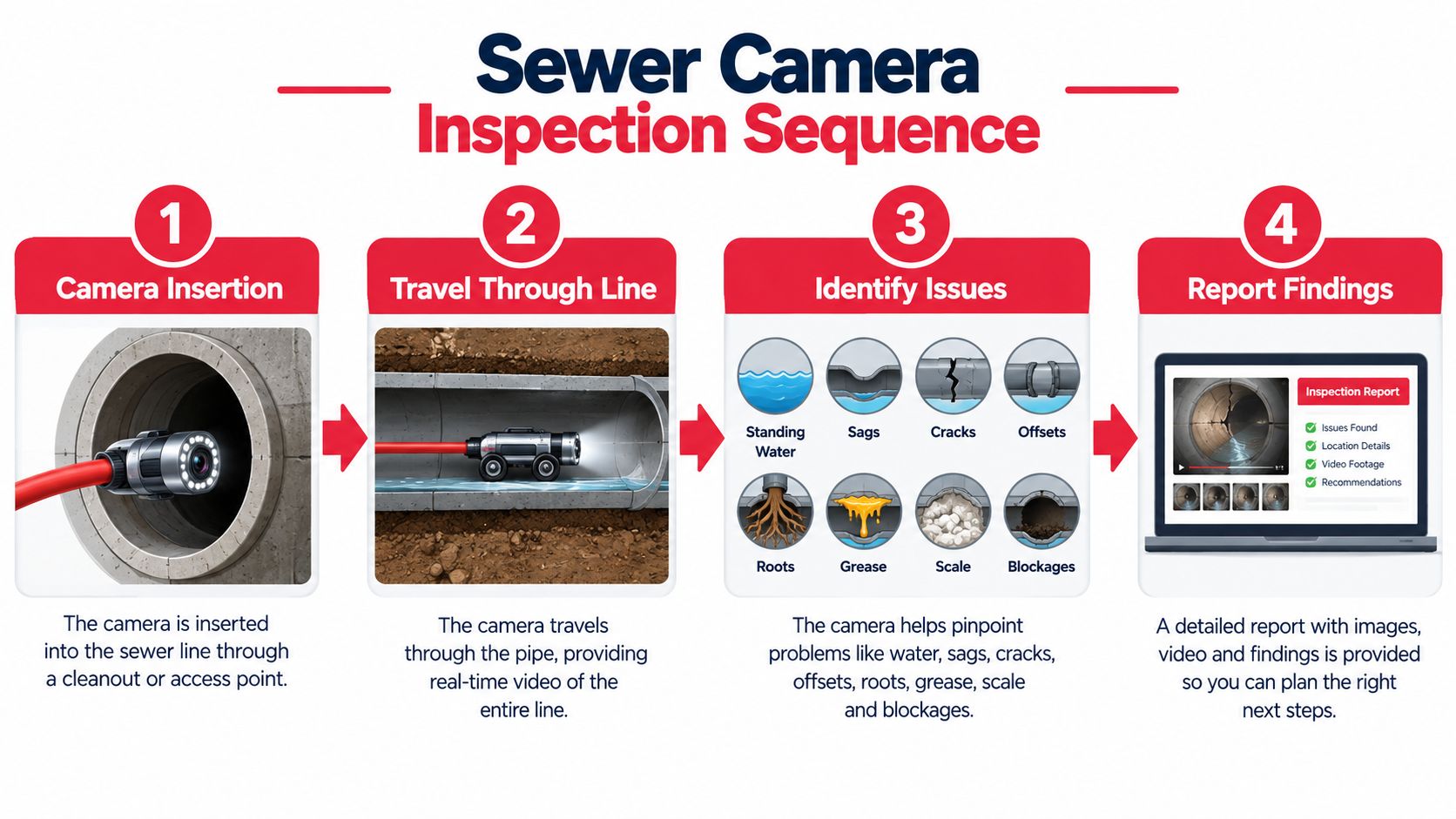
A good inspection follows a sequence, and each step answers a different question. The camera enters through an access point, travels the line, and shows the interior on a monitor. What the operator does with that footage determines whether you get a documented finding or just an opinion.
First, the line may need cleaning. Heavy sludge, grease, or a complete blockage can hide the pipe wall and make standing water impossible to interpret. Clearing the line first isn't upselling when the lens can't see, it's what allows the operator to tell intact pipe sitting low from a damaged pipe floor or debris piled at a joint.
What the camera documents
As the camera moves through, it can reveal bellies, cracks, offsets, roots, grease, scale, and blockages. In practical terms, a CCTV sewer inspection can document roots, cracks, grease, blockages, offsets, and bellies, while a camera equipped with a sonde can work with an above-ground locator to identify horizontal position and approximate depth. That locating step matters because a repair estimate built on a marked location and depth is very different from one built on guesswork.
The camera should travel the full length of the accessible line, not stop at the first pool of water. Stopping early risks missing a second sag, downstream damage, or the actual obstruction causing the ponding. For a belly specifically, the operator should cross the depression and confirm the pipe rises again on the far side.
A useful report records specifics you can act on:
- Distance from a fixed access point: So the same spot can be found again.
- Affected length and approximate depth: So repair scope can be sized.
- Pipe material and joint condition: So grade problems aren't confused with structural damage.
- Downstream flow behavior: So ponding isn't blamed on a sag when a blockage sits beyond it.
- Evidence of accumulation: Solids repeatedly collecting in the same depression carry diagnostic weight.
Homeowners who want to see how this service is structured can review what's involved in a sewer camera inspection and locating visit before scheduling one.
Interpreting thresholds with care
Municipal and pipeline standards offer context, not automatic rules for your house. Some acceptance specifications reject new pipe when settlement causes ponding deep enough to submerge a golf ball measuring 1 5/8 inches in diameter at any point in the line. That kind of benchmark shows that engineers treat ponding as measurable, but it was written for construction acceptance, not as a universal verdict on an existing residential lateral.
Practical rule: Ask for location, length, depth, and pipe condition in writing, not just a verbal "you've got a belly."
If the footage can't establish severity, say the lens stays submerged and the pipe floor never becomes visible, a second opinion or supplementary testing is reasonable. You're not being difficult by asking. You're making sure the repair matches a measured defect.
Examples That Show When Repair Matters
Two homes can produce similar camera images and still call for different decisions. The difference usually lies in symptom history and what's collecting in the low spot. These illustrations show how to reason through that gap without treating them as diagnoses for your own line.
A visible dip with no functional problem
In the first scenario, a camera crosses a small, isolated depression during a pre-purchase inspection. Water sits in the pipe, but the seller reports no backups, the pipe floor looks intact, and there's no heavy accumulation of solids. Cleaning history doesn't suggest a repeating cycle.
That finding deserves documentation, not panic. The sensible conversation covers monitoring, sensible use, and periodic cleaning if needed, with the footage saved for comparison later. The measured location still matters, because a future inspection can show whether the depression is stable or changing.
A sag that keeps capturing solids
Contrast that with a home where the main line backs up on a repeating schedule. Each cleaning restores flow, each relief period gets shorter, and the camera finds a deeper depression holding paper and solids at the same distance from the cleanout. The locator marks it, the surrounding joints look sound, and downstream pipe runs clear.
That combination points to a functional failure, not a cosmetic one. In short, a small isolated low spot may be manageable through monitoring and periodic cleaning when backups are absent, while a deep or recurring sag that traps solids is a functional failure requiring a closer repair assessment. Repair belongs in the conversation because the defect is interfering with the job the pipe exists to do. When a belly needs correction, see how our sewer line repair service resets the slope.
When the real culprit isn't grade at all
A third home shows standing water too, but the camera finds roots massed at a joint and heavy scale narrowing the pipe. Water ponds because flow is restricted, not because the pipe drops below grade. Excavating to regrade that section would miss the actual problem.
This is why severity isn't judged by water alone. Symptom history, measured depth, affected length, pipe material, and joint condition all sit on the scale together. When they point the same direction, the decision gets easier. When they don't, more evidence beats a faster answer.
Comparing Repair Approaches for a Confirmed Belly
Once a belly is confirmed and measured, the question changes from "what's wrong" to "how much correction does this defect need." No single method fits every condition, and the honest comparison starts with what each option can and cannot change. Cleaning, for example, can empty a low spot, and services such as hydro jetting for grease, scale, and root buildup can restore flow, but neither lifts a pipe back to grade.
Matching the response to the documented condition
| Observed condition | Possible response | Key limitation |
|---|---|---|
| Minor pooling, no backups, intact pipe | Monitor and clean periodically | Doesn't correct the sag, and the condition needs rechecking |
| One confirmed sag, surrounding lateral sound | Spot excavation, re-bedding, and regrading | Requires digging at the marked location |
| Multiple bellies or recurring joint failures | Replace or reroute a longer section | Larger scope, justified only by broader instability |
| Cracks or corrosion with grade still intact | Lining where structurally suitable | Follows the existing pipe shape and can't restore slope |
| Sag plus severe corrosion or structural damage | Broader replacement | Most disruptive, but spot work may leave failing pipe in place |
The logic behind the table is scope matching. As one municipal handbook framing puts it, if the rest of the lateral is sound, a localized spot repair may correct one sag, while multiple sags may justify replacing or rerouting a longer section, and lining does not restore a pipe's missing slope.
Why the no-dig question needs a precise answer
Lining builds a new surface inside the existing pipe, so it inherits the existing geometry. Line a bellied pipe and you get a smoother bellied pipe, with the same low point holding the same water. That's not an argument against lining in general, it can suit cracked or corroded pipe that still holds grade. It's an argument against expecting it to solve a slope defect.
Rerouting sits in a different category. When a longer section is unstable or access makes direct replacement impractical, a new route at proper grade can make sense. But rerouting shouldn't be proposed instead of diagnosing the original line. You still need to know what failed and whether the rest of the system is sound.
A repair fixes a belly only if it physically re-establishes grade or replaces the low section with pipe laid at grade.
Finally, pay attention to what happens under the new pipe. Excavation, stable bedding, correct alignment, and proper compaction aren't cosmetic finishing steps. Inadequate support is one of the mechanisms that created the sag, so a repair that swaps pipe without rebuilding its foundation invites the same settlement story to repeat. Ask any proposal to state plainly how the grade problem, not just the blockage, will be corrected.
Making an Evidence-Based Repair Decision
By the time estimates arrive, you should be comparing documents, not impressions. A strong proposal names the defect it intends to correct and ties the scope to measurements you can verify. If two bids describe very different work for the same line, the inspection details are where you reconcile them.
Ask for these items before you approve anything:
- Measured location and depth: Distance from a fixed access point, with surface marking.
- Affected length: One discrete sag or several low sections.
- Pipe material and nearby joints: Whether sound pipe borders the repair area.
- Symptom history: How the proposal accounts for your recurring backups.
- Support correction: How bedding and compaction will be rebuilt.
- Verification step: Whether post-repair camera confirmation is included.
That checklist also protects you from scope drift. A bid to correct one sag shouldn't grow into full replacement without new evidence, and a bid for cleaning shouldn't be presented as a grade repair. Written estimates work best when they state whether the job addresses a single depression, several defects, or the underlying support failure.
For local context, MG Plumbing Services LLC is a family-owned, owner-operated residential company led by Miguel Garcia, a Nevada-licensed C-1d plumbing contractor and journeyman plumber with more than 25 years of plumbing experience. The company is licensed and insured and uses sewer camera, locating, drain cleaning, and hydro jetting equipment to base recommendations on documented condition rather than guesswork. Homeowners comparing drain and sewer diagnosis and repair options can use the same checklist with any contractor they interview.
Service boundaries are worth stating plainly. The company serves residential customers in Las Vegas, Henderson, North Las Vegas, Summerlin, and nearby Las Vegas Valley communities, and doesn't market itself as a commercial or 24/7 emergency provider. You can call 702-480-8070 or visit mgplumbingservices.com to request service, and Spanish service is available. Se habla español.
Key Takeaways for Las Vegas Valley Homeowners
A belly becomes a repair priority when a documented low spot repeatedly captures solids and causes functional backups, not merely because standing water appeared once on a screen. For broader perspective, an EPA review reported that 57.5% of surveyed sewer-system assets were between 21 and 100 years old, which speaks to aging infrastructure generally rather than measuring how common residential bellies are.
Keep the sequence simple. Inspect, locate, document, compare the finding against your symptom history, choose the least disruptive approach that corrects the actual defect, and verify the finished work. Cleaning removes a blockage but can't restore grade, and lining can't create missing slope.
Online guidance can't establish your pipe's depth, sag length, material, or condition. A documented professional assessment can, and that record serves homeowners, property managers, landlords, real estate agents, escrow coordinators, and community associations across the Las Vegas Valley.
If recurring backups keep returning after cleaning, MG Plumbing Services LLC can run a sewer camera inspection with locating to document the location, depth, and length of any low spot before recommending a repair scope. You'll get straightforward findings you can compare against your symptom history, with residential service across the Las Vegas Valley and Spanish available. Visit MG Plumbing Services LLC or call 702-480-8070 to request an inspection.