The upstairs shower disappoints. The kitchen sink downstairs will about splash the counter, the hose bibb out back reads fine on a gauge, and that shower still fizzles the moment the dishwasher runs. So the search begins: booster pump for home water pressure, sort by horsepower, skim a few reviews, add to cart.
Hold that order. In most Las Vegas Valley homes, the pump is the last step, not the first. A booster adds pressure to water that's already arriving. It can't open a scaled aerator, free a half-closed gate valve, or replace water a restricted service line never delivered. Testing costs an afternoon and a hose-bibb gauge. Buying first can cost more than the repair would have and leave the shower exactly as weak as it was.
Table of Contents
- Normal Home Water Pressure Ranges
- Test Your Pressure and Find the Fault
- How a Booster Pump Adds Pressure to Your Home
- Pressure Controls and Code Limits That Protect Your Plumbing
- When a Professional Assessment Makes Sense
- Confirm the Fix Before You Buy Equipment
Normal Home Water Pressure Ranges
Every booster pump decision starts with one number: static water pressure, read at an outdoor hose bibb with every tap, appliance, icemaker line and irrigation zone shut off. Static pressure is what the street and the service line deliver when nothing is moving. It's the baseline. Flowing pressure and fixture performance sit on top of it.
The EPA WaterSense program identifies 45 to 60 psi as the preferred incoming service-pressure range for homes, and advises keeping service pressure at or below 60 psi in labeled homes to reduce the likelihood of leaking pipes, water heaters, faucets and hoses. Below 45 psi, fixtures underperform and a leak becomes a real suspect. Treat that band as the target, not a suggestion.
| Static reading | What it means | Next step |
|---|---|---|
| Below 45 psi | Possible leak, restriction or supply shortfall | Run the leak and restriction tests before any equipment decision |
| 45 to 60 psi | Target range for most homes | No booster needed on static pressure alone |
| 60 to 80 psi | Acceptable, but adds stress to faucets, hoses and water heaters | Check the PRV setting; keep labeled homes at 60 psi or less |
| Above 80 psi | Code requires an approved pressure-reducing valve | Repair or install the PRV; a pump is the wrong fix |
Start here: A gauge on the hose bibb and ten quiet minutes with everything shut off will save you more money than any single purchase decision in this article.
Those bands describe a house at rest. They don't describe a house in use, and a normal static reading clears nothing. A home can sit comfortably in the middle of that band with the water off and still collapse to a trickle when the shower, the kitchen faucet and a toilet fill at once. That gap between static and flowing pressure is where most misdiagnosed low water pressure complaints live, and it's what the next test measures.
The working rule: a healthy static reading paired with a weak shower points at a restriction, not at missing pressure.
Test Your Pressure and Find the Fault
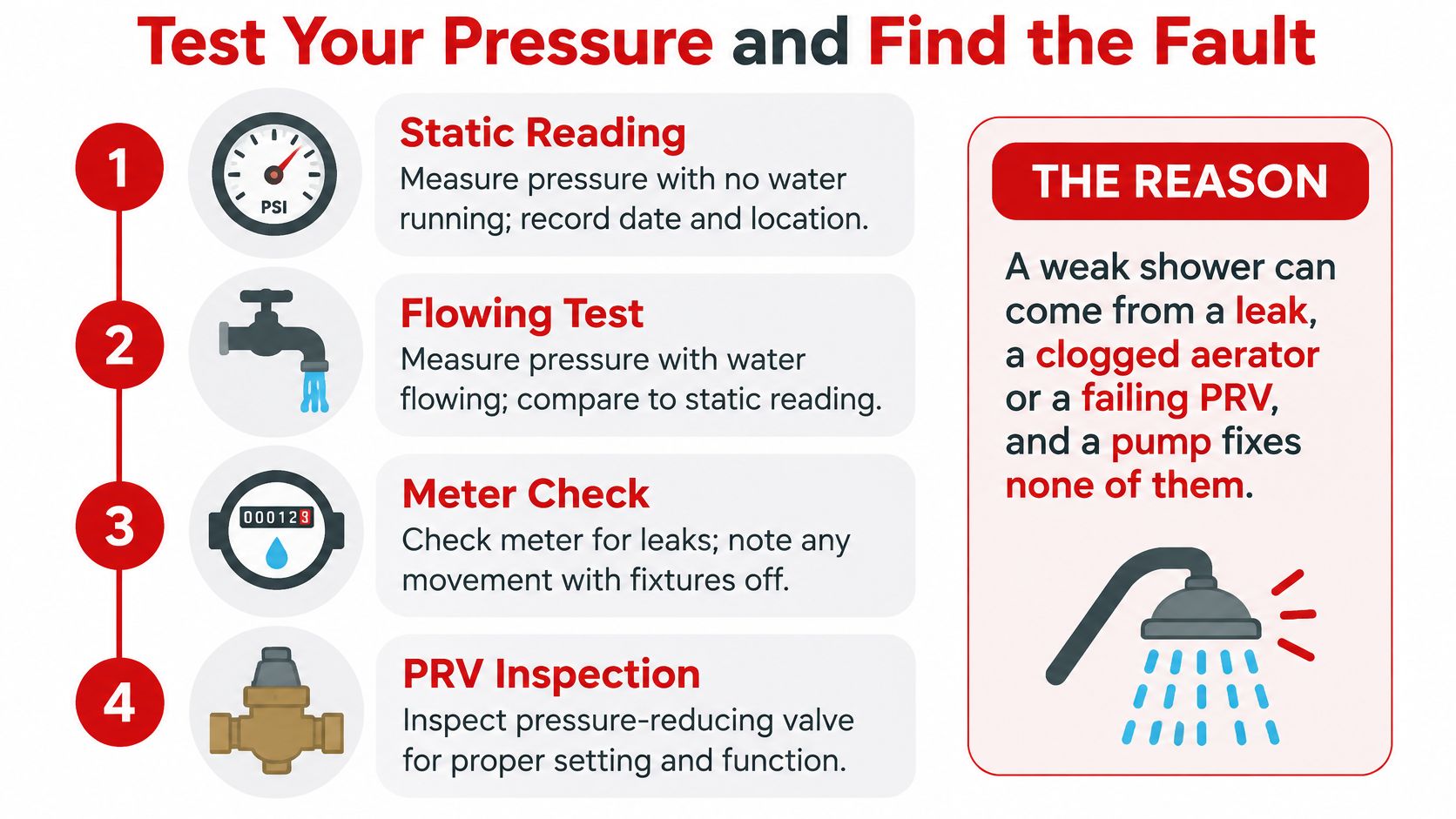
A weak shower is a symptom. A leak, a clogged aerator, a pressure-reducing valve stuck at a low setting, mineral scale inside old pipe or an inadequate supply all produce the same complaint, and a pump addresses exactly one of them. The EPA's WaterSense home maintenance guidance is direct about the order: pressure should generally read 45 to 60 psi, anything far outside that deserves professional attention, low pressure may come from a leak, and high pressure may call for a pressure-regulating valve. Test, then decide.
That order matters more in Las Vegas Valley hard water than almost anywhere. Scale narrows old galvanized and cast iron supply piping from the inside, so a house that once saw 60 psi at the street can read 45 at the bibb with no leak anywhere in the yard. The pressure diagnostic breakdown from Upchurch Inspection frames the question homeowners need answered: do I need a pump, or do I need a repair? A 20 psi or greater drop under light demand points to downstream restriction rather than an inadequate supply, which is exactly why the flowing test belongs before the shopping.
The sequence below separates a pump problem from a plumbing problem:
The Seven-Step Pressure Test
- Static reading at the hose bibb. Screw a glycerin-filled gauge onto the outdoor bibb, confirm the irrigation controller is off, and shut every tap, appliance and icemaker line. Record the number, the date and where you took it. Common mistake: reading pressure at the kitchen faucet, where a scaled aerator or a tired cartridge drags the number down and sends you shopping for equipment you don't need.
- Flowing test with two fixtures open. Run the kitchen faucet and the shower together, then read the gauge again. The difference between the two numbers is your diagnosis. Common mistake: testing with a single fixture running, which rarely moves enough water to expose friction loss, so the drop never shows up.
- The meter leak check. Close every fixture and watch the leak indicator on the water meter for two full minutes. Movement means water is leaving the system where you can't see it. Common mistake: forgetting the pool fill, the irrigation valve or a water softener mid-regeneration, then chasing a phantom leak.
- One fixture at a time. Test the shower alone, the kitchen sink alone, each bathroom sink alone. If only one is weak, the problem is local: an aerator, a cartridge, a showerhead restrictor or a partially closed angle stop. Common mistake: condemning the entire system over one clogged aerator that costs about the price of a washer to fix.
- Main shutoff and PRV inspection. Open the main valve fully, since a gate valve turned half a turn off full is a classic culprit, then inspect the pressure-reducing valve. A clogged PRV strainer or a regulator that has drifted out of adjustment will hold the whole house down permanently. Verify the downstream setting with the gauge before touching the adjustment screw. Common mistake: cranking the PRV up to cure a flow problem the PRV didn't cause.
- Neighbor comparison. Ask a neighbor on the same street for their bibb reading. If the whole block is low, the problem sits on the utility side of the meter and no residential equipment fixes it. Common mistake: comparing against a house at a different elevation or on a different pressure zone, then drawing the wrong conclusion.
- Price the booster last. Only after steps 3 through 5 come back clean and the static reading is still short does a pump become worth pricing. At that point, the measurements you wrote down become the sizing basis instead of a guess.
Pressure Symptoms, Likely Causes and First Checks
| Symptom | Likely cause | First check |
|---|---|---|
| Under 45 psi static at every tap | Leak or utility-side shortfall | Confirm the meter stays still with fixtures closed |
| Good static, drop of 20 psi or more when fixtures open | Scale, partly closed valve or PRV fault | Inspect valves, aerators and the PRV |
| Weak shower only when two or more fixtures run | Friction loss or undersized piping | Measure flowing pressure at each fixture |
| Weak at one tap only | Clogged aerator or local fixture problem | Clean or replace the aerator |
| Pressure jumps at each draw | Failing PRV or fluctuating supply | Test the PRV and compare neighbor pressure before adding a pump |
What a Healthy Result Looks Like
You're finished testing when static pressure lands inside the target band, the flowing drop stays under 20 psi with two fixtures running, and the meter indicator doesn't budge with everything closed. That's a plumbing system with nothing to fix and no reason to buy equipment.
A gauge read at rest tells you what the street delivers. The same gauge read with water moving tells you what your plumbing does with it. Only the second reading predicts how your shower will actually feel on a Tuesday morning.
When the flowing test fails and the scale is inside the service line itself, the repair may be a main water line replacement in Las Vegas rather than a pressure device bolted onto a choked pipe.
How a Booster Pump Adds Pressure to Your Home
The clearest picture of a booster is a second person shouldering into a crowd filing through a narrow doorway. That person adds no people. They add force to the people already there, and if the hallway behind them empties out, nothing comes through the door no matter how hard anyone pushes.
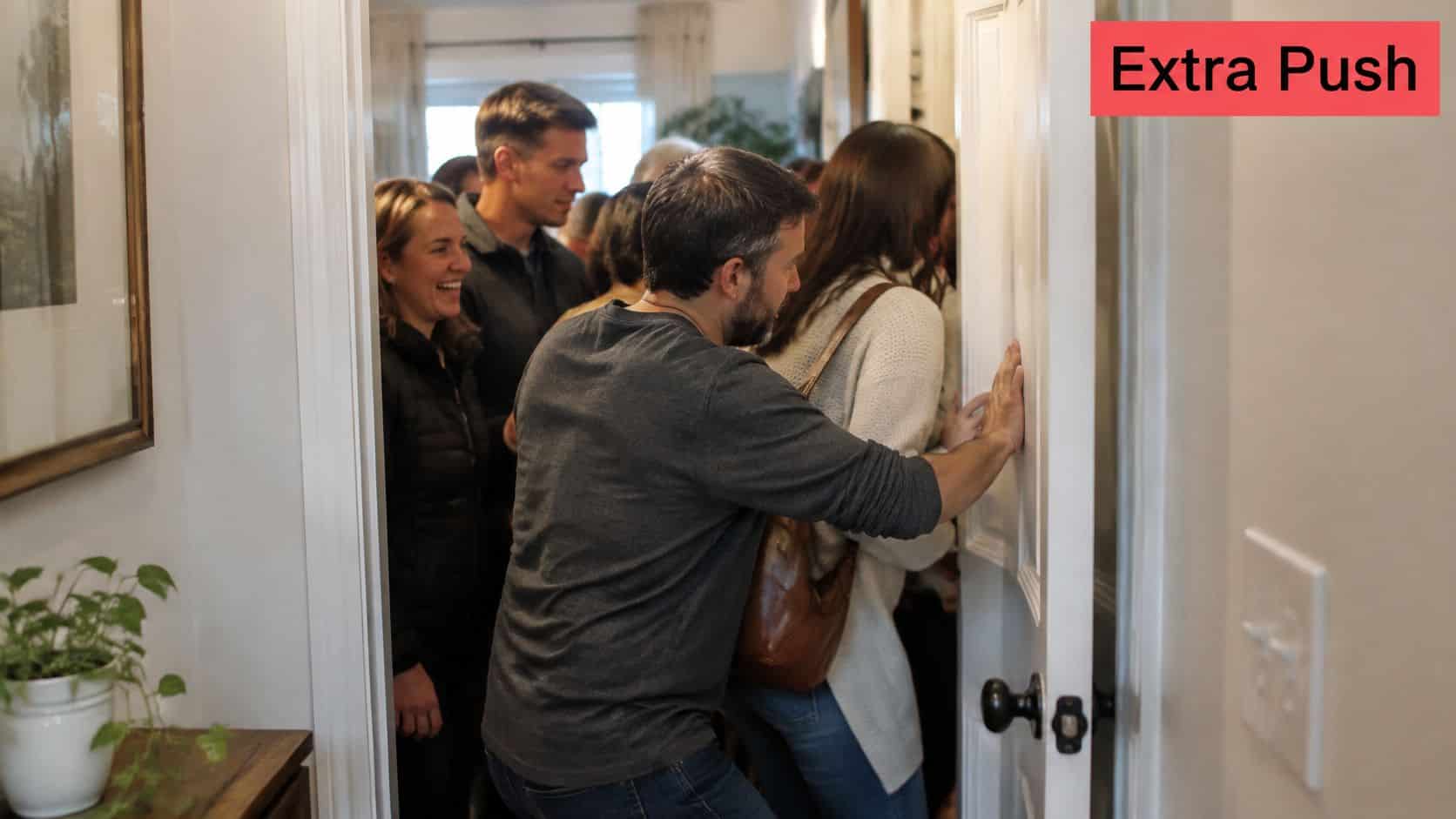
Water behaves the same way. Supply arrives from the street on the pump's suction side, the impeller spins and raises the pressure of the water it receives, and that water leaves toward the house at a higher pressure than it arrived. A pressure tank downstream absorbs the jolt of a tap opening so the system doesn't spike and sag, and a pressure switch or a variable-speed drive decides when the motor runs and how hard it works.
Why Horsepower Doesn't Size a Pump
The work the pump has to do has a name: total dynamic head. The Hydraulic Institute's water booster guidebook breaks it into the pieces that matter, which are elevation, pipe and fitting friction, pressure losses through the meter and backflow preventer, and the minimum pressure needed at the most remote fixture. Height alone costs about 0.43 psi per vertical foot, so the second floor of a typical house sits roughly 4 to 5 psi behind the ground floor before a single gallon moves through the piping.
A product page never shows you that math. A unit that reaches its advertised maximum only at shutoff can deliver very little usable pressure with three fixtures open, which is precisely the moment you notice the problem. The engineering goal isn't maximum pressure anyway. It's enough residual pressure at the highest or most distant fixture without pushing the washer valve into water hammer, without short cycling, and without the pump announcing itself through the floor.
The measurement that sizes the equipment is the lowest inlet pressure recorded during peak household demand, paired with the flow those simultaneous fixtures draw, then checked against the pump curve at that exact point.
A short walkthrough of how these systems are assembled on a residential supply:
Pressure Controls and Code Limits That Protect Your Plumbing
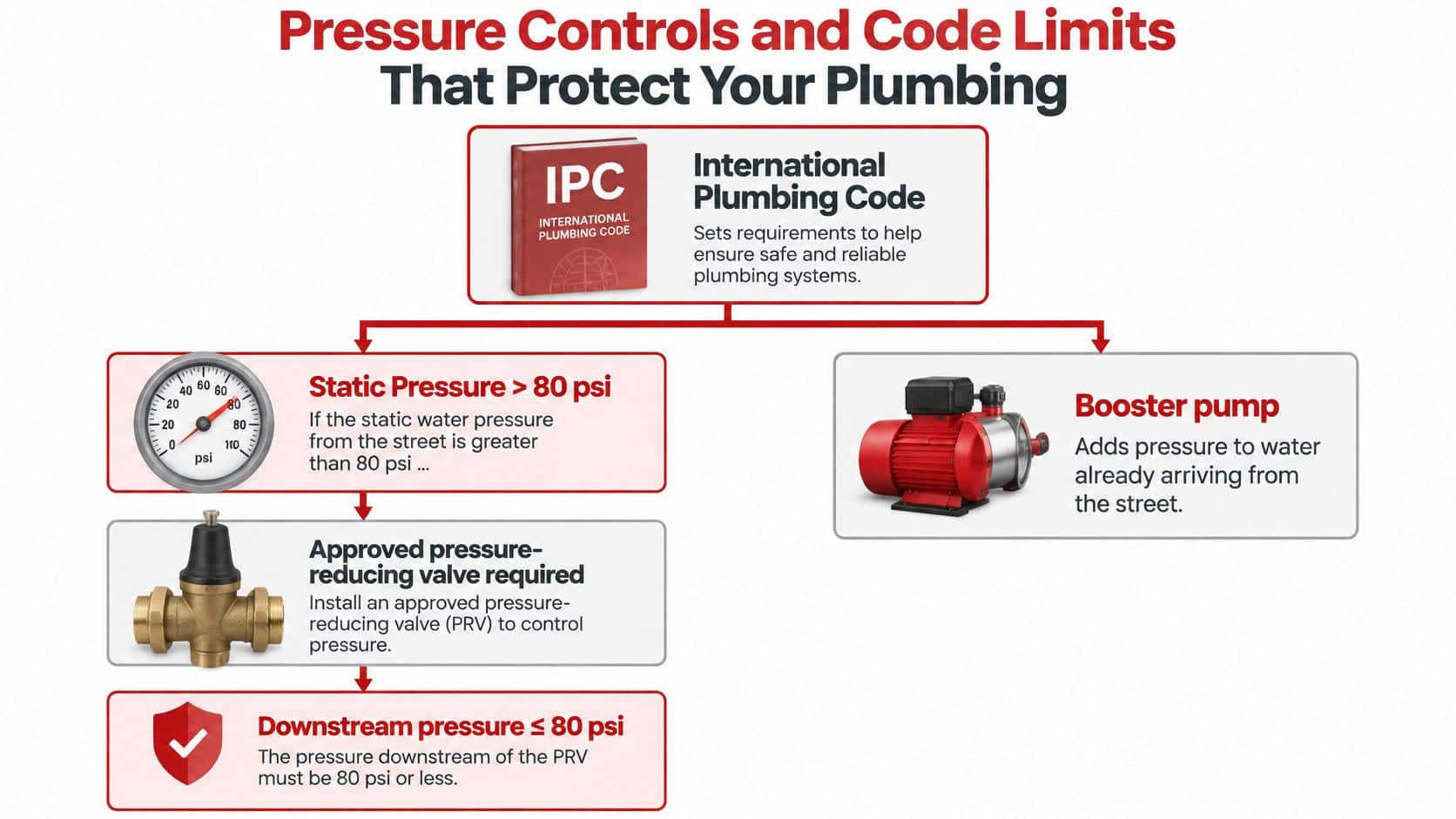
A hose bibb that sits above the code ceiling is a regulator problem, not a pump problem. When static water pressure inside a building climbs above 80 psi (552 kPa), the International Plumbing Code requires an approved pressure-reducing valve, and the downstream distribution pressure has to come down to 80 psi or less. A booster adds pressure that the fixtures do not have. It does not correct a supply that is already too high. Check the leak, the restriction, and the PRV before you size one.
Where the Code Draws the Line
The same provisions cover the low end. When the public main or another source cannot deliver minimum flow pressure and quantity at the fixtures, supplementation through a raised water tank, a hydropneumatic booster system, or a booster pump is permitted under the applicable requirements. The 2018 IPC fixture minimums put numbers on that bar: 8 psi at residential sinks with a listed design flow of 1.75 gallons per minute, and 8 psi at residential dishwashers at 2.75 gpm. That is a flow standard and a pressure standard together. A unit that only hits its advertised maximum at shutoff can still miss both once two fixtures are open.
Permission comes with protective controls. A booster pump needs a low-pressure cutoff that shuts the unit down when suction-side pressure falls too far, so it does not run dry against an interrupted supply. Every pressure tank in a hydropneumatic system needs a pressure-relief valve.
Code boundary: regulation handles pressure that's too high, boosting handles pressure that's too low, and the two are never interchangeable.
The Parts That Work Together
A booster for home water pressure is one piece of a pressure-control system. I treat the pump as the last step, after the inlet, the PRV setting, and the relief path are known.
- The PRV. Its condition and setting determine what the pump sees on the suction side. A regulator that has drifted shut starves the pump it was supposed to protect. The Las Vegas Valley Water District places responsibility for privately owned pressure regulators on the property owner, so the PRV on your side of the meter is yours to maintain, not the utility's.
- The pressure tank. Sized for the small draws, it keeps the pump from starting every time someone rinses a cup.
- The control scheme. A simple on/off pressure switch holds one setting. A variable-speed drive modulates output with demand and produces smaller pressure swings at each draw.
- The bypass. Service calls and power losses both happen, and a bypass keeps water available when they do. Regulated pumping facilities are expected to hold adequate pressure at peak demand, include a bypass where needed, and use automatic controls so the pump does not cycle excessively.
- Potable-water certification. Wetted components should carry applicable NSF/ANSI drinking-water certification, as this field guide to booster and PRV systems lays out.
What residual pressure should the farthest fixture receive, and what shuts the system down or relieves it when demand changes? Those two answers pick the hardware.
When a Professional Assessment Makes Sense
Most of the testing above fits into an afternoon with one gauge and a notepad. A handful of situations don't, and those are the ones where a licensed plumber should see the system before anyone buys hardware.
- Static pressure stays below the target band after the leak and restriction checks. Something upstream is costing you pressure, and finding it takes leak detection equipment rather than a larger pump.
- Readings sit above the code limit or jump at every draw. Both point at the regulator, and a failed PRV plus a new pump is how a homeowner ends up with a pressure problem they didn't have last month.
- The piping is original cast iron or heavily scaled. Pressure devices on a narrowed pipe move less water, not more, and the scale keeps accumulating around them.
- The house has several floors or a long service run. Elevation and friction eat pressure in ways a front-bibb gauge can't reveal.
- The PRV needs adjustment or replacement. Once the regulator becomes the answer, anything sized downstream of it has to be measured, not guessed.
Pump installation touches the water supply, the electrical circuit and several code-required protections, so it isn't a homeowner project. A proper assessment covers static and flowing readings under realistic demand, a meter movement check, PRV and shutoff inspection, slab leak repair in Las Vegas when the readings suggest a concealed loss under the floor, and a written sizing basis tied to the pressure needed at the farthest fixture and the peak simultaneous flow.
For landlords and HOA boards: document the readings, photograph the gauge, and get a written scope before approving work. One shared service line feeds several units, and the owner carries the regulator responsibility.
If you only do one thing yourself, run the seven steps and write down what you find.
Confirm the Fix Before You Buy Equipment
The hose bib gauge is still on the faucet, the checklist is filled in, and the catalog page for a booster is already open. Hold the order.
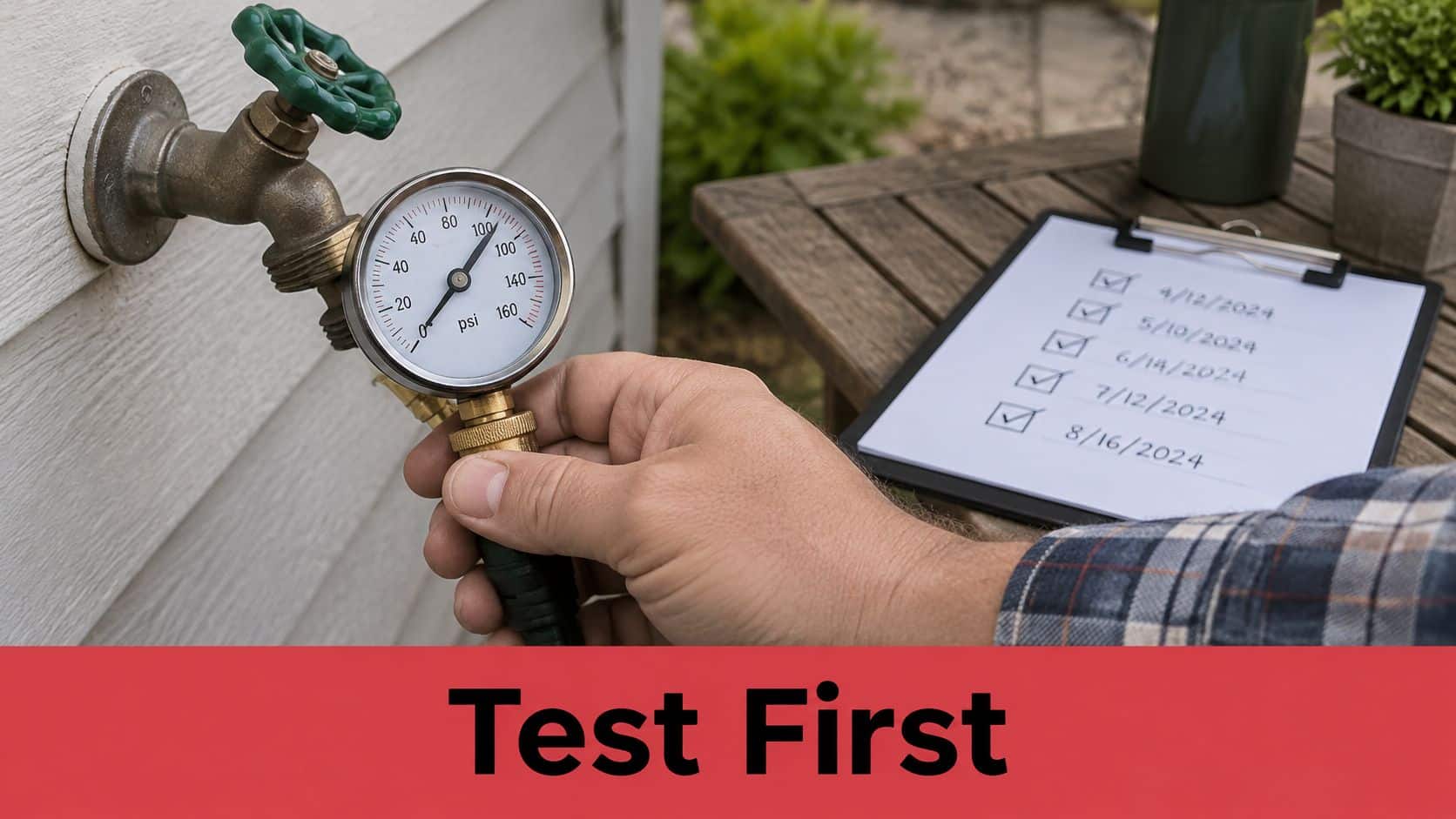
A static reading, a flowing test, a meter check, and a PRV inspection, each written down with a date and a location, turn a vague complaint into a decision. If a leak, a restriction, or a regulator fault showed up, that repair is the fix, and it is almost always the cheapest line on the estimate. If every check came back clean and the source still cannot hold pressure while fixtures run, the supply has the volume. Pressure is the only missing piece. That is the single case where equipment earns its price.
Ask for the written estimate to show its work. The readings that justify any equipment should appear next to the specific repair recommended for each finding. A quote that names a pump without a single measurement is a guess with a price tag. Where the numbers point to a leak you cannot see, water leak detection settles it before anything gets ordered.
MG Plumbing Services LLC handles this work across the Las Vegas Valley as an owner-operated residential plumbing company serving Las Vegas, Henderson, North Las Vegas, Summerlin, and the surrounding communities. Owner Miguel Garcia, a Nevada-licensed C-1d plumbing contractor in the trade since 2000, runs the calls. Main water line replacement includes the water service, Wirsbo AquaPEX, PRVs, and booster pumps, so the diagnosis and the equipment come from the same visit rather than two contractors.
Request service at the office, 5725 S Valley View Blvd., Suite 5, Las Vegas, NV 89118. Service is bilingual in English and Spanish, and it is residential only. If water is actively running, shut the main valve off first. MG Plumbing Services will walk you through locating and operating it while the appointment is being scheduled.
I would not buy a pump until those recorded checks either name a repair or show a supply that has volume and still falls short on pressure.