The drain was cleared recently, but the shower is filling again when the washing machine empties. Now you're wondering whether another cleaning will solve it or whether the cast iron beneath the house is failing. Those are different problems, and they shouldn't receive the same recommendation.
Cast iron sewer pipe problems require separating restricted flow from damaged pipe. A cable can open a passage through debris without telling you much about the surrounding wall. The right starting point is the symptom pattern, followed by an inspection that shows what needs cleaning and what needs repair.
Table of Contents
- Warning Signs of Failing Cast Iron Sewer Lines
- Why Cast Iron Sewer Pipes Fail Inside and Out
- How Plumbers Diagnose a Cast Iron Sewer Line
- Choosing Between Cleaning, Repair and Replacement
- How Often Cast Iron Lines Need Jetting
- Questions to Ask Before Approving a Sewer Repair
- When to Call About a Cast Iron Sewer Line
Warning Signs of Failing Cast Iron Sewer Lines
| Symptom | Likely cause | Next step |
|---|---|---|
| Backup returns within weeks of clearing | Partial scale, grease or a belly that holds waste | Camera inspection of the lateral |
| Several fixtures slow at once | Restriction in the main sewer line | Flow test from multiple fixtures, then camera |
| Sewer odor inside the home | Cracked pipe, failed joint or dry trap | Trap check, then camera inspection |
| Gurgling toilet when another fixture drains | Venting or main line restriction | Camera and vent check |
| Wet spot or sinking soil over the line | Leaking joint eroding the soil around the pipe | Locate the leak and camera the section |
| Rust-colored or flaking water at a clean-out | Internal corrosion and scale on the pipe wall | Camera assessment of wall condition |
These symptoms are diagnostic clues, not proof of failure. A dry floor-drain trap can explain an odor without a broken sewer, and toilet gurgling can involve venting rather than a collapsed lateral. Rust-colored wastewater at a sewer clean-out also isn't the same issue as discolored water coming from a drinking-water faucet.
The concerning pattern is recurrence combined with evidence that the problem extends beyond an individual fixture. A mechanics-based study of corroded cast-iron pipesPS.1949-1204.0000582) identifies corrosion and soil expansion as important contributors to fracture risk, which helps explain why a blockage can accompany underlying structural damage.
Checks that change the next step
The same fixture backs up after cleaning. That can mean the original obstruction wasn't fully removed, but it can also mean waste keeps catching at an offset joint or rough, damaged section. Record how soon the problem returns and what household activity triggers it.
More than one fixture is affected. A slow bathroom sink alone suggests a different investigation than a tub filling when a toilet flushes. Fixtures reacting to each other direct attention toward their shared drain path.
Water remains in the line after cleaning. Persistent pooling can indicate a belly, back-pitch or downstream restriction. The plumber needs to distinguish those conditions rather than assuming every dark patch on camera is a sag.
Practical rule: Two or more warning signs together justify a camera inspection before paying for repeated cleaning.
Don't open a clean-out that's holding backed-up sewage yourself. Stop running affected fixtures, keep people away from contaminated water, and have the access point evaluated safely.
Why Cast Iron Sewer Pipes Fail Inside and Out
Cast iron can lose strength from either side of its wall, and a drain that flows today proves very little about how much metal is left. The obstruction you can see is often the smaller half of the problem.
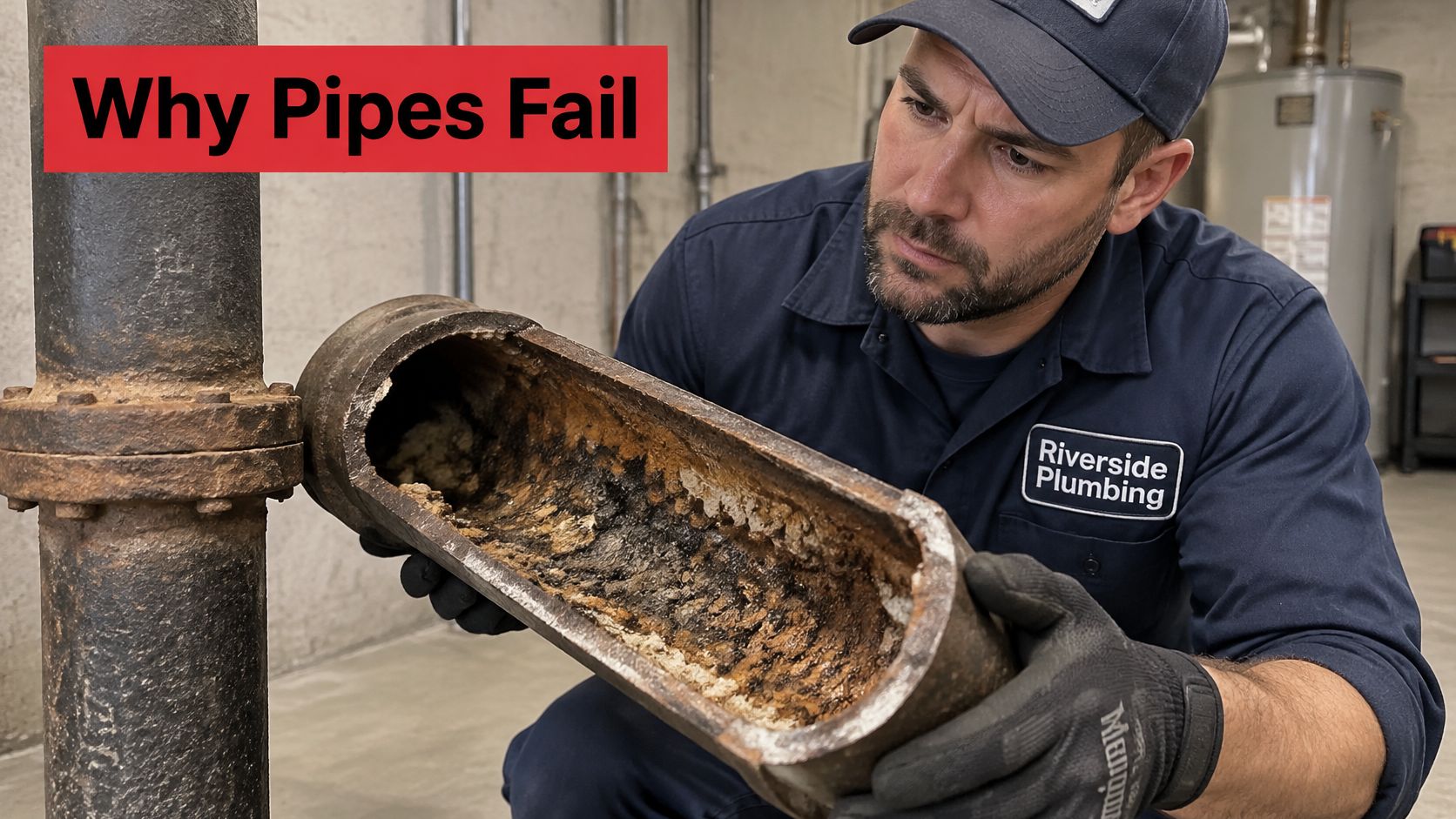
An exposed pipe section shows the difference between surface deposits and missing metal.
Corrosion above and outside the flow
Crown corrosion attacks the upper interior surface. Hydrogen sulfide produced during waste decomposition can undergo microbial conversion to sulfuric acid on moist pipe surfaces, progressively consuming the iron, as described in James Armstrong Plumbing's explanation of cast-iron deterioration. Because this damage sits above the normal wastewater level, the bottom of the pipe can still carry flow while the crown thins toward perforation.
Rust through a car's floor pan works the same way. The vehicle still rolls while a load-bearing surface is gone. Steady drainage from a fixture says nothing about whether the full circumference of the pipe is intact.
External corrosion works from the soil side. Buried cast iron in acidic, highly saturated soil develops localized pitting that reduces effective wall thickness, and the exterior can still look continuous while the metal underneath is pocked and thin. A camera running down the bore sees a smooth inner wall and misses that loss entirely.
Movement and trapped debris
Expansive clay swells and shrinks as moisture changes. That movement bends or pulls on a brittle pipe, and a corrosion pit concentrates stress where less sound metal remains. A gravity sewer needs no internal pressure to crack under external loading.
Grease, paper towels, wipes labeled flushable and roots entering joints restrict the passage and catch more debris. Those materials rarely create a structural belly on their own. A belly develops when the pipe loses grade, often through soil movement or lost support, and then traps wastewater and solids in a standing pool.
Long service life is possible. A historical infrastructure review in WaterWorld identified utilities with cast-iron pipe still operating after more than 100 years, while also describing much earlier corrosion-related failures under severe conditions. Municipal experience at that scale tells you what the material can survive, not what a single residential lateral has left.
The mechanisms combine. Corrosion thins a wall, movement opens a joint, leakage washes out supporting soil, and the resulting low spot catches waste. The final backup can look sudden even though the defects behind it built up over years.
How Plumbers Diagnose a Cast Iron Sewer Line
A useful inspection produces a location, a documented defect and a reason for the recommendation. It shouldn't end with an unexplained image of rusty pipe.
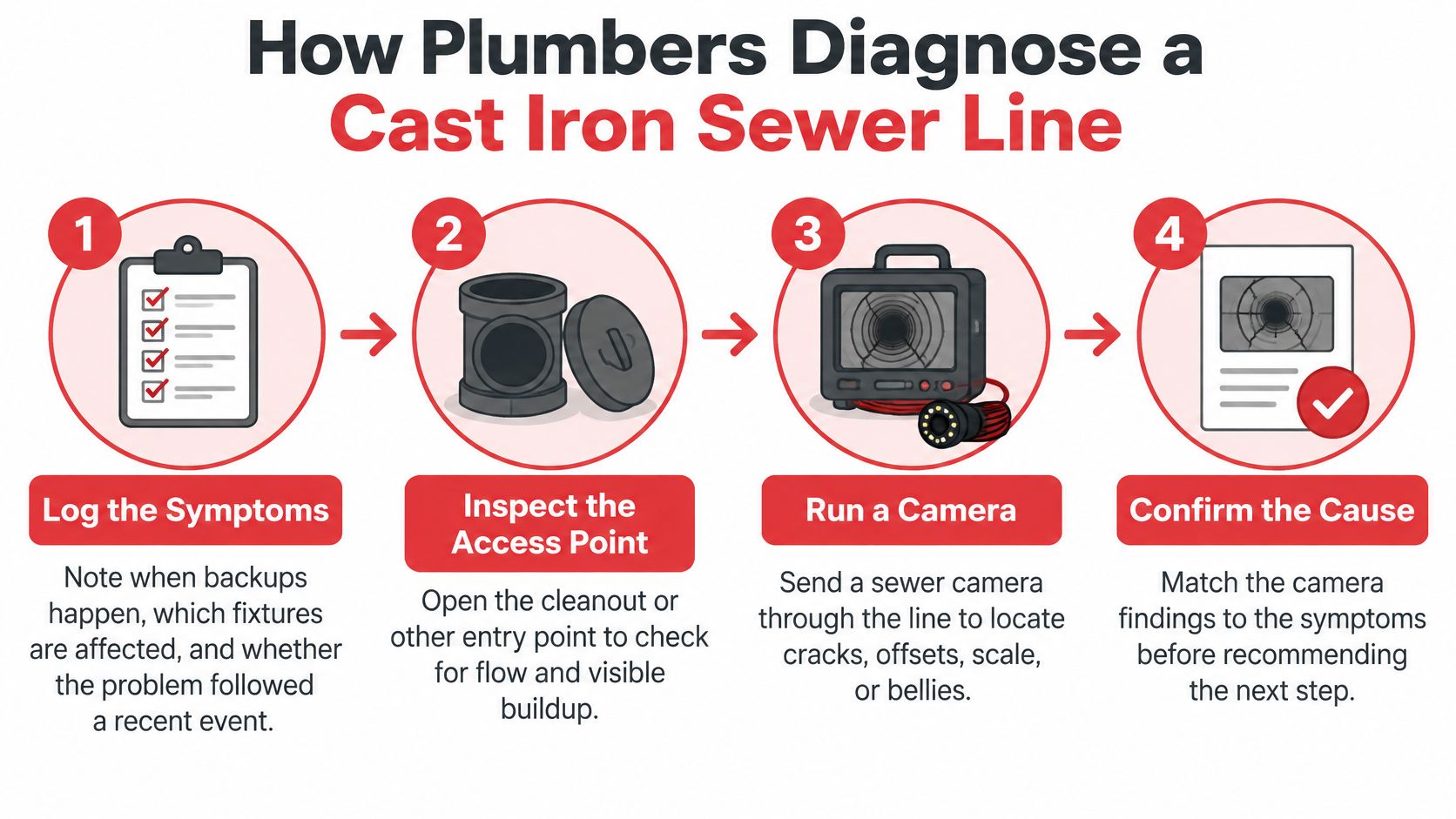
Log the symptoms. Record when backups happen, which fixtures react and whether the problem followed a recent cleaning. That history helps distinguish an isolated branch obstruction from a shared sewer problem.
Inspect an accessible clean-out or drain opening. Our camera inspections use an existing access point and require no digging for the camera run. If the line is full, controlled clearing may be necessary before useful footage is possible.
Record the lateral toward the municipal connection. A camera can reveal scale, corrosion, cracks, root entry, offsets, pooling and collapse, as described by 360 Home Inspection's cast-iron inspection guide. Record where visibility or access prevents completion rather than treating an incomplete run as a full assessment.
Locate the defects from above. Use a locator to mark the camera transmitter's position and estimated depth at relevant findings. Matching the footage to the yard or slab prevents an estimate from referring only to an unexplained distance down the pipe.
Test flow from multiple fixtures. Run controlled discharges while watching the response at the access point and affected fixtures. This helps establish whether a restriction serves one branch or the shared main line.
Review the footage with the homeowner. Show the defect, its apparent length and whether wastewater clears the section. Explain whether pooling suggests lost grade and whether cleaning has exposed damage previously hidden by buildup.
| Method | What it reveals | What it cannot show |
|---|---|---|
| Sewer camera inspection | Cracks, root entry, offset joints, bellies, scale and collapse | Remaining wall thickness or soil corrosion outside the pipe |
| Line locating | Depth and position of the pipe and of defects | Internal condition of the pipe wall |
| Multi-fixture flow test | Whether the restriction is in one branch or the main line | The cause of the restriction |
What the camera cannot certify
A camera records the interior, not remaining structural strength. Research on cast-iron wastewater assets at the University of Surrey treats wall loss, loading and operating environment as separate parts of mechanical assessment. A clean-looking passage therefore isn't a wall-thickness measurement.
Where severe deterioration lies beneath a slab, localized exposure, wall assessment or engineering review may be appropriate before approving extensive work. Our Las Vegas sewer-camera inspection process focuses on connecting visible findings with the actual cause of the complaint.
This process illustration summarizes the main diagnostic stages.
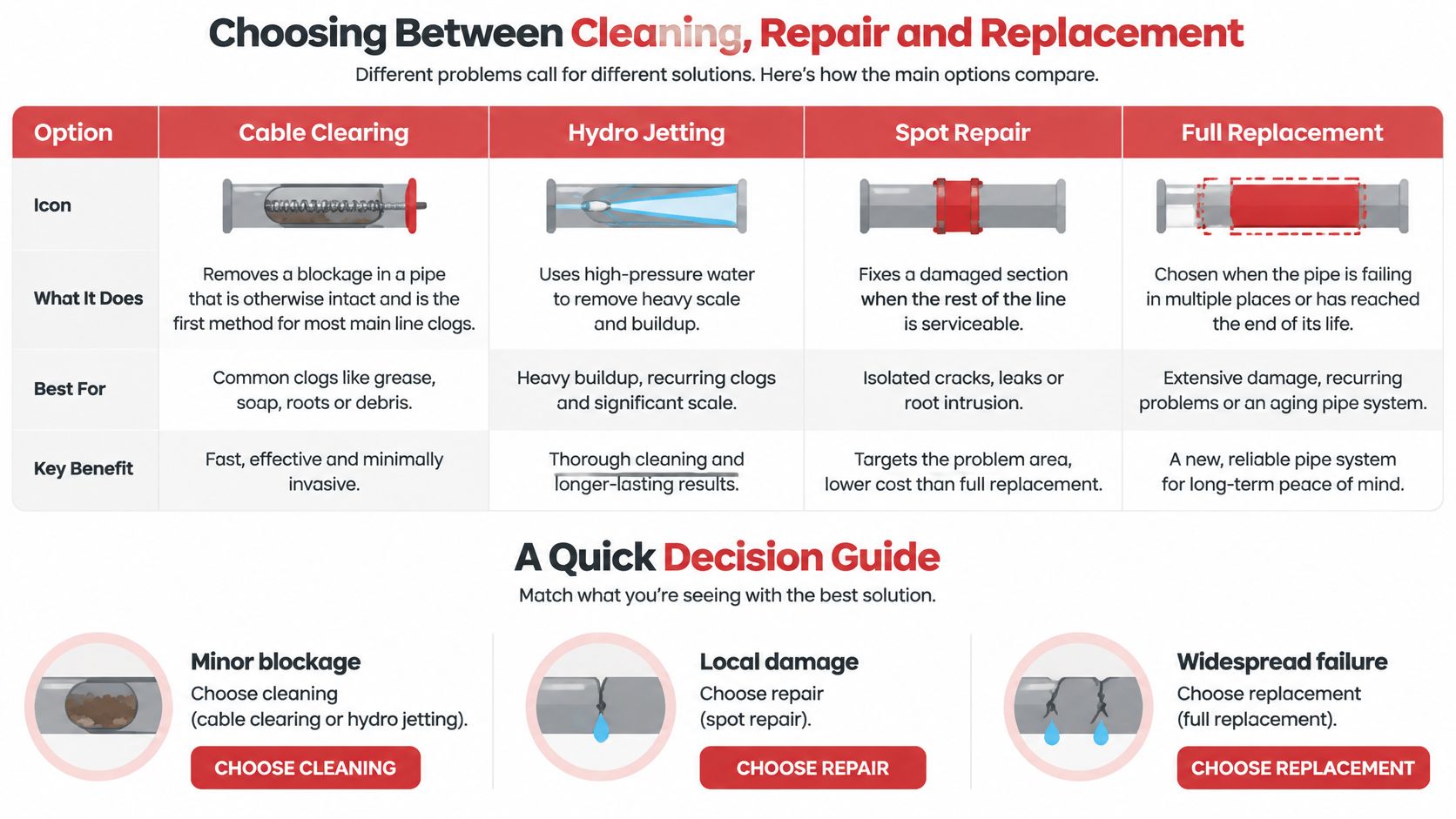
Choosing Between Cleaning, Repair and Replacement
| Option | Best when | What it fixes | Main limit |
|---|---|---|---|
| Cable clearing | Blockage in an otherwise intact pipe | Removes the clog and restores flow | Does not repair wall loss or cracks |
| Hydro jetting or descaling | Scale, grease or roots in a pipe with sound walls | Cleans the full wall and restores diameter | Needs a camera run first on damaged pipe |
| Spot repair | One localized break or offset joint | Replaces the failed section | Neighboring old pipe may still fail |
| Pipe lining | Sound pipe with defects that are feasible to line | Seals defects without excavation along the full run | Depends on diameter, shape and defect type |
| Cast iron to ABS replacement | Widespread corrosion or repeated failures | Replaces the whole run with new pipe | Requires access under the slab or an open trench |
Match the work to the defect
Cable clearing is the first method for most main sewer clogs. Properly performed with cutting heads sized to the pipe, it's safe for older cast iron common in 1960s and 1970s Las Vegas homes. It opens the obstruction, but doesn't necessarily remove deposits around the entire circumference.
Hydro jetting scours grease and debris from the wall. Damaged or corroded pipe requires more care, so we run a camera before jetting older lines rather than selecting pressure without knowing their condition.
Descaling adds a mechanical head to grind hard mineral and rust deposits from cast iron. It's useful when ordinary flushing leaves stubborn scale behind, but removing deposits cannot replace missing metal.
A spot repair makes sense when a single break or offset sits between serviceable sections. The trade-off is that the neighboring pipe remains old, so the estimate should distinguish a localized correction from rehabilitation of the entire run.
Lining can seal suitable defects where access is difficult. Diameter, bends, deformation and the condition of the host pipe determine feasibility; lining isn't a way to correct every belly or bridge every collapse.
Full replacement becomes appropriate when corrosion is widespread, different sections repeatedly fail or the remaining walls are paper-thin. Cast-iron-to-ABS work can require access beneath the slab or an open trench, making accurate locating and a defined scope especially important.
Evidence that changes the recommendation
Rust, tuberculation and a narrow opening show a restricted passage. They don't, by themselves, justify whole-line replacement. The cast-iron homeowner guide from Restar describes how bottom-wall erosion can progress to leakage, soil entry and loss of support, which is a different concern from deposits alone.
Treat cracks, displaced joints, roots at joints, a bottom channel approaching a hole, leakage-related bellies and crown loss as structural findings requiring evaluation. Roots can be removed, but their entry point remains a defect.
Restored flow is a cleaning result. Restored pipe integrity requires a separate finding.
Hidden upper-wall damage can remain after a cable or jet opens the wastewater path, a distinction discussed in DCSpia's explanation of cast-iron failure. If the same segment slows again after a proper clearing, the next decision is a replacement evaluation, not an automatic repeat cleaning.
Our drain and sewer diagnosis process uses the documented cause to separate those choices. Where serious damage is confirmed, we explain the finding and put the available options in writing.
How Often Cast Iron Lines Need Jetting
| Line condition | Typical interval | Notes |
|---|---|---|
| Cast iron with recurring backups | Every 18 to 36 months | Shorten the interval if backups return sooner, after reassessing condition |
| Newer ABS or PVC lines | Five years or more | Camera check if slow drainage appears |
| Lines with mature trees near the lateral | Yearly root cut and jet | Root entry is the usual driver |
These are maintenance planning intervals, not a promise that every line needs scheduled jetting. We use these starting points for residential maintenance, then adjust the recommendation to the last inspection, the material and the reason debris accumulates.
An older cast-iron line with rough walls may catch waste sooner than a smooth newer line. If it remains structurally serviceable, planned cleaning can be reasonable. A newer ABS or PVC lateral that drains normally doesn't need aggressive cleaning merely because a calendar reminder appears.
Trees create a different maintenance problem. Cutting roots restores clearance, but annual regrowth means the entry point remains active. Compare the burden of recurring maintenance with correcting the defective joint rather than treating root removal as permanent repair.
Adjust the schedule from evidence
If backups return earlier than expected, inspect before shortening the cleaning cycle. The table's shorter interval is appropriate only after confirming that maintainable buildup, rather than a broken section or grade problem, explains the recurrence.
Keep a simple service record with:
- Service dates and methods. Note cable clearing, jetting, descaling or root cutting.
- Located findings. Save footage references and marks identifying the affected section.
- Observed results. Record which fixtures were tested and whether the symptoms stopped.
Our hydro-jetting assessment starts with whether the line can safely tolerate the method. The next maintenance date should follow that condition assessment, not replace it.
Skip chemical drain cleaners
We advise against chemical drain cleaners because the heat they generate can damage PVC joints and they can corrode cast iron. They rarely remove the full clog and may leave caustic water sitting behind the obstruction.
That trapped liquid can splash onto a plumber's hands or equipment during the next service. If you've already used a chemical product, tell the plumber its name and when you poured it in, and don't add another product.
Use an appropriate mechanical method, preserve the inspection record and schedule maintenance from what the line needs.
Questions to Ask Before Approving a Sewer Repair
A sewer estimate should connect a visible finding to a defined scope of work. Before approving excavation or rehabilitation, make sure the explanation addresses the pipe itself, not just the inconvenience of the backup.
Before work begins
- Can I see the inspection footage? The relevant segment should show what supports the recommendation, with its location and the limits of visibility explained.
- What exactly failed? Distinguish deposits from a crack, offset, perforation or loss of grade so the proposed work addresses the cause.
- What are the reasonable options? We explain serious camera findings, walk through the alternatives and provide a written estimate before repair or replacement begins.
- Is the price itemized and flat-rate? Our written estimates establish the scope and price before work starts, without open-ended, after-the-fact add-ons.
- What remains outside this scope? Identify adjacent old pipe, inaccessible sections and restoration boundaries so a localized repair isn't mistaken for a whole-system renewal.
Footage lets you compare the recommendation with the actual finding. Written options also give you something concrete to review instead of making a major decision from a verbal description at the clean-out.
For a repair beneath the house, the estimate should identify the access area and how the failed section was located. A general statement that the sewer is old isn't enough to define where someone should open a slab.
After the work
- Was flow checked from multiple fixtures? Our cleaning process ends with test-flushing from multiple fixtures to confirm full flow, rather than checking only the branch that was cleared.
- What documentation will I receive? We provide a paid invoice with photos and any warranty, giving you a record of what was completed.
- What does the warranty cover? Read the stated coverage and scope rather than assuming it applies to every remaining section of old pipe.
- What should trigger another inspection? Establish which recurring symptoms require reassessment instead of waiting for a full backup.
Approval standard: The finding, the location, the scope and the price should agree before work starts.
A successful flush confirms performance under the test conditions. It doesn't independently certify every buried wall or joint, so keep the footage and repair documentation together.
For landlords and property managers, that record also helps the next plumber avoid restarting the diagnosis from scratch. Note tenant-reported symptoms alongside the service paperwork, especially when problems occur only during laundry or simultaneous fixture use.
When to Call About a Cast Iron Sewer Line
Call when a backup returns soon after clearing, when several fixtures slow at once, or when a toilet gurgles as another fixture drains. Sewer odor, wet soil, or sinking ground along the lateral also warrants a prompt visit. If sewage is actively backing up, stop using the affected plumbing and keep clear of unstable ground around a suspected sinkhole.
One slow drain after heavy household use can be a local clog. Combined symptoms, or the same backup after a recent cable job, justify recording the line before another cleaning is sold as the fix. A drain that clears proves the cable found a path, not that the pipe wall is sound. That distinction matters most on cast iron, where a smooth-looking cable pull can hide paper-thin walls or a joint that has opened.
What the first visit should establish
The visit should identify usable access, document the lateral toward the city connection where the camera can pass, and locate meaningful defects. In Las Vegas Valley homes, hard-water deposits and rust scale can narrow older cast iron without proving wall failure. A leaking joint and lost bedding call for a different response. A belly or back-pitch also changes the decision. Jetting clears the buildup, but the slope problem returns the clog, so repair deserves discussion before another cleaning.
MG Plumbing Services LLC provides drain and sewer repair, including main line repair and cast-iron-to-ABS replacement, with two-option estimates before the customer decides. We recommend ABS replacement when cast-iron walls are paper-thin from corrosion.
Local residential service
MG Plumbing Services LLC is licensed and owner-operated, serving Las Vegas, Henderson, North Las Vegas, Summerlin and nearby Las Vegas Valley communities. Owner Miguel Garcia is a Nevada-licensed C-1d plumbing contractor and has been a plumber since 2000. The company serves residential customers, with scheduled service during business hours.
Its work covers recurring drains, sewer diagnosis, leak detection, water heaters and general repairs, including toilets, faucets, sinks, showers, disposals, shutoff valves, hose bibbs, water piping and pressure problems. The company uses professional camera, locating, cleaning and leak-detection equipment, with straightforward recommendations, flat-rate written estimates and careful workmanship. Request service through our website. Se habla español.
MG Plumbing Services LLC offers sewer-camera inspections, drain cleaning and targeted repair or cast-iron-to-ABS replacement for deteriorated residential lines. If your drains keep backing up, visit MG Plumbing Services LLC to request a diagnosis and written options based on the condition of your pipe.