

The toilet in the hall bathroom gurgles when the shower runs. Four months ago someone ran a cable down the main, the drains cleared, and everything looked fine. Now the same sink is slow again and the water in the bowl rises before it drops.
That pattern, clear and return, is how a failing clay sewer lateral usually announces itself in older Las Vegas Valley neighborhoods. Clay pipe plumbing isn't one material behaving one way. It's a run of short, hard barrel sections joined at bells, and nearly every problem starts at a joint, a crack or a low spot. Read the line that way and the decision stops being a debate about pipe age and becomes a question about which defect the camera found.
Table of Contents
- Clay Pipe Defects at a Glance
- Telling a Sewer Problem From Water Problems
- How Clay Sewer Pipe Is Built and When Age Matters
- What a Sewer Camera Inspection Reveals
- Repair, Lining or Replacement Compared
- Questions to Ask Before Approving Clay Pipe Work
- Book a Camera Inspection Before You Dig
Clay Pipe Defects at a Glance
A line that drains for a few months after cleaning and then backs up again is telling you something specific. Nothing in the house changed. The obstruction didn't appear out of nowhere. What happened is that the cleaning removed the symptom and left the opening that let it in.
A clay sewer is a chain of barrel sections, each seated into the next at a bell. The fired clay itself doesn't wear away like cast iron corrodes or like a thin-wall pipe scales shut. What fails is the seam, the barrel around the seam, or the slope the pipe sits on. That's why two houses on the same street, both with 1970s clay laterals, can need completely different work.
The table below is a starting point, not a diagnosis. The remedy in the third column gets confirmed only after the full run has been surveyed on video from the cleanout to the connection.
| Defect | What the camera shows | First remedy to evaluate |
|---|---|---|
| Root intrusion at a joint | Fine root mass entering through a joint, often near a bell | Root cutting, then joint repair or lining if the line is intact |
| Open or separated joint | Gap at a bell, soil or groundwater entering, sometimes a visible offset | Localized joint repair; lining if the surrounding run is continuous |
| Longitudinal or circumferential crack | Crack along the barrel, isolated or repeated | Spot repair for one crack; lining if cracks are widespread |
| Belly or sag | Low section where water and debris sit between access points | Regrading or section repair; cleaning alone returns the clog |
| Offset or misalignment | Displaced section with a step or change in angle at a joint | Section replacement at the offset |
| Collapse or broken section | Missing pipe, fractures or fragments blocking the view | Open-cut replacement of the affected segment |
| Grease or scale buildup | Coating along the invert with a restricted opening | Hydro jetting; structural defects still need separate evaluation |
Cleaning restores flow, not structure. A cable or jetter clears roots and grease out of an opening that will let them back in. That's not a reason to skip cleaning. It's a reason to treat a second backup within a year as evidence rather than bad luck.
Practical rule: one backup is a clog. Two backups in the same line within twelve months is a defect report waiting to be written.
What you can do right now is match your symptoms to the table and ask for a camera inspection that records every defect with its distance from the cleanout. Gurgling toilets, several slow fixtures at once, and a backup that returned after cleaning all point to the same request.
Telling a Sewer Problem From Water Problems
A kitchen sink that drains slowly, clears with a plunger, and slows again within a week is the hardest call in residential plumbing. The cause can sit in the sewer line under the slab, in the trap and branch serving that one fixture, or in the water itself.
Separate the possibilities by how many fixtures are involved.
- Several fixtures at once: backups in more than one drain, a toilet that gurgles when another fixture drains, sewage odor, soggy ground or a patch of grass that stays greener than the rest of the yard, depressions over the line, or a backup that returns within weeks of cleaning. Those point to the main.
- One fixture only: a single slow sink, low flow from one showerhead, or crust on an aerator. That points to the fixture, its trap, or the supply side.
Southern Nevada adds a complication most sewer articles ignore. The Las Vegas Valley Water District water quality report puts local hardness at 291 parts per million, or 17 grains per gallon, and classes the supply as very hard. That calcium and magnesium settles on aerators, showerheads, valves and water-heater components, restricts flow in narrow passages, and can reduce usable hot-water capacity as sediment builds in a tank.
Pressure is the other half of the puzzle. The district warns that sustained pressure above 80 psi can damage on-site plumbing and fixtures, and recommends a pressure-reducing valve at that level, as laid out in the LVVWD water pressure guidance. A gauge test at an outdoor hose bibb takes minutes and separates excess incoming pressure from scale, clogged screens and failing valves. If you're chasing a wet spot rather than a slow drain, water leak detection for hidden line leaks is the right next step instead of another round of drain cleaning.
| Symptom | Likely location | First check |
|---|---|---|
| Several fixtures back up or gurgle together | Sewer line or main | Sewer camera inspection |
| Backup returns within weeks of cleaning | Defect in the line | Camera inspection with defect log |
| Sewage odor, soggy ground or green patch over the line | Possible sewer leak | Leak detection and camera survey |
| One slow sink or shower | That fixture or its trap | Clear trap and aerator |
| Low flow from one showerhead with mineral crust | Hard-water scale | Clean or replace screen |
| Pressure above 80 psi at the property | Excess incoming pressure | Pressure test; PRV at 80 psi or higher |
One rule covers most of it. Several fixtures slowing together is a sewer question. One fixture slowing alone is a fixture question.
How Clay Sewer Pipe Is Built and When Age Matters
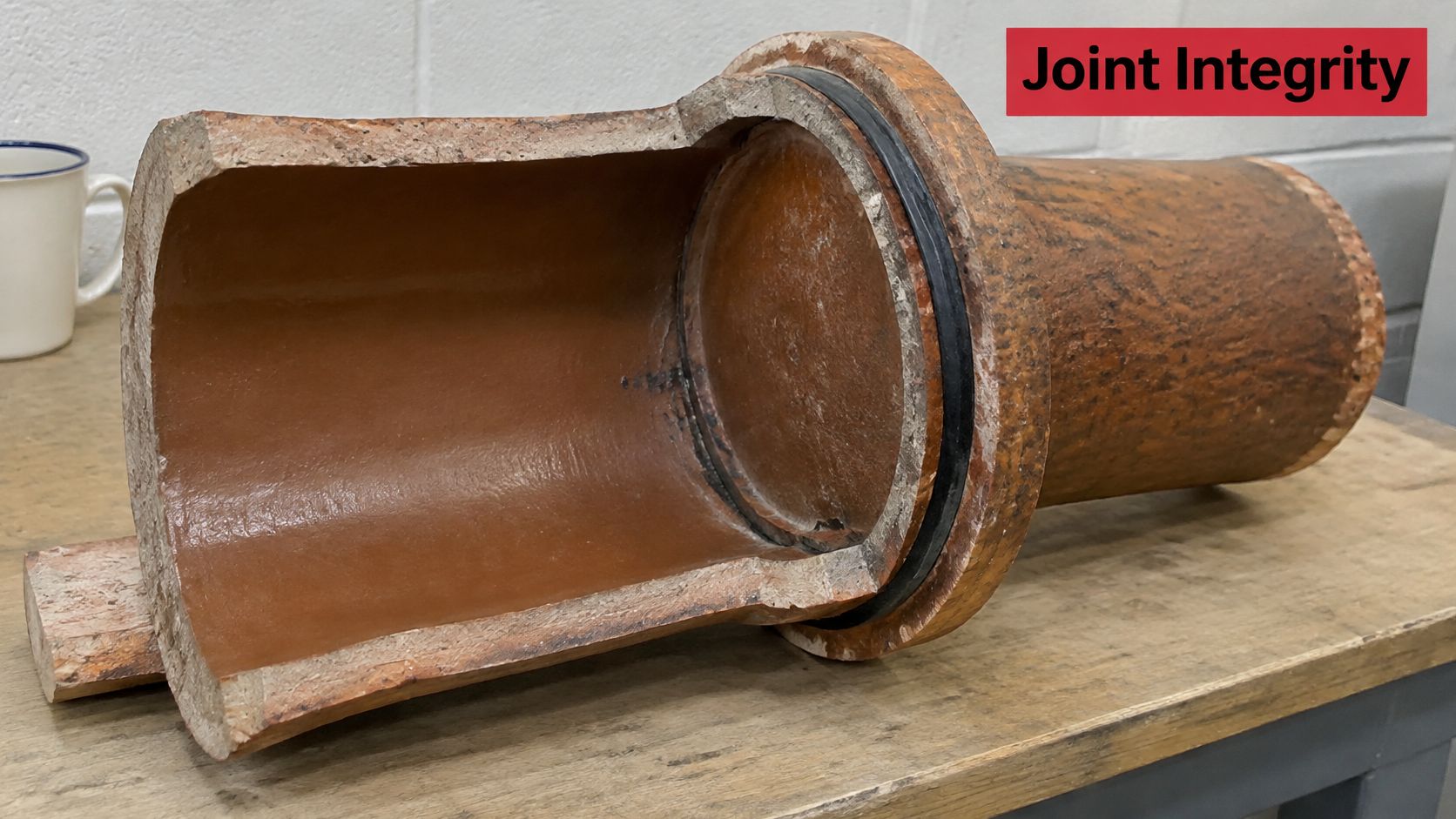
Think of a clay lateral the way you'd think of a row of heavy mugs glued lip to lip. The porcelain doesn't wear out. The seams do. Get the seams right and the assembly outlasts everyone in the house. Get them wrong and the whole run leaks while every individual mug stays perfect.
What firing does to the material
Vitrified clay pipe is formed from fire clay, shale, surface clay or a blend of them, then fired above roughly 1,093 °C (2,000 °F). The ASTM C700 standard for vitrified clay pipe covers standard-strength and extra-strength product for sanitary sewage, industrial waste and stormwater, and sets a water absorption limit of no more than 8%. That low absorption is what makes the finished pipe resist the acids found in sanitary sewers.
The practical upside is real. Clay doesn't corrode the way metallic sewer piping does, and it holds up against chemical and biological attack that would shorten the life of other materials. The trade-off is rigidity. Clay is brittle, so it cracks under settlement, excavation loads and root-driven movement instead of flexing.
Why the joint, not the barrel, decides the outcome
Older laterals were built from short sections joined with mortar or oakum. Those joints open as soil settles. Modern vitrified clay relies on factory-made compression joints, which ASTM's clay pipe standards catalog addresses through C425 for both watertightness and flexibility.
The failure points to watch for are consistent:
- Separated bells where two sections have pulled apart
- Displaced joints that create a step or change in angle
- Infiltration of groundwater through open seams
- Root entry at any gap wide enough for a hair root
- Soil migration into the line through a failed joint
None of those require the barrel to be broken. Water flow can be restricted for years while the pipe body itself is sound. The National Clay Pipe Institute's history of clay pipe traces the material back to drainage systems in Babylonia around 4000 BCE, notes Washington, D.C. introducing it to U.S. sewers in 1815, and records ASTM accepting its first major laying recommendation, C12, in 1915. That timeline matters because "clay pipe" covers very different generations of manufacturing and joint design.
A well-installed clay line can serve for generations. Age alone doesn't establish imminent failure. What you want on the inspection report is the installation date if it's known and the joint type visible on camera. Then ask the only question that drives the repair: is the barrel failing, or is it the joint?
What a Sewer Camera Inspection Reveals
A camera inspection is the evidence that turns a guess into a decision. Without it, every recommendation is a coin flip between cleaning, lining and digging.
This is what the process should look like on your property.
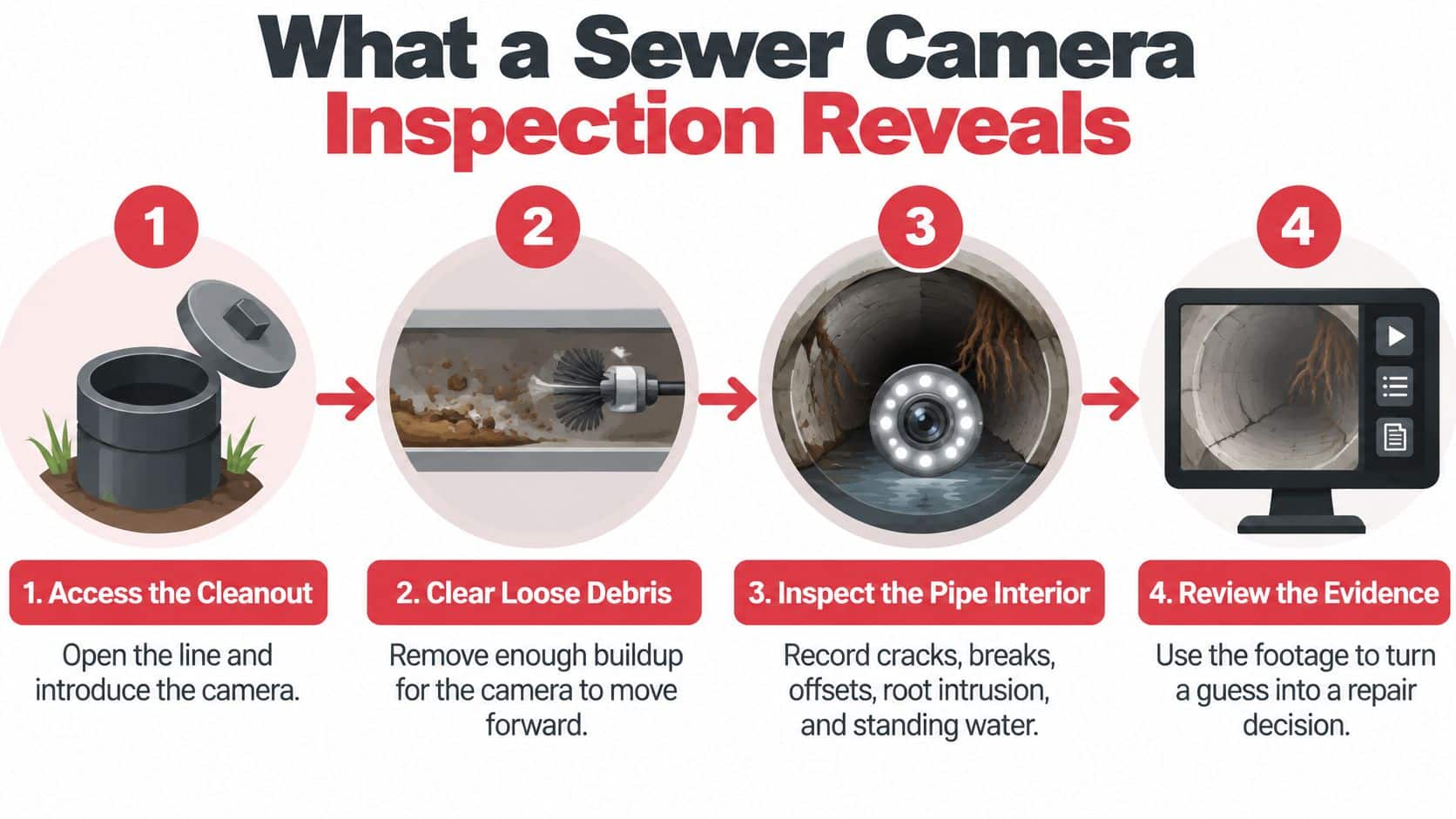
- Access the line at the cleanout and clear enough loose debris for the camera head to travel.
- Run the full length while recording, from the access point to the connection at the municipal main. A partial pass proves nothing about the last twenty feet.
- Log each defect with its type, clock position, distance from the access point and degree of offset. "Roots in the line" is not a finding. "Root mass at a joint, 34 feet out, 3 o'clock" is.
- Check for hidden leaks, because some failures never show up on video.
- Review the video and the written report before you approve anything.
Step four is where most inspections stop short. The ASTM F2550 leak location standard describes an electrical-current method for nonconductive sewer materials including clay, in diameters from 3 to 60 inches, and notes that leaking joints and defective service connections may not appear as visible defects from inside the pipe. A camera sees the bore. It doesn't always see the water leaving through the wall. Our tracer gas method covers plastic pipe, deep lines, noisy locations and leaks too small to make a sound, which is what you want when the video looks clean but the ground above the line doesn't.
Here's the same sequence in motion, including how a defect reads on screen.
Repeated backups after cleaning point to the inspection findings, not to cleaning frequency. Ask for a sewer camera inspection in Las Vegas that delivers three things: the full video, a defect log with positions, and a written recommendation that names the defect each remedy addresses.
Repair, Lining or Replacement Compared
The method follows the defect pattern, not the pipe's age. A 60-year-old line with one leaking joint and a 60-year-old line that has collapsed 12 feet from the cleanout need different answers, and neither answer is decided by the material label.
| Method | Best for | Limits | Disruption |
|---|---|---|---|
| Hydro jetting or cable cleaning | Scale, grease and root growth in a structurally sound pipe | Does not repair cracks, offsets or belly; roots return without a joint fix | Low; works through the existing cleanout |
| Repeated root cutting | Root regrowth at otherwise intact joints | Temporary; a schedule manages symptoms but does not seal the joint | Low |
| Spot or joint repair | One isolated crack or a single leaking joint | Does not address widespread deterioration along the run | Moderate; may need a small excavation |
| Cured-in-place lining | Distributed cracks, leaking joints and moderate intrusion in a continuous host pipe | Requires a clean, continuous and open host; not for collapse, severe deformation, inaccessible connections or grade problems | Low to moderate; needs access points |
| Open-trench replacement | Collapse, severe offset, loss of grade or paper-thin walls | Highest cost and disruption; landscaping and surface restoration follow | High; trenching across the yard |
Where lining stops working
Cured-in-place lining is a strong option with a hard prerequisite. A study of cured-in-place lining installed inside an existing vitrified-clay host pipe describes the liner sitting within the original pipe, which means the host has to remain continuous and open enough to be cleaned, surveyed and prepared. A liner needs something to line. It won't bridge a missing segment, correct severe deformation, reach a connection nobody can access, or fix a grade problem that leaves water standing.
Material comparisons deserve the same honesty. That same body of work reports vitrified clay at 174.6 kg CO2e per foot for embodied impact against 398 kg CO2e per foot for a compared alternative, which is a fair point in clay's favor and still not the only variable. Access, hydraulics, durability and repairability all belong in the decision.
What a real mixed repair looks like
Big rehabilitation jobs rarely use one method. In an Ohio EPA rehabilitation project, television inspection of 8- to 24-inch vitrified clay sewers found cracks, holes, leaking joints, root intrusion, collapsed sections and broken fittings, and the planned work covered approximately 23,000 linear feet. The chosen scope combined grouting, cured-in-place lining, limited open-cut point repair, root cutting, manhole sealing and lateral restoration.
Your lateral may need the same kind of combination, just smaller. That's why I'd rather see a two-line scope than a single method sold as a cure-all. When jetting is the answer, we work through the existing cleanout with no digging and no trenching and no disturbance to the yard. When a defect does require opening soil, we repair the underground pipe in-house, so nothing gets handed off mid-job. For the full picture of what falls inside drain and sewer repair, see our Las Vegas drain and sewer services.
Questions to Ask Before Approving Clay Pipe Work
Start from the findings, not the pipe's age. Location, frequency, severity, hydraulic performance and access decide the risk. A structurally sound line with leaking joints may need a targeted repair that a collapsed line never could, and a root-intruded line isn't automatically a replacement candidate.
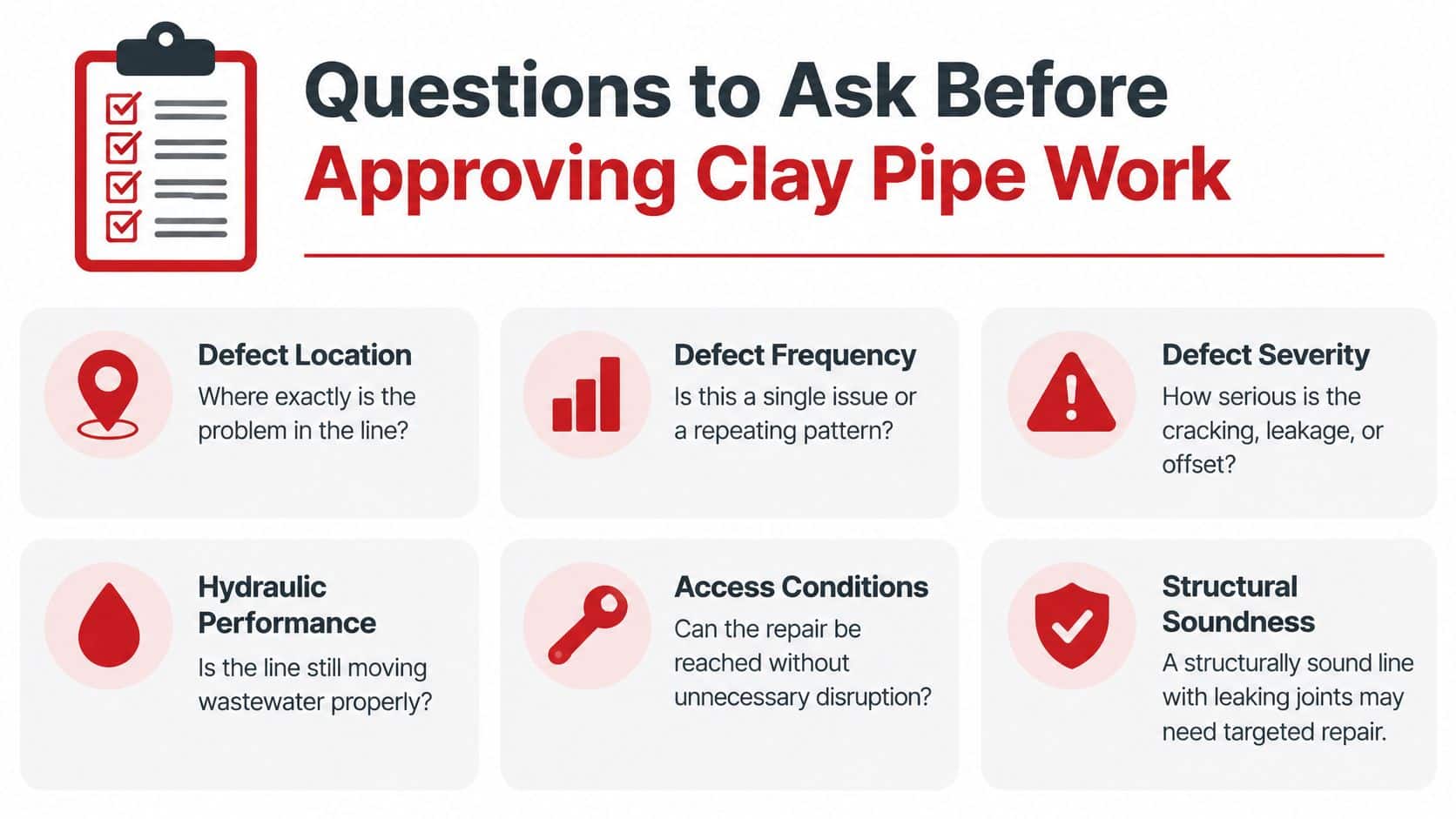
Ask these seven questions before you sign anything.
- Does the report include the full video and a defect log with positions? If you can't see where the problem sits in the line, you can't judge the quote.
- Does the quote address each defect found, or only cleaning? A scope that ignores a documented offset is a cleaning invoice waiting to happen.
- Are the options separated, with a recommended choice and the reason for it? Two honest options with a stated preference beat a single take-it-or-leave-it number.
- Is the price written and fixed before work starts? Flat-rate pricing in writing, with no charges added after the job, is the standard to hold a contractor to.
- Is the plumber who quotes the job the one who performs it? It should be. The person who read the camera footage is the person who knows what the repair has to accomplish.
- Is a post-repair test planned? If the goal was stopping infiltration, a low-pressure air or hydrostatic test confirms it. Otherwise you're trusting a repair you can't see.
- If lining is proposed, has the host pipe been confirmed continuous and open? Ask to see the footage that supports it.
The Dataintelo vitrified clay pipe report makes a related point that applies directly to homeowners and HOA boards reviewing inspection reports. Vitrified clay resists chemical and biological degradation and documented service lives can exceed 100 years, but older mortar and oakum joints open as soil settles. Material age alone doesn't establish imminent failure.
A provider who recommends only what the job needs and explains the findings in plain language is easier to trust than one who treats clay pipe as the diagnosis.
That's the standard I hold our work to: honest recommendations, no upselling, no pressure tactics, and a scope you can read in one pass.
Book a Camera Inspection Before You Dig
Repeating backups, several slow fixtures at once, or a wet patch over the lateral are enough to justify a camera before anyone prices a dig. The footage decides. Everything else is speculation.
- Write down the symptoms. Note the start date, how often they return, and which fixtures are involved.
- Request full video with distance markers, a defect log with positions and depths, and a leak check where the ground suggests one.
- Match the findings to the defect table earlier in this guide: roots at joints, a belly, offset or separated joints, grease, or scale.
- Ask for written options when more than one repair can solve it, with a stated preference and the reason behind it.
- Approve work only when scope, flat-rate price, and the post-repair test are in writing.
Miguel Garcia, a Nevada C-1d licensed plumbing contractor in the trade since 2000, performs residential sewer diagnosis and repair, and the same plumber carries the job from inspection through the finished repair. The jetter, camera, and nozzle set ride on one truck, so there is no subcontractor, dispatch queue, or rental delay between finding the defect and fixing it.
Service is residential only and scheduled during business hours. Request an appointment through the contact page on the company website. Se habla español.
MG Plumbing Services LLC is an owner-operated residential plumbing company serving Las Vegas, Henderson, North Las Vegas, Summerlin, and the surrounding valley. If your clay lateral has backed up more than once, the next step is a sewer camera inspection with full video, a defect log, and a written recommendation, followed by drain and sewer repair or hydro jetting through the existing cleanout when the footage supports it. Use the contact page at MG Plumbing Services LLC to schedule service and get a flat-rate price before any work begins.