The drain is slow again, even though someone cleared it recently. You're deciding whether to pay for another cleaning, and there's already talk of replacing the sewer line. Before approving either, you need to know what's happening inside the pipe.
Drain camera inspection services should connect a visible finding to a specific repair and a written scope. An obstruction in sound pipe calls for a different response than a displaced joint. The useful question isn't just whether the line is blocked, but why it keeps blocking.
Table of Contents
- Common Drain Findings and What They Mean
- How a Camera Inspection Works, Step by Step
- What a Residential Camera Inspection Costs
- Telling a Clog From a Structural Problem
- How Southern Nevada Conditions Show Up on Camera
- What a Camera Report Proves and What It Cannot
- Matching Each Finding to a Targeted Repair
- Schedule a Camera Inspection Before Committing to Repairs
Common Drain Findings and What They Mean
What will the camera find? A waterproof camera records the accessible interior of the drain, showing pipe surfaces, joints, obstructions, and water conditions. Most residential findings fall into a manageable list.
Common drain camera findings and their meanings
| Finding | What the camera shows | What it usually means |
|---|---|---|
| Blockage, including grease, debris, or sludge | Material lodged at one point, with clear pipe walls beyond it once accessible | Localized obstruction; cleaning often resolves it |
| Root intrusion | Fine, fibrous roots entering through joints | An opening at a joint; roots tend to regrow after cleaning |
| Pipe belly or sag | Low section where water and solids pool | Potential for repeated backups even after clearing |
| Crack or broken pipe | Visible fracture, displaced or missing sections | Structural damage that cleaning won't correct |
| Offset or separated joint | Pipe ends misaligned at a joint | Joint or grade failure that can trap debris |
| Cast iron deterioration | Rough, scaled, apparently thinned walls or flaking material | Aging material, common in older homes; video doesn't measure remaining thickness |
| Grease or scale buildup | Coated walls narrowing the bore | Restricted flow and recurring slow drains |
The scale of sewer failures explains why cameras aren't just a last resort. The U.S. Environmental Protection Agency estimates at least 23,000 to 75,000 sanitary sewer overflows annually in the United States, excluding sewage backups into buildings.
For removable deposits, hydro jetting may be appropriate, but only after assessing the underlying pipe. A camera operator shouldn't interpret every dark patch as corrosion or every submerged stretch as a confirmed belly.
Practical rule: A finding is a clue about cause, not a verdict that the entire sewer needs replacement.
The same slow-drain symptom can come from any of these conditions. Good interpretation separates what the camera clearly shows from what still needs testing.
How a Camera Inspection Works, Step by Step
The inspection starts with access and preparation, not with pushing a camera against an obstruction. This process overview shows the basic sequence.
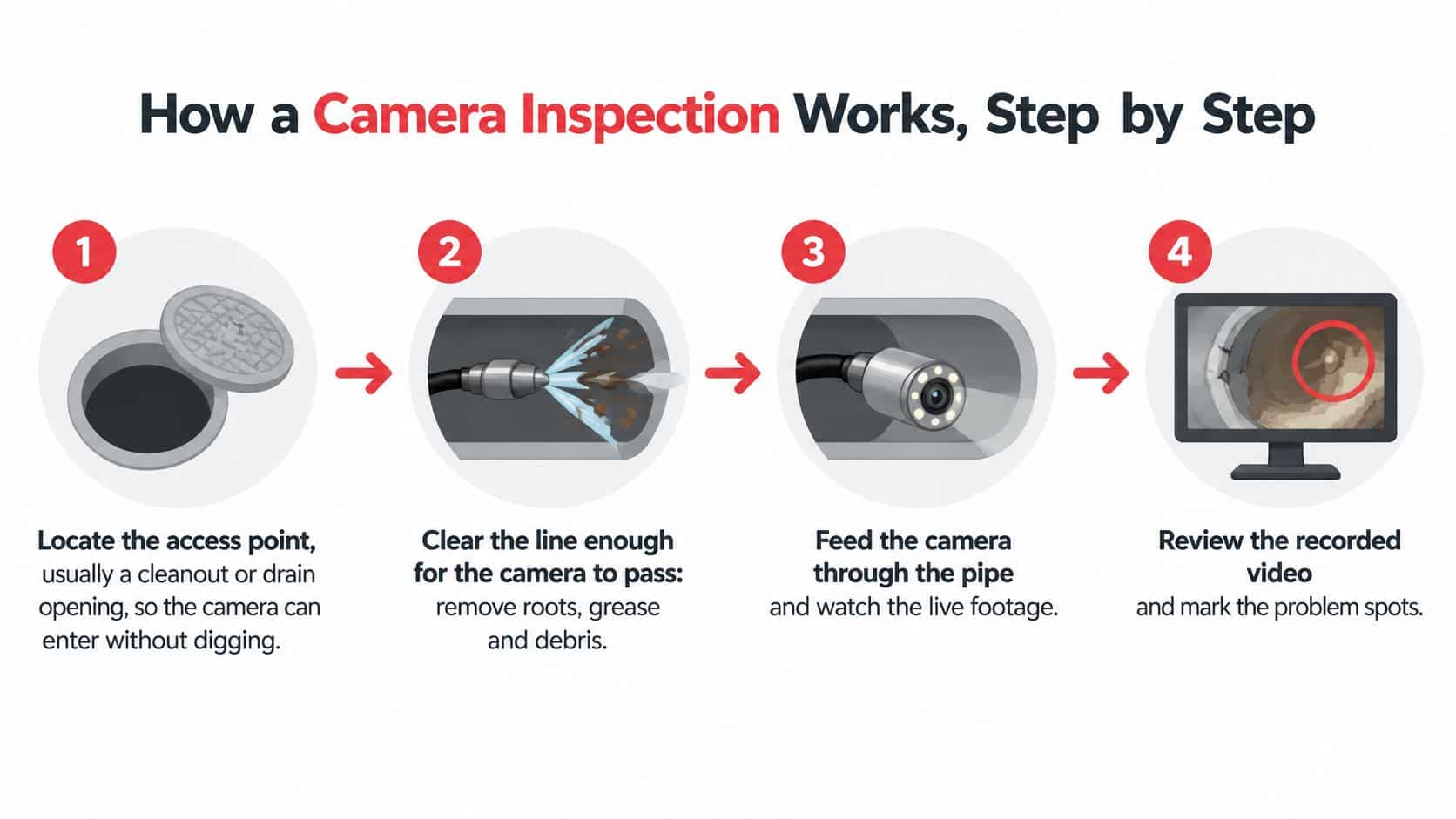
Locate the access point. We enter through a cleanout or drain opening, so the camera inspection requires no digging. The access point also becomes the reference for describing findings.
Prepare the pipe for visibility. Grease, roots, and debris can stop the camera or foul its lens. EPA inspection guidance calls for sufficient cleaning to distinguish structural defects, misalignment, and infiltration, and records defects by distance from an established reference point.
Advance the waterproof camera. The technician watches the live monitor while feeding the camera through the line. Resistance is a reason to assess the obstruction, not force the equipment forward.
Log distance consistently. Record each finding from the starting reference, rather than describing it as somewhere beneath the yard. Municipal measurements may begin at the center of a starting manhole; residential reports should clearly identify their access-point reference.
Mark findings and viewing limitations. Note defect type, measured location, and its position relative to the waterline. Record where standing water, debris, or active discharge prevents a useful view.
Review the results on site. We explain the findings in plain language and can provide written documentation. You should leave with footage, located defects where obtainable, and a clear next step.
This video offers another view of the inspection process.
Most residential inspections take 30 to 45 minutes. Longer runs and multiple access points take more time, and MG Plumbing Services LLC provides a time estimate when you schedule.
What a Residential Camera Inspection Costs
A 2026 published pricing guide from BroomBook lists $325 as an example residential camera inspection price with video and gives a broader comparison range of $290 to $640. These are examples from one published guide, not quotes from our company.
The scope explains much of the price difference. Line length, access points, preliminary cleaning, locating, and documentation all affect the work involved.
Before booking, clarify:
- Inspection charge: Get the diagnostic price in writing.
- Deliverables: Confirm whether footage, still images, locating, and a written report are included.
- Preparation: Establish whether cleaning needed to reach the defect is billed separately.
We provide written estimates, so you can distinguish diagnosis from any proposed repair. An inspection isn't the repair itself, but it can prevent spending on repeated cleaning where the grade is wrong, or excavation where a removable obstruction is the main problem.
Compare equivalent scopes, not just the lowest headline price. A video without an identifiable entry point or defect location may leave the next plumber repeating the diagnosis.
Telling a Clog From a Structural Problem
Does the obstruction return at the same measured location? That pattern deserves closer examination. A recurring stoppage after cleaning can point toward a displaced joint or grade problem, although recurrence alone doesn't prove structural failure.
The technician needs to connect the symptom to a visible condition.
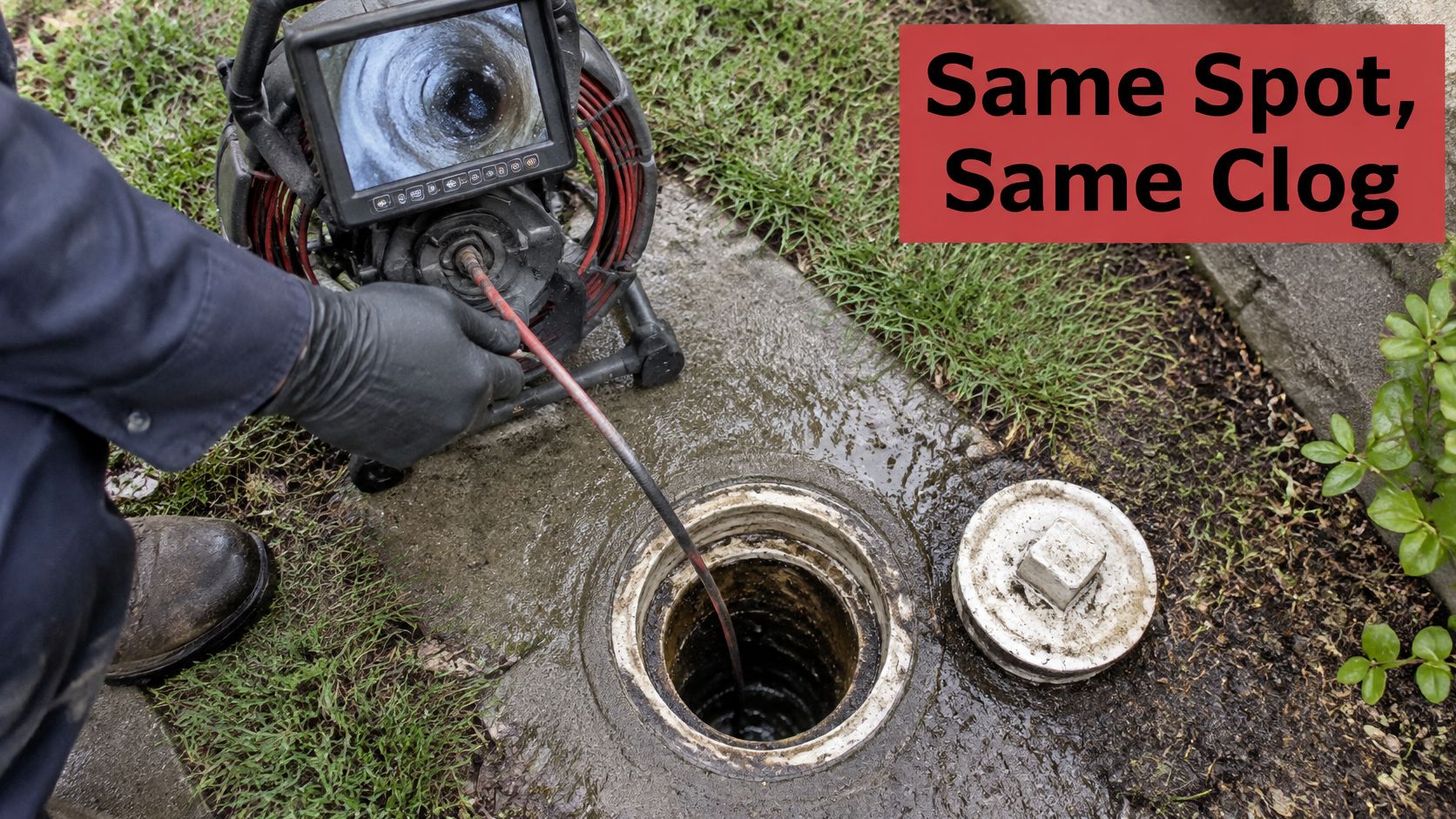
Read the water level and the pipe together
A belly retains water and solids after use, even when an opening remains through the line. Roots entering a joint indicate an opening, while displaced joints and breaks may provide pathways for groundwater entry, soil migration, or sewage leakage.
The EPA's underground-pipe condition assessment guidance explains why CCTV findings need interpretation alongside flow conditions. Conventional video is strongest above the waterline; submerged surfaces may remain hidden, and flow monitoring or further analysis may be needed.
Standing water doesn't show everything beneath it. The report should say whether water, debris, or discharge limited visibility, and whether another pass under better conditions is necessary.
Consider symptoms without an obvious blockage
Several slow drains can indicate a shared downstream problem rather than separate fixture clogs. Unexplained odors may also justify investigating the sewer, though traps and venting need evaluation when footage doesn't explain the smell.
Our clogged drain service in Las Vegas can include camera diagnosis to locate the cause of these less obvious problems. A sewer inspection can also help confirm or rule out a broken sewer pipe as the source of unexplained water under a slab; concealed sections may require additional leak detection.
Before accepting a recommendation, ask:
- Where is the defect? Identify the affected pipe section.
- How far from access? Tie the finding to a measured reference.
- Which category applies? Separate a maintenance issue from structural damage.
How Southern Nevada Conditions Show Up on Camera
The Las Vegas Valley Water District reports water hardness of approximately 291 parts per million, about 17 grains per gallon, and states that these minerals do not pose a health risk.
That mineral load changes what a camera is likely to find. Scale can bind with grease and soap residue until the pipe wall looks rough and the opening reads narrower than it really is. Water-heater and fixture scale still need their own diagnosis, because a drain line can be clear while hot-water flow suffers elsewhere.
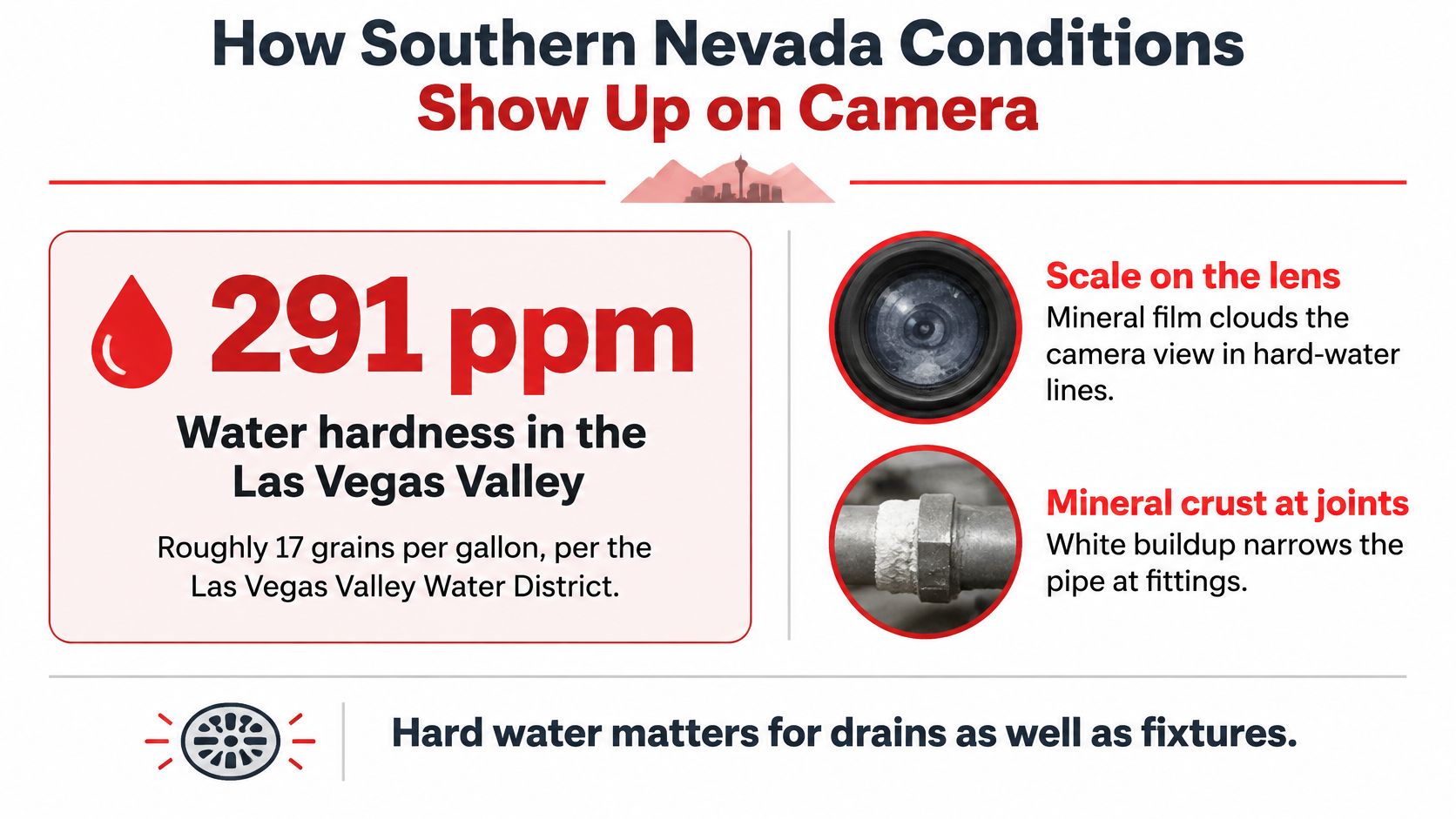
Read buildup as a clue, not a verdict. A camera can show coating, corrosion, roots at a joint, an offset connection, or a low spot holding water, but the image alone cannot prove the exact chemistry of a rough surface. In cast iron especially, I would not treat every dark, jagged wall as removable scale; flaking metal and mineral crust can look similar until cleaning exposes what remains.
Older under-slab cast iron raises the stakes. Internal deterioration can leave rough surfaces, separated joints, and snag points that keep catching paper even after a cable clears the blockage. That is the difference between paying for another cleaning and paying to locate, document, and scope the actual defect. MG Plumbing Services LLC inspections look for cast iron deterioration, root intrusion, offset or separated joints, grease and scale buildup, and pipe belly or sag.
For an older home with recurring backups, document the walls and joints along with whether water passes through.
MG Plumbing Services LLC offers pre-purchase sewer camera inspections, especially useful in older Las Vegas neighborhoods where under-slab cast iron drains are common. A clear-running line is useful information; condition footage, measured locations, and a written report make that information usable for a purchase, a repair scope, or a landlord's maintenance file.
What a Camera Report Proves and What It Cannot
A clear-looking video doesn't prove the sewer is safe. It establishes visible conditions in the sections reached, under the flow and visibility conditions present during inspection.
The Spencer Home Service explanation of sewer-camera findings highlights the value of documentation that another reader can understand and connect to the property. For a transaction, rental file, or repair decision, a short clip without context isn't enough.
What belongs in the report
- Inspection reference: Entry point, route inspected, and distance traveled.
- Pipe information: Material and diameter when observable.
- Evidence: Measured defect locations, footage, and annotated still images.
- Limitations: Unreachable sections and obscured surfaces.
- Interpretation: Confirmed observations separated from professional judgment, with repair priorities.
We offer written reports for real estate use and post-cleaning inspections that document clearance and pipe condition for landlords. Customers can review the footage with us on site and discuss the options in plain language.
What remains unknown
A camera alone can't establish exact burial depth, exterior soil conditions, bedding failure, leak rate, or remaining wall thickness. Separate locating or testing may add information, and sewer-camera footage doesn't evaluate pressurized water-supply lines, as explained in this sewer inspection overview.
Debris, standing water, severe corrosion, sharp bends, collapse, or blocked access can prevent full coverage. The next step may be cleaning, locating, another inspection, or targeted investigation rather than immediate replacement.
Documentation check: Every segment the camera couldn't reach should be listed as unknown, not passed by assumption.
Matching Each Finding to a Targeted Repair
| Finding | Typical repair | When it applies |
|---|---|---|
| Grease or scale coating with otherwise sound pipe walls | Hydro jetting | Slow drains recur and no structural defect is recorded |
| Roots entering a joint | Root cutting, hydro jetting, then re-inspection | Roots return after cleaning, so a maintenance schedule may be needed |
| Pipe belly holding solids | Scheduled hydro jetting, then regrading or spot repair | Backups repeat after cleaning |
| Crack or displaced joint | Spot repair or trenchless lining | Localized damage with otherwise sound pipe and suitable geometry |
| Collapsed or heavily corroded cast iron | Section or full replacement with ABS | Failure along a run or defects in several sections |
| Foreign object lodged in line | Removal by cable or targeted excavation | Object is visible at a fixed distance from the access point |
Cleaning restores an opening; it doesn't restore pipe grade. Scheduled cleaning can manage solids in a belly, but correcting the sag requires regrading or appropriate repair. Lining also isn't a universal answer for misalignment or collapse.
Roots create a different trade-off. Cutting and jetting remove the intrusion, but don't necessarily close its entry point. Re-inspection helps determine whether ongoing maintenance is reasonable or targeted sewer line repair is the better choice.
Our hydro jetting process recommends a camera inspection first, matches pressure to pipe material, and works through the existing sewer cleanout without digging. Optional post-job camera verification documents the result.
For a main sewer with light to moderate root intrusion, our flat-rate hydro jetting price is $747, with a camera inspection strongly recommended. That cleaning price isn't a substitute for a footage-based scope defining the affected section, access, limitations, and verification.
We use sewer cameras and electronic leak detection to address the cause rather than repeat symptom relief. Approve the method that fits the finding, not a repair selected before diagnosis.
Schedule a Camera Inspection Before Committing to Repairs
Recurring backups, sewer odors, several fixtures slowing at once, or water under the slab all point to the same question: where is the defect, and what does it need? A camera inspection answers that before you authorize cleaning, repair, or replacement.
- Write down the symptoms and when they happen.
- Schedule the inspection and confirm the time estimate when you book.
- Watch the live feed as the camera runs from the clean-out or drain opening.
- Have each finding named plainly and tied to a written scope.
- Approve or decline the estimate before any repair begins.
MG Plumbing Services LLC is a licensed, owner-operated residential plumbing company serving Las Vegas, Henderson, North Las Vegas, Summerlin, and nearby Valley communities. Owner Miguel Garcia has been in the trade since 2000 and runs each call under a Nevada C-1d plumbing contractor license, with flat-rate written estimates and service in English or Spanish.
The service list covers the work that commonly follows a camera diagnosis: drain cleaning, main sewer cleaning, hydro jetting, sewer camera inspection and locating, leak detection, water heater repair and replacement, water line work, and general plumbing repairs. If repair is needed, you get the footage and a written estimate, then decide whether to move forward.
Get a documented diagnosis before paying for repeated cleaning or sewer replacement. Visit MG Plumbing Services LLC to request a residential camera inspection, review the findings, and receive a written scope for any proposed repair.