Las Vegas pipes can and do freeze, usually in exposed branches during the coldest overnight lows of winter, and a burst often becomes apparent only after the ice thaws. Letting every faucet drip isn't the best first move. Protecting the vulnerable branch and knowing where your main shutoff valve sits matter more.
Table of Contents
- Why Las Vegas Pipes Still Freeze
- What to Do Right Now If a Pipe Freezes
- How Often Freezing Hits the Las Vegas Valley
- Which Pipes Freeze First and How to Protect Them
- Vacant Homes and Rental Properties
- When to Stop Troubleshooting and Call a Plumber
Why Las Vegas Pipes Still Freeze
Yes, Las Vegas pipes freeze, though far less often than plumbing in northern cities. The risk is real but localized, which makes blanket advice to winterize every pipe less useful than finding the exposed sections.
A Las Vegas house is like a warm coat with a few bare spots. Cold reaches the plumbing through those spots, not through the whole garment. Your living room can feel comfortable while a hose-bib branch outside the wall sits in freezing air.
The usual weak points are outdoor hose bibs, irrigation connections, garage supply lines, attic runs, and sink cabinets against exterior walls. A thermostat measures the air near the thermostat, not the temperature inside an exterior-wall cavity.
Exposure matters more than the address
Two homes on the same street can have different outcomes. One has insulated garage piping and sealed wall penetrations; the other has a bare copper elbow beside a drafty garage door.
Freezing depends on how long the pipe stays cold, how much moving air reaches it, and whether insulation slows heat loss. Pipe material matters, but even resilient tubing doesn't protect every valve, adapter, or fitting attached to it.
Practical rule: Prepare for the coldest exposed section of your home, not the temperature where you watch television.
Published freeze-frequency figures differ by source and reporting period. That uncertainty shouldn't change the practical decision: plan for the worst forecast night rather than an annual average.
Start by walking the property and identifying exposed plumbing. Locate the main shutoff before cold weather arrives, then decide which branches need covers, insulation, or closer attention. If water stops, establish whether you're dealing with an isolated fixture or a broader supply problem before applying heat.
What to Do Right Now If a Pipe Freezes
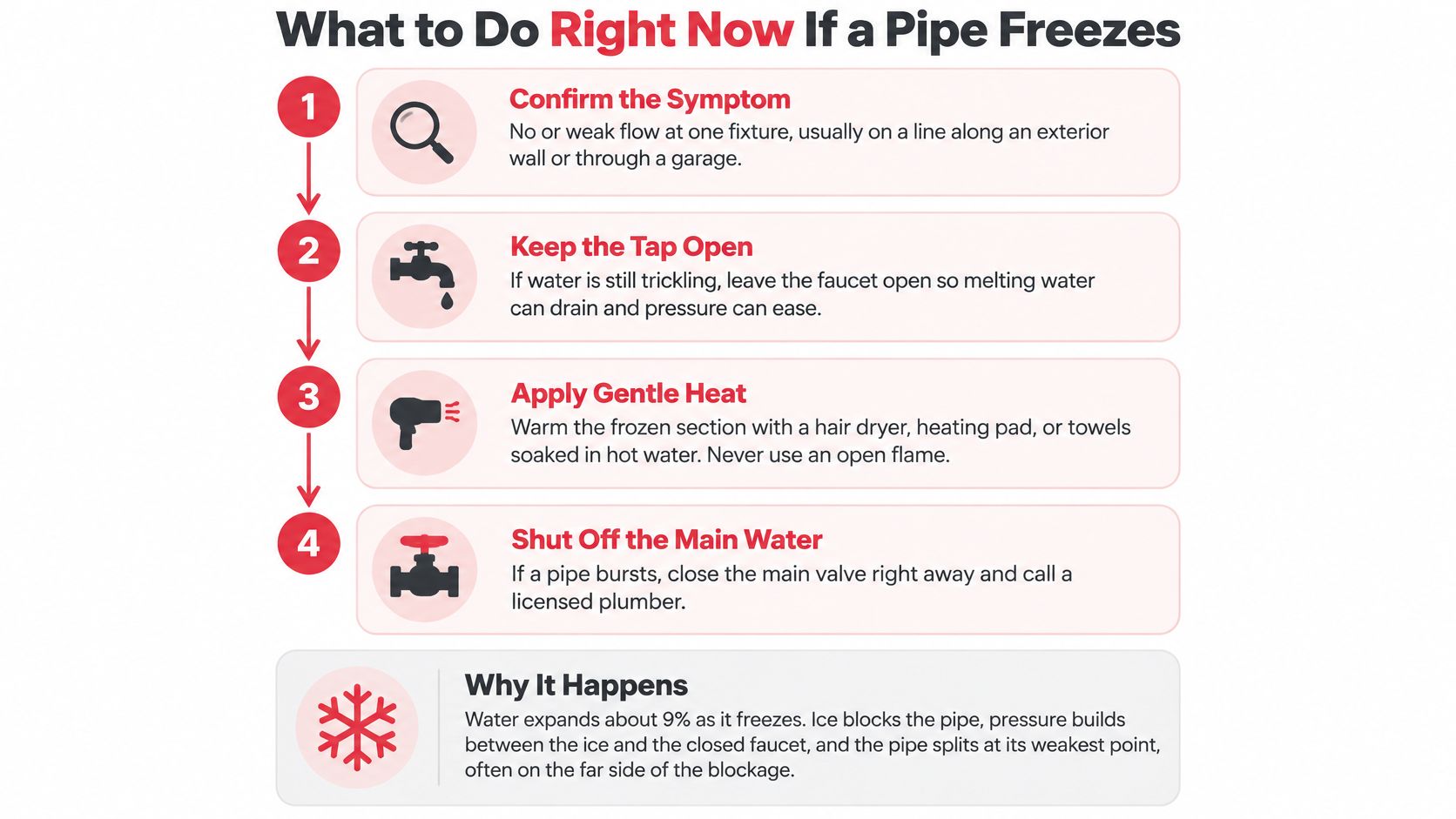
- Confirm the symptom. Check whether one fixture has weak or absent flow while others work normally. A branch through a garage or exterior wall is a stronger freeze suspect than a protected interior run.
- Isolate the water before thawing. If water is spraying or pooling at a wall, ceiling, or slab, close the homeowner's main shutoff immediately. Don't operate the utility-owned meter valve without authorization; if you're unsure which valve is yours, call for help.
- Open the affected faucet. Give trapped pressure and meltwater an outlet. Leave the handle open while you warm the accessible section.
- Apply gentle heat. Use warm towels or a hair dryer on a dry, accessible pipe. A space heater can warm a dry room if it's attended, stable, and clear of combustibles; don't place it inside a cabinet.
- Work from the faucet toward the blockage. Warm the outlet end first, then progress along the pipe so meltwater has an open path.
- Never use flame. A torch, propane heater, or kerosene heater can ignite framing or damage piping. Don't use electrical appliances around standing water.
- Inspect while warming. Look for dripping fittings, split tubing, bulges, damp drywall, and wet insulation. Stop if you find damage.
- Verify recovery carefully. Keep the faucet open during thawing. After controlled restoration of the supply, watch the line for 24 hours, checking accessible joints and nearby finishes.
- Don't repressurize damaged piping. A visible split, displaced fitting, or unexplained wet area needs inspection before the supply returns.
Use this visual checklist alongside the isolation precautions above.
Why the leak may appear later
Ice can form plugs that trap liquid water. Continued freezing then acts like a syringe plunger, forcing pressure into the confined liquid; the pipe can rupture away from the visible frozen spot, especially at a fitting or constrained section.
The Plastics Pipe Institute technical review describes confined-freezing pressures of about 8,000 psi, rising toward 28,000 psi at much lower temperatures, and reports tested PEX specimens surviving five freeze-thaw cycles before later burst testing at approximately 784–791 psi, above the ASTM F876 minimum of 475 psi. Those are controlled technical findings, not expected household operating pressures or a guarantee that installed PEX connections will survive.
When the ice melts, water escapes through damage that was previously blocked. That's why getting flow back isn't enough to declare the repair finished.
Don't assume every flow problem is ice
The City of Las Vegas cold-weather guidance recommends insulating outdoor pipes and allowing them to drip. But absent flow can also come from a closed valve, failed pressure component, or concealed leak.
Don't heat a wall blindly because the faucet stopped working. If you can't identify an accessible frozen section, water leak detection can help distinguish a hidden leak from a supply restriction without opening finishes at random.
Watch the thawing method before attempting work on accessible piping.
A successfully thawed line has steady flow, dry joints, and no developing stains. Flow alone doesn't prove that concealed connections are sound.
How Often Freezing Hits the Las Vegas Valley
Recorded freezes extend beyond the middle of winter. An early autumn freeze can catch irrigation equipment still operating, while a spring freeze can reach outdoor fixtures after homeowners have removed their covers.
The NOAA climate summary reports a 30-year average of 24 days annually with minimum temperatures at or below 32°F. The National Weather Service airport climate record instead describes about three such nights annually, with freezes recorded as early as October 21 and as late as April 12.
Those summaries give a reported range, not interchangeable estimates of what will happen at your home. Their definitions and measurement periods aren't reconciled here, so averaging them would create false precision.
Notable Las Vegas freeze records and cold events
8 News Now's account of Las Vegas airport observations describes a record beginning in 1937, a typical first freeze around November 22, a latest first freeze of February 18, and the historical cold events below.
| Event or Milestone | Date | Recorded Temperature | Why It Matters for Pipes |
|---|---|---|---|
| Earliest freeze in NWS record | October 21 | At or below 32°F | Outdoor lines can freeze before winter starts |
| October cold snap | October 29 to 31, 1971 | 30°F, 26°F and 30°F | Early-season freezes catch unprepared homes |
| Typical first freeze of the season | Around November 22 | At or below 32°F | Finish preparations before Thanksgiving |
| Extended freeze event | Beginning January 3, 1947 | Freezing for 32 days; record low 20°F twice | Repeated cold gives exposed piping less opportunity to warm |
| Latest first freeze on record | February 18 | At or below 32°F | A mild early winter doesn't eliminate later risk |
| Latest freeze in NWS record | April 12 | At or below 32°F | Spring nights can freeze exposed lines |
| Recent hard freeze | January 21, 2025 | 29°F | Below-freezing conditions remain possible in the modern valley |
A mild season isn't permission to ignore a severe overnight forecast.
Duration matters alongside the minimum temperature. A brief dip followed by strong daytime warming isn't the same exposure as repeated cold nights and chilly days. Airport observations establish that freezing happens; your pipe's location determines whether that weather becomes a plumbing problem.
Which Pipes Freeze First and How to Protect Them
The pipes that freeze first share three traits: direct exposure to outdoor air, no insulation, and no nearby heat source. Whether the living room feels warm tells you nothing about the temperature at an outdoor valve or a supply elbow behind a garage wall.
Freeze risk by pipe location in a Las Vegas home
These are practical priorities rather than guarantees. A well-covered outdoor branch can ride out a night that freezes an indoor line next to an unsealed wall penetration.
| Location | Why It Freezes or Stays Protected | Relative Freeze Risk |
|---|---|---|
| Outdoor hose bibs and faucets | Short exposed branch sits in direct outdoor air | Very high |
| Irrigation backflow assembly and sprinkler valves | Exposed, holds water, often in a shallow box | Very high |
| Garage water supply and wall-mounted water heater | Unheated space cools far faster than living areas | High |
| Attic supply runs | Uninsulated attic piping lacks dependable indoor heat | High during severe outbreaks |
| Cabinets on exterior walls under sinks | Cold wall cavities and drafts cool supply lines | Medium to high |
| Pool and spa equipment lines | Pumps, valves, and equipment piping sit outside conditioned space | Medium to high |
| Crawlspace or unheated utility room | Cold air reaches piping without a reliable heat source | Medium |
| Under-slab and buried service lines | Soil insulates piping; leaks from soil movement or corrosion are the bigger concern | Low for freezing |
The National Weather Service's Climate of Las Vegas describes the coldest winter nights commonly falling into the 20s°F, with teens or lower during severe outbreaks. Uninsulated attic supply runs sit close to that exposure: an attic sheds heat quickly once outdoor air drops, so those lines belong on the high-risk list whenever a severe outbreak is in the forecast.
A water heater's warm tank doesn't protect the cold supply valve, exposed connectors, or the distribution piping a few feet away. A backflow cover helps only if it fully encloses the assembly; a cover with gaps around the piping does little.
Protect the highest-risk runs first
- Watch the forecast before bedtime. Clark County's cold-weather safety guidance warns that 32°F or lower can freeze desert plumbing and recommends pipe protection, sprinkler shutdown, fixture covers, and pool circulation. Treat a freeze forecast as a reason to inspect exposed equipment that evening.
- Disconnect garden hoses. Drain them and store them out of the weather. A hose left attached traps water at the faucet and can defeat the self-draining design of frost-resistant fixtures.
- Shut down irrigation correctly. Turn off the controller, then isolate and drain the outdoor supply at the system's designed drainage points. Killing the watering schedule leaves water sitting in the exposed backflow assembly.
- Cover the fixtures. Fit insulated hose-bib covers snugly against the wall and protect exposed sprinkler valves and irrigation boxes. Leave backflow relief openings and components that need servicing accessible.
- Insulate complete sections. Use closed-cell foam pipe sleeves, including elbows and exposed valves where the fittings allow. Seal the seams and shield outdoor insulation from moisture and sun; newspaper under plastic is a temporary fallback rather than a durable fix.
- Stop cold drafts. Caulk small gaps around pipe penetrations and use suitable foam on larger openings. Keep appliance vents, combustion-air openings, and required clearances open.
- Bring indoor warmth to vulnerable branches. Open exterior-wall sink cabinets and move household chemicals out of reach of children and pets. Keep garage doors closed, and skip the unattended portable heater beside plumbing.
- Use dripping selectively. A small flow through the vulnerable branch can supplement insulation, provided that branch connects to the open faucet and the drain is clear. Dripping an unrelated interior faucet does nothing for an isolated outdoor line.
- Protect pool circulation equipment. Keep water moving during near-freezing conditions following the equipment's freeze-protection procedure. If the pump fails or power goes out, contact the pool-service provider instead of assuming the programmed protection is still running.
What isn't worth doing everywhere
Insulation slows heat loss; it generates none. Heat tracing helps on persistently exposed sections, but it needs a listed product rated for the pipe material and a safe electrical installation.
Permanent heat tracing or full winterization is usually disproportionate for protected plumbing in an occupied desert home. Reserve stronger measures for genuinely exposed runs facing sustained cold, rather than buying equipment for every visible pipe.
Under-slab and buried lines call for a different diagnosis. Persistent wet soil or unexplained water use points to a service-line problem, not a frozen one; main water line replacement in Las Vegas becomes relevant once testing confirms the buried line has failed.
Write your exposed runs down in risk order: outdoor valves and fixtures first, unheated spaces next, protected interior piping last. That list turns the next freeze warning into a quick walk-through instead of a guess.
Vacant Homes and Rental Properties
A vacant house gives a burst pipe time to work. Water can run for days before anyone sees a wet floor, and shutting the heat off or locking utility rooms makes both exposure and remote response worse. Rentals carry the same risk with an extra failure point: the person living there may not know where the shutoff is or have authority to use it.
Before leaving the property
- Maintain indoor heat. Keep the thermostat on at a steady, moderate setting during an absence rather than shutting the system down. Interior heat still does nothing for outdoor or isolated garage piping.
- Document the shutoff. Photograph the homeowner-operated valve and its surroundings. Give the tenant, manager, and authorized caretaker written access instructions so nobody searches for a hidden valve while water is running.
- Label vulnerable runs. Identify the irrigation isolation valve, exposed garage branch, and other sections needing attention.
- Arrange inspections. Have someone check the property during forecast cold outbreaks, including cabinets, garage piping, and exterior equipment.
- Drain outdoor supplies. Use the system's intended isolation and drainage points. An empty house does not mean empty pipes.
A remote-response procedure
If a tenant reports absent water or a wet wall, first establish whether water is actively escaping and whether the main shutoff is accessible. Send the shutoff photograph, have the tenant close the valve if safe, and arrange a plumber rather than directing exploratory demolition by phone.
A meter that continues moving when fixtures and automatic water-using equipment are off points toward a downstream leak, not merely a frozen obstruction. Have the person on site photograph the meter and affected area without delaying isolation of an active leak.
Give the caretaker authority to stop water damage. A contact list isn't enough if nobody knows which valve to close.
When to Stop Troubleshooting and Call a Plumber
A frozen branch you can reach and warm safely is a homeowner job. A rupture, a hidden leak, a blockage you cannot locate, or an unexplained pressure change is not. The dividing line is simple: if you cannot see the problem, stop applying heat and start diagnosing.
Symptoms after a freeze and the next step
| Symptom | Likely Cause | Next Step |
|---|---|---|
| No water at one fixture, faucet open | Frozen branch at that fixture, or a local restriction | Thaw from the faucet end; call if flow doesn't return within a few hours |
| No water at several fixtures | Frozen main, service interruption, or pressure problem | Check the main shutoff and call a plumber |
| Water appearing at a slab, yard, or exterior wall | Concealed or slab leak, or a burst line | Shut the main and call for leak detection |
| Meter keeps moving with all fixtures closed | Leak downstream of the meter, after ruling out automatic water-using equipment | Shut the main and book leak detection rather than cutting into walls to hunt for it |
| Low water pressure after thawing | Damaged or pinched line, or a faulty pressure component | Call for a pressure test and inspection |
| Water spraying from a pipe or ceiling | Active rupture | Shut the main immediately and call the same day |
| Unsure where the main shutoff is | Shutoff not yet located | Call before the next freeze to have it located and tested |
Test pressure instead of guessing
The Nevada residential water-supply provisions specify static pressure at the building entrance of at least 40 psi and no more than 80 psi, with an approved pressure-reducing valve required above 80 psi. A reading well below that minimum points to the service line, a partially closed valve, a restriction, or a failing pressure component, and a threaded gauge on a hose bibb gives you a number instead of a hunch.
Static pressure and pressure under flow are two different tests. A system can hold normal pressure standing and collapse to a trickle the moment a second fixture opens, which usually means a restriction rather than a supply failure. A plumber compares both readings and isolates branches instead of guessing.
Match the tool to the symptom. Leak-detection equipment locates concealed water loss in pressurized lines. A sewer camera examines drains and sewer lines, which matters when the actual symptom is a backup rather than absent supply.
Residential help with clear service limits
MG Plumbing Services LLC is an owner-operated residential plumbing company serving Las Vegas, Henderson, North Las Vegas, Summerlin, and surrounding Las Vegas Valley communities. Miguel Garcia, a Nevada C-1d licensed plumber in the trade since 2000, runs every call, and written flat-rate estimates go out before work begins.
Residential work covers drain cleaning for clogged, slow, and recurring lines; hydro jetting; sewer camera inspections; water and sewer line repair or replacement; water leak detection; water heater service; and PRV and booster pump work. That scope matters after a freeze because the usual damage is a burst line, a leaking hose bibb, a concealed slab leak, or a pressure problem, and all of it falls inside that list.
We offer same-day plumbing for burst pipes, sewage backups, and major leaks across the Valley, Monday through Saturday, 7 AM to 5 PM. Book online or call (702) 480-8070. Se habla español.
The company does not run commercial work or a 24/7 emergency line. If a pipe ruptures outside those hours, shut the main, open a faucet to bleed off pressure, and call the first available licensed residential plumber instead of letting water run while you wait for a callback.
MG Plumbing Services LLC diagnoses and repairs freeze-damaged water piping, leaking hose bibbs, concealed leaks, and pressure problems. Visit MG Plumbing Services LLC to request service, or call 702-480-8070 with the affected fixture, the visible symptoms, and whether you have shut off the water.