Your Henderson home's showers have turned lukewarm, the water heater rumbles when it starts, and there's a faint burnt smell near the closet. You're trying to decide whether this is a maintenance problem, a repair to schedule, or a reason to get everyone outside.
Gas water heater problems need safety triage before parts replacement. Noise and weak hot water can come from mineral buildup. A burnt smell, soot, or abnormal flame can point to combustion trouble that a flush or new thermostat won't fix.
Table of Contents
- Gas Water Heater Problems at a Glance
- Warning Signs That Mean Shut Off and Leave Now
- Pilot, Ignition and Thermostat Faults
- Sediment and Scale Behind Noise and Weak Hot Water
- Relief Valve Drips and High Pressure Problems
- Scald Risk and the Temperature Trade-Off
- Repair or Replace Your Gas Water Heater
- Call a Licensed Plumber Before You Replace the Heater
Gas Water Heater Problems at a Glance
Start with what you can observe without opening the burner compartment or touching gas components. Note where water appears, when noise occurs, whether every fixture loses hot water, and whether anyone feels unwell indoors.
The table gives likely causes, not a diagnosis. More than one row can apply at once, and a dangerous symptom takes priority over an inconvenient one.
Gas water heater symptoms, likely causes and urgency
| Symptom | Likely cause | Urgency |
|---|---|---|
| Smell of gas or rotten eggs | Leaking gas fitting or valve | Immediate: leave and call the gas utility from outside. Shut off gas only if authorities direct you and it's safe. |
| Soot, yellow flame or CO alarm | Combustion or venting failure | Immediate: stop using the heater, leave, and call emergency services or the gas utility. |
| Water dripping from relief valve pipe | Thermal expansion, high supply pressure or failing valve | Immediate to same day: don't cap the pipe. Diagnose the cause first. |
| Water pooling at base of tank | Tank leak or failed fitting | Immediate if the tank leaks: shut off water and gas only if safe, and call service. |
| Rumbling, popping or crackling | Sediment or scale on the tank bottom above the burner | Same week: schedule inspection and a flush assessment. |
| Lukewarm water or running out faster | Sediment insulation, weak burner or faulty thermostat | Same week: schedule service. |
| Pilot will not stay lit | Faulty thermocouple or gas control valve | Same week: arrange service. Never bypass safety devices. |
| Rising gas bills with normal use | Scale insulation or efficiency loss | Routine: inspect at the next maintenance visit, unless other warning signs appear. |
What the urgency levels mean
Immediate means stop troubleshooting. For suspected gas or carbon monoxide exposure, leave the building and call for help from outdoors. Don't approach the appliance to operate its controls.
Same-week service means the heater may still run, but it isn't operating reliably. Repeated pilot outages, declining capacity, and persistent rumbling deserve diagnosis rather than repeated resets.
Routine maintenance covers gradual efficiency loss without leakage, abnormal combustion, or exposure symptoms. It doesn't mean leaving the condition indefinitely.
Triage rule: A heater that still makes hot water isn't necessarily safe to keep operating.
Many homeowners first notice longer recovery times or increased gas use, then adjust their routines around the problem. An early inspection can identify deposits or a failing component before further damage develops, although it can't guarantee that an aging tank is sound.
If any immediate-level symptom appears, follow the emergency response below before doing anything else with the appliance.
Warning Signs That Mean Shut Off and Leave Now
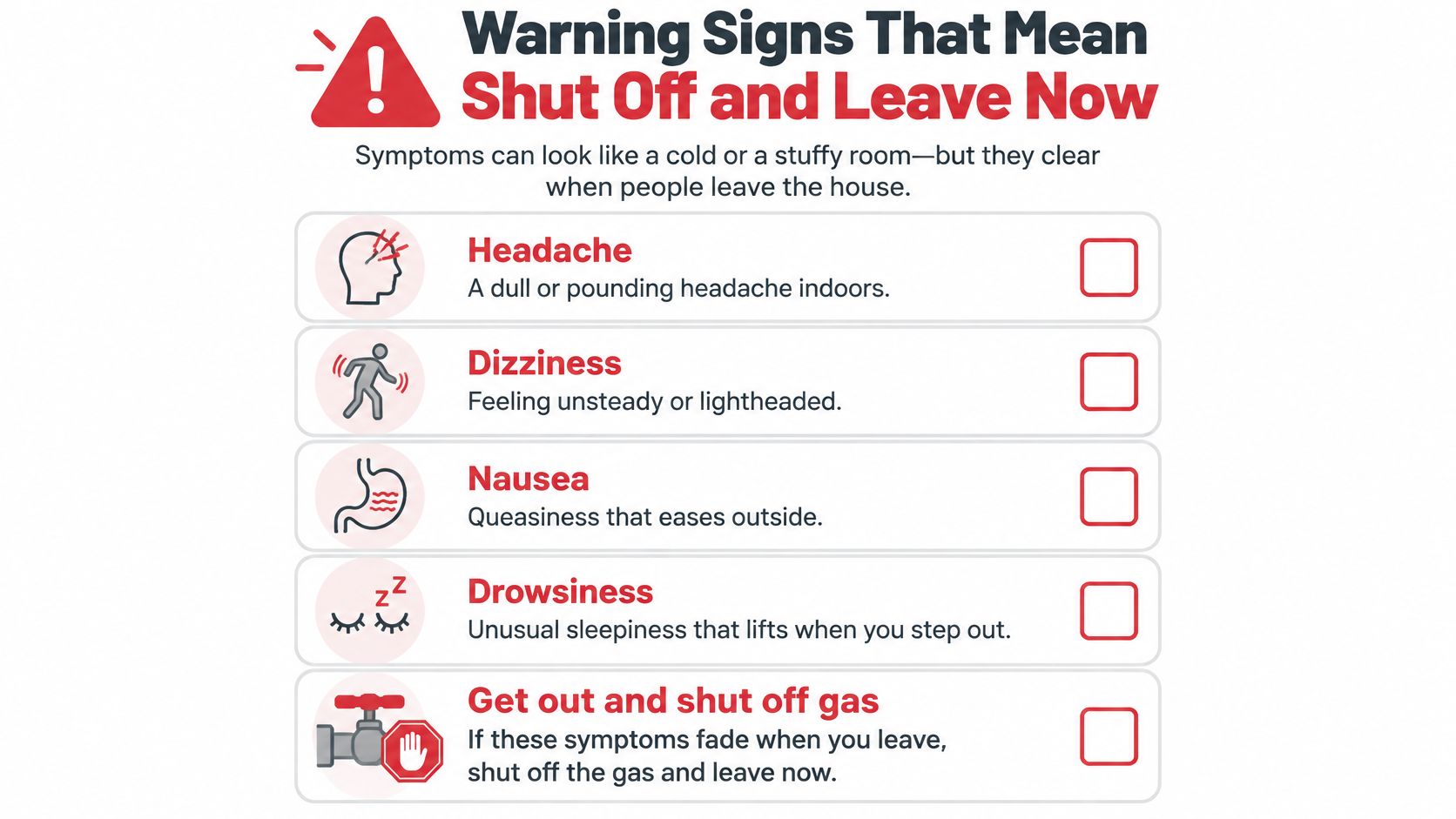
Headache, dizziness, nausea, or unusual drowsiness that improves outdoors can indicate carbon monoxide exposure. Don't wait to establish that the water heater caused it. Move everyone outside and call emergency services.
These symptoms can resemble a cold or a stuffy room. Carbon monoxide itself has no warning smell, so the absence of an odor doesn't make the building safe.
Use this checklist to recognize symptoms that require leaving the house.
Why flame and vent changes matter
Soot, a persistent yellow or lifting flame, scorching around the vent, and a damaged vent connector require qualified inspection. A naturally vented heater can spill exhaust indoors when the vent is obstructed or household pressure pulls air down the flue.
The Department of Energy's combustion-appliance safety guidance gives a suggested action level of 100 parts per million of carbon monoxide measured in the flue and states a 9 ppm maximum allowable concentration in a living area. These are testing benchmarks, not permission to remain indoors until a particular reading appears.
A technician uses combustion-testing instruments and checks draft under realistic operating conditions. A homeowner shouldn't try to judge exhaust safety by flame color alone.
A CO alarm is a backup, not proof that the appliance is safe. A silent alarm doesn't establish that the burner, vent, and combustion-air supply are operating correctly.
The following video accompanies the safety discussion. Don't delay an emergency call to watch it.
Keep ignition hazards away
Gasoline, solvents, paint thinners, and flammable cleaning chemicals don't belong near a gas water heater. Vapors can reach an ignition source even when the appliance is operating normally, a hazard documented in the Consumer Product Safety Commission's gas water heater fire analysis.
Don't use the heater closet as general storage. Keep combustion-air openings clear, and don't place boxes against the burner compartment.
Follow this emergency response
- Move everyone outdoors. Include pets when you can do so without delaying evacuation.
- Don't switch the heater or any gas appliance on or off. Don't operate electrical switches, relight a pilot, or return to shut a valve.
- Call emergency services or the gas utility from outside the building. Report exposure symptoms, odors, and any alarm.
- Let only a qualified technician restart the heater after the emergency is cleared and venting and combustion air have been checked.
Despite the shorthand “shut off and leave,” leaving comes first. Let responders handle a shutoff when reaching it would expose you to gas or combustion products.
Pilot, Ignition and Thermostat Faults
A pilot that won't light or keeps going out can result from a weak thermocouple, a dirty pilot orifice, a draft at the burner, or a failing gas control valve. Electronic-ignition models use different flame-sensing components, so identify the heater before ordering parts.
Safe checks before a service call
With no gas odor, CO alarm, soot, or exposure symptoms, make these observations without dismantling anything:
- Gas supply: Visually confirm the supply valve position. Don't reopen a valve that the utility or a technician closed.
- Thermostat setting: Check that the control is calling for heat rather than sitting in vacation mode or below the tank's current temperature.
- Pilot appearance: Through the viewing window, note whether the flame is steady blue, weak, or lifting. Don't remove a sealed combustion cover.
A thermocouple allows the gas control to recognize an established pilot flame. If the pilot drops out shortly after you release the control, the safety circuit isn't proving flame reliably.
Never tape down, jumper, or bypass a thermocouple, gas control, or other safety device to keep the burner running.
What a technician should test
The professional path is to test thermocouple output, inspect and clean the pilot assembly, and check draft and combustion air. Replace the gas control valve only after testing supports that diagnosis.
Follow the heater's printed instructions for any permitted relight attempt. Repeated outages require same-week service, not a succession of relights, and any gas odor means leaving immediately.
Sediment and Scale Behind Noise and Weak Hot Water
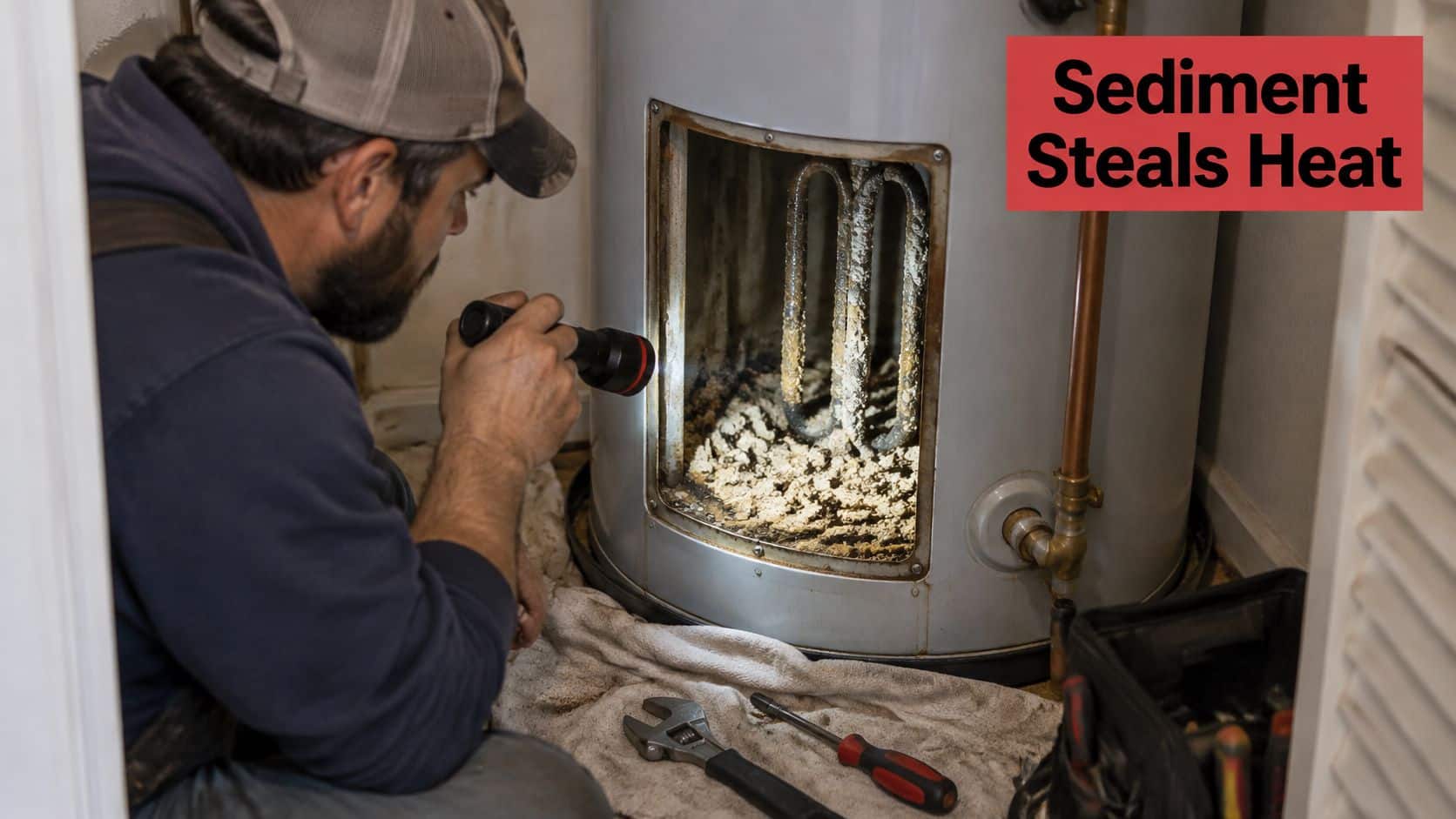
A water heater that rumbles, pops, or delivers lukewarm water after a short draw often has deposits inside the tank. Sediment settles on the tank bottom. Mineral scale can cling to heat-transfer surfaces. Both make it harder for the burner to move heat into the stored water.
In a controlled National Bureau of Standards test, adding approximately 9 liters of sand, averaging about 10 cm deep, reduced recovery efficiency from 74% to 69%. That test shows how deposits insulate the tank. It does not estimate a particular household's gas bill.
The deposits sit inside the tank above the burner, not underneath the burner itself. Water trapped beneath deposits can flash into steam as the tank heats, producing popping, crackling, or rumbling. Weak hot water can follow because the tank's usable heat transfer is reduced, even when the burner still runs.
This illustration shows the type of buildup a service inspection may uncover.
Don't diagnose scale from noise alone
Long recovery times, reduced capacity, and higher gas consumption fit sediment buildup, but they don't prove it. A technician should also consider burner malfunction or misadjustment, soot or rust in the flue, baffle deterioration, and partial flue blockage.
That distinction matters. Flushing a tank won't correct a restricted exhaust path or a burner that's operating improperly. Those conditions can also create combustion and venting hazards, so the heater needs the right diagnosis before anyone treats the problem as routine maintenance.
For homes with recurring mineral buildup, water-softener installation guidance for Las Vegas homes can help owners ask the right water-quality questions during maintenance planning. Water treatment doesn't repair existing corrosion or make a damaged tank serviceable.
Use a maintenance routine with stopping points
Flushing frequency and procedure should follow the manufacturer's manual for the specific heater. That matters because valve layout, drain design, and refill requirements vary by model.
- Turn off the gas control and electrical power, following the appliance instructions, and let the tank cool. Don't work on a suspected overheated or unsafe heater.
- Attach a suitable hose to the drain valve and route it to a safe drain. Follow the manufacturer's instructions for the small maintenance draw-off.
- Perform a full flush only under the model's procedure. Valve positions and refill requirements matter. Never fire an empty or partially filled tank.
- Stop for persistent gritty discharge, poor drainage, or a valve that won't reseal. Arrange service rather than forcing the valve or poking tools into it.
Flushing removes loose material more readily than hardened scale. On a neglected tank, it can also expose existing corrosion or leave debris lodged in the drain valve.
Heavy scale calls for an assessment, not a promise that flushing will restore the heater. Replacing the heater without checking venting and relief-valve function can leave the hazard in place.
Relief Valve Drips and High Pressure Problems
Never cap, plug, or block the temperature-and-pressure relief discharge pipe. Water from that pipe is a diagnostic signal, not a drain connection to seal.
The valve protects the tank against excessive pressure and temperature. DOE water-heater safety guidance describes protection against over-pressurizing and exceeding 210°F, with maintenance guidance calling for testing at least annually and a separate building checklist recommending checks every six months.
Separate the possible causes
A dripping relief pipe doesn't automatically mean the valve is defective. A plumber needs to distinguish among these conditions:
- Thermal expansion: Water expands as it heats. In a closed plumbing system, an absent or ineffective expansion-control arrangement can allow pressure to rise.
- Excessive supply pressure: The incoming water pressure may be too high, or a pressure-reducing valve may not control it properly.
- An overheated tank: A control fault can produce an unsafe temperature condition.
- A failing relief valve: Wear or debris may prevent the valve from sealing after other conditions have been ruled out.
Occasional discharge during heating points the inspection in a different direction from a constant drip. Neither pattern justifies replacing the valve without checking the system.
Gather observations without opening the valve
Record whether discharge is continuous, follows showers, or occurs while the heater recovers. Note recent plumbing changes, pressure-regulator work, or a noticeable change in faucet pressure.
A plumber can connect a pressure gauge at an appropriate hose connection and observe pressure during a heating cycle. The inspection should include the expansion tank, where fitted, and actual water temperature.
Repair priority: Check pressure and tank temperature before deciding the relief valve itself has failed.
Testing or replacement must follow the manufacturer's instructions and local plumbing code. Opening a hot or overheated system can release scalding water, and an older valve may fail to reseal after operation.
Keep clear of the discharge outlet. Hot, forceful, or persistent discharge deserves prompt attention, especially if the tank is unusually hot or making violent noises.
A recurring discharge must be diagnosed. Installing another valve won't correct excessive supply pressure, failed expansion control, or an overheating heater, and replacing the whole heater won't necessarily correct those installation problems either.
Scald Risk and the Temperature Trade-Off
Turning down the thermostat isn't a complete answer to scald prevention. It changes storage conditions without proving that fixture temperatures are controlled or that the system manages bacterial risk appropriately.
Maine public-health guidance on Legionella recommends storing tank water at 140°F (60°C) to reduce Legionella growth, while warning that this temperature can burn skin and recommending point-of-use mixing to control delivery temperature.
Storage temperature isn't delivery temperature
A mixing valve, also called a tempering valve in some applications, blends hot and cold water to control downstream temperature. Point-of-use anti-scald controls protect particular fixtures, while a central tempering arrangement serves a different role in the system.
The practical questions are:
- What does the tank store? The thermostat dial is a setting, not a verified temperature measurement.
- What reaches each fixture? A kitchen faucet, shower, and bathtub may deliver different temperatures.
- Does the mixing control work? Mineral deposits, a changed setting, or a failed component can interfere with regulation.
Children, older adults, and people with disabilities may have less ability to recognize excessive heat or move away quickly. Rental and multifamily properties also need consistent controls rather than depending on every occupant to adjust a faucet carefully.
Gas versus electric isn't the central distinction here. Storage temperature, circulation, and fixture controls determine how the system handles the trade-off.
Check the outlet temperatures deliberately
- Measure at the kitchen sink, shower, and bathtub. Use a thermometer and a container without putting your hand in the hot stream. Keep children away during testing.
- Inspect the tempering valve for leakage, sediment-related symptoms, and evidence that someone changed its setting. Have a plumber verify its operation.
- Address sediment under the heater's maintenance procedure. Don't flush a tank with unresolved safety problems.
- Change the thermostat only within the manufacturer's guidance and a verified mixing-valve setup. Don't raise storage temperature on an unprotected system.
A sudden increase in outlet temperature deserves diagnosis. Turning the dial down may hide a control failure rather than resolve it.
Repair or Replace Your Gas Water Heater
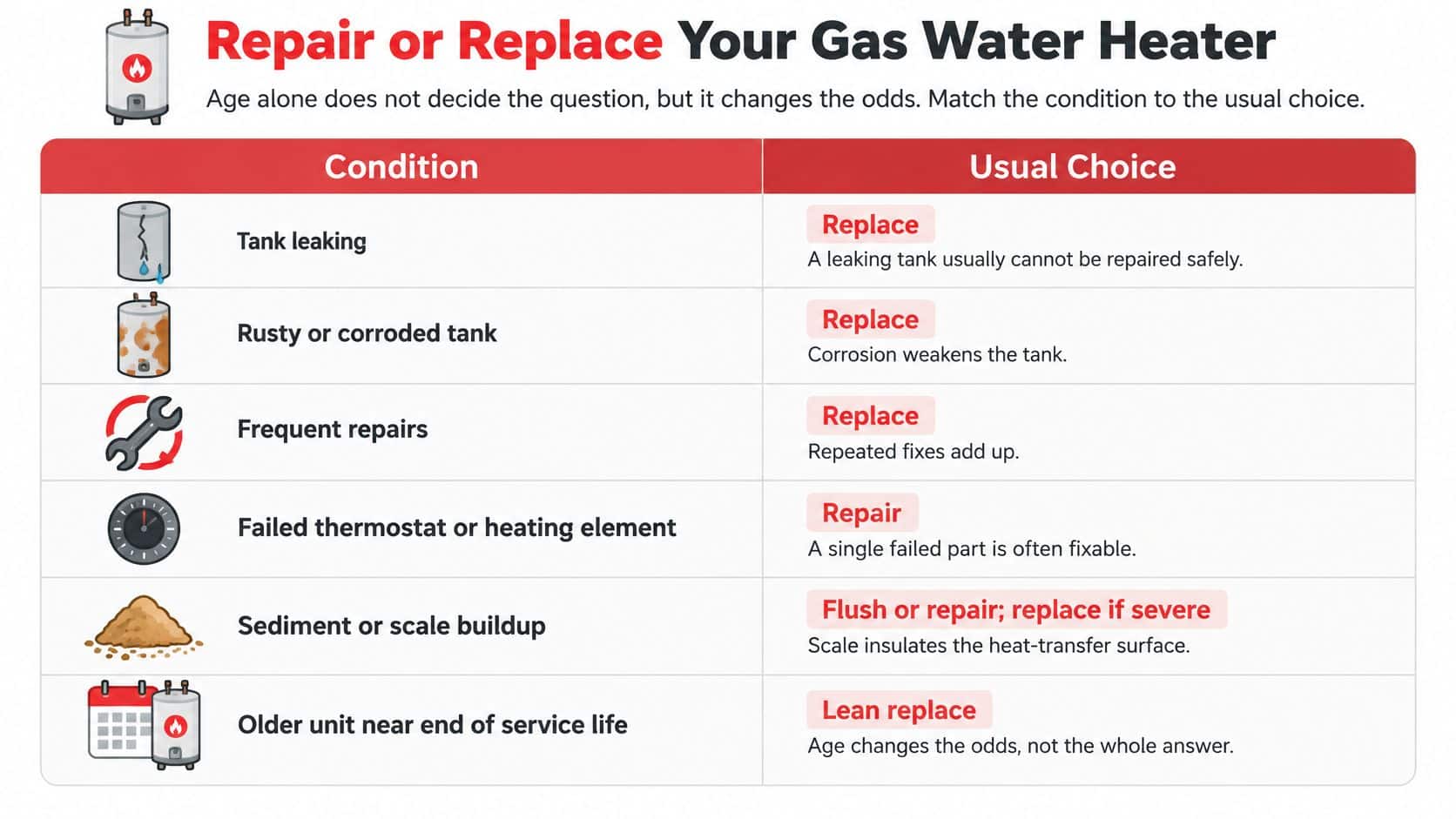
Age alone doesn't decide the question, but it changes how much repair risk makes sense. Tank condition, the failed component, maintenance history, and the installed venting arrangement matter more than a birthday by itself.
Use age bands as decision prompts, not guarantees of remaining service life.
Repair or replacement by condition
| Condition | Usually repair | Usually replace |
|---|---|---|
| Single failed thermostat, gas valve or thermocouple on a unit under about 8 years old | Yes, if the tank is sound and the part is available | No, unless inspection reveals broader damage |
| Unit 10 years old or more with a failing part | Not usually for a major repair, though an inexpensive isolated fix may make sense | Lean yes after comparing condition and installed cost |
| Heavy scale, a corroded tank or a leaking tank | No for structural tank damage | Yes for a leaking or weakened tank; assess scale severity |
| Recurring relief valve discharge after pressure and valve checks | Repair external pressure or expansion faults if found | Yes only if tank or control failure warrants it |
| Failed carbon monoxide or venting test | Correct a repairable venting or combustion defect before operation | Replace or re-vent to code, according to the confirmed cause |
| Sediment only, tank sound, flush restores performance | Yes, maintenance may restore recovery | No, not solely for removable sediment |
A new tank won't fix an external pressure problem. Likewise, a failed combustion test doesn't automatically condemn the tank, but it does prohibit treating the job as an ordinary component swap.
This comparison chart provides a visual decision aid.
For gas heaters, the repairable heating components are the burner and controls, not the electric heating elements found in electric storage models.
Compare the complete installed job
Federal efficiency standards have changed replacement requirements over time, with amended compliance milestones in 2004 and 2015 documented in the Federal Register's residential water-heater standards discussion. A replacement may require different dimensions, venting, controls, or combustion-air arrangements.
A useful repair and replacement estimate should identify the failed part and necessary installation corrections. Compare that complete scope, not a bare tank price against a finished repair.
Inspection can change the recommendation
Miguel Garcia once arrived equipped to replace a customer's heater after another plumber had recommended replacement. After inspection, he determined that only the internal rod needed replacing, drained the tank, replaced the rod, and left everything clean.
That outcome doesn't mean every old tank deserves another part. It demonstrates why a second opinion should include an inspection rather than another assumption.
A heater that produces hot water can still need installation corrections. A leaking or structurally corroded tank is usually a replacement case, while heavy scale requires an honest assessment of whether service can recover useful performance.
Call a Licensed Plumber Before You Replace the Heater
Smell gas or hear a carbon monoxide alarm? Leave the building and call 911 or the gas utility from outside first. A plumbing inspection comes after emergency clearance, never instead of it.
Once the immediate danger is ruled out, a licensed residential plumber can trace why the pilot keeps failing, why the relief valve discharged, or where the sediment and leakage are coming from. This step matters more than it seems. A new heater connected to a backdrafting vent will spill combustion gases the same way the old one did, and a blocked relief discharge line stays in the house when the tank leaves. Replacement alone does not clear the hazard.
Residential diagnosis in the Las Vegas Valley
MG Plumbing Services LLC is a licensed, owner-operated residential plumbing company serving Las Vegas, Henderson, North Las Vegas, Summerlin, and surrounding Las Vegas Valley communities. Owner Miguel Garcia holds a Nevada C-1d plumbing contractor license and has worked in the trade since 2000. Estimates are flat-rate and provided in writing before work begins.
Residential services include tank and tankless water heater repair and replacement, with code-compliant tank installation and permits when required. The company also handles drain cleaning, hydro jetting, sewer camera inspection, water leak detection, main water line replacement, PRV and booster pump service, and general repairs to fixtures, faucets, and garbage disposals. Diagnosis comes first: sewer cameras, pipe locators, acoustic listening, and thermal imaging identify the cause before any repair is quoted.
Prepare for the appointment
- Heater information: Age, model, and serial number, photographed only if access is safe.
- Symptoms and dates: Include when the problem occurs.
- Alarm information: Any CO alarm readings, without re-entering to retrieve them.
- Maintenance history: Previous repairs and flushing.
A short list like this cuts diagnostic time on site. Mention whether the pilot failure, dripping relief valve, or rumbling started before or after any recent plumbing work, since pressure changes can surface heater problems that were already developing.
MG Plumbing Services assesses gas-line concerns and refers work outside its scope to a licensed gas specialist. Same-day appointments run Monday through Saturday during business hours. This is a residential company, not a commercial or 24/7 emergency service.
Call 702-480-8070 or visit mgplumbingservices.com to request scheduled service. Spanish-language service is available. Se habla español.
MG Plumbing Services LLC offers residential water heater diagnosis, repair, and replacement to help distinguish a fixable component problem from a damaged tank or unsafe installation. Call 702-480-8070 or visit MG Plumbing Services LLC to request an inspection and a straightforward recommendation before replacing your heater.