You're halfway through a morning shower when the water turns lukewarm, and from the garage you hear the water heater popping like corn in a pan. Nothing has changed in your routine. You didn't add a bath, run the dishwasher early, or turn the temperature down. That's often how Hard Water in Water Heater problems announce themselves in the Las Vegas Valley, for years and then all at once.
It doesn't mean your tank has suddenly lost power. More often, minerals have been building a crust inside it, a little with every heating cycle. Understanding that crust, what you can clean, what you can't, and when replacement is justified will save you from two common mistakes. One is replacing a heater that needed service. The other is paying to descale a tank that's already leaking.
Table of Contents
- How Hard Water Turns Into Scale Inside a Water Heater
- Warning Signs That Scale Is Building Up in Your Tank
- How Scale Cuts Efficiency, Capacity, and Tank Life
- Checking Hardness Levels in the Las Vegas Valley
- Repair, Flushing, Softening, or Replacement Compared
- When to Call a Plumber for Hard Water Damage
- Scheduling a Water Heater Inspection in Las Vegas
How Hard Water Turns Into Scale Inside a Water Heater
Think of the white crust inside a kettle you've boiled hundreds of times. A tank water heater does the same work on a larger scale. Cold water enters carrying dissolved calcium and magnesium you can't see. The burner or electric element heats it, and heat pushes those minerals out of solution. They settle and cling where the water gets hottest, on the tank bottom, heating elements, heat-transfer surfaces, and outlet passages.
The chemistry is simple once you picture it. Dissolved bicarbonate in the incoming water shifts as temperature rises, forming poorly soluble calcium carbonate. That solid has to go somewhere, so it plates onto metal or drops as loose grains. The U.S. Geological Survey identifies this kind of mineral buildup in plumbing, fixtures, and water heaters as a recognized consequence of hard water, not a cosmetic nuisance.
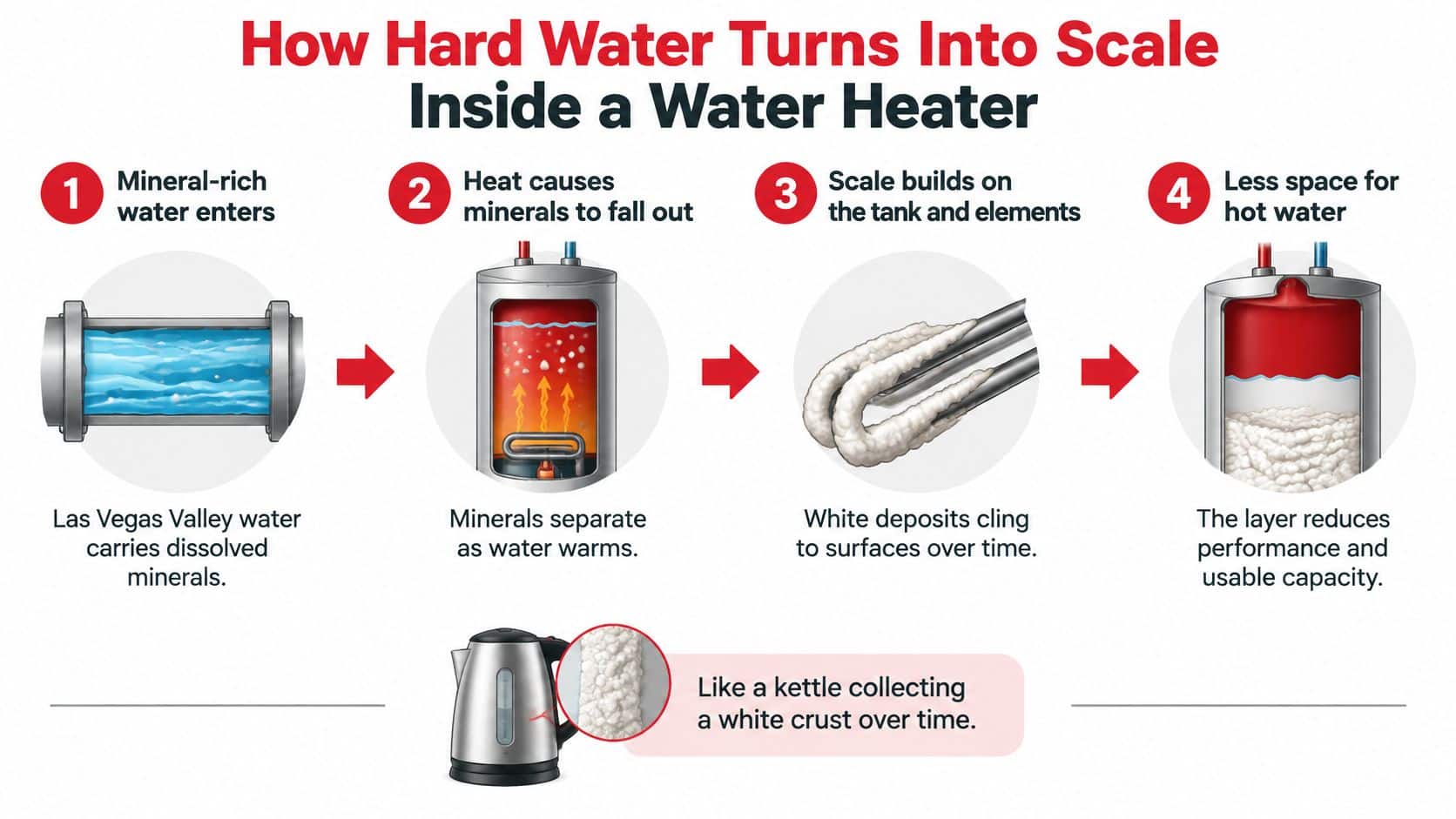
The Four Steps Inside Your Tank
- Mineral-rich water enters: Each refill after a shower or load of laundry brings a fresh supply of dissolved minerals.
- Heat causes minerals to fall out: Warmer water holds less of this mineral load in solution, so precipitation accelerates at hot surfaces.
- Scale builds on the tank and elements: Some deposits bond hard to metal. Others collect as loose sediment that can shift and pile up.
- Less space for hot water: The layer occupies volume and covers the surfaces that should be heating clean water.
Temperature matters more than most homeowners expect. Scale forms faster as water gets hotter, so a tank set higher than your household needs will crust up sooner. Usage matters too. A household that turns over its tank several times a day feeds the process more mineral-rich water than a home that's empty most of the week.
That's why you rarely see trouble in year one. Each cycle adds a thin deposit, and thin deposits don't change how a shower feels. After years of quiet accumulation, the layer is thick enough to insulate the tank bottom or coat an element, and the symptoms arrive together. The heater didn't fail overnight. It reached a threshold you'd been approaching since installation.
A kettle crust you can scrub. Tank scale you mostly can't reach, which is why prevention and early flushing beat late cleaning.
Warning Signs That Scale Is Building Up in Your Tank
Start with what you hear. Popping or rumbling during a heating cycle usually means water trapped beneath sediment on the tank bottom is flashing into steam and forcing its way up through the layer. On a gas heater, that points to sediment sitting directly over the burner area. The sound isn't the tank exploding, but it is the tank telling you the bottom isn't clean metal anymore.
Next, notice what you feel at the tap. Slower recovery means the heater takes longer to bring a fresh tank of cold water back up to temperature after use. Reduced hot-water capacity means showers run short even though nobody changed the settings. Scale coating an electric element slows heat transfer from that element into the water. Sediment in the tank also displaces storage volume, so there's less hot water waiting for you.
What Each Sign Points To
- Popping and rumbling: Loose sediment insulating the tank bottom, most common on gas storage heaters.
- Long waits between showers: A coated element or insulated heat-transfer surface that's slowing recovery.
- Hot water running out early: Lost usable capacity, a failing element, or both. Don't assume scale alone explains it.
- Granular material when draining: Visible sediment confirms buildup, and the amount helps a technician judge severity.
Virginia Tech's household water guidance treats these signs as a reason to inspect, since scale inside water heaters reduces efficiency and raises heating costs. That distinction matters. A noisy tank isn't proof you need a new heater, and a quiet tank isn't proof yours is clean. Electric heaters in particular can accumulate scale on elements with few sounds at all.
Before anyone services the heater, write down what you've observed. Note when the noise happens, how long recovery takes after a typical shower, and whether the shortfall is getting worse month to month. If you drain a sample and see grains, save a photo. Those details let a technician separate a sediment problem from a thermostat, dip tube, or element problem instead of guessing.
One caution keeps homeowners out of trouble. Symptoms overlap. A failing heating element and a scale-coated element can feel identical at the showerhead. Treat your notes as a starting point for inspection, not a diagnosis you've already finished.
How Scale Cuts Efficiency, Capacity, and Tank Life
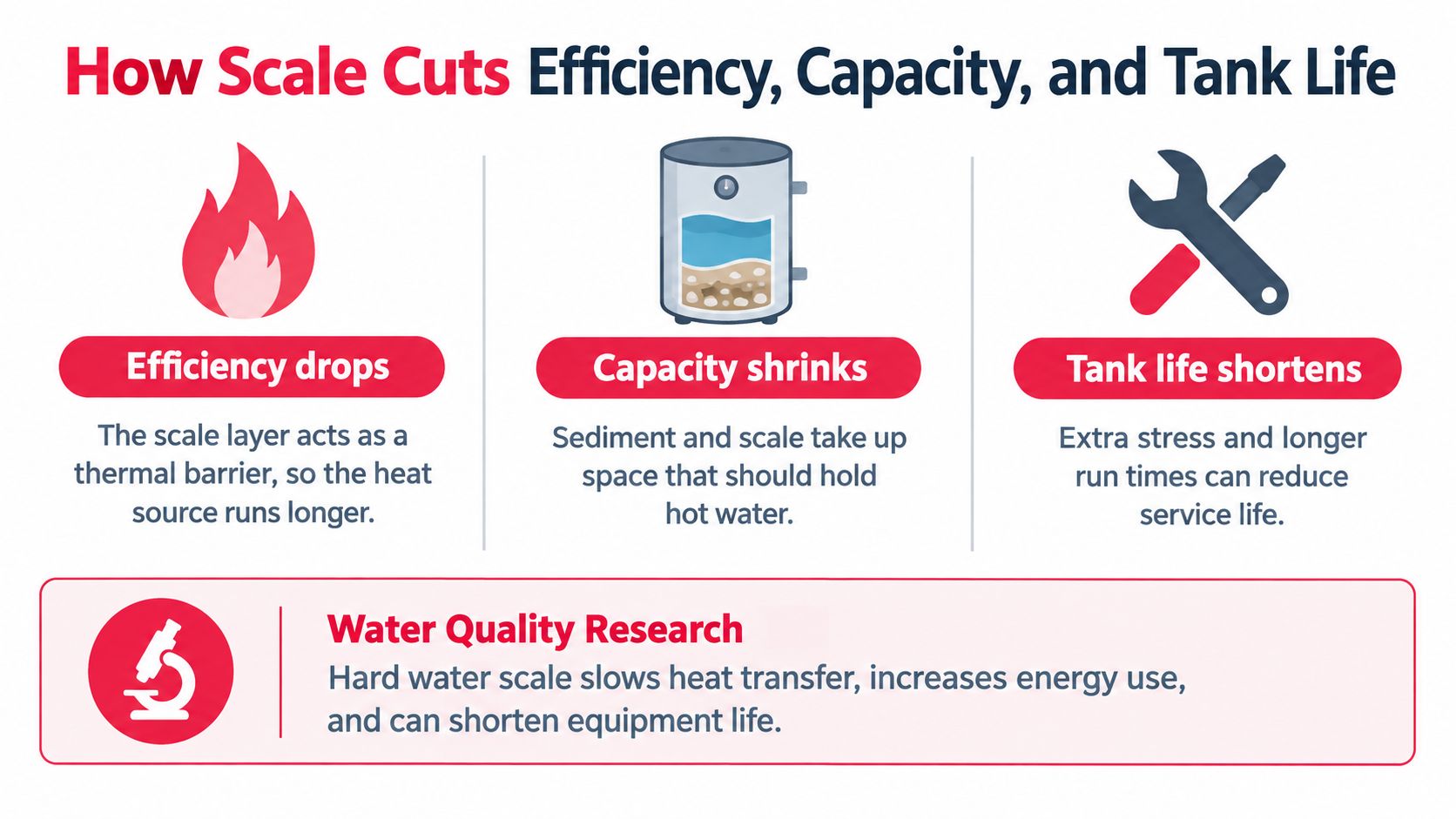
Scale is a poor conductor of heat. When it coats a heating surface, it works like a blanket between the heat source and the water. The burner or element must run longer, and the metal underneath the layer gets hotter than it should, to push the same energy through. An American Council for an Energy-Efficient Economy paper describes how deposits on heat-transfer surfaces act as a barrier that raises surface temperature and reduces thermal efficiency. That extra heat stress, repeated daily, is what ages components early.
The effect has been measured under controlled conditions. A Water Quality Research Foundation summary reports that every additional 5 grains per gallon of hardness caused approximately a 4% efficiency loss and a 4% increase in operating cost for a gas storage heater in its testing, as detailed in the Water Quality Research Foundation executive summary of residential heater findings. The same research found electric storage heaters accumulated about 0.4 pounds of scale per year for each 5 gpg of hardness. Those are study conditions, not a promise about your bill, but they show the loss grows with hardness rather than appearing all at once.
A separate technical assessment tracked a slower, more typical decline. Gas storage heater efficiency fell from 70.4% to 67.4% over an equivalent two years on unsoftened water, a 3-percentage-point reduction, according to the U.S. Department of Energy related assessment of water quality and heating equipment. That assessment also notes severe accumulation may shorten equipment life, but it cautions against treating upper-end figures as guaranteed for every home.
Why Your Results Will Differ
Your actual loss depends on hardness, water temperature, daily usage volume, and heater design. A tankless unit has narrow heat-exchanger passages, so a modest coating can affect it quickly. A conventional tank often keeps working while consuming more energy. Either way, capacity shrinks as sediment takes up space, and longer run times add wear to burners, elements, and controls.
The practical read is calm, not alarmed. Scale costs you efficiency first and service life later. Catching it while it's still loose sediment is a maintenance task. Ignoring it until surfaces overheat and components fail turns it into a replacement conversation.
Checking Hardness Levels in the Las Vegas Valley
You can't judge hardness by looking at a glass of water. Dissolved calcium and magnesium are invisible until heat forces them out, so clear water can still crust a tank. What you need is a number, reported as milligrams per liter of calcium carbonate equivalent, and a scale to interpret it against. The U.S. Geological Survey classifies 0 to 60 mg/L as soft, 61 to 120 mg/L as moderately hard, 121 to 180 mg/L as hard, and above 180 mg/L as very hard, per the USGS table of water hardness classifications.
Against that scale, local water sits well into the top category. Las Vegas Valley water averages about 280 mg/L, or 16 grains per gallon, which is very hard, according to the Las Vegas Valley Water District water quality report. The utility also states the calcium and magnesium content poses no health risk. That distinction should shape your response. Your problem is equipment performance, not unsafe drinking water, so you don't need to panic or buy treatment out of fear.
A USGS reference adds useful context for that top range, noting that water above 200 mg/L usually requires some softening before use for most purposes. That doesn't obligate you to soften every line in the house. It tells you the scale-forming environment here is strong enough that ignoring it has predictable consequences for a heater.
Getting a Number You Can Trust
- Check the current utility report: It reflects the supply reaching the Valley, not a generic national chart.
- Test at the tap if your home has treatment: A point-of-use test shows what reaches your heater after any existing softener or filter.
- Compare against manufacturer limits: Your heater's manual may state water-quality conditions that affect warranty and maintenance intervals.
Hardness varies by source and reporting period, so last year's figure is a guide, not a guarantee. White spots on fixtures confirm minerals are present, but they can't tell you whether you're modestly or severely hard. Base flushing frequency, treatment decisions, and replacement planning on a measured value. It's the difference between guessing at your tank's condition and knowing the conditions it's working in.
Repair, Flushing, Softening, or Replacement Compared
Hardness alone shouldn't trigger replacement, and scale alone shouldn't trigger a softener. The right response depends on where the deposits are, whether they're loose or bonded, and what condition the tank and its components are in. A flush handles one problem well. It does nothing for another. Sorting that out first keeps you from paying for the wrong fix.
Hard Water Response Options Compared
| Option | Best Fit | Main Limitation |
|---|---|---|
| Sediment flushing | Loose grains on the tank bottom, early rumbling | Can't remove scale bonded to heating surfaces |
| Targeted descaling | Tankless heat exchangers and coated components | Won't restore a corroded or leaking tank |
| Component repair | Consumed anode rod, failed element, faulty thermostat | Useless if the tank itself is compromised |
| Water softening | Ongoing prevention for very hard incoming water | Adds regeneration water use and discharge considerations |
| Replacement | Leaking tank, damaged bottom, repeated failures | Highest cost, unnecessary when components are sound |
Flushing deserves a clear boundary. Draining and flushing can reduce loose sediment that insulates the tank bottom and may obstruct the drain valve. It cannot strip scale bonded to an element or heat-transfer surface. If your symptoms persist right after a proper flush, the problem likely sits in that bonded layer or in a component, and repeating the flush won't change that.
Softening is prevention, not a cure for an already damaged tank. Softened water substantially reduces new scale formation, but a softener brings its own obligations, including regeneration cycles that use water and produce discharge, plus decisions about whether outdoor irrigation stays unsoftened. Point-of-use treatment protects selected lines. Whole-house softening protects everything downstream. Neither removes the need to inspect the heater you already own.
A real example from our work: Miguel arrived equipped to replace a customer's water heater, as requested, because another plumber said replacement was needed. After inspecting it, he found only the rod inside needed replacing. He drained the tank, replaced the rod, and left everything clean.
That outcome is exactly why diagnosis comes before recommendation. When we evaluate a heater, we check sediment quantity, anode rod condition, temperature setting, and recovery behavior before talking about replacement. If you're weighing options and want to understand pricing before committing, our plumbing cost estimates page explains how written, itemized estimates are structured. A sound tank with a consumed rod is a repair. A leaking tank with clean water is still a replacement. The inspection, not the hardness number, decides.
When to Call a Plumber for Hard Water Damage
Some findings move you out of home maintenance territory. Recurring relief-valve discharge means the valve is repeatedly releasing pressure or temperature, and that needs a licensed plumber, not another flush. Visible leakage from the tank body is similar. A tank that's seeping through its steel isn't a descaling candidate, and cleaning it can expose or worsen the leak.
The checklist below shows the signs that call for professional diagnosis rather than more home checks.
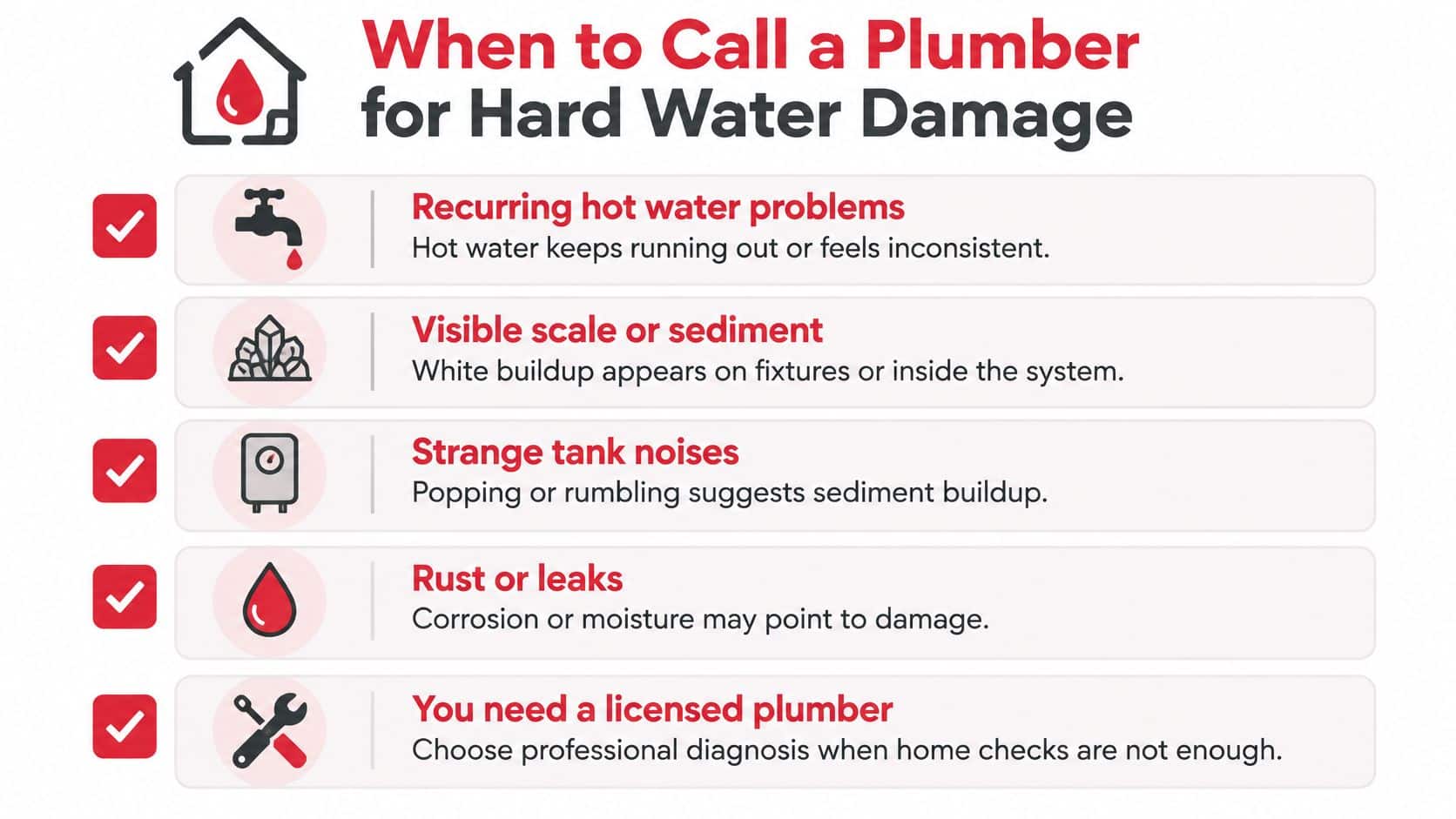
Persistent symptoms after sediment removal belong on that list too. If you've flushed the tank and recovery is still slow, capacity is still short, or the rumbling returns immediately, something beyond loose sediment is wrong. At that point a technician should evaluate bonded scale on heat-transfer surfaces, the anode rod, the dip tube, the thermostat, and on gas units, combustion performance. Guessing among those without testing wastes money.
What a Thorough Inspection Documents
- Recovery time and outlet temperature: Measured performance, not impressions from one shower.
- Burner cycle duration: Longer cycles for the same load suggest an insulating layer at work.
- Sediment observed during service: Quantity and character help separate routine buildup from neglect.
- Anode rod and tank bottom condition: These determine whether repair protects the tank or just delays failure.
The video below walks through heater issues in a home setting, which can help you describe what you're seeing when you call.
One honest limit is worth stating. An older leaking tank shouldn't be saved merely because scale removal is technically possible. The steel has already failed. Also plan realistically about timing. MG Plumbing Services serves residential customers and doesn't market itself as a 24/7 emergency company. If you have an active, flooding leak, shut off the water and power or gas to the heater first. For non-flooding problems during business hours, our same-day plumber service in Las Vegas explains how scheduling works.
Scheduling a Water Heater Inspection in Las Vegas
The decision path from this guide is short. Measure your hardness, watch and note the symptoms, flush loose sediment if the tank's condition permits, and inspect the anode rod and components before anyone recommends replacement. Choose softening to prevent future scale, because it cannot rescue steel that has already failed. Homeowners who follow that order rarely replace a heater early, and they rarely keep a dying one too long.
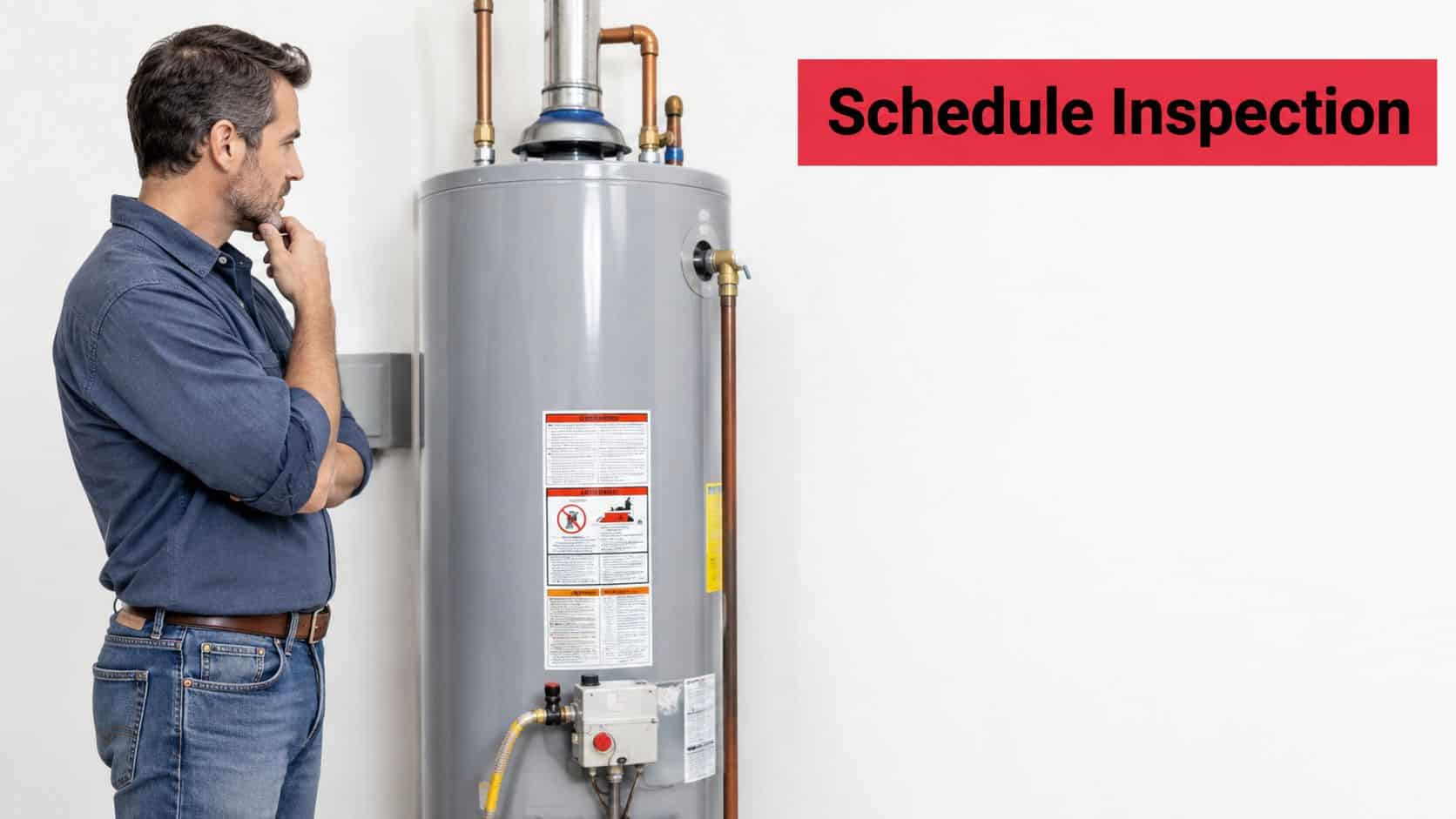
The photo below shows the kind of hands-on look an inspection involves, standing at the tank rather than judging it from the shower.
MG Plumbing Services LLC is a residential plumbing company working in a valley where the water runs roughly 16 grains per gallon. Scale is a routine finding here. That shapes how we approach a water heater call: we expect mineral buildup, we look for it, and we measure how much of the problem it explains before recommending anything.
What Water Heater Service Includes
Our water heater service covers residential tank water heater diagnosis, replacement, and installation, and we repair and replace both tank and tankless units. Replacement work is code-compliant and permitted when required. Because hard water is the default condition in Las Vegas Valley homes, we check what scale has done inside the tank, including sediment load and anode rod depletion, before quoting work. The full scope is listed on our water heater repair service page for Las Vegas.
That diagnose-first approach shows up in real calls. On one, Miguel arrived prepared to replace a water heater because another plumber had told the homeowner replacement was needed. After inspecting the unit, he found only the rod inside needed replacing, so he drained the tank, swapped the rod, and left everything clean. The heater stayed in service. That is the outcome a symptom-based inspection is built to produce.
Whoever you hire, ask for the findings and the price in writing before work begins. If your tank is rumbling, running short, or recovering slowly, schedule the inspection before a leak makes the decision for you. A measured hardness value and a documented look inside the tank will tell you whether you need a flush, a rod, a repair, or a new heater.
If hard water scale is cutting your hot water short, MG Plumbing Services LLC can inspect your tank or tankless heater, document what we find, and explain the options before any work begins. Visit MG Plumbing Services LLC to schedule a residential water heater inspection in the Las Vegas Valley.