The washing machine stops filling, and you hear a bang behind the wall. Meanwhile, the bathroom faucet has started dripping again, even though you recently had it repaired. It's reasonable to wonder whether you've got separate plumbing problems or high water pressure in your house.
For Las Vegas homeowners, the answer takes more than judging how strong the shower feels. You need to distinguish pressure when everything is off from pressure while water is flowing, then consider whether local mineral buildup is disguising the problem.
Table of Contents
- Is Your Home's Water Pressure Too High
- What Causes High Water Pressure in a House
- How to Check Your Home's Water Pressure
- Why High Pressure Damages Pipes and Fixtures
- The Las Vegas Hard-Water Factor
- When You Need a Pressure-Reducing Valve
- Getting Professional Help for Persistent Pressure Problems
Is Your Home's Water Pressure Too High
A forceful faucet can make excessive pressure seem obvious. A weak shower can make it seem impossible. Neither observation tells you enough on its own, because water pressure and water flow aren't the same thing.
Think of pressure as the push available inside the plumbing. Flow is the water that makes it through the pipes, valves, and fixture openings. A restriction can limit what comes out without eliminating the pressure behind it.
That distinction matters when you're deciding whether to replace a faucet, clean a showerhead, or have the incoming supply checked. You don't want to replace a working component just because another part of the system is causing confusing symptoms.
Clues are a reason to test, not a diagnosis
Suppose you notice a dripping faucet, an unusually forceful spray, and a toilet that needs attention. You might suspect a shared pressure problem, but each fixture still needs inspection. A worn component can need repair even after the home's pressure is corrected.
Use your observations to build a useful description:
- Where it happens: Is the problem limited to a bathroom, or do fixtures throughout the house behave differently?
- When it happens: Does the behavior change after water use stops or after the water heater operates?
- What keeps returning: Are you repeatedly dealing with the same leak or replacing similar fixture components?
Excessive static pressure can stress supply piping, fixture valves, water-heater components, and flexible hoses, which is why a pressure problem deserves attention beyond shower comfort. The International Residential Code's residential plumbing provisions establish 80 psi as the key threshold above which an approved pressure-reducing valve is required.
Practical rule: Treat the feel of the water as a clue. Treat a properly taken gauge reading as evidence.
You don't need to assume that the whole house needs new piping. Start by finding out what the pressure is, under what conditions it changes, and whether the issue affects the entire system or only a particular outlet.
What Causes High Water Pressure in a House
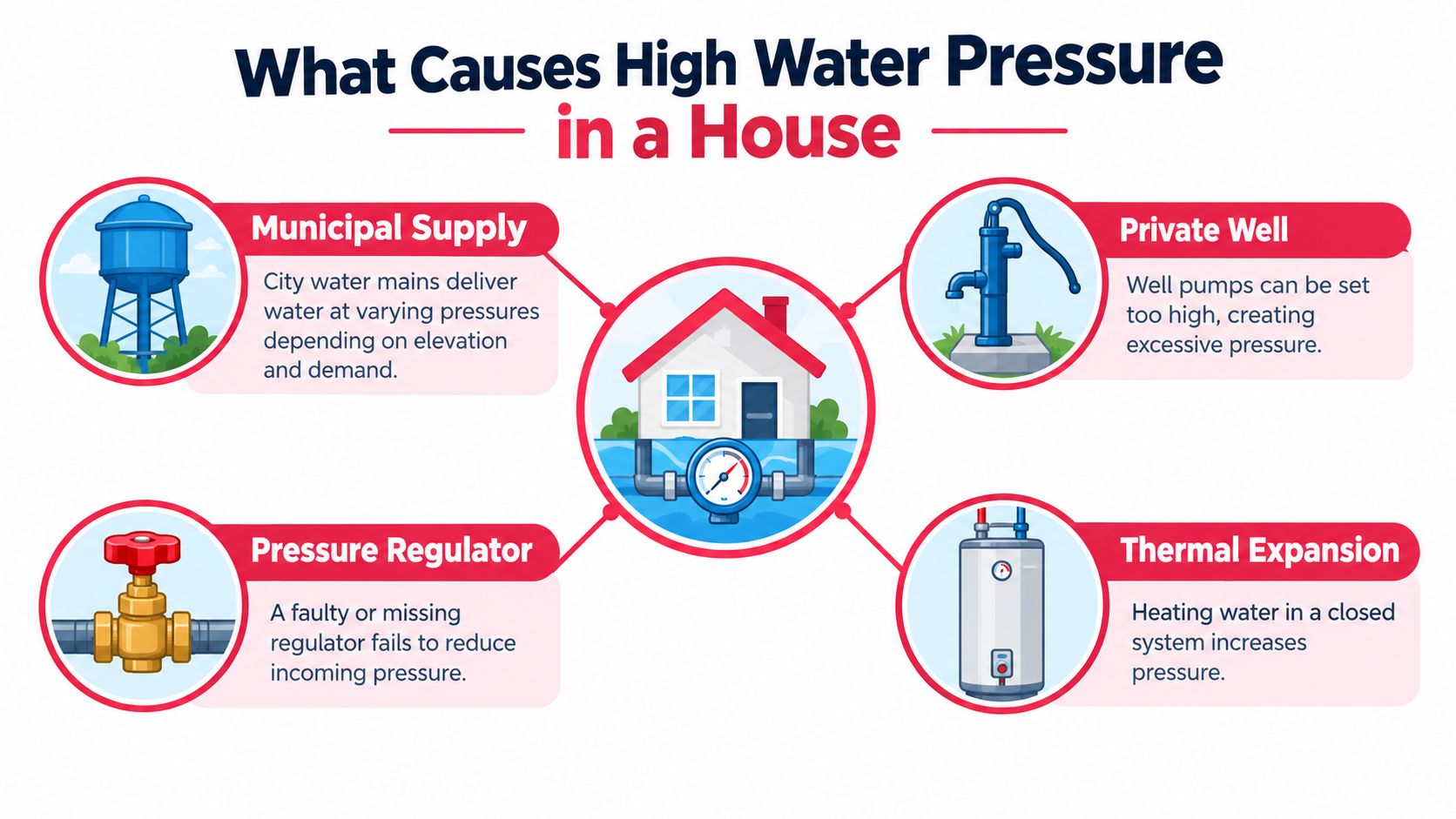
Pounds per square inch, or psi, measures water pressure. The public supply delivers water to your property, and the home's plumbing must control that incoming pressure before it reaches household fixtures.
A pressure-reducing valve, often called a PRV, acts as the control point. If it's missing or no longer regulating properly, the pressure inside the home may remain higher than intended. Pressure can also increase downstream for reasons that aren't excessive pressure from the street.
The illustration groups the main diagnostic possibilities.
Static pressure versus flowing pressure
Static pressure is the pressure present when no water is being used. Flowing pressure is the pressure measured while a fixture is drawing water.
Think of a garden hose with its nozzle closed. Water isn't coming out, but pressure is still present inside the hose. Opening the nozzle changes the conditions because water now has a path out.
Inside a home, elevation, pipe friction, partially closed valves, scale, and simultaneous fixture use can affect flowing pressure. That means a reading taken while someone is showering doesn't necessarily reveal the pressure that remains after everyone turns the water off.
| Condition | What it helps you understand |
|---|---|
| Everything is off | The pressure household components face without water demand |
| A fixture is running | How the system performs while delivering water |
| Pressure rises after use stops | Whether the regulator or thermal-expansion protection needs investigation |
Why the cause matters before the repair
A high static reading and poor fixture flow can exist together. Don't assume that weak delivery rules out excessive pressure, or that opening a valve farther will solve the underlying issue.
Likewise, a pressure complaint doesn't automatically justify main water line replacement in Las Vegas. The service piping, regulator, fixture restrictions, and water-heating system need to be considered separately before selecting a repair.
The private-well branch in the illustration isn't the starting point for a home connected to the municipal supply. Begin with the equipment your property has rather than troubleshooting every possible system.
A useful diagnosis identifies where the pressure originates, where it's controlled, and what changes when water starts or stops moving. That's more informative than a single observation that the kitchen faucet feels unusually strong.
How to Check Your Home's Water Pressure
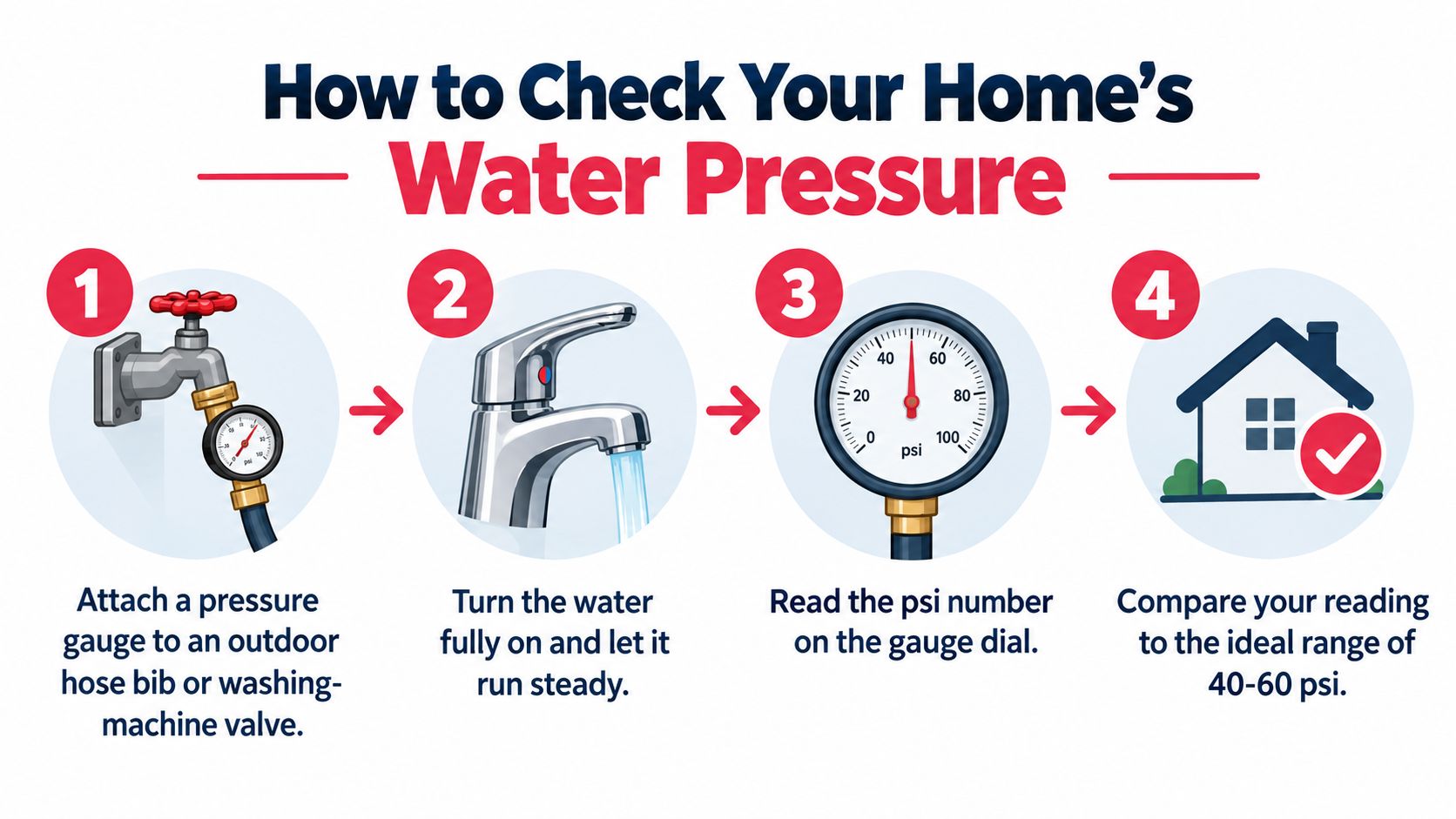
Use a threaded water-pressure gauge that fits an accessible hose bibb or suitable washing-machine supply connection. An outdoor connection is often the simpler choice because you don't have to disturb an appliance hose.
Choose a sound, accessible valve. If the connection is corroded, leaking, stuck, or difficult to reach, leave it alone and have a plumber take the measurement.
Take a static reading first
Follow this sequence to avoid confusing the gauge connection with an open, running outlet:
- Stop household water use. Close faucets and make sure toilets, appliances, and irrigation aren't drawing water.
- Attach the gauge. With the hose bibb closed, remove the hose and secure the gauge to the outlet.
- Open the connected valve. This exposes the gauge to the plumbing pressure. Water doesn't need to discharge freely from the test connection.
- Record the reading and conditions. Note whether the water heater was operating and whether any water use may have interrupted the test.
The visual below offers a quick overview. For interpretation, use the EPA guidance explained beneath it rather than treating the illustration's range as a separate technical standard.
Compare pressure while water is flowing
Leave the gauge connected and open another faucet. Record the pressure under that demand, then close the faucet and watch what happens as the system returns to rest.
EPA WaterSense's service-water-pressure guidance identifies approximately 45–60 psi as the preferred incoming range for fixture performance and efficiency; a static reading above 80 psi warrants evaluation rather than accepting a strong spray as normal.
A drop during use isn't, by itself, proof that the regulator has failed. Interpret it alongside how much water is running, whether other outlets are affected, and whether pressure climbs again while the house is inactive.
Write down both readings and what was happening when you took them. A number without test conditions can send the repair in the wrong direction.
If symptoms are intermittent, keep a short record instead of relying on a reading taken during a convenient moment. A plumber can compare measurements at different locations and investigate pressure peaks that a basic spot check may miss.
When you finish, close the hose bibb before removing the gauge. Don't start turning the regulator adjustment screw merely because you now have a measurement. First establish whether the issue is the regulator, a restriction, or pressure increasing elsewhere in the system.
Why High Pressure Damages Pipes and Fixtures
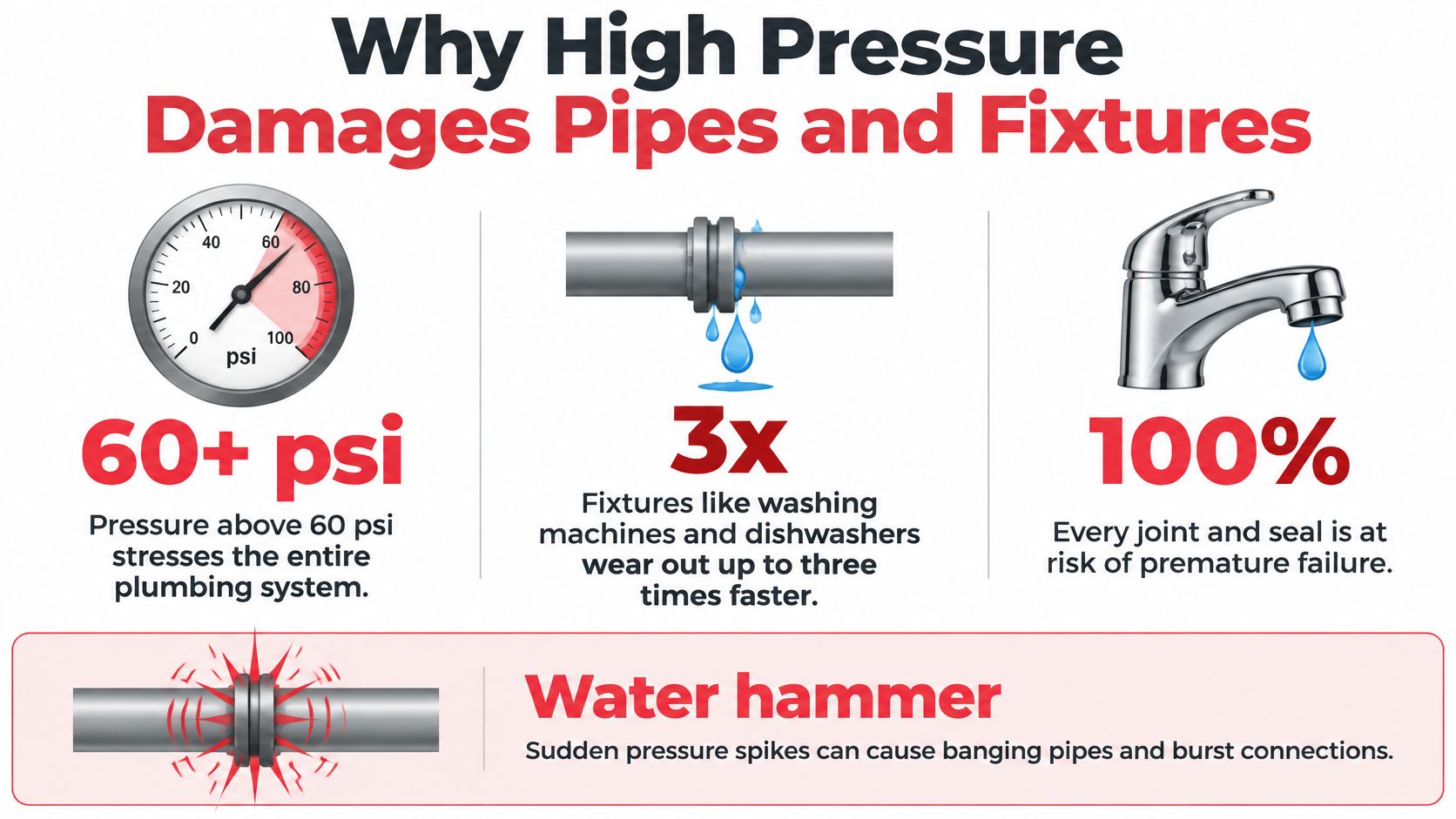
Household plumbing contains more than rigid pipe. It includes cartridges, seals, flexible connectors, appliance valves, and joints concealed behind finished surfaces. Excessive pressure increases the force those components must contain.
A damaged seal may still need replacement after the pressure is corrected. Conversely, replacing the seal alone won't address excessive force elsewhere in the system. Repairing the leak and diagnosing the operating conditions are different jobs.
The illustration highlights vulnerable plumbing components, but its numerical wear-rate and universal-risk claims aren't established benchmarks. Use the code threshold and gauge-testing guidance above, not those graphic claims, when deciding whether pressure is excessive.
Small defects can become substantial waste
The EPA's household water-use and leak statistics estimate that an average family's leaks waste approximately 180 gallons per week, or 9,400 gallons annually, while a faucet dripping once per second can waste more than 3,000 gallons per year.
Those are household leak estimates, not a calculation of waste caused solely by high pressure. That distinction matters: you can't look at a water bill and assign all unexplained use to the regulator.
You can, however, avoid treating a recurring drip as an isolated nuisance. Excessive pressure can magnify leakage through a weak connection or defective fixture component, making pressure testing a useful companion to professional water leak detection.
Inspect the component and the system
A practical inspection separates visible damage from the conditions that may contribute to it:
- Fixture valves and cartridges: Determine whether the part itself needs repair while checking whether excessive pressure is contributing.
- Appliance connections and hoses: Inspect their condition rather than assuming that correcting pressure repairs an already damaged connection.
- Water-heater components: Investigate recurring leakage alongside pressure behavior and thermal-expansion protection.
- Concealed piping: Consider hidden leakage when visible fixture repairs don't explain the problem.
A running toilet or dripping faucet isn't proof of high pressure. Aging parts, installation problems, and other defects remain possible. The goal is to avoid either extreme: blaming every leak on pressure or repeatedly replacing components without checking it.
For a visual companion to the discussion of household pressure, see the video below.
The most useful repair recommendation explains both what has failed and whether a wider operating problem needs correction. That gives you a clearer basis for approving work than another fixture replacement with no explanation of why the trouble returned.
The Las Vegas Hard-Water Factor
A weak bathroom faucet and a forceful outdoor hose bibb may seem contradictory. In the Las Vegas Valley, mineral buildup is an important reason to investigate the outlet as well as the incoming pressure.
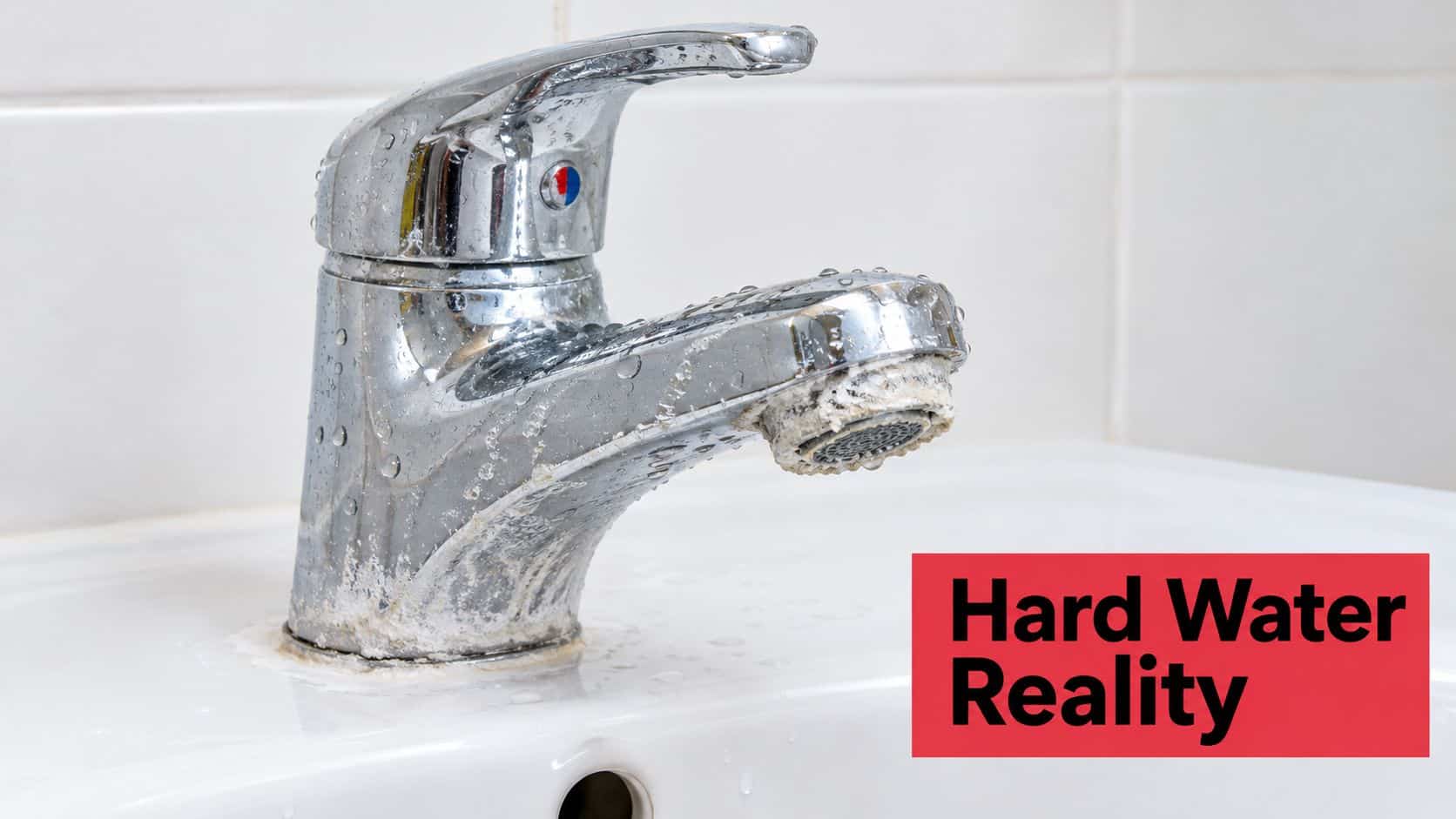
The Las Vegas Valley Water District's water-quality facts report local hardness of approximately 291 parts per million, or 17 grains per gallon, classified as very hard. The district identifies calcium and magnesium from the mineral-rich Colorado River as the cause and explains that mineral deposits can detach from plumbing as white particles.
The chalky deposits around a faucet can provide a visible clue to the conditions inside the fixture.
A restriction can hide the available pressure
Scale can reduce the effective opening through an aerator, showerhead, valve, or water-heater component. Less water reaches you, so the symptom feels like low pressure even when the static measurement doesn't indicate a shortage.
Think of a partially blocked doorway. Fewer people can pass through, but that doesn't tell you how many are waiting on the other side. Similarly, a restricted outlet doesn't reliably describe the pressure behind it.
This is why you shouldn't raise the regulator setting just to make a scaled-up showerhead feel stronger. You could change pressure throughout the house while leaving the actual restriction untouched.
Compare patterns before choosing treatment
Look for a pattern that helps separate a local restriction from a broader supply or control problem:
- A single weak outlet: Inspect the aerator or showerhead and note any visible deposits.
- Hot-water-only trouble: Include the heater and hot-water path in the investigation rather than assuming an incoming-supply problem.
- Changes throughout the home: Compare pressure measurements and inspect shared valves or controls.
- White particles or chalky buildup: Tell the plumber where you see them and whether the change developed gradually.
Local insight: A restricted fixture and excessive incoming pressure can exist in the same home. Fixing either one doesn't prove the other has been addressed.
Water treatment and pressure regulation solve different problems. A softener shouldn't be proposed as a substitute for pressure diagnosis, and a PRV shouldn't be expected to remove existing mineral restrictions.
For homeowners and property managers, the useful question isn't whether the water is hard or the pressure is high. It's which condition is affecting each part of the plumbing, and what measurements support the proposed repair.
When You Need a Pressure-Reducing Valve
A pressure-reducing valve belongs on the homeowner's side of the water meter, between the public supply and the building's internal plumbing. It reduces incoming pressure; it can't increase an inadequate supply.
Municipal guidance on pressure regulation and water quality also addresses the companion issue: when a PRV creates a closed plumbing system, heated water can expand and raise pressure unless an expansion tank or another code-compliant control absorbs that expansion.
Match the repair to the diagnosis
If testing confirms excessive incoming pressure, the plumber should determine whether a regulator is absent, incorrectly set, unsuitable, or failing. Those findings lead to different recommendations, so adjustment shouldn't be the automatic answer.
The installation also needs to remain accessible for service. A control device that can't be inspected or maintained creates an avoidable obstacle when future pressure problems arise.
Before authorizing work, ask for a clear explanation:
- What did the measurements show? Request the static and flowing readings and the locations tested.
- What is wrong with the existing control? Ask whether adjustment, repair, or replacement is appropriate.
- How will performance be verified? The completed work should include checking downstream pressure and fixture operation.
- What about expansion protection? Ask whether the water-heating system needs a separate corrective measure.
Why turning the setting down may not work
A regulator controls incoming supply pressure. It doesn't necessarily solve a pressure increase generated inside a closed system after the water heater operates.
Imagine a container that can't accommodate additional volume. Heating water within that confined arrangement can increase pressure even though the supply was regulated correctly. The diagnosis must therefore include the heater type, check valves, backflow devices, and expansion controls.
The plumbing-code provisions addressing excessive pressures describe regulator selection, downstream verification, and thermal-expansion considerations. A plumber should apply the requirements governing the property's jurisdiction rather than assuming guidance from another municipality is the final installation standard.
An expansion tank is not a substitute for correcting excessive incoming pressure. Likewise, a new regulator doesn't automatically resolve a closed-system expansion issue. They address different parts of the pressure problem.
The appropriate outcome is a system that operates correctly both during water use and after use stops. Ask the plumber to explain how the proposed work will address both conditions, especially if your measurements show pressure returning after an apparently successful adjustment.
Getting Professional Help for Persistent Pressure Problems
Call a licensed plumber when measurements exceed the safety benchmark, pressure changes substantially without a clear explanation, or fixture failures keep recurring. Bring your notes about test locations, water use, heater operation, and visible mineral deposits.
A professional can compare pressure at multiple points, inspect the regulator, assess expansion protection, and separate supply conditions from fixture restrictions. That's a more useful starting point than approving another replacement based only on how the water feels.
Residential help across the Las Vegas Valley
MG Plumbing Services is a local, family-owned and owner-operated residential plumbing company serving Las Vegas, Henderson, North Las Vegas, Summerlin, and surrounding Las Vegas Valley communities. Owner Miguel Garcia is a Nevada-licensed C-1d plumbing contractor and journeyman plumber with more than 25 years of plumbing experience.
The licensed and insured company focuses on professional diagnosis, straightforward recommendations, honest pricing, and quality workmanship. Its hands-on Southern Nevada experience includes hard-water buildup, recurring drain blockages, sewer problems, leaks, aging components, and other conditions affected by the local environment.
- Pressure and supply repairs: Water piping, shutoff valves, hose bibbs, water-pressure problems, water leak detection, water softeners, and other water treatment.
- Drain and sewer work: Clogged and slow drains, recurring blockages, main sewer cleaning, hydro jetting, sewer camera inspections and locating, and sewer and drain line diagnosis and repair.
- Household plumbing service: Water heater repair and replacement, toilets, faucets, sinks, showers, garbage disposals, and general residential repairs.
The company uses professional drain-cleaning, hydro-jetting, sewer-camera, locating, and leak-detection equipment to identify causes and recommend appropriate repairs rather than temporary fixes. Homeowners can ask about same-day residential plumbing service in Las Vegas during business hours; the company serves residential customers and doesn't market itself as a commercial or round-the-clock emergency provider.
For pressure testing, regulator evaluation, leak detection, and related residential plumbing repairs, visit MG Plumbing Services LLC to request service. Call 702-480-8070 and describe your pressure readings, recurring leaks, or changes in fixture performance so the cause can be investigated before more parts are replaced. Se habla español.