Cast iron drain pipes commonly last 50 to 100 years under favorable conditions, but that range is misleading for many homes. Horizontal runs frequently begin significant deterioration between 25 and 50 years, while above-ground vertical stacks can reach or exceed 100 years, so the key question is which section of the system you're asking about.
After pulling cast iron lines from older Las Vegas homes, I've stopped treating installation year as a diagnosis. A vertical stack in conditioned space and a kitchen branch buried under a slab may have been installed on the same day, yet one can remain serviceable while the other has already lost flow capacity, developed channel rot, or started leaking into the soil.
That difference matters across Las Vegas, Henderson, North Las Vegas, and Summerlin. Hard-water mineral buildup, long horizontal runs, slab movement, soil conditions, wastewater chemistry, and past use of aggressive drain cleaners all influence which portion fails first. Homeowners don't need a universal replacement age. They need a clear picture of the remaining service life of each pipe location.
Table of Contents
- Why the 50 to 100 Year Lifespan Is Misleading
- How Cast Iron Pipes Actually Fail
- Warning Signs Las Vegas Homeowners Notice First
- What a Camera Inspection Really Tells You
- Replacement Options That Hold Up in the Las Vegas Valley
- When to Repair, Replace, or Wait and Watch
- A Practical Plan for the Next 90 Days
Why the 50 to 100 Year Lifespan Is Misleading
The headline lifespan is the wrong question. What matters is how long until your specific pipe section fails. Good-quality cast iron under favorable conditions may last 75 to 100 years and beyond, while another section in the same building may average closer to 40 years. A plumbing-inspection discussion describes kitchen horizontal lines wearing out around 30 years, with as much as 20 years of variation between sections in one building. Independent cast iron service-life discussion
A vertical soil stack generally has an easier operating environment than a buried kitchen branch. It stays in conditioned air, has fewer prolonged low-flow areas, and is not trapped beneath a slab where settlement can stress joints. A horizontal branch carries wastewater along its bottom, collects scale where flow is weakest, and can develop crown corrosion above the flow line. Buried pipe also faces soil contact and external movement that an above-ground stack never sees.
Location changes the answer
| Pipe Section | Typical Lifespan | Why It Differs |
|---|---|---|
| Above-ground vertical stack | 100 years or more in favorable conditions | Conditioned air and vertical flow can reduce prolonged standing moisture |
| Horizontal kitchen branch | Often begins significant deterioration between 25 and 50 years | Hot wastewater, grease, scale, and crown corrosion attack the run |
| Buried horizontal lateral | Often begins significant deterioration between 25 and 50 years | Soil contact, settlement, corrosion, and low spots increase stress |
| Overall cast iron system | About 50 to 100 years under favorable conditions | Different sections age at different rates |
These ranges are planning references, not promises. One overview places indoor cast iron around 75 to 100 years, buried pipe in neutral soil around 60 to 80 years, acidic-soil burial around 40 to 60 years, and wet or high-humidity environments as low as 40 years. Cast iron lifespan by location and environment
Las Vegas adds conditions that can shorten the useful life of particular runs. Hard-water mineral buildup reduces the opening inside an already rough pipe. Long horizontal branches hold more residue, while slab movement can stress buried joints or change the line's grade. A kitchen branch under a slab can therefore become the system's problem section long before a nearby vertical stack shows serious deterioration.
Practical rule: Treat the age of the house as a reason to investigate, not as proof that every drain needs replacement.
Installation era and joint construction also affect risk. Older lead-and-oakum joints can loosen as materials age or the surrounding structure moves. Later rubber-gasket connections can develop their own aging and compression problems. For a Las Vegas home, check whether the pipe runs under the slab, whether the kitchen branch repeatedly collects grease and scale, and whether the line still has a stable grade. Those findings matter more than the permit date.
How Cast Iron Pipes Actually Fail
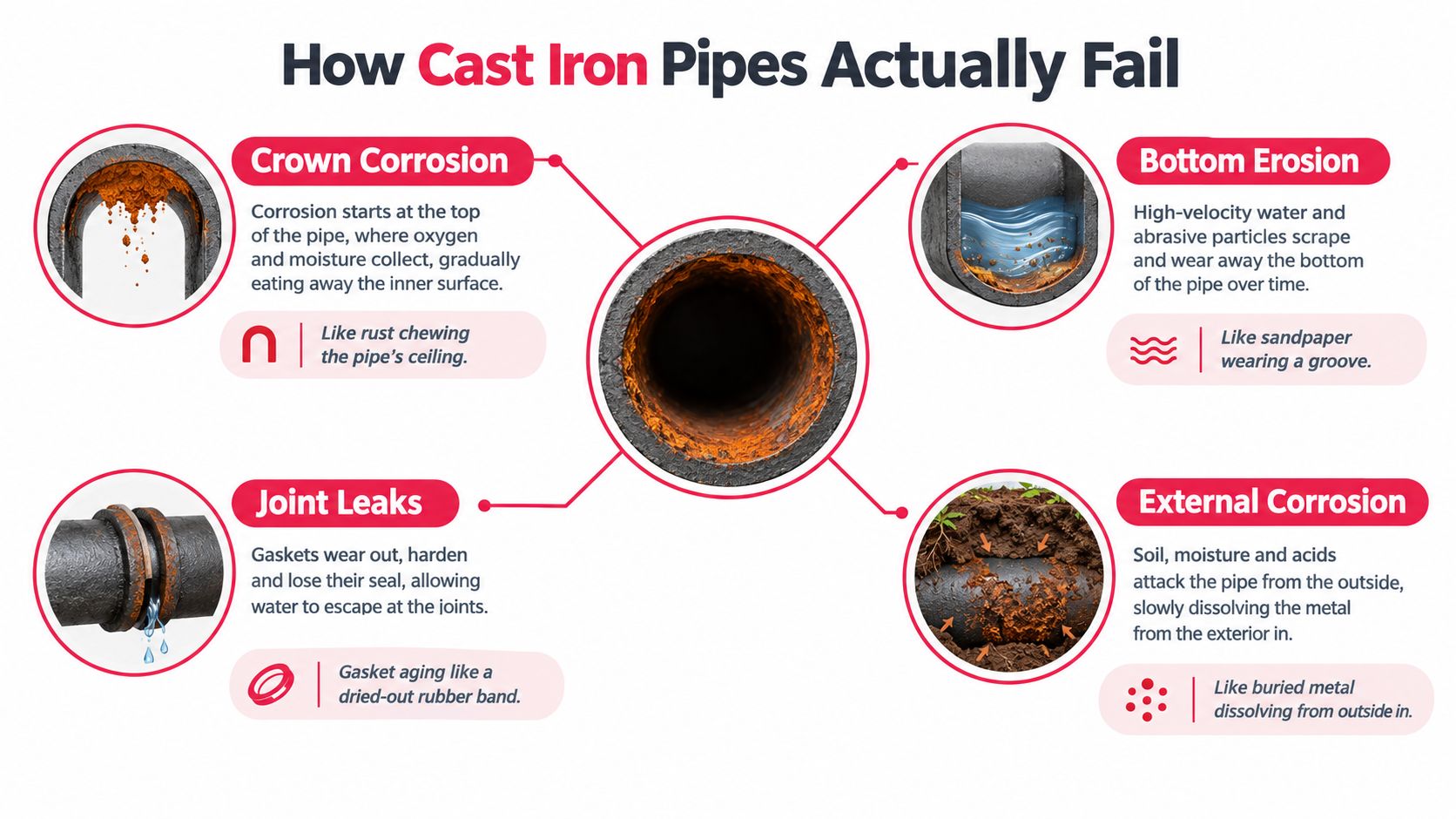
Cast iron rarely fails because one dramatic event suddenly destroys a healthy pipe. More often, the interior becomes rough, narrowed, and weak over years. By the time the homeowner sees a leak, the pipe may have been losing capacity for a long time.
Crown corrosion eats the ceiling
Crown corrosion attacks the upper inside portion of a horizontal run, where moisture and sewer gases remain above the normal flow line. A homeowner guide describes this as acidic conditions forming on moist surfaces above the wastewater, causing the upper portion to corrode faster than the submerged bottom. Explanation of crown corrosion in cast iron
The visual analogy is rust under a car. The outside may look acceptable, but the hidden underside is thinning. Inside a drain, the “ceiling” can become paper-thin while water still passes below it.
Tuberculation narrows the channel
Tuberculation is a hard, irregular buildup of corrosion products and mineral scale on the inside wall. In Southern Nevada, hard-water minerals can make an already rough pipe even less forgiving. The waste still moves, but the usable opening gets smaller and debris catches on the uneven surface.
One plumbing guide reports that internal corrosion can begin reducing flow capacity after about 25 years and may reduce capacity by around 25 percent as deposits and wall changes accumulate. Cast iron flow-capacity guidance
Channel rot removes the floor
As corrosion advances along the bottom of a horizontal run, the pipe can develop a V-shaped channel. The bottom flakes away, leaving a groove that holds waste and catches paper, grease, and sediment. Cleaning may open that groove temporarily, but it can't put the missing iron back.
A line can look open on a basic drain test yet remain structurally fragile. Repeated cabling against a severely deteriorated floor can clear the obstruction while damaging the remaining wall.
Joints and exteriors create separate problems
Lead-and-oakum joints can dry, loosen, or separate when the pipe shifts. Rubber couplings and gaskets can lose compression. Buried pipe may also corrode from the outside, especially where moisture, soil chemistry, or a leak keeps the surrounding material wet.
Las Vegas homes add practical complications. Slab movement can offset joints, while caustic drain cleaners can worsen corrosion and attack weakened areas. Hydro jetting can remove scale in a structurally sound line, but forcing high pressure through a brittle, badly corroded pipe isn't a substitute for diagnosis.
Warning Signs Las Vegas Homeowners Notice First
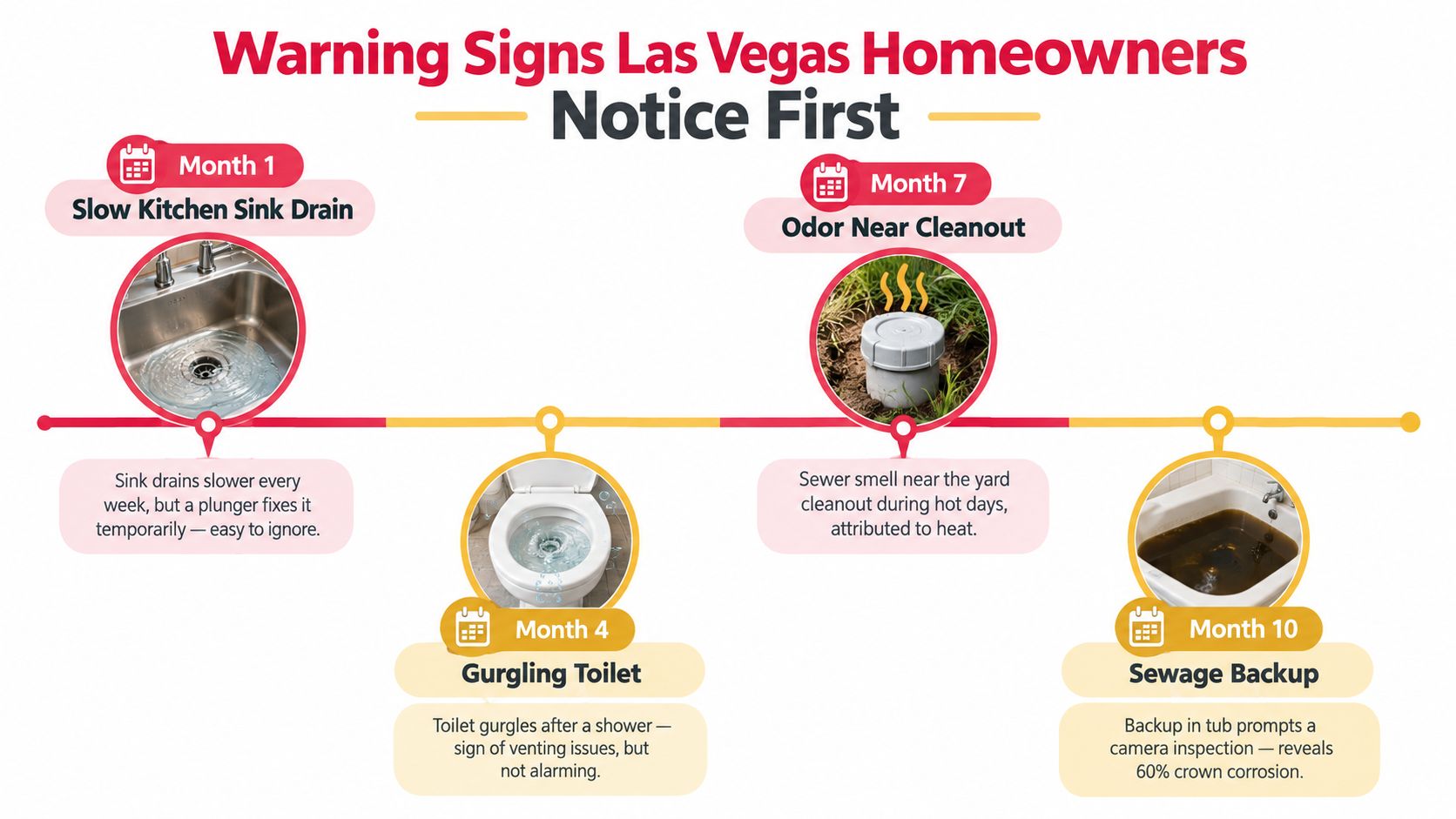
A representative Las Vegas homeowner might first notice a kitchen sink that gurgles when the dishwasher drains. The bathtub empties a little slower than it used to, but a plunger restores normal flow. A faint sewer odor near the garage cleanout appears on hot days, then disappears, so nobody treats it as a pipe problem.
Early symptoms are easy to dismiss
The first symptoms often look like isolated fixture problems:
- Gurgling kitchen sink: Air is moving through a restricted branch or shared drain path when another appliance discharges.
- Slower bathtub: Hair may be involved, but a recurring slowdown after cleaning can point to rough, narrowed pipe walls farther downstream.
- Faint sewer odor: Odor near a cleanout, garage stack, or floor drain deserves attention if it returns.
A single slow drain doesn't prove structural failure. Several fixtures changing behavior over time deserve a different response, especially in a home with older cast iron.
Recurring patterns carry more weight
Months later, the same homeowner may see a backup at the lowest fixture. Water pools near a floor drain. The toilet bubbles when the washing machine discharges. Each event gets explained away as a bad load of laundry or an ordinary clog.
The pattern over 6 to 18 months is more informative than one isolated incident. Cast iron drain failure and clog discussion Progressive scaling, crown corrosion, localized channel rot, and joint separation can reduce practical capacity before a visible leak appears.
A drain that repeatedly returns to the same symptom isn't giving you a cleaning problem. It may be showing you the weakest section of the system.
Serious signs should end the guessing
Soggy soil along the sewer route, an unexplained damp area near the slab, or a cleanout that spits wastewater when opened requires prompt professional evaluation. Multiple fixtures backing up together usually point beyond a single sink trap. Sewer odor combined with moisture is more concerning than odor alone.
Don't keep pouring chemical cleaner into an older cast iron system. It may move a blockage while leaving the corrosion, scale, or damaged joint untouched. A camera inspection can identify whether the next step is cleaning, a targeted repair, or replacement.
What a Camera Inspection Really Tells You
A sewer camera isn't a simple pass-or-fail test. It gives the technician a moving view of the pipe so the decision can follow the actual defect instead of the home's age or the most dramatic symptom.
The technician should document the usable diameter, scale thickness, cracks, channel rot, offset joints, and changes in grade. A belly or backfall matters because water and debris can remain trapped even when the pipe wall is sound. The camera also helps distinguish a removable obstruction from a structural restriction.
Access determines what gets inspected
A cleanout camera may show the building drain or the line toward the street, but it won't automatically show every branch inside the home. A roof-stack push can inspect a vertical path, though bends and branch connections may limit the view. Pulling a toilet can provide a more direct route to a bathroom branch or building drain.
That access point should appear in the report. If the camera only reached the main line, you shouldn't assume the kitchen branch or under-slab bathroom section is healthy.
For example, a 1972 home might have 80 percent of the original diameter still intact in the stack while the horizontal kitchen branch is paper-thin at the slab penetration. Those findings would support different recommendations for different sections, not a blanket conclusion about the entire system. The dates and condition figures in this example illustrate why location matters, rather than representing a customer case study.
A useful report leaves a record
Request:
- Recorded video: You should receive footage that shows the defects, not only a verbal opinion.
- Distance markers: The report should identify how far each defect is from the access point.
- Still images: Important cracks, offsets, channels, and collapsed areas should be easy to locate.
- Written segment map: The summary should separate the stack, branches, building drain, and buried sewer path.
- Repair logic: The recommendation should explain why cleaning, lining, spot repair, or replacement fits the finding.
A one-paragraph invoice saying “old cast iron, replace” isn't enough for a major decision. MG Plumbing Services' Las Vegas sewer camera inspection service uses camera and locating equipment to identify the cause and location of drain and sewer problems.
Hydro jetting can remove scale and restore flow when the remaining wall is sound. Spot repair can correct one isolated defect. Lining can create a new interior pipe where the host pipe has enough structure, while full replacement becomes more sensible when several segments show wall loss or unstable grade. The camera tells you which condition you're dealing with.
Replacement Options That Hold Up in the Las Vegas Valley
Replacement method should follow the failing section, access, grade, and remaining wall strength. A contractor who recommends the same method for every cast iron line is solving for convenience rather than for the property.
I compare four practical paths in the Las Vegas Valley. Each one works in the right setting and becomes a poor investment when the pipe condition doesn't support it.
| Method | Best Location | Typical Lifespan | Las Vegas Caveats |
|---|---|---|---|
| Open trench excavation | Under-slab branches or main lines beneath concrete additions | Qualitatively, a long-term replacement when properly installed | Concrete access, restoration, utilities, and depth can make the work disruptive |
| Trenchless pipe lining, or CIPP | Yard runs with stable grade and enough host-pipe structure | Qualitatively, a long-term rehabilitation option when correctly matched | It reduces the inside diameter and is a poor fit for severe channeling, multiple bellies, or backfall |
| Pipe bursting | Straight yard runs where full-diameter replacement is needed | Qualitatively, a long-term replacement option | Utilities, cleanouts, bends, and confined access can limit feasibility |
| ABS replacement | Interior stacks, branches, under-slab sections, and open-trench work | Qualitatively, a durable modern replacement when properly installed | The route still determines access, restoration, and code requirements |
Open trench work is often the honest answer
Under-slab kitchen branches frequently require concrete access. If the pipe has channel rot, multiple failing joints, or a belly, opening the slab lets the crew remove the compromised section and correct the grade. It is invasive, but lining a structurally weak or poorly graded pipe doesn't solve the underlying geometry.
Trenchless methods protect finished surfaces
Cured-in-place lining earns consideration when a buried yard run has stable grade and enough sound wall to support the liner. The liner occupies space inside the existing pipe, so the finished opening is smaller. That trade-off may be acceptable on a larger sewer path and unacceptable in an already narrowed branch.
Pipe bursting replaces the old path without a continuous open trench. It can make sense through suitable soil on a relatively straight run, but nearby utilities, cleanouts, bends, and access constraints can rule it out. A camera and locating process should come before a trenchless promise.
ABS works well for many residential replacements
ABS, or Acrylonitrile Butadiene Styrene, is commonly used for residential drain, waste, and vent replacement in this market. Local code requirements and the specific application determine whether ABS or PVC is allowed, so material selection should follow the approved design rather than a sales preference. MG Plumbing Services describes Las Vegas drain and sewer services that include diagnosis, cleaning, repair, and cast-iron-to-ABS replacement.
The practical decision rule is simple. Match the method to the failure pattern, pipe location, and budget, not to the equipment a contractor happens to own.
When to Repair, Replace, or Wait and Watch
The repair decision depends on the specific section that is failing, not the installation date alone. A horizontal kitchen branch, vertical stack, and buried sewer can age at different rates. In Las Vegas, hard-water scale can narrow the passage, while slab conditions make an under-slab failure more disruptive to reach. Use the camera findings, symptoms, access, and surrounding pipe condition to choose among three paths.
Replace now
Prioritize replacement when the line has channel rot, a major offset, active seepage, or several deteriorated segments. A pre-1975 home with recurring backups, moisture at the slab, or pest entry near a cleanout needs a system review rather than another routine cable cleaning. Cast iron and pre-1975 housing guidance
One defect can justify replacement when it lies in a critical under-slab section and nearby cast iron is visibly thin. A patch addresses the opening, not the brittle pipe around it. If two or more connected sections show wear, broader replacement is usually the more controlled choice.
Repair targeted sections
Spot repair fits an isolated defect in otherwise substantial pipe. Examples include one offset at a hub, a localized crack above the slab, or root intrusion at the property line when the remainder of the run remains structurally sound.
Hydro jetting belongs here only when the camera confirms that scale, grease, roots, or debris are causing the restriction. A contractor may use hydro-jetting equipment for cast iron drain cleaning to clear that material, but cleaning cannot rebuild lost pipe wall. Jetting a fragile line without confirming its condition can create a larger problem.
Wait and watch carefully
Monitoring is reasonable when the camera shows manageable scale, no backfall, no active leakage, and a stable modern ABS or PVC section. It can also suit an older stack that remains thick and functional, provided the homeowner understands that buried and horizontal sections may have a different failure outlook.
A 40 to 60-year-old stack with one slow fixture should be scoped, not ignored. If the inspection finds early wear without an immediate structural threat, budget for replacement within 2 to 5 years instead of treating the symptom as cosmetic. Those ranges describe planning conditions, not a promise for every home.
Insurance and home warranties rarely cover aging cast iron replacement as ordinary deterioration. Check the policy, then plan before a backup damages flooring or forces emergency access.
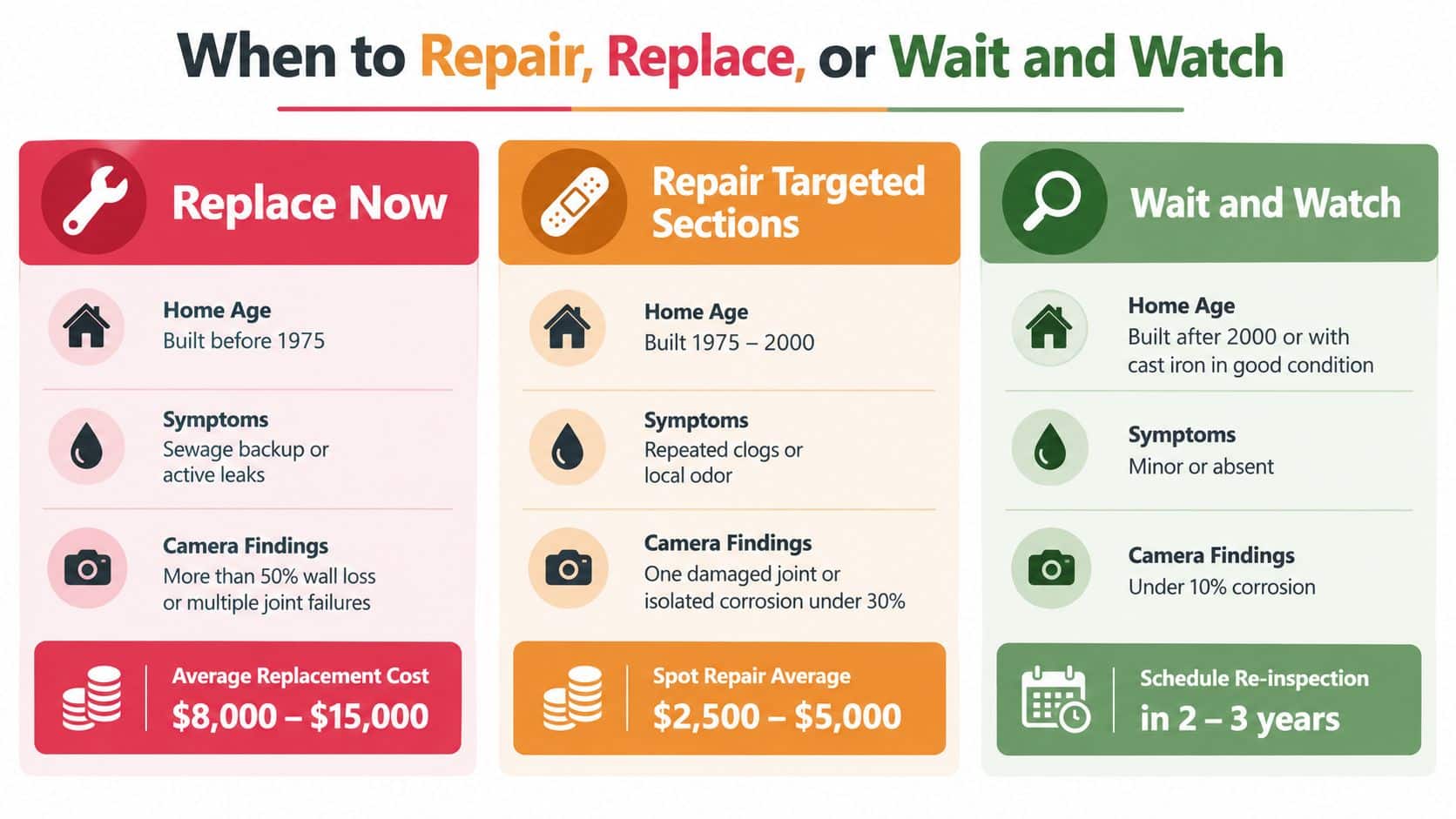
Fix the symptom when the camera shows an isolated failing section. Replace more of the system when deterioration is distributed, especially under the slab. One successful cleaning proves only that the restriction was cleared, not that the cast iron is healthy.
A Practical Plan for the Next 90 Days
A cast iron concern doesn't need to become a same-day panic, but it shouldn't remain an unanswered question. Use the next 90 days to replace assumptions with records, camera footage, and comparable scopes of work.
Days 1 to 14
Start with information you already have:
- Recover records: Look for remodel permits, prior sewer cleanings, drain-repair invoices, and any documentation showing pipe material.
- Photograph symptoms: Capture stains, standing water, cleanout discharge, floor moisture, and recurring fixture backups.
- Map the system: Note which fixture acts up, where the cleanouts sit, and whether the problem appears under the slab or toward the yard.
- Request inspections: Ask licensed contractors for camera inspections that identify the access point, distance markers, pipe material, and recorded footage.
Don't accept a recommendation based only on the home's build year. Ask the technician to separate vertical stacks, horizontal branches, the building drain, and the buried sewer.
Days 15 to 45
Review the video with the plumber. Get written scopes for the options that fit the findings, such as targeted repair, full ABS replacement, and trenchless lining where the pipe qualifies.
Make the bids comparable. Each should state the pipe segment, access method, concrete or ground restoration, permitting, connections, testing, and what happens if the camera finds another failed section. A low initial number isn't useful if it excludes the work needed to reach the defect.
A fair estimate describes the work before it describes the price.
Days 46 to 90
Choose based on four facts: pipe location, failure mode, warning pattern, and camera condition. If the line is structurally compromised, schedule the work before the next backup. If the inspection supports monitoring, record the findings and set a reinspection reminder.
For this week, take three actions:
- Stop using chemical drain cleaner on suspected cast iron.
- Gather your plumbing records and photograph any active symptoms.
- Schedule a camera inspection that includes recorded video and locating.
MG Plumbing Services LLC is a local, family-owned, owner-operated residential plumbing company serving Las Vegas, Henderson, North Las Vegas, Summerlin, and surrounding areas. The company provides drain cleaning, hydro jetting, sewer camera inspections and locating, leak detection, water heater service, sewer and drain diagnosis, and cast iron-to-ABS replacement, with Nevada-licensed C-1d contractor Miguel Garcia bringing more than 25 years of plumbing experience. Se habla español.
Call 702-480-8070 to request a sewer camera inspection, drain diagnosis, or written repair and replacement recommendation for your Las Vegas Valley home. Visit MG Plumbing Services LLC to schedule service and find out whether your specific cast iron section needs cleaning, targeted repair, monitoring, or replacement.