Most residential hydro jetting jobs in the Las Vegas Valley land between $258 and $670. A kitchen grease line starts at $320 flat. A 4-inch main sewer line starts at $534 flat. Every hydro jetting job is priced flat, and that price is shown before work starts.
Published national estimates vary widely by source and by job type. Use the national benchmark table below as the comparison point, not one nationwide average.
Clearing a line and diagnosing why it clogs are two separate purchases that often get quoted under one name. The $320 kitchen jet removes grease. Scale, roots, a belly, or a joint that has come apart can sit behind the same backup. Camera verification is an $83 add-on. I recommend it when the same drain keeps backing up: one camera pass costs less than paying for another clearing after the line fills again, and it shows whether jetting will hold or the pipe needs repair.
Grease, scale, and roots are jetting work. A separated joint is repair work. The flat rate is worth paying once when you know which problem is in the pipe.
Table of Contents
- Hydro Jetting Cost Benchmarks by Job
- What Moves a Hydro Jetting Quote Up or Down
- Reading a Written Estimate Line by Line
- Cable Cleaning Versus Hydro Jetting Costs
- When to Jet, Film or Repair the Line First
- Why Las Vegas Water Raises the Stakes
- Three Worked Cost Scenarios
- Confirm the Written Estimate Before You Book
Hydro Jetting Cost Benchmarks by Job
The national benchmark for a standard residential jetting visit is $350 to $600, averaging near $475, according to Angi's hydro jetting cost guide. Where a specific job lands inside that band depends almost entirely on which line is being cleaned, how long it runs, and how the technician gets into it.
| Job | Typical range | Basis |
|---|---|---|
| Standard residential jetting visit | $350 to $600 (average near $475) | National benchmark |
| Branch line under about 50 feet | $350 to $650 | Branch-line tier |
| Kitchen, tub or laundry branch | $350 to $550 | Published pricing breakdown |
| 2- to 3-inch residential line | $400 to $650 | Published pricing breakdown |
| 4-inch main sewer | $500 to $950 | Published pricing breakdown |
| Main building sewer, general | $600 to $1,500 | Main-sewer tier |
| Main line with heavy roots | $750 to $1,400 | Published pricing breakdown |
| Camera inspection alone | $195 to $395 | Standalone inspection |
| Camera plus jetting package | $650 to $1,200 | Combined package |
| Las Vegas rate for each job | $258 to $670 residential flat rate | Quoted in writing before work starts |
Pipeline On's published pricing breakdown divides the same territory by line type: about $350 to $550 for a branch serving a kitchen, tub or laundry area, $400 to $650 for a 2- to 3-inch residential line, $500 to $950 for a 4-inch main, and $750 to $1,400 for a main with heavy roots. It prices a standalone camera inspection at $195 to $395 and a camera-plus-jetting package at $650 to $1,200. Those camera rows sit on their own in the table because they're frequently billed apart from the cleaning. Ask which side of the line they fall on before you compare two quotes.
Locally we price these jobs flat rather than hourly: $320 for kitchen grease removal, $427 for a 3-inch drain line with setup and cleanup included, and $534 for a 4-inch main at 3,000 PSI and 4 GPM. Most residential jobs run 1 to 2.5 hours including jetting and the post-job flow check.
What Moves a Hydro Jetting Quote Up or Down
Scope splits jetting into two tiers, and Contractor Ranks' drain cleaning cost breakdown shows the seam: about $350 to $650 for a branch line shorter than roughly 50 feet, $600 to $1,500 for a main building sewer, and up to $700 to $1,800 when a camera inspection is bundled in, because the package adds diagnostic labor and equipment to the cleaning.
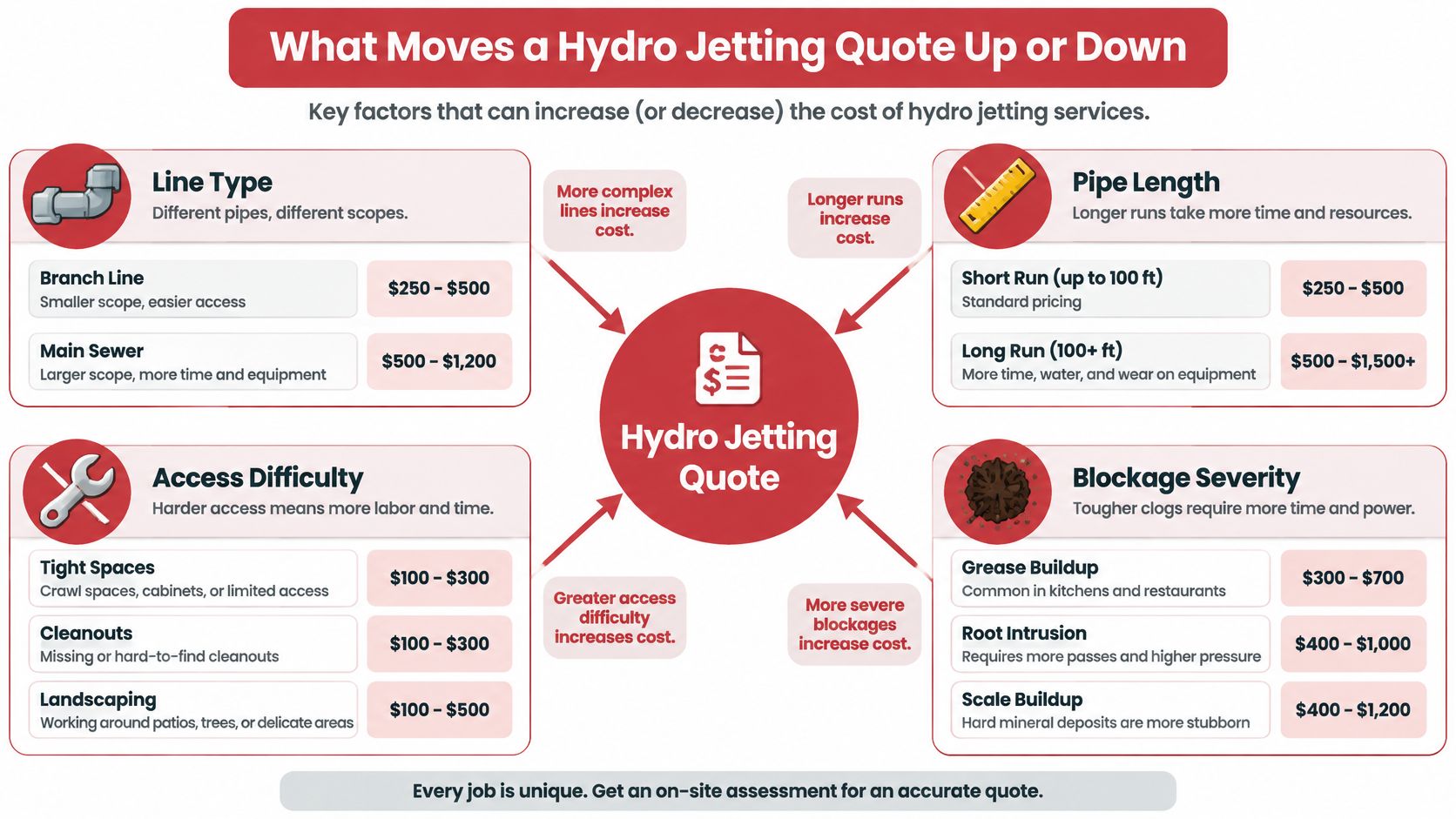
Five inputs do most of that work.
- Length and diameter. Longer runs take more time and more water. Historical EPA cost data for sewer cleaning puts pressurized cleaning at $0.44 per linear foot against $0.86 per foot for conventional rodding, with television inspection at $0.97 per foot (EPA sewer operations fact sheet). Footage drives the number more than the severity of what's on the wall.
- Access. A cleanout at the base of the stack keeps the job short. Sewer clearing is $250 with an accessible cleanout, and that price moves when the line has to be reached through a roof vent or by pulling a toilet.
- Blockage type. The nozzle changes with the filling: penetrator nozzles for roots, chain knockers for hard scale, flushing nozzles for grease. Roots add a cutter pass and a camera check behind it.
- Pipe material. Cast iron, ABS, PVC and clay take different pressures. Running PSI too high on old cast iron or clay is how a cleaning turns into a repair estimate.
- Passes and camera timing. A second pass, or a camera placed before rather than after cleaning, changes the total.
What I'd ask first: which of those five conditions your quote assumes. A figure built for a short accessible branch doesn't survive contact with a 90-foot main full of roots.
An accessible kitchen line with soft grease sits at the bottom of every range. A main with roots, a buried cleanout and a verification pass sits at the top.
Reading a Written Estimate Line by Line
The written estimate is the only part of the job you can inspect before you pay for it. A quote that says "drain cleaning" and a number tells you nothing about what happens if the jetter finds roots, if the cleanout is buried, or if the "clog" turns out to be a collapsed clay pipe.
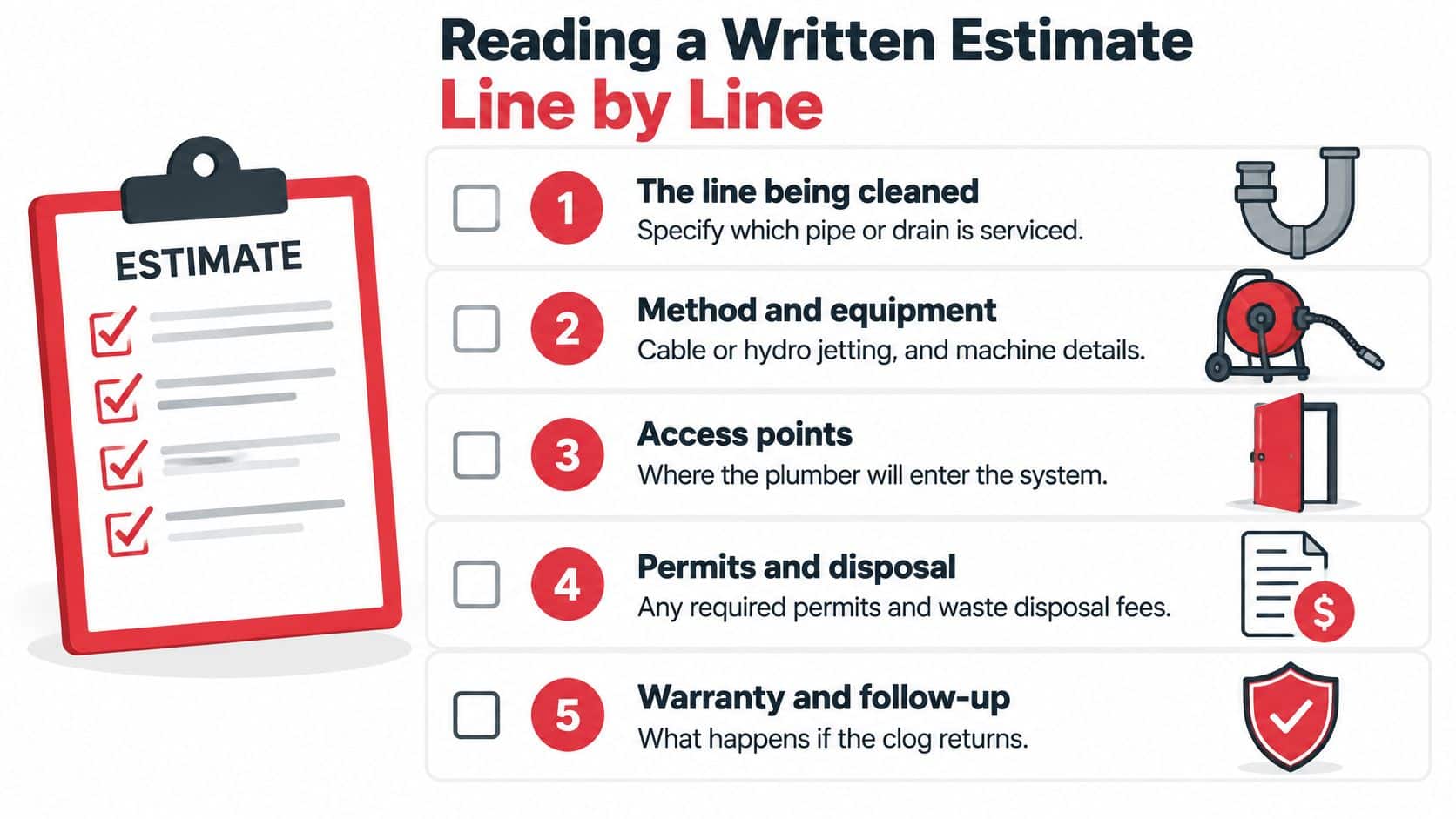
Nine items belong on it.
- The line, with length and diameter. Branch versus main and a rough footage figure set the price tier, so both should be named.
- The cleanout used for access. Where it sits and whether it's clear tells you if access labor is already inside the number.
- Camera timing. Before jetting, after, or not at all, never left implied.
- Pipe material and the pressure matched to it. Cast iron and clay don't tolerate what ABS does.
- Setup and cleanup. Jetting through an existing sewer cleanout means no digging, no trenching, no yard disturbance, and any setup charge should still be visible.
- Post-job verification. A flow check confirms the line is open, not just wet.
- Triggers for extra charges. A root cutter, a second pass, added access work.
- Whether repair is excluded. If a belly or failed joint appears, is separate authorization needed?
- After-hours surcharge. Ask even when you're booking at 10 a.m. on a Tuesday.
Our cost estimates page breaks the flat rates out by job so you can map a tier to an actual figure. A quote missing three or more of these items isn't cheaper. It's incomplete, and the missing pieces reappear on the invoice.
Cable Cleaning Versus Hydro Jetting Costs
A cable machine and a jetter are priced for different jobs. Mixing those prices is how a cheap clear turns into another backup. A cable punches a passage through the clog. Hydro jetting scours the pipe wall, lifting grease, hard water scale, root tips, and decades of debris out of cast iron that a cable slides past.
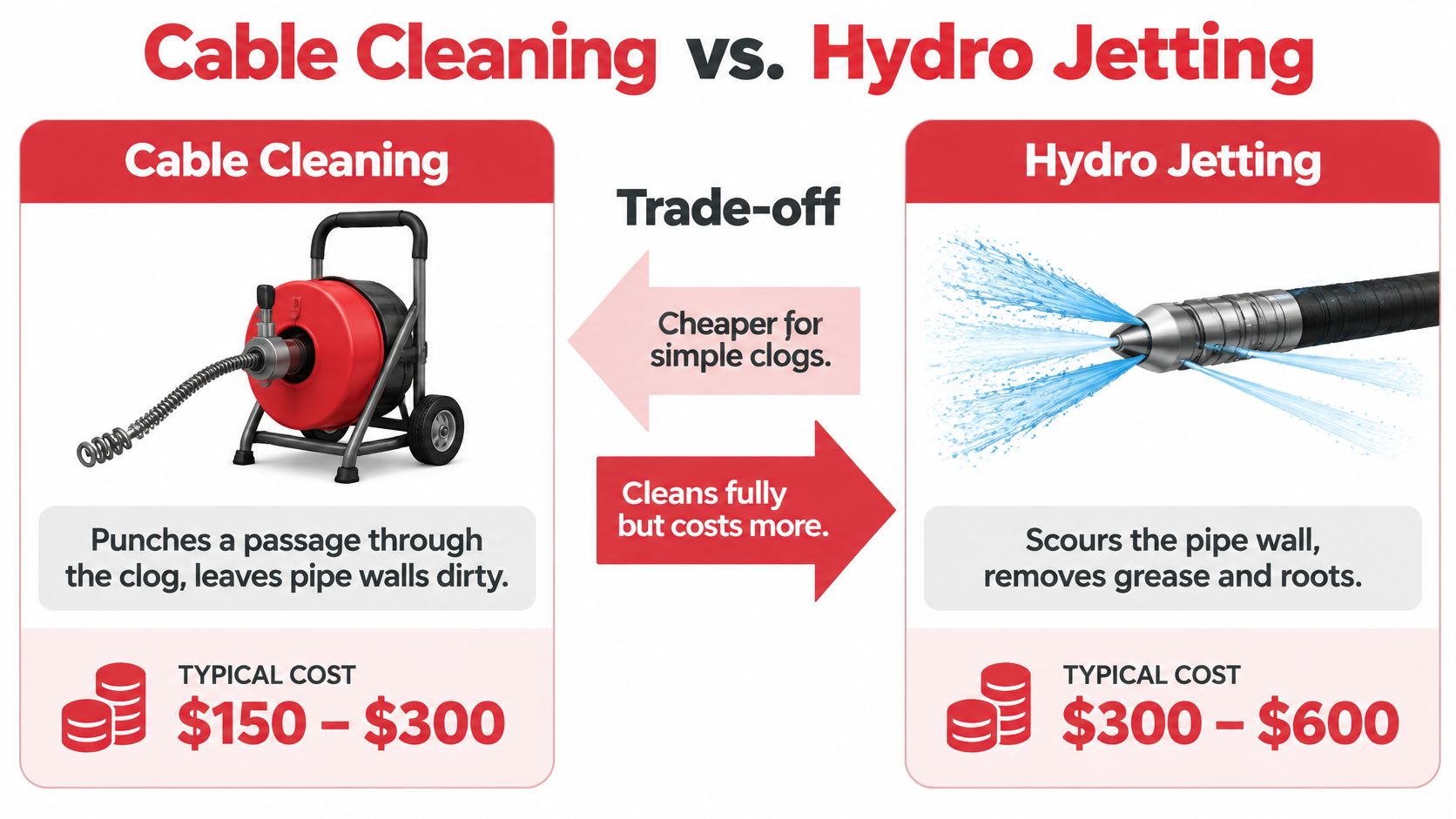
That leftover film is why a house can be "cleared" every spring and still back up every autumn. The residue never left the wall.
| Factor | Cable machine | Hydro jetting |
|---|---|---|
| What it removes | Punches a passage through the clog | Scours grease, scale and loose debris from the pipe wall |
| Typical cost | $250 with an accessible cleanout; more if access is through a roof or a toilet | $258 to $670 residential, flat rate, shown before work starts |
| Best for | A single localized clog in a sound pipe | Grease buildup, mineral scale, recurring main-line backups, heavy roots |
| Repeat risk | Higher when residue stays on the pipe wall | Lower when the pipe is sound and buildup is the cause |
| Pipe condition check | Not usually needed for a simple clog | Camera inspection recommended first; verification is an $83 add-on |
| Limit | Does not restore a damaged pipe | Does not repair a collapsed or cracked pipe |
Cable is the right call for one localized clog in a pipe that is otherwise healthy. The bill gets expensive on the return trip. Repeat cable visits add up over a year, often past one jetting price plus a camera check that shows whether grease, roots, or a bad joint is sending the backup back. Clearing the line and diagnosing why it clogs are separate charges. Paying only for the clear leaves the cause in the pipe.
Neither method repairs a pipe. On a collapsed, cracked, or bellied line, both restore flow for a while and then stop mattering. MG Plumbing Services LLC uses hydro jetting when cable cleaning is not enough, most often on grease buildup and heavy root growth, the Las Vegas drain cleaning work that recurs most in this valley.
I recommend the $83 camera verification when the same main has already backed up more than once. Opening the line without seeing the wall only buys the next service call.
When to Jet, Film or Repair the Line First
Film the line before you pay to scour it, or skip cleaning when the pipe itself has failed. That order is what keeps a hydro jetting bill from buying the same backup twice.
HomeAdvisor's unclog drain cost guide lays out the trade-off: jetting suits stubborn or recurring blockages, larger lines, grease and roots because the water stream cleans more of the pipe interior than a cable pass, but that same force can open pre-existing cracks, severe corrosion, failed joints or a deteriorated cast-iron line.
Symptom sets the sequence.
Backups that return, or several fixtures draining slowly at once, get a camera first. Roots and a damaged joint look the same as a grease clog from the fixture end. The camera is what separates them. I want that look before pressure is matched to the pipe, because a cracked or corroded wall should not take a full jet.
A sound pipe with grease or scale is a jetting job. Restoring the inside diameter is the fix, and the clog is less likely to return once the wall is clean. The hose goes in through the existing sewer cleanout. No digging, no trench, no torn-up yard.
A belly, a root-damaged joint or a collapsed section is a repair, not another cleaning. Jetting only restores flow for a while. The water still has to travel that low spot or broken joint, and pressure will not close the gap.
Sewer-line camera inspection pricing depends on access and scope, which is why the camera belongs on the estimate as a line item instead of an assumption. Camera verification after hydro jetting is an $83 add-on. That is a small charge next to a second emergency call and a wet crawlspace. Clearing and diagnosing are separate prices. Paying only for the jet, then guessing why the line filled again, is how the backup bill repeats.
The rule I use: a residential hydro jetting charge, typically $258 to $670 depending on line length, buildup severity and cleanout access, earns its money against repeat backups when the pipe is sound. It earns nothing if nobody has looked inside first.
For buyers, a pre-purchase sewer camera inspection is the lowest-cost hour in the transaction, particularly in older Las Vegas neighborhoods where cast iron drain lines under the slab are common.
Why Las Vegas Water Raises the Stakes
Hard water here doesn't stop at spotting the shower door. The Las Vegas Valley Water District reports area water at approximately 280 parts per million hardness, or about 16 grains per gallon, with another district figure of about 291 parts per million, or 17 grains per gallon, from dissolved calcium and magnesium (LVVWD water quality facts). The district classifies that as a nuisance rather than a health risk. Scale still forms on fixtures and piping, then breaks loose as white particles.
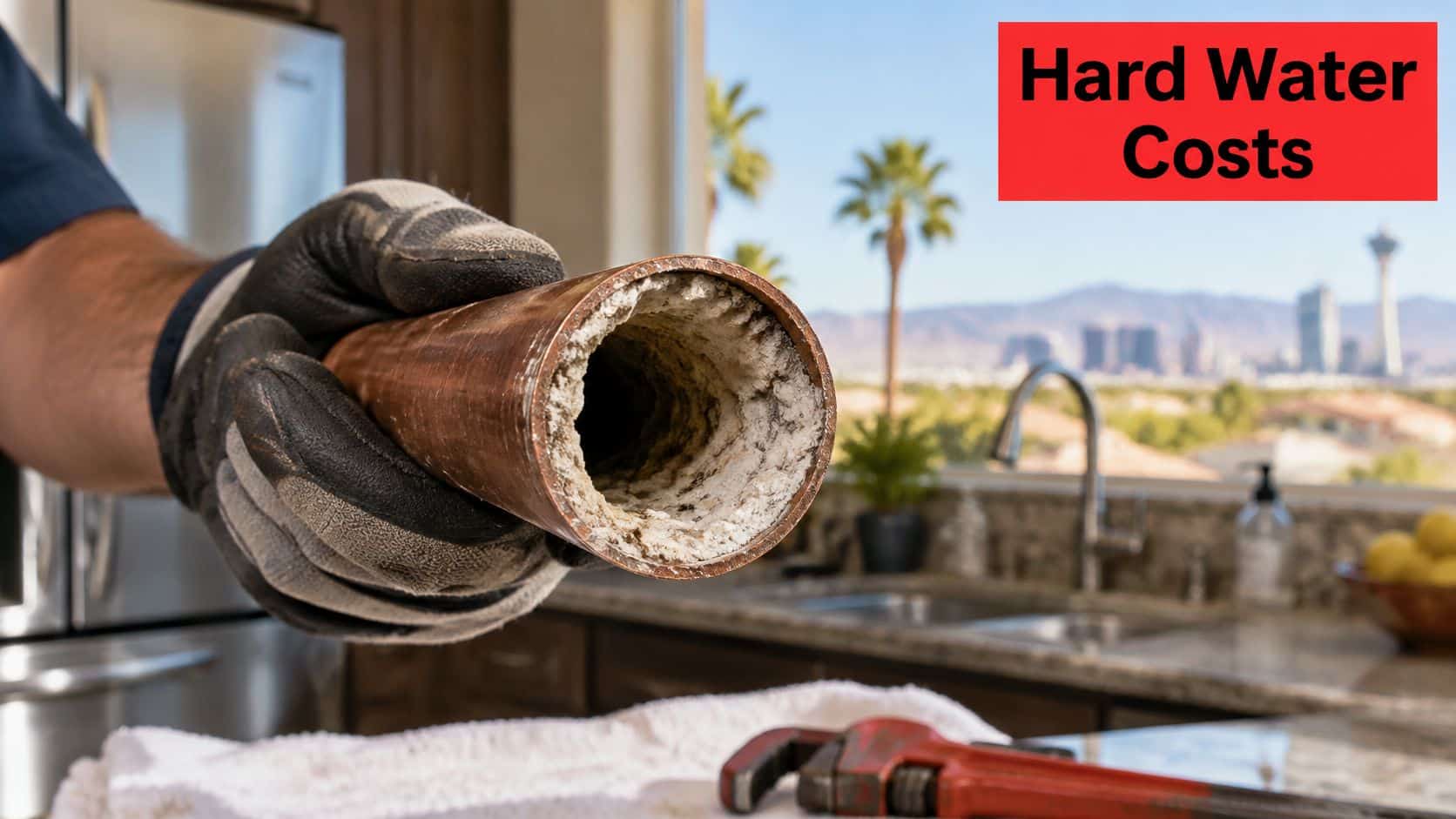
Scale narrows the opening and gives grease a surface to grip. A cable punches through the middle of that deposit. High-pressure water scours the wall, which is the right pass when mineral and grease coat a pipe that is still intact.
The nozzle starts as soon as it is in the line.
Roots at the joints, cracked clay or cast-iron laterals, a belly, and a failed section are a different problem. Cleaning restores flow while the entry point and the damaged pipe stay in place, so the backup returns.
Clearing and diagnosing are separate charges. Hydro jetting is the flat price for grease, scale, or a recurring main-line backup, and that price is shown before work starts. Camera verification is an $83 add-on. I recommend it when the same line has already backed up more than once. Another emergency visit costs more than learning the pipe is cracked or bellied, which jetting will not repair.
Landlords, HOA managers on common-area lines, and escrow coordinators get the most from before-and-after footage. The video records whether the line had grease, scale, or damage, and that record settles the argument later.
MG Plumbing Services LLC uses hydro jetting for grease, scale, and recurring main-line backups. The camera is what tells you which of those you are paying to remove.
Three Worked Cost Scenarios
Nationally, a September to November 2025 report put standard residential jetting at $475 to $700, with individual jobs ranging from $350 to $3,000 (NJ Pipe Doctor's hydro jetting cost report). That spread is the reason a flat rate, confirmed in writing, is easier to plan around than a range.
A rental kitchen with grease
Kitchen grease removal is $320 flat, and camera verification adds $83, so the visit totals $403. Excluded: a second pass and any repair if the camera finds a failed trap arm or joint. The decision point is the video. Soft grease on a sound pipe ends the job right there, and the tenant gets a working sink the same day.
A 1960s house with cast iron under the slab
Cast iron descaling runs $428 to $601 and is the longest jetting job on the list. A 3-inch line, jetted with setup and cleanup included, comes to $427. The decision point here isn't price. It's whether the camera shows scale on sound cast iron, which cleaning handles, or a channeled and cracked pipe that pressure can't fix.
A main sewer with light to moderate roots
Root work is a flat $747, and a camera inspection is strongly recommended rather than optional, because a cutter pass needs proof that the roots are gone and the pipe held. If the camera finds a broken joint, that's a separate repair quote, and it should be in writing before the jetter goes back on the truck.
Priced off the national breakdown instead of local flat rates, those same three jobs total roughly $545 to $945, $650 to $1,200 and $945 to $1,795. Same work, same order of magnitude, different market.
Confirm the Written Estimate Before You Book
A clear written estimate should identify what the price covers and what could change it. Before booking, provide the symptoms, ask whether a camera inspection is recommended, and confirm the access point and any verification or repair charges.
- Describe the symptoms. Note which fixtures drain slowly, how often backups occur, the approximate age of the house, and whether you know where the cleanout is.
- Ask whether a camera inspection is recommended. It can help distinguish a blockage that cleaning may clear from pipe damage that requires repair.
- Check the estimate line by line. Confirm the pipe size, access point, camera charges, cleanup, post-job verification, and any repair exclusions.
- Confirm the flat rate before work starts. Ask what circumstances, if any, would change the quoted price.
MG Plumbing Services LLC provides flat-rate written estimates for residential plumbing work in the Las Vegas Valley. Owner Miguel Garcia has worked in the plumbing trade since 2000. Same-day appointments are available during business hours, Monday through Saturday, and Spanish-language service is offered.
The price to clear a line and the cost to diagnose recurring backups are separate decisions. Camera verification is available as an $83 add-on for hydro jetting. Visit MG Plumbing Services LLC to request service.