For most homes, set the regulator within 50 to 70 PSI, and never allow household pressure to exceed the 80 PSI code threshold. A garden hose bibb gauge is the only reliable way to know your actual pressure before touching the regulator.
You may notice the problem while showering, running a washing machine, or hearing pipes knock after a faucet closes. Perhaps the pressure feels weak, or it surges from one fixture to another. In Las Vegas Valley homes, hard-water mineral buildup, aging components, and changing supply conditions can make the adjustment screw look like an easy answer when the actual fault is inside the valve or elsewhere in the plumbing system.
A pressure-reducing valve, or PRV, controls steady incoming water pressure before it reaches fixtures, appliances, and interior piping. The safe approach is measured and incremental. Check the pressure, make a small change, let the valve settle, and test again. If the reading won't stabilize, stop adjusting and diagnose the cause.
Table of Contents
- Finding and Understanding Your Pressure Reducing Valve
- Step-by-Step Water Pressure Regulator Adjustment Process
- When Adjustment Fails and What It Really Means
- Las Vegas Valley Plumbing Challenges and Local Code Considerations
- Calling a Licensed Plumber in the Las Vegas Valley
Finding and Understanding Your Pressure Reducing Valve
Fluctuating pressure often leads homeowners to the main water line first. That's the right place to look, but don't turn a screw until you know which component you're handling and have a pressure reading.
Locate the valve on the incoming line
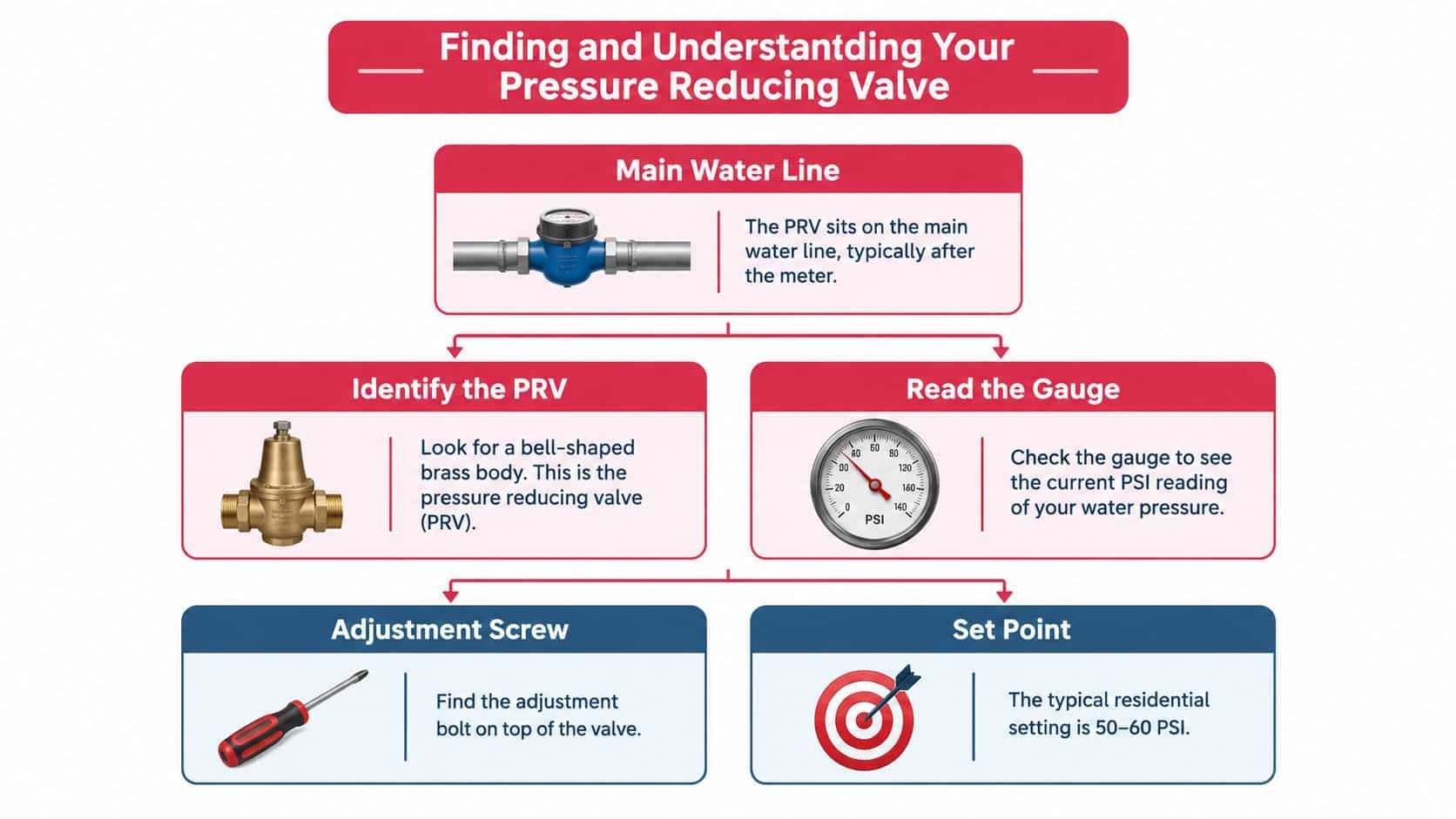
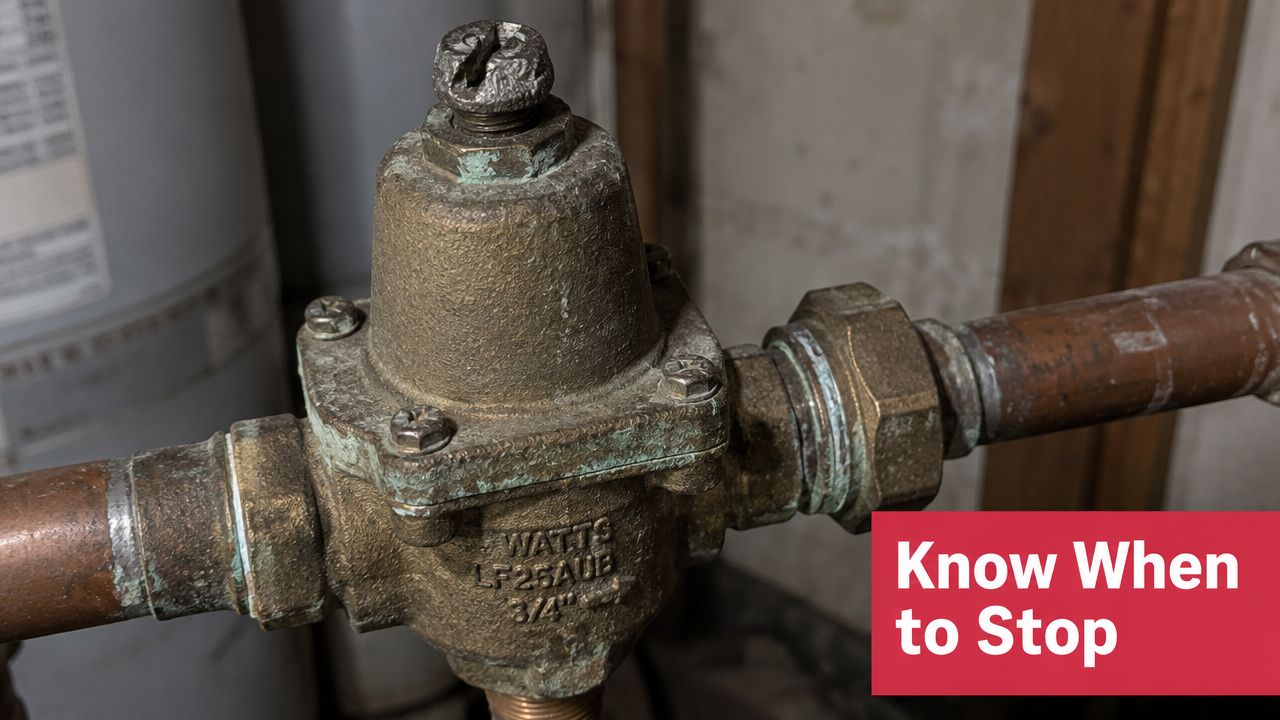
Start where the municipal water supply enters the property. The PRV is commonly installed after the water meter, near the main shutoff, or in a utility area, crawl space, basement, or exterior valve box. In many homes, it's a compact brass valve installed inline with the main water pipe.
A globe-style PRV usually has a rounded or bell-shaped body. Look for a bonnet on top, a threaded adjustment screw or bolt, and a locknut that holds the setting in place. Some valves have a factory label or an arrow showing the direction of water flow. Don't confuse the PRV with the main shutoff valve. The shutoff opens or closes the supply, while the regulator reduces pressure continuously.
If the valve is buried, corroded, difficult to reach, or installed close to electrical equipment, don't force access. A problem with the main water line installation can involve more than regulator adjustment.
Understand the pressure target
The familiar residential code rule is straightforward. When static municipal pressure exceeds 80 PSI, an approved pressure-reducing valve is required, and the building distribution pressure must be reduced to 80 PSI or less, as summarized by residential PRV code guidance.
Many residential regulators arrive factory-set near 50 PSI and commonly adjust within a 25 to 75 PSI range, according to manufacturer and supplier regulator information. Most homes work well in a moderate range rather than at the highest available setting. The correct target depends on fixture performance, appliance protection, building height, and the condition of the piping.
Safety rule: Pressure you can “feel” at a faucet isn't a measurement. Install a gauge first, and treat any reading above 80 PSI as a reason to stop experimenting and investigate the PRV.
Step-by-Step Water Pressure Regulator Adjustment Process
A safe adjustment is a controlled test, not a blind clockwise turn. You'll need an adjustable wrench, a screwdriver or socket that fits the adjustment screw, and a hose-bibb pressure gauge. A gauge that screws onto an exterior spigot gives you a direct downstream reading.
Establish the baseline
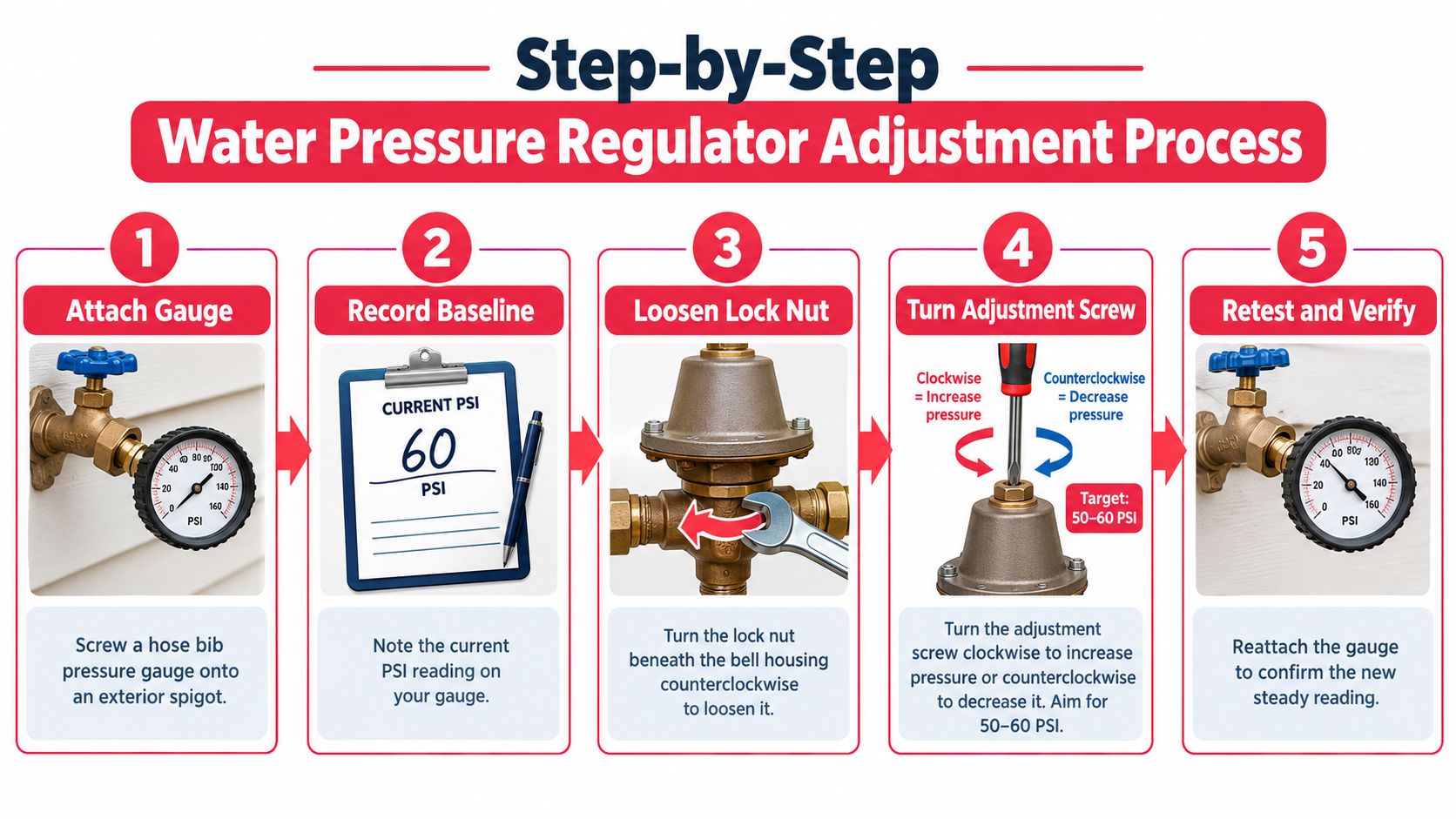
Close faucets, stop water-using appliances, and make sure nobody is drawing water inside the house. Screw the gauge onto an exterior hose bibb, preferably one supplied after the regulator. Open the bibb fully and record the static pressure.
If the gauge is above 80 PSI, don't try to increase anything. The code threshold exists because excessive pressure stresses fixtures, valves, appliances, and connections. If pressure is low, record that reading before assuming the regulator is the culprit. A low reading can reflect a restricted supply, a partially closed shutoff, a leak, or a regulator that has reached the end of its useful adjustment range.
Make small changes
Find the locknut below or around the top adjustment screw. Hold the screw steady while loosening the locknut carefully. You don't need to remove it. On common residential designs, turn the adjustment screw clockwise to raise pressure and counterclockwise to lower pressure.
Use quarter-turns. After each change, briefly open a nearby faucet, then close it. This cycles the downstream pressure and allows the regulator's spring and diaphragm to settle before you read the gauge again. Expert adjustment guidance recommends small increments and no more than one full revolution before checking the result, as explained in the PRV adjustment workflow from Aalberts IPS.
| Observation | Sensible response |
|---|---|
| Pressure rises gradually after a small clockwise turn | Continue cautiously, then retest |
| Pressure drops after a counterclockwise turn | Continue only until the desired range is reached |
| The gauge barely changes | Stop and consider debris, a worn valve, or insufficient supply |
| The reading jumps or fluctuates | Stop adjusting and investigate the regulator or system |
Verify and secure the setting
For many residences, a target around 50 to 60 PSI provides a practical balance between usable flow and component protection. Broader guidance treats 50 to 70 PSI as a normal residential target, as described by water pressure regulator guidance from Angi.
Once the gauge shows a stable setting, tighten the locknut without turning the adjustment screw. Cycle a faucet again, wait for the pressure to settle, and confirm the reading. Then check exposed joints, the regulator body, hose bibbs, water heater connections, and fixtures for leaks. If you can't get a stable reading, the adjustment process has already provided useful diagnostic information. The valve may not be responding mechanically.
When Adjustment Fails and What It Really Means
Turning the screw only changes the spring force acting on the regulator diaphragm. It can't remove mineral scale from the seat, repair a torn diaphragm, open a restricted main line, or restore a failing water supply. When the gauge ignores careful adjustments, the result is a clue, not an invitation to turn harder.
Separate a setting problem from a valve problem
A healthy regulator usually responds predictably to small changes. Pressure should move in the intended direction, settle after a fixture is cycled, and remain reasonably stable. If the gauge swings repeatedly, pressure changes without a corresponding screw movement, or the reading creeps upward after water use stops, the internal seat, spring, or diaphragm may be worn.
Hard-water deposits can also interfere with the seat. Mineral debris may prevent the valve from closing correctly, restrict flow through the body, or make the adjustment feel stiff. In that situation, repeated turning won't clean the passage. It can damage the adjustment mechanism or leave the home with an unsafe setting.
Diagnostic rule: If the valve won't hold a stable downstream pressure, treat it as a component problem until testing proves otherwise.
Recognize supply-side restrictions
Consistently low pressure throughout the home points to a different set of possibilities. The main shutoff may not be fully open, the incoming line may be restricted, a concealed leak may be diverting flow, or the municipal supply may be inadequate at that moment. A PRV can't create pressure that isn't available upstream.
Pressure that falls sharply when several fixtures run can also indicate a flow restriction or undersized, deteriorated piping rather than a simple setpoint issue. If nearby homes have the same problem, the cause may sit outside your property. If only one fixture is affected, inspect its aerator, cartridge, supply stop, or local piping before changing the main regulator.
A useful test is to compare static pressure with pressure while water is flowing. A normal static reading followed by a severe drop under flow suggests restriction or inadequate volume. If you see water around the valve, the main line, or an interior wall, stop using the adjustment as a workaround and arrange professional water leak detection.
Las Vegas Valley Plumbing Challenges and Local Code Considerations
Las Vegas Valley homes deal with pressure conditions that generic adjustment guides often overlook. Hard water can leave mineral deposits on internal regulator components, faucet cartridges, water heater parts, and shutoff valves. When a PRV becomes restricted by scale, the symptom may look like low pressure, but raising the setpoint won't restore the lost passage area.
Local soil and infrastructure conditions matter too. Expansive soils can stress underground piping and service connections, while aging components may develop leaks or restrictions. A pressure complaint that appears after yard work, a repair, or a seasonal change deserves a system check rather than an automatic regulator adjustment.
Apply the code threshold to local conditions
The 80 PSI limit is the critical safety boundary. If static pressure entering the home exceeds that threshold, the system needs approved pressure reduction, and the downstream distribution pressure must remain at or below it. A home can still have poor fixture performance below that limit, but increasing pressure to make one shower feel stronger can increase stress elsewhere.
A moderate setting commonly protects fixtures while preserving usable flow. Product data shows that PRVs may have broader adjustment ranges, including models advertised around 15 to 90 PSI, so the available screw range isn't the same thing as the correct household setting. The right result comes from measuring the whole system, considering the plumbing condition, and confirming that the pressure remains stable.
Water hammer needs separate diagnosis. A pressure regulator controls steady-state pressure, while a water hammer arrestor absorbs shock when flow stops suddenly. Those devices solve different problems, as reflected in water hammer arrestor product specifications. Turning a PRV won't correct a transient banging noise caused by rapid valve closure.
Choose qualified work
For PRV replacement, piping changes, or work that affects the main supply, verify that the contractor is properly licensed and insured. In Nevada, a C-1d plumbing contractor credential is directly relevant to residential plumbing work. Ask for a written scope, the planned pressure test, the proposed replacement or adjustment, and an explanation of why the component is being changed.
That approach is especially useful for older homes in Las Vegas, Henderson, North Las Vegas, and Summerlin, where a regulator may be only one part of a larger pressure problem.
Calling a Licensed Plumber in the Las Vegas Valley
DIY adjustment is reasonable when the valve is accessible, the gauge is accurate, the pressure responds normally, and no leak or electrical hazard is present. It isn't a good DIY project when the regulator is seized, buried, leaking, badly corroded, or connected to piping you can't isolate safely.
Call for professional diagnosis if the gauge reads above 80 PSI, pressure fluctuates after careful adjustment, the regulator body leaks, or pressure disappears completely. Those symptoms can indicate a failing valve, a supply restriction, a concealed leak, or a problem with the main line. Continuing to turn the screw can conceal the fault while increasing the chance of fixture or piping damage.
MG Plumbing Services LLC is a local, family-owned and owner-operated residential plumbing company serving Las Vegas, Henderson, North Las Vegas, Summerlin, and surrounding areas of the Las Vegas Valley. Owner Miguel Garcia is a Nevada-licensed C-1d plumbing contractor and journeyman plumber with more than 25 years of plumbing experience. The company is licensed and insured, provides flat-rate written estimates, and focuses on professional diagnosis, straightforward recommendations, honest pricing, and quality workmanship.
Its residential work includes pressure problems, PRV service, leak detection, water heaters, fixtures, shutoff valves, water piping, drain cleaning, hydro jetting, sewer camera inspections, locating, and general plumbing repairs. Professional equipment helps distinguish a regulator issue from hard-water buildup, a concealed leak, or a main-line restriction.
For homeowners who need a prompt evaluation during business hours, same-day plumbing service in Las Vegas can be a practical option. Se habla español.
A gauge reading is more useful than a guess, and a stable result matters more than a temporary increase at one faucet.
If your pressure remains high, low, or unstable after measurement and small adjustments, call 702-480-8070 for a diagnosis rather than continuing to turn the regulator.
MG Plumbing Services LLC can test household pressure, diagnose whether the PRV needs adjustment or replacement, and investigate leaks, restrictions, and water-line problems across the Las Vegas Valley. Visit MG Plumbing Services LLC to request service, receive a flat-rate written estimate, and get straightforward plumbing recommendations.