

Your bill climbed, nobody changed how the house runs, and there's no puddle to blame. Maybe one spot on the tile feels warm, or you hear water when every faucet's off. That's the moment most Las Vegas homeowners start guessing, and guessing leads to opened walls in the wrong place. I wouldn't start there. Learning how to find a hidden water leak starts with proof first, then isolation, then location. You can get that proof in one afternoon with your meter, a notebook, and some discipline about what stays off.
Table of Contents
- Run a Meter Test to Confirm a Hidden Leak
- How Much Water Small Leaks Really Waste
- Warning Signs That Point to Where a Leak Is Hiding
- Rule Out False Readings Before You Test Fixtures
- Telling Mineral Scale From a Slab Leak in Las Vegas
- Safe First Actions When Water Is Spreading
- When to Call a Licensed Plumber
Run a Meter Test to Confirm a Hidden Leak
The meter settles the question faster than any stain or hunch. It measures every gallon entering your home, including water you never see. Run the test cleanly and you'll know whether you're chasing a real leak or a normal cycle you forgot about.
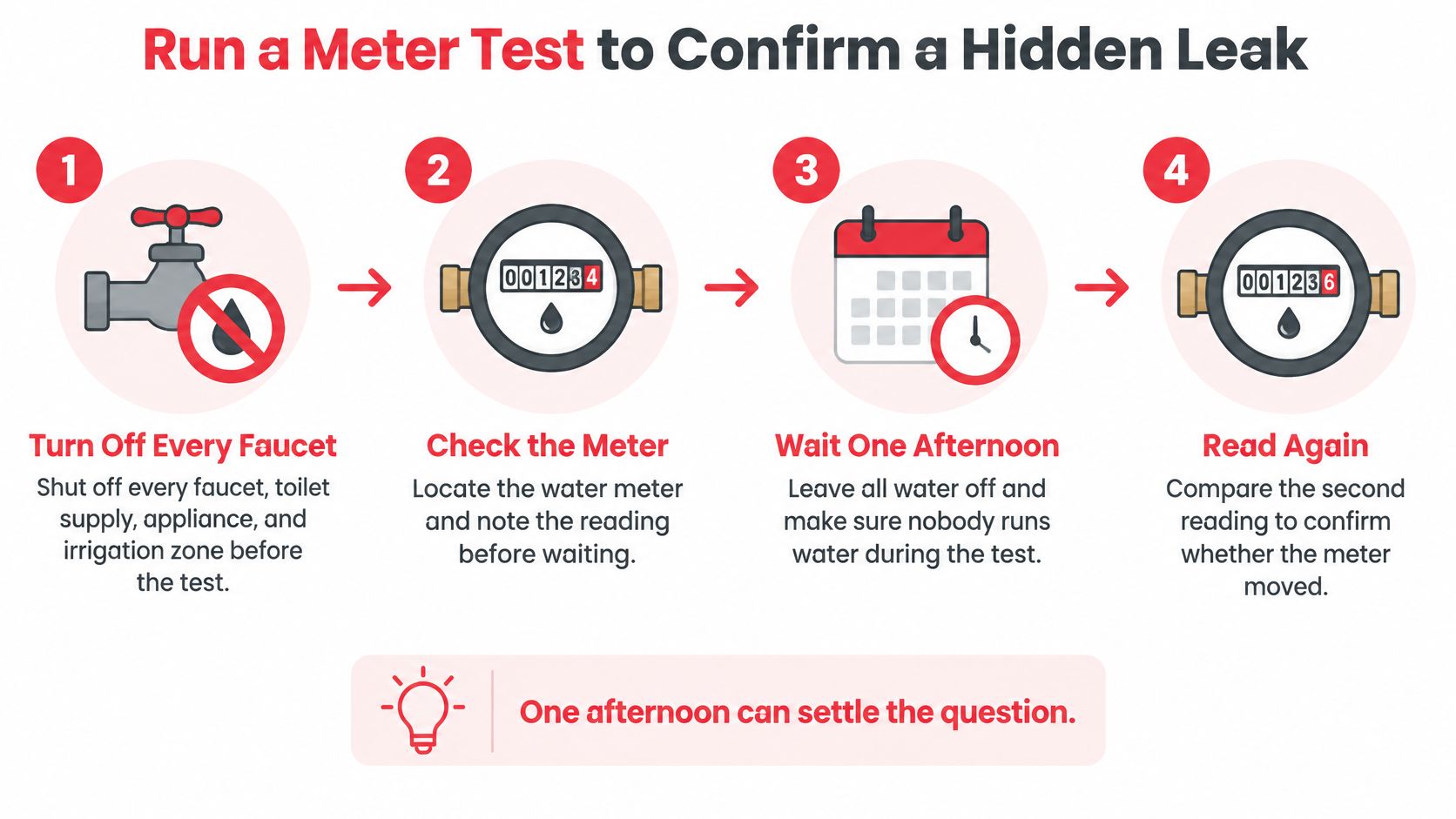
The Six-Step Sequence
- Turn everything off. Close every faucet and toilet supply, pause the washer and dishwasher, and shut off every irrigation zone. Nobody in the house can run water during the test, because one flush invalidates the reading.
- Find and record the meter. In most Las Vegas homes it's at the curb or in a yard box. Write down the full reading, the time, and the position of the low-flow leak indicator if your meter has one. That small dial or triangle moves on losses too slow to change the main numbers quickly.
- Wait about two hours. Leave all water off for the full window. A short check misses slow seepage, and a longer controlled window lets equipment cycles finish so they don't confuse the result.
- Read the meter again. If the reading moved and nobody used water, you most likely have an active leak. Note exactly how much it moved, not just that it moved, because the rate helps separate a dripping fixture from a pressurized line losing water continuously.
- Interpret a still meter carefully. If it didn't move, the leak may be intermittent or there may be no leak at all. Compare your current bill with the same month last year before assuming a problem, since summer irrigation alone can make a recent month look alarming.
- Close the home's main shutoff and retest. If you're still unsure, shut the main where water enters the house and watch the meter once more. Movement with the main closed points to the buried service line between the meter and the house. A stopped meter points indoors.
Why the Details Matter
Don't rush step one. Ice makers refill, softeners regenerate, and pool equipment tops off on its own schedule. If you don't account for those cycles, you'll record normal use and call it a leak. That's also why I want the low-flow indicator noted at both readings. A main dial can look unchanged while that small indicator creeps.
Photograph both readings with your phone so the timestamps are saved. Write down which valves you closed, too. If you end up calling a plumber, that record saves the first half hour of the visit.
Practical rule: A confirmed result is a steady, unexplained rise while everything in the home is verifiably off. Anything less is a candidate, not a conclusion.
Treat any movement as unproven until you've ruled out softeners, ice makers, toilet refills, irrigation controllers, and pool equipment. A moving meter tells you water went somewhere. It doesn't yet tell you a pipe failed.
How Much Water Small Leaks Really Waste
Annual water loss by common leak source
| Leak source | Typical flow or size | Estimated water loss |
|---|---|---|
| Faucet dripping once per second | One drip per second | More than 3,000 gallons per year |
| Showerhead leaking | 10 drips per minute | Over 500 gallons per year |
| Irrigation leak | Hole about 1/32 inch wide | About 6,300 gallons per month |
| Average household, all leaks | Combined fixture and valve leaks | Nearly 10,000 gallons per year |
The EPA Fix a Leak guidance reports that the average household's leaks waste nearly 10,000 gallons of water per year and may increase the water bill by about 10 percent. The same guidance notes a faucet dripping once per second can waste more than 3,000 gallons annually. The EPA Fix a Leak Week page adds that about 9% of U.S. homes are estimated to have leaks wasting 50 gallons or more per day.
Reading Your Own Result Against the Table
Visible size doesn't predict cost. Duration and pressure do. A faucet drip looks trivial, but it never sleeps, so one drip per second passes thousands of gallons in a year. A showerhead at 10 drips per minute is slower, so its annual loss lands much lower, even though both look like minor annoyances in the moment.
The irrigation row is the warning. A hole roughly the thickness of a dime outdoors can waste in one month what a dripping faucet wastes in two years. Outdoor lines run at full pressure, often unnoticed, and desert landscaping hides the evidence well.
Use your meter result this way:
- Convert your test loss: Multiply the gallons lost during your two-hour window out to a day, then a month.
- Match the row: A small daily figure fits a fixture drip. A large one fits continuous flow or irrigation.
- Check the usual sources first: Leaking valves, poor hot and cold supply connections, and irrigation components are frequent culprits, so inspect those before assuming a buried failure.
If your projected loss matches the irrigation or continuous-flow range, don't schedule it for someday. Act today. A slow faucet drip can wait for a planned repair. A pressurized line losing water around the clock can't.
Warning Signs That Point to Where a Leak Is Hiding
A higher bill compared with the same month last year is a useful flag, not proof. Seasonal irrigation raises usage on its own. The physical signs are more specific, and each one points to a different first check.
Damp or discolored walls, a musty smell, and bubbling paint suggest water inside a wall cavity. A warm spot on tile or wood can mean a hot water line is leaking under the slab. Running-water sounds with everything off, or one patch of yard growing unusually well, point toward a buried line.
Where hidden leaks show up and where to check first
| Location | Signs to notice | Check first |
|---|---|---|
| Under a slab | Warm spots on floor, damp flooring, unexplained bill increase | Hot water line near the water heater and slab-level flooring |
| Inside a wall | Damp or discolored drywall, mold odor, bubbling paint | Wall near supply lines, water heater and fixtures on that wall |
| Water heater area | Drip or puddle at the pan, rust staining, rising humidity | Pan, valves and connections on the heater |
| Yard or service line | Soggy or unusually green lawn patch, low pressure, meter moves with everything off | Outdoor meter box and irrigation zones |
Check around the water heater for a drip, rust staining, or a wet pan, and if those signs are present, review your options for water heater repair in Las Vegas before the unit fails completely. Run a hand along baseboards in the room with the warm spot. Carry the matched row into your fixture checks.
Rule Out False Readings Before You Test Fixtures
A moving meter doesn't always mean a broken pipe. That's the assumption that sends homeowners into walls they didn't need to open. Several systems in a Las Vegas home use water on their own schedule, and each one can fake a leak.
Equipment That Mimics a Leak
- Water softeners: A regeneration cycle draws and discharges water without anyone touching a faucet.
- Refrigerator ice makers: The fill valve opens briefly to refill the tray.
- Toilet tanks: A tank can top itself off after a flush or through a slow internal seep.
- Irrigation controllers: A programmed zone can start while you're watching the meter.
- Automatic pool equipment: Auto-fill valves add water as evaporation lowers the level.
Let each cycle finish completely, then repeat the meter test. If the meter stops moving once a cycle ends, you've found your answer and it isn't a pipe. If it keeps moving, start isolating fixtures.
The Toilet Test Worth Doing First
Toilets are the most common silent leak in the house. The EPA leak-free homes technical sheet describes placing a few drops of food coloring in the toilet tank, waiting 10 minutes without flushing, and checking the bowl. Color in the bowl confirms water is passing through the flapper or another internal seal, and the EPA lists worn toilet flappers among the common household leak sources.
Test every toilet, not just the one you suspect. A flapper costs little and takes minutes to replace. Retest the meter afterward to confirm the movement stopped.
A toilet can leak all day without making a sound. The dye test catches what your ears won't.
Fixtures and Irrigation Zones
Check faucets and showerheads for steady drips. Under each sink, inspect the hot and cold connections and shutoff valves with a dry hand or a paper towel, since a slow seep shows as dampness before it drips. Close fixture shutoffs one at a time while watching the meter to isolate which branch is moving it.
For irrigation, run each zone separately. Watch the meter during each run and inspect valve boxes for standing water between cycles. A box that's wet when the zone hasn't run points to a valve that isn't sealing.
If a fixture or cycle explains the movement, fix it and retest. If nothing explains it with everything off, stop testing on your own. At that point the leak is likely in a concealed line you can't reach safely, and further guessing only adds damage.
Telling Mineral Scale From a Slab Leak in Las Vegas
The Southern Nevada Water Authority water quality facts put Southern Nevada's water at approximately 280 parts per million of hardness, equivalent to 16 grains per gallon, and categorize it as very hard. The principal minerals are calcium and magnesium carried from the mineral-rich Colorado River, and dislodged white particles can be mineral deposits or scale formed inside piping or fixtures.

That hardness creates a common mix-up. Scale shows as white crust on aerators and showerheads, reduced flow at one fixture, or white particles in the water. It doesn't move your meter with everything off. A slab leak does, and it usually adds warm or damp floor spots, a climbing hot water bill, or a sudden pressure drop.
Mineral scale versus active leak
| Observation | Mineral scale | Active leak |
|---|---|---|
| White crust on fixtures | Yes | No |
| Meter moves with all water off | No | Yes |
| Warm or damp floor spots | No | Yes |
| Reduced flow at one fixture | Yes | Possible |
| Rising hot water bill | No | Yes |
Expansive soils, aging copper, and pinhole failures are common concerns in the valley, so slab leaks deserve a faster response than scale. Don't dig, drill, or cut into a slab yourself. Sketch the suspected hot line path from the water heater, record meter readings, and take dated photos of any staining for the plumber.
Safe First Actions When Water Is Spreading
Find your main shutoff before you ever need it. Test that it closes fully and label it so anyone in the house can find it under stress. When water is actively spreading, work in this order:
- Close the main shutoff at the meter or where the line enters the home. Stopping supply pressure stops the damage from growing.
- Make the water heater safe. Switch off power to an electric heater at the breaker, or set a gas heater to pilot or off as its label directs, before touching it. A drained electric tank can burn out its elements.
- Clear the wet area. Move rugs, furniture, and electronics out. Don't step into standing water near outlets or electrical equipment.
- Contain and document. Set towels or buckets under active drips and photograph the damage with date and time visible in your records.
- Use the local valve for one fixture. If a single sink or toilet is the source, close its supply valve instead of shutting down the whole house.
- Don't open anything up. Skip digging, drilling, cutting, or removing drywall and flooring before a locating visit. Demolition before diagnosis usually removes the wrong section.
Keep the main closed until a plumber confirms the repair. If you need help the same day, our same-day plumber service in Las Vegas covers urgent shutoff and diagnosis visits. Reopen the main slowly afterward and watch the meter and pressure for any sign of a remaining loss.
When to Call a Licensed Plumber
A meter that continues to move after all water use and automatic cycles have stopped points to a leak that needs professional diagnosis. The same applies when you find persistent dampness or unexplained staining. Once fixtures and appliances have been ruled out, further DIY testing is unlikely to pinpoint a hidden line.
Before calling, gather your meter readings and the times you took them. Photos of staining or wet areas, a list of fixtures and cycles you checked, and a simple sketch showing where symptoms appear can help focus the inspection.
MG Plumbing Services LLC follows four steps: confirm the leak, isolate the line, pinpoint it with tracer gas, then report and repair. Tracer gas can locate a leak within roughly a 3-foot area, helping avoid unnecessary demolition. Same-day appointments are available for water leak detection. If the inspection finds a failed buried line, the company also handles main water line replacement in Las Vegas.
MG Plumbing Services LLC is a licensed, owner-operated residential plumbing company serving Las Vegas, Henderson, North Las Vegas, Summerlin, and surrounding areas. Owner Miguel Garcia is a Nevada-licensed C-1d plumbing contractor who has been in the trade since 2000. The company serves residential customers and is not a 24/7 emergency service. Call 702-480-8070 or visit mgplumbingservices.com. Se habla español.
If your meter test confirms a leak that you cannot trace to a fixture, MG Plumbing Services LLC uses tracer gas, acoustic equipment, and thermal imaging to locate hidden leaks. Call 702-480-8070 to request a same-day leak detection appointment in English or Spanish. Bring your meter readings to help guide the inspection.