
The water is up around your ankles, you've already stood there a minute waiting, and the drain is doing that slow swirl that never quite finishes. Most nights you step out and forget it. Tonight the water sits longer than it did last week, and that's the point where a slow bathtub drain stops being an annoyance and starts being a symptom.
Nearly every slow tub in the Las Vegas Valley comes down to the same three things: hair packed into the waste and overflow, soap scum and body oil coating the linkage, and calcium scale narrowing the pipe after years of hard water running through it. The order of work matters more than the tool. Clear the stopper, test the flow, plunge with a real seal, then snake.
One exception sits ahead of all of it. If someone already poured a chemical drain opener into the tub, your first job isn't the clog. It's what's now sitting in the trap.
Table of Contents
- Match Your Symptoms to the Likely Cause
- What to Do If Chemical Drain Cleaner Was Already Used
- How to Clear Hair and Debris from the Stopper
- How to Plunge and Snake the Tub Drain Safely
- How to Test Whether the Drain Is Truly Clear
- Signs the Blockage Is Past the Tub
- Decide When to Call a Licensed Plumber
Match Your Symptoms to the Likely Cause
Is the tub the only fixture that's slow? That one question decides almost everything about how to fix a slow bathtub drain. If water backs up in the tub and nowhere else, and you can see a mat of hair on the stopper, you're dealing with a fixture-level clog sitting at the drain opening or in the waste and overflow assembly. Pull it out and you're done.
If the tub drains acceptably on its own but gurgles when the sink or the toilet empties, the restriction is farther in, at the tub trap or in the branch line those fixtures share. Gurgling is air being pulled through water that can't move fast enough, and it's the sound of a partial blockage past the fixture.
Hard water leaves a different kind of clog
The U.S. Geological Survey explains that hard water causes mineral buildup in plumbing and fixtures, and that heating hard water lets calcium carbonate deposits form that can clog pipes and reduce plumbing performance. In a bathtub, that scale gathers around the drain opening, on the stopper assembly, and inside the trap and branch drain, narrowing the passage wastewater has to travel through. A chalky white crust at the drain, or a tub that slows again a few weeks after a thorough cleaning, points to minerals rather than hair. The same source notes that hardness affects how soap and detergent perform, which is part of why residue collects in bathing areas and makes deposits more noticeable over time.
Where the problem sits changes the answer again. A sewer line clog backs up multiple fixtures at once, while a drain clog only affects one fixture, so a slow tub alongside a slow shower or a slow sink is a shared-line conversation, not a tub-cleaning job.
| Symptom | Likely cause | First fix |
|---|---|---|
| Tub only slow, hair visible on the stopper | Hair clog at the stopper or drain opening | Remove the stopper and pull out hair |
| Tub slow and gurgles when another fixture drains | Restriction in the tub trap or branch line | Plunge and snake, then test other fixtures |
| Chalky white crust around the drain opening | Hard-water mineral scale | Mechanical cleaning, then inspect if it returns |
| Tub and shower or sink slow together | Shared branch line | Stop cleaning the tub and arrange a camera inspection |
| Several fixtures back up with a sewer smell | Main sewer line blockage | Stop running water and call a plumber |
| Slow again within days of cleaning | Pipe slope, damage or deteriorated pipe | Professional diagnosis |
Find the row that matches your drain, then work the section that clears it.
What to Do If Chemical Drain Cleaner Was Already Used
A bottle of drain opener looks like the fast fix. Once it's in the trap, it becomes the first problem to solve, ahead of the clog. We advise against these products for a plain reason: they generate heat that damages PVC joints and corrodes cast iron, they rarely remove the full clog, and they leave caustic water sitting in the line. That's before anyone gets hurt. The EPA's household hazardous waste guidance classifies leftover drain products as corrosive or toxic waste and identifies lye and sulfuric acid as common ingredients capable of producing dangerous fumes, severe burns, blindness, or death if swallowed. If a product is already in the tub, work in this order.
- Stop adding anything. No second bottle, no enzyme follow-up, nothing else down the tub. Two products in one trap can react with each other.
- Don't mix cleaner with bleach, acid, or another drain product. Mixtures can release hazardous fumes in a small, poorly vented bathroom.
- Ventilate and clear the room. Open the window or run the fan, and keep children and pets out until the tub is dealt with.
- Photograph the label. Product name, active ingredient, and strength. Keep the bottle if you can.
- Keep the plunger out of the tub when there's standing water and cleaner in it. Splashback from residual chemical can burn skin and eyes.
- Call a plumber and say exactly what went in and when. That detail determines which tools are safe to run and in what order.
University extension guidance describes these products as caustic or corrosive, notes that they can damage pipe materials and fixture finishes and harm septic microorganisms, and warns against plunging or augering a drain that still holds cleaner because splashback can cause serious injury (University of Maryland Extension). The same guidance is direct that a baking soda and vinegar mix isn't automatically safe when reactive chemistry is still in the trap, and that it won't remove a dense hair plug anyway.
For a clogged tub, EPA septic system guidance points homeowners to boiling water or a drain snake instead of chemical openers. It also explains why the choice matters on a septic system: anything poured down a household drain reaches the tank, and toxins can damage the microorganisms the system needs for wastewater treatment.
What to tell the plumber: the product name, roughly how much went in, and when. That answer changes the tools we bring and the order we use them in.
Stop, ventilate, document, then call.
How to Clear Hair and Debris from the Stopper
Hair is the first thing to check because it causes most slow tubs and it's the easiest to remove. You need a plastic barbed retrieval tool, a small screwdriver, a dish for screws, and a trash bag within reach.
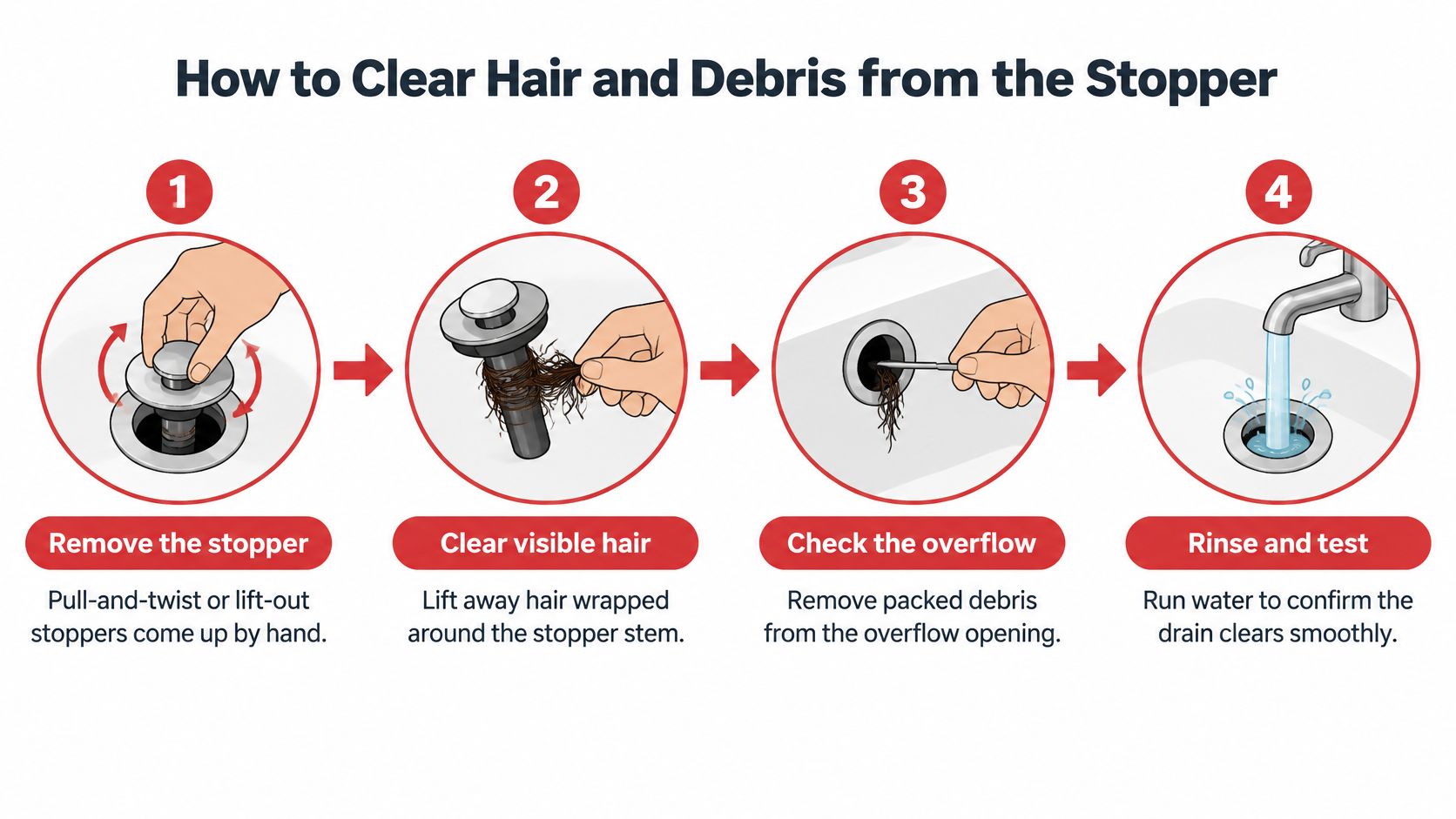
- Remove the stopper. Push-pull and lift-out stoppers come up by hand with a twist. A trip-lever stopper is different: loosen the two screws on the overflow faceplate first and set them in a dish, because a faceplate screw dropped down a tub drain turns a ten minute job into an open trap.
- Pull the hair out in one motion. Feed the retrieval tool down, hook the mat, and pull steady and slow so the clump comes out whole. Yanking shreds it and sends half into the trap.
- Open the overflow plate. Two screws hold it. Behind it sit the linkage and a coil where soap scum, body oil, and hair pack together into a felt-like ring. This is the debris most homeowners never reach, and it's often the actual reason the tub is slow.
- Scrape the drain opening. A bent wire or a small hook clears what's clinging to the lip of the drain shoe. Work around the edge, not straight down, so you lift debris instead of pushing it deeper.
- Run hot water and watch the level. Not warm. Hot enough that you wouldn't hold your hand in it comfortably. If the water pulls away in a steady whirl, the fixture level is clear.
- Trash everything you pulled out. Hair, soap curds, and the overflow debris go in the bin, never back down a drain.
The two slips that leave people with a tub that's still slow are skipping the overflow entirely and reinstalling the stopper in the wrong position, so it no longer seals and the tub won't hold water.
A clean setup is easy to recognize: the stopper moves freely, the overflow path is open, and water drains without gurgling.
Prevention that actually holds
Put a tub drain screen over the opening so hair stops at the surface instead of reaching the trap, and clean the stopper and overflow on a schedule rather than when the water rises. Keep grease, oils, and coffee grounds out of every drain in the house. The EPA's septic system answers are specific on this point: many poured materials don't decompose easily, can harm the bacteria a septic system depends on, and may affect groundwater and drinking-water supplies.
How to Plunge and Snake the Tub Drain Safely
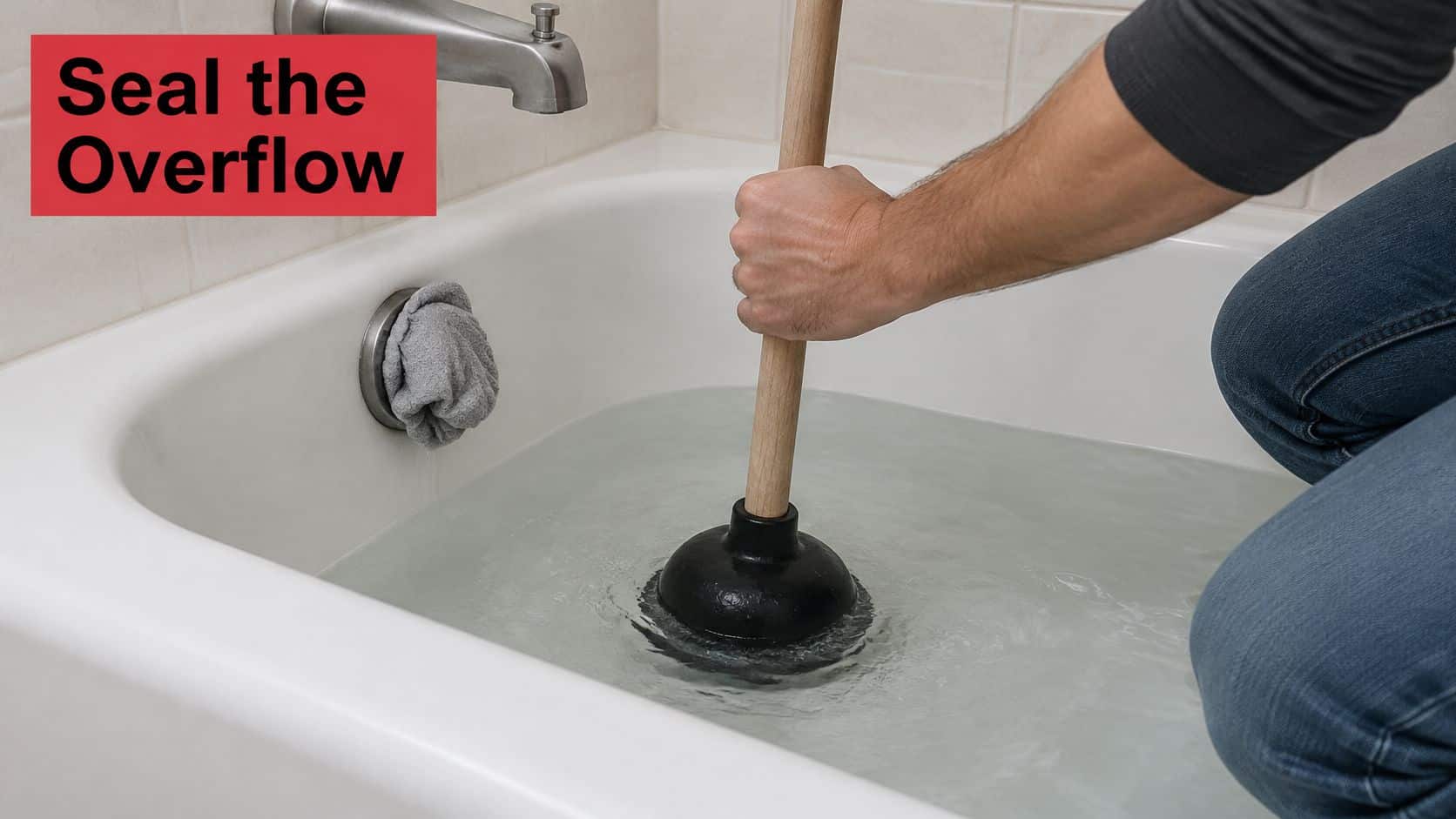
Plunging works on one condition. The pressure has to go down the drain instead of escaping up the overflow, and an open overflow bleeds off most of what you generate.
- Seal the overflow with a wet cloth. Fold a hand towel, soak it, and stuff it into the overflow opening. Hold it there with one hand while you plunge with the other.
- Add about two inches of water. The plunger cup has to be fully submerged to move water rather than air.
- Use a tub plunger, not a sink cup. A flange cup or a large rubber cup seats over the drain opening. Twenty to thirty firm strokes, straight up and down, keeping the seal on every stroke.
- Break the seal and check the flow. Pull the plunger off and watch. If the water drops in a clean whirl, you're finished.
- Move to a hand auger at the overflow, not the tub drain. Feed the cable through the overflow opening, rotate as you advance, and withdraw every foot or so to pull debris back out with it. Forcing a tool down through the tub shoe is how people crack a drain fitting.
- Test with sustained hot water. Run it for a few minutes. A drain that clears and stays clear under a full flow is the goal.
Extension guidance from the University of Florida IFAS lays out the same sequence: clean the stopper linkage and overflow plate, cover the overflow with a wet cloth, add roughly 2 inches of water, and make 20 to 30 firm plunger strokes while holding the seal, then run a hand auger through the overflow if plunging fails. It also warns that excessive force at a bend can damage plastic piping or drive the obstruction farther downstream. That last point matters more than it sounds, because a clog pushed past a fitting usually comes back bigger.
The safety case for mechanical work is not theoretical. The Consumer Product Safety Commission's review of 2004 consumer-product injury data put chemical drain openers at an estimated 7% hospitalization rate, compared with 3% for consumer-product injuries overall.
Stop here: if the tub re-clogs within a few days, or a second fixture starts draining slow, put the plunger down. More strokes won't reach a restriction past the trap, and repeated plunging on a scale-narrowed branch just churns the same water.
If you want to see the stroke rhythm and the seal before you try it, this walkthrough shows the technique in motion:
When an auger clears the clog but the line keeps slowing a few weeks later, the problem is usually buildup on the pipe wall rather than a fresh plug. That's the point where hydro jetting scours scale and grease film back to bare pipe instead of punching another hole through it.
How to Test Whether the Drain Is Truly Clear
A drain that moves water once isn't proven clear. Hair shifts, water finds a path, and the tub looks fixed for a day or two before it slows again. Three checks tell you whether you've cleared it.
- Run the tub faucet on hot for several minutes. Watch the area right around the drain. If water pools there and takes time to disappear, the restriction is still at the fixture.
- Fill the tub to a set depth, pull the stopper, and time it. Compare against a fixture you know drains well, like a bathroom sink that empties cleanly.
- Run the sink and the shower while the tub drains. If the tub level rises or its flow drops when another fixture runs, the two share a restriction.
| Test result | What it means | Next step |
|---|---|---|
| Tub drains quickly, other fixtures unaffected | Fixture-level clog cleared | Run hot water for several minutes to confirm |
| Tub still slow after stopper and plunging | Restriction in the trap or branch | Auger through the overflow, then retest |
| Tub and a nearby fixture both slow | Shared branch or main line | Schedule a camera inspection |
| Slow again within a few days | Recurring restriction or scale | Professional diagnosis |
Two traps catch people here. A tub that drains after cleaning but slows again within days wasn't fixed, it was reopened, and the cause is scale, a partly blocked trap, or a slope problem that fills back in. A tub that looks clear once the hair is out can still have a partly blocked trap, so the flow test tells you more than the pile of hair you removed.
A drain is fixed when it stays fixed through a week of normal use, not when it drains once on a Tuesday night.
The success signal is specific: water clears in a fast whirl, nothing gurgles when the toilet or sink empties, and the tub still drains well several days later.
Signs the Blockage Is Past the Tub
A tub that clears and then slows again is telling you where the blockage lives. Watch for these.
- The slowdown returns after every cleaning. A fixture-level clog doesn't come back in ten days. A scaled or sagging branch does.
- The tub reacts to other fixtures. Water rising in the tub when the sink empties means the two share a restriction downstream.
- A sewer smell hangs in the bathroom. Odor with slow drainage points past the trap.
- The problem started after a remodel. Altered drain routing is a common reason a tub that drained fine for years suddenly doesn't.
The geometry explains why surface work stalls. Bathtub drains are typically only 1.5 inches in diameter, and code provisions may require an access panel behind the tub or below the ceiling to reach the bath trap, while slab construction can recess the trap below the floor (UpCodes plumbing provisions). A trap you can't physically reach isn't going to be cleared by anything poured into the tub.
Say a family clears the upstairs tub, everything runs fine for a week, then the tub slows again after a stretch of daily showers. That pattern points to a belly in the line, a low spot that holds waste until it fills, or back-pitch where the pipe runs uphill. Cleaning restores flow until the low spot refills; the repair is slope correction, not another round of plunging. Older homes with cast-iron branch lines add scale and corrosion to the list, and remodeled or rental properties often hide an earlier repair that narrowed the run. Two or more of these signs mean the next step is a sewer camera inspection in Las Vegas, not another tool.
Decide When to Call a Licensed Plumber
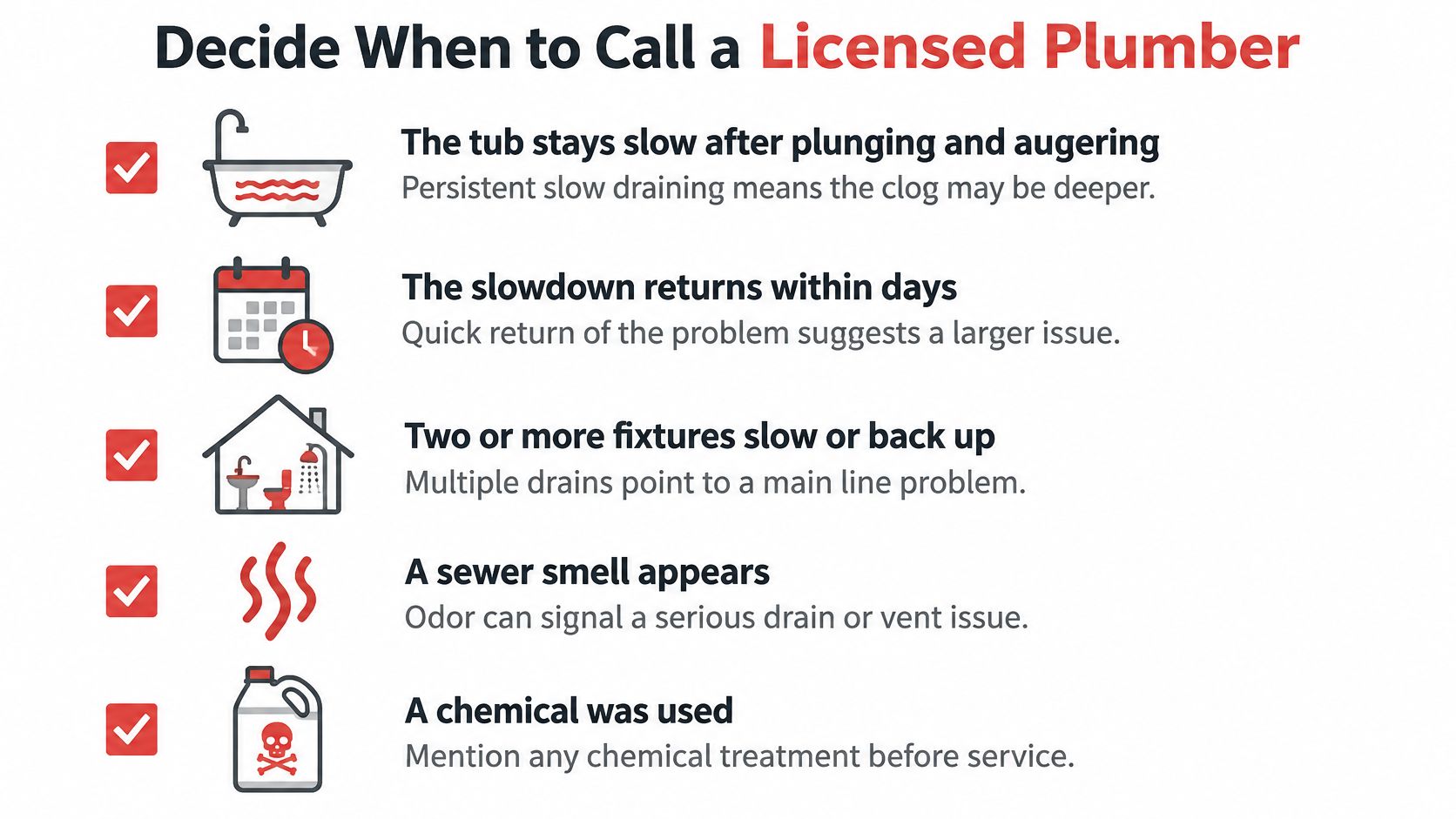
Call when two or more of these are true: the tub stays slow after you've plunged and augered, the slowdown is back within days, a second fixture drains slow or backs up, a sewer smell has appeared, or a chemical product is in the trap and someone needs to work on it.
If sewage is backing out of a drain, stop running water into every fixture on that line and call as early in the day as you can. What a visit covers is diagnosis first: a cable machine, jetter, and camera to confirm the cause, then a repair recommendation instead of a temporary fix. Most standard drain cleanings run 30 to 60 minutes, while root cutting, descaling, and jobs needing a camera take longer. Bathtub or shower drain cleaning with a cable machine is a flat rate of $214 and includes a flow test.
MG Plumbing Services LLC is a licensed, insured, family-owned and owner-operated residential plumbing company serving Las Vegas, Henderson, North Las Vegas, Summerlin, and the surrounding valley. Owner Miguel Garcia is a Nevada-licensed C-1d plumbing contractor with more than 25 years in the trade. We're not an after-hours emergency service, and we work in English and Spanish. Call 702-480-8070 to request service, or use our drain cleaning service in Las Vegas. If only the stopper is involved, keep clearing it yourself. If two or more of the signs above apply, book the call.
A slow tub that comes back is a diagnosis problem, not a cleaning problem, and MG Plumbing Services LLC handles both with cable machines, jetters, and cameras on the same visit. We test the flow before we leave so you know the clog is gone instead of just moved, and you get the price in writing before any work starts. Visit MG Plumbing Services LLC to request service, or call 702-480-8070. Se habla español.