You step into the shower before work, turn the handle, and get just enough warmth to believe the heater is recovering. A minute later, the water turns cold. In Las Vegas, that failure often has less to do with a mysterious electrical problem than with the minerals working inside the equipment every day.
Las Vegas water is classified as very hard, at roughly 16 to 18 grains per gallon, or about 272 to 308 parts per million, because of minerals including calcium and magnesium associated with the Colorado River and Lake Mead supply. Local water-quality reporting helps explain why scale changes the repair decision here. A part that might be worth replacing in another market can fail again quickly when mineral buildup remains inside the heater.
The right approach is triage. Identify the symptom, perform only the checks that are safe for your equipment, and stop before gas, live electrical wiring, or tank integrity becomes part of the diagnosis. The process below follows the way an experienced Las Vegas plumber approaches a water-heater call, from the first complaint to the repair-or-replacement decision.
Table of Contents
- When Your Morning Shower Turns Cold in Las Vegas
- Safety First Checks Before You Touch Anything
- Diagnosing the Four Most Common Hot Water Problems
- Annual Maintenance That Actually Extends Tank Life
- Repair or Replace How to Decide
- When to Call a Licensed Las Vegas Plumber
- Quick Reference Checklist Before You Call
When Your Morning Shower Turns Cold in Las Vegas
A homeowner in Henderson calls after a cold morning shower. The heater hasn't stopped completely. The first person in the house gets hot water, the second gets lukewarm water, and everyone else gets a cold rinse. That pattern tells a plumber more than “the water heater is broken.” It suggests the unit is making some heat but losing capacity, often because sediment or scale is insulating the heating surface or restricting flow.

Southern Nevada's water conditions make that distinction important. A U.S. National Bureau of Standards review summarized here estimated that public supplies in 20 states with hard, scale-forming water served about 94 million people, including approximately 24 million residential water heaters. After accounting for water softening, about 14 million water heaters were still potentially exposed to scale-related problems. That historical finding helps explain why flushing, descaling, and anode inspection became basic service steps in hard-water markets.
Scale doesn't sit there as an unattractive coating. It can insulate heat-transfer surfaces, lengthen recovery, reduce hot-water output, and make a serviceable tank look like a failed one. Before you order a replacement, determine whether you're facing a tripped control, one failed component, heavy mineral buildup, or a leaking tank.
Practical rule: If water is pooling at the tank base, stop treating the problem as a routine adjustment. Shut down the heater safely and arrange a professional diagnosis.
A homeowner can check a breaker, observe a pilot-light window, inspect visible fittings, and record symptoms. Opening gas controls, testing energized wiring, or deciding whether a tank shell is compromised belongs with a licensed technician.
Safety First Checks Before You Touch Anything
A cold shower can tempt you to reset controls immediately. Stop first. Electric storage heaters contain high-voltage circuits, while gas models combine fuel, combustion, venting, and pressurized hot water. In Las Vegas Valley homes, very hard water, often around 16-18 gpg, adds scale to elements, thermostats, valves, and connections. That raises the chance that a reset only hides the fault.
Shut down the energy source
For an electric unit, switch off the double-pole water-heater breaker. Do not rely on the handle position alone. Isolate power and verify that the heater is de-energized before removing an access panel. Electric water-heater troubleshooting guidance places the upper thermostat high-limit reset and element testing in that sequence because working on live wiring can cause shock or damage a replacement part.
For a gas heater, set the control to the appropriate off position. Close the gas shutoff valve if you smell gas or suspect a gas-related problem. Do not operate electrical switches, use a flame, or continue testing near a strong gas odor. Leave the area and contact the gas utility or a qualified professional.
Isolate water and make a visual check
Close the cold-water inlet above the heater before opening a drain, inspecting a connection, or limiting additional water entering the tank. Check the tank base, drain valve, temperature and pressure relief discharge, flex connections, and hot and cold nipples. Look for moisture, rust trails, mineral crust, or active dripping.
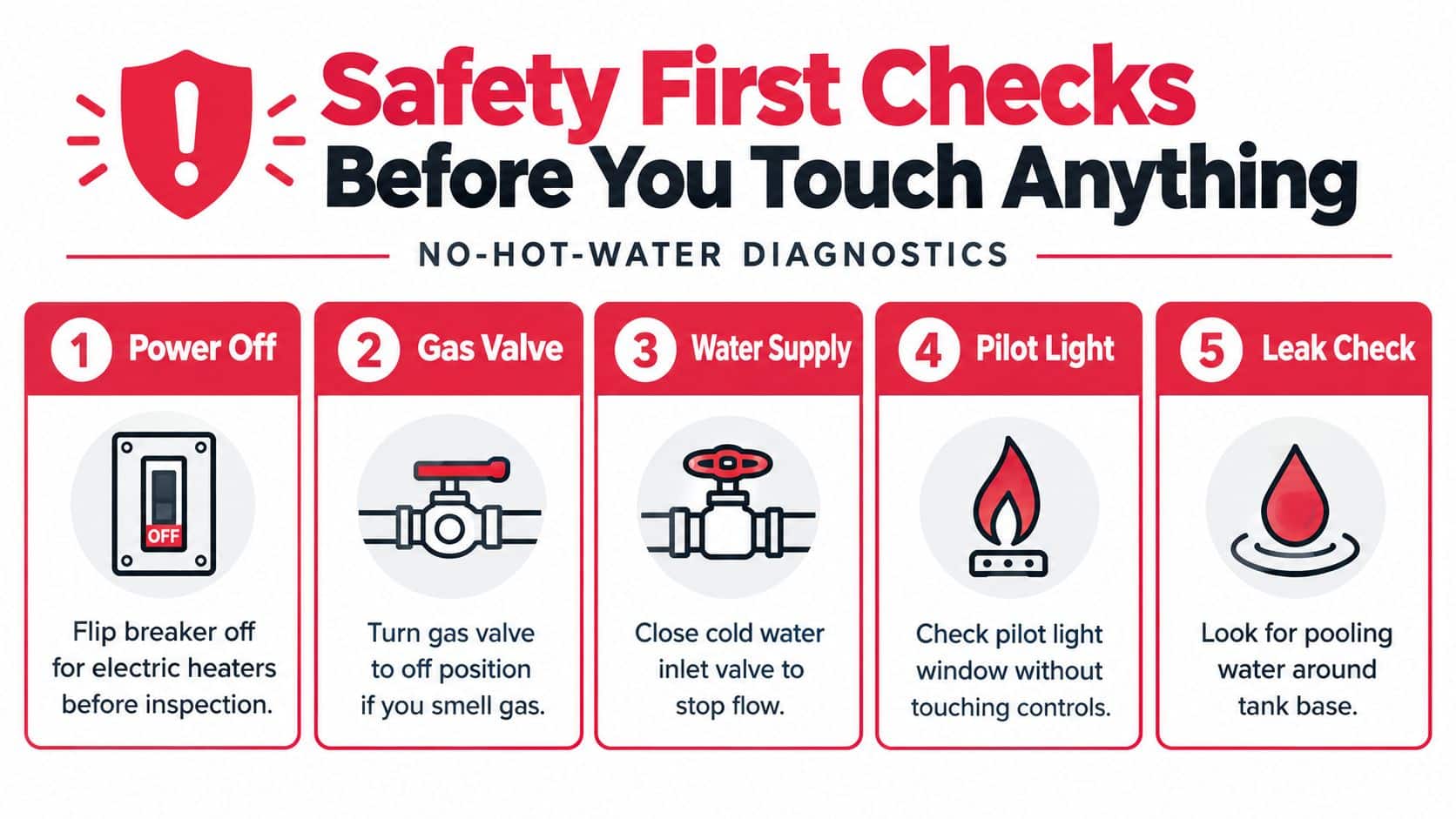
If an electric model is dry and power has been isolated, a homeowner may press the red high-limit reset button after restoring power according to the manufacturer's instructions. A reset can restore operation, but repeated tripping may point to an overheating thermostat, scaled element, wiring fault, or another control problem. Hard-water scale makes repeated resets a poor repair strategy. If the button trips again, stop.
On a gas model, inspect the pilot-light viewing window without opening the burner compartment. Relight only as the unit label directs. Gas odor, scorch marks, damaged venting, or visible leaks require professional service. A homeowner can record what happened and inspect exposed fittings. Testing energized wiring, opening gas controls, or deciding whether corrosion has compromised the tank belongs with a licensed technician.
Diagnosing the Four Most Common Hot Water Problems
The symptom usually narrows the search quickly. “No hot water” points toward energy, ignition, controls, or an element. “Not enough hot water” often points toward scale or one heating stage. Low pressure and leaks require looking beyond the heater itself.
| Symptom | Likely Cause | DIY Fixable |
|---|---|---|
| No hot water | Tripped breaker or high-limit reset, failed igniter, bad thermocouple, or failed heating element | Basic visual checks and a reset may be reasonable. Gas controls and electrical testing require a professional. |
| Lukewarm water | Sediment, a failing lower element, thermostat trouble, or a defective mixing valve | Temperature observation and visible inspection are reasonable. Component testing and valve replacement may require a technician. |
| Low hot-water pressure | Clogged aerators, a failing pressure-reducing valve, or scale in fixtures and piping | Cleaning a faucet aerator is usually manageable. PRV, piping, and heater-side restrictions need diagnosis. |
| Leak | Loose fitting, drain valve, relief-valve discharge, or a corroded tank shell | Tightening an accessible fitting may help. A tank-shell leak means replacement evaluation. |
No hot water
Start with the energy source. An electric unit may have a tripped breaker, a high-limit cutout, a shorted element, or an open element. A gas heater may have an extinguished pilot, failed igniter, or bad thermocouple. A homeowner can observe the breaker and pilot window, but testing resistance or checking for a short to ground requires a meter and a safe, verified de-energized circuit.
Lukewarm water
Las Vegas scale earns attention. A hard-water testing summary reports that one-quarter inch of scale can reduce heating efficiency by 25% to 40%, while one-half inch can push losses above 50%. The same source reports a tankless heater exposed to 26 grains per gallon completely failed from scale blockage after 1.6 years of equivalent use, with efficiency falling from 80% to 72%. Those figures don't prove every lukewarm heater needs replacement, but they show why a single element swap can miss the cause.
Low pressure
Remove and clean a clogged faucet aerator if only one fixture has weak flow. If every hot fixture is affected, look for a restriction at the heater, a pressure-reducing valve problem, or mineral scale in the hot-water piping. Don't assume the heater is the source until cold-water pressure and fixture flow have been compared.
Leaks
Water from a fitting, drain valve, or relief discharge may be repairable. Water emerging from the tank shell, seam, or bottom itself indicates internal corrosion, and no valve replacement can restore that steel. Shut off the energy source and water supply, then arrange a replacement assessment.
Annual Maintenance That Actually Extends Tank Life
A tank flush is useful only when it removes sediment and the heater is restarted correctly. The basic sequence is to shut off gas or power, close the cold-water supply, connect a garden hose to the drain valve, and route the hose to a safe drain or outdoor location. Open the drain valve and allow the tank to empty.
Flush the mineral load
Once the tank has drained, briefly open the cold-water supply to stir sediment from the bottom, then drain again until the discharge runs clear. Water-heater sediment guidance identifies popping, rumbling, and crackling noises as mechanical clues, along with cloudy, gritty, or sandy water during draining.
Sediment insulates the burner or element and forces longer heating cycles. A flush can improve recovery when the tank shell and controls remain sound, but it won't rebuild a corroded tank or repair a failed thermostat.
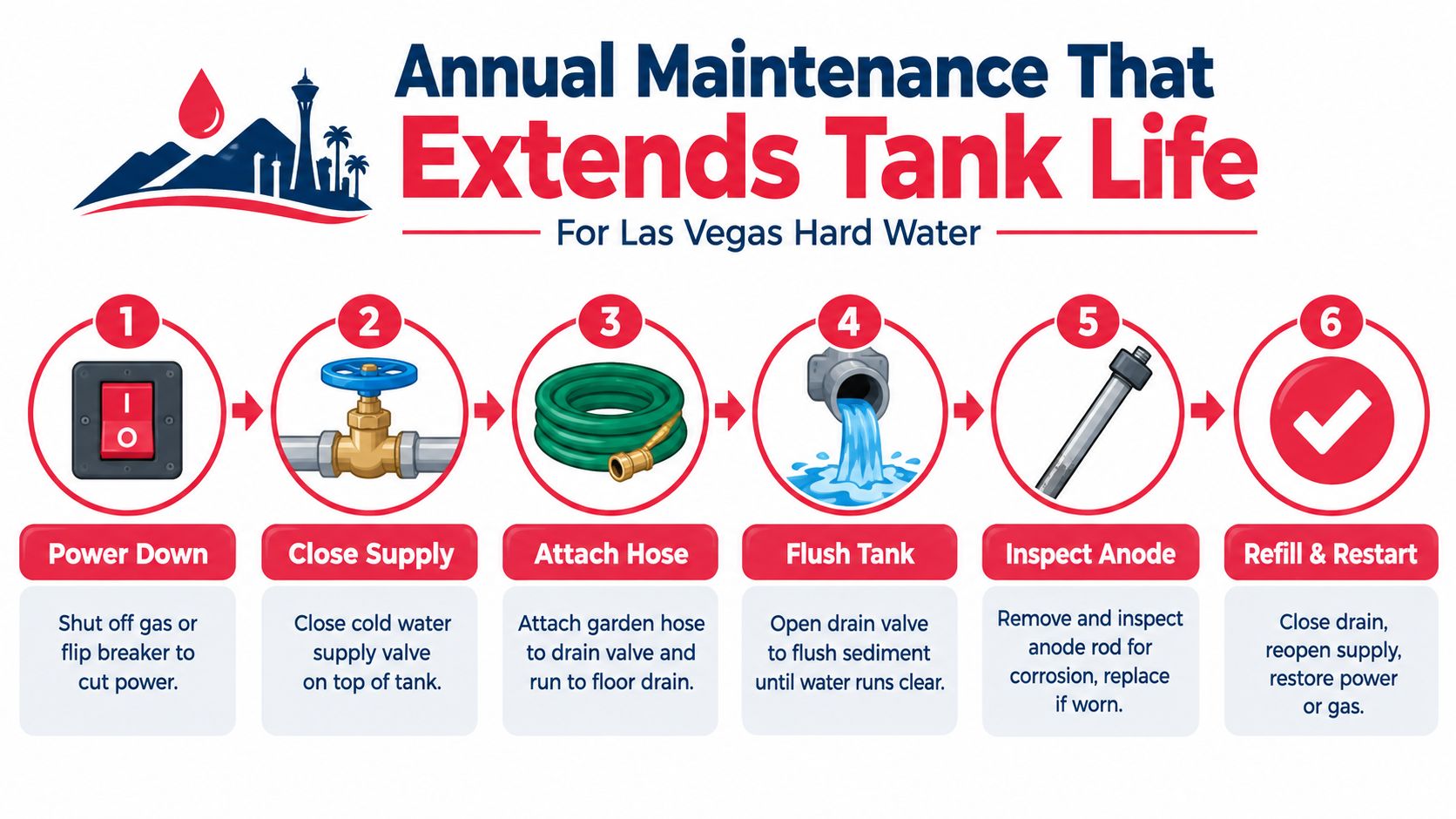
Close the drain, reopen the cold-water supply, and open a hot faucet until air stops sputtering and water flows steadily. The tank must refill completely before you restore power or relight the burner. Restarting an electric heater while an element is exposed to air can dry-fire and destroy it.
Inspect the anode and safety controls
An anode rod protects the tank lining by corroding in place. Remove it through the top hex plug or hot outlet when the installation allows, and look for calcium carbonate crust, deep pitting, or a rod reduced to its steel core. Las Vegas's 16 to 18 grains per gallon hardness, documented by Las Vegas water-quality information, can accelerate both scale formation and anode depletion.
Inspect the temperature and pressure relief valve and its discharge piping, but don't force a valve that appears seized or continues leaking after testing. If the rod looks borderline, photograph it and show the image to a plumber before deciding whether the tank deserves another service cycle.
A standard tank typically receives service-life guidance of 8 to 12 years, and consumer and industry guidance commonly recommends annual or biannual flushing. Step-by-step tank maintenance guidance supports that maintenance path. In hard-water homes, a six-month flush is a sensible adjustment for tanks older than five years or units already showing lukewarm output.
Repair or Replace How to Decide
Age alone doesn't decide the outcome. A water heater with a failed thermocouple and a dry, sound tank can be a sensible repair. A younger unit with a leaking shell, severe scale, and repeated control failures may be a poor candidate for continued part replacement.
Four checkpoints matter most
Tank age provides context. A unit under eight years old with no active tank leak generally leans toward repair, while a unit beyond 12 years in the Las Vegas Valley often sits past the practical cost-benefit line because hard-water wear has had more time to affect the tank and components.
Leak location carries more weight than the size of the drip. A fitting, drain valve, or relief-valve issue may be serviceable. Seepage from the shell or seam signals internal corrosion and replacement.
Symptom history separates an isolated failure from a system that is wearing out. One igniter, thermocouple, or element can be replaced. Repeated lukewarm water, popping noises, or recurring element burnouts point toward scale-choked internals.
Water-quality damage closes the gap. Large sediment chunks during flushing or an anode that has deteriorated unusually quickly indicate that the tank is under persistent mineral stress.
| Criteria | Lean Toward Repair | Lean Toward Replacement |
|---|---|---|
| Tank condition | Dry shell, sound fittings, isolated component failure | Shell corrosion, seam seepage, or water at the base |
| Age | Under eight years with manageable symptoms | Beyond 12 years with recurring failures |
| Scale | Sediment responds to flushing and descaling | Heavy scale returns quickly or has damaged elements and valves |
| Failure pattern | One reset, thermostat, igniter, or thermocouple issue | Repeated lukewarm output, noise, or component burnout |
| Planning | Repair supports the remaining service life | Replacement avoids repeated short-term work and allows updated equipment planning |
Don't accept a vague “repair versus replace” recommendation. Ask for a written comparison that separates the component repair, associated maintenance, installation work, and replacement options. MG Plumbing Services' cost-estimate information is one place to request that type of written service information.
Energy savings may favor a newer model, but they shouldn't be invented or assumed without reviewing the home's usage, fuel type, equipment condition, and installation requirements. For electric systems, the planning conversation is changing: DOE's 2024 efficiency-standard announcement says the standards take effect in 2029 and are expected to push more than 50% of newly manufactured electric storage water heaters toward heat-pump technology, compared with 3% today. Consumer Reports has noted heat-pump models with UEF ratings from 3.3 to 4.1. That doesn't mean every Las Vegas home should replace a working heater today, but it does make electrical capacity, controls, space, and future equipment planning part of a serious replacement discussion.
When to Call a Licensed Las Vegas Plumber
Gas control work belongs with a licensed professional. A thermocouple, burner assembly, or gas control valve can look simple, but an incorrect connection or combustion problem can create fire or carbon monoxide hazards. Nevada plumbing and mechanical requirements also make licensing relevant for this work.
Four clear hand-off points
Call for professional help when the tank shell or seam is leaking. A technician can distinguish condensation, a fitting leak, relief-valve discharge, and actual tank failure before you spend money on the wrong repair.
Electrical diagnosis beyond a straightforward, manufacturer-approved reset or element replacement also deserves a licensed technician. Upper and lower thermostat wiring mistakes can trip breakers, damage components, or leave the heater unsafe even when it appears to operate.
Code-related work should be planned professionally as well. Expansion-tank installation, drain-pan fitting, and seismic strapping can affect inspection and resale requirements in the Las Vegas Valley. A repair that works temporarily but fails inspection isn't a complete repair.
Ask for evidence, not a guess: A proper visit should identify the source of the failure, not simply recommend the first replacement part.
A professional diagnosis should include confirmation of the local hardness condition, inspection of the anode and heating elements, combustion analysis on a gas unit, and a written quote separating repair parts from replacement options. Ask to see the Nevada contractor license, request recent local references, and ask whether the recommended anode alloy suits hard-water service.
For local tank and tankless diagnosis, water-heater repair service in Las Vegas is one option homeowners can evaluate. MG Plumbing Services LLC is a family-owned, owner-operated residential plumbing company serving Las Vegas, Henderson, North Las Vegas, Summerlin, and nearby communities. Owner Miguel Garcia is a Nevada-licensed C-1d plumbing contractor and journeyman plumber with more than 25 years of experience, and the company provides water-heater repair and replacement alongside drain, sewer, leak-detection, water-treatment, and general residential plumbing services.
Quick Reference Checklist Before You Call
A cold shower in the Las Vegas Valley often starts with a simple observation. Use the checks below to give the plumber useful facts without opening gas controls, removing electrical panels, or working around live wiring.
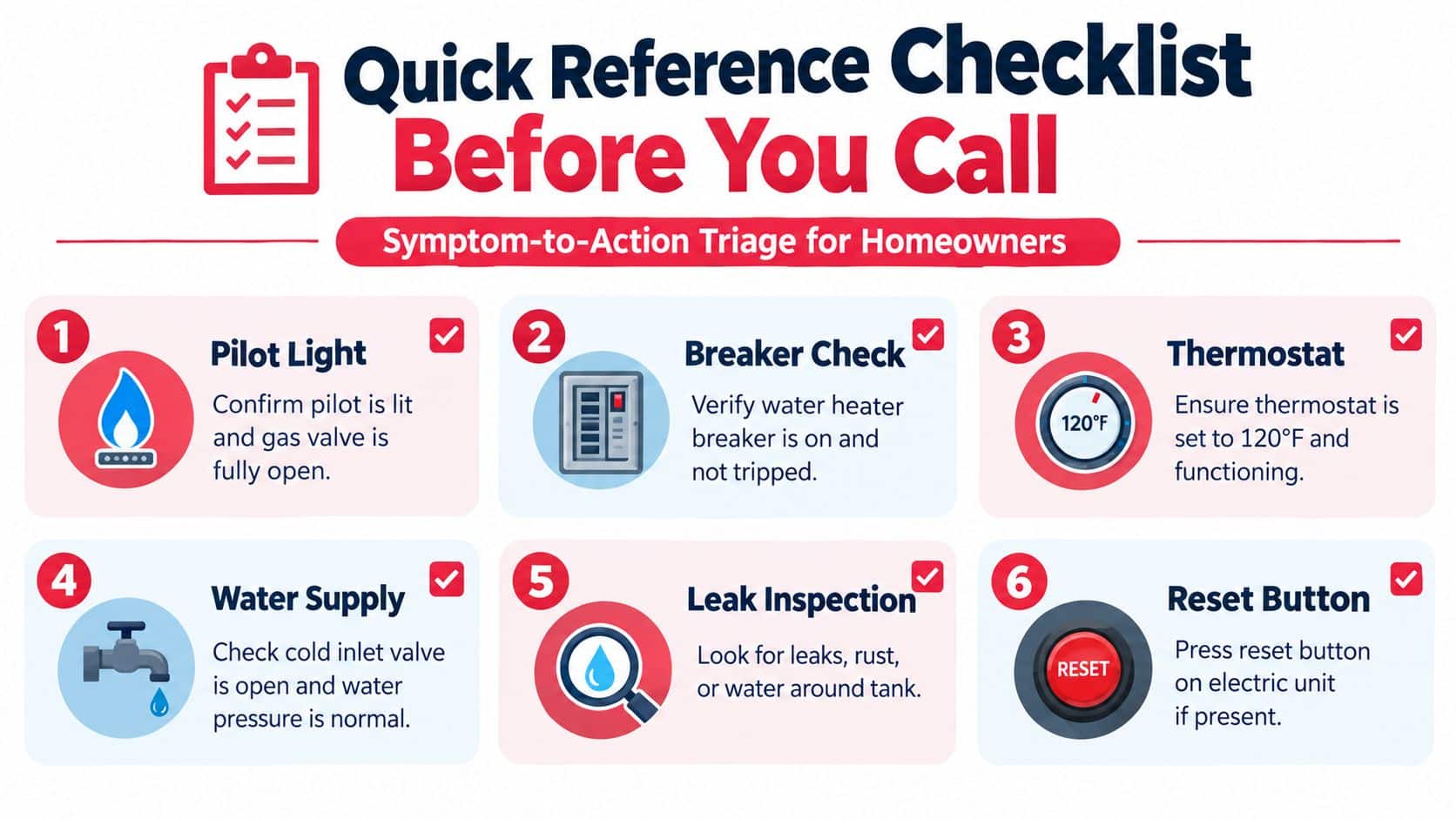
- Confirm the pilot: Look through the viewing window and note whether the pilot is lit. If you smell gas, leave the controls alone and exit the area.
- Check the breaker: Confirm the electric heater's double-pole breaker has not tripped. Do not remove panels or test voltage unless you are qualified and can verify the unit is de-energized.
- Observe the thermostat: Compare its setting with the water temperature at a faucet. A setting near 120°F is a common baseline. Raising it will not correct a heater that cannot recover, and it increases scald risk.
- Inspect water supply: Verify that the cold inlet valve is open. Compare hot and cold flow at the same fixture. Reduced flow at every hot fixture points to a restriction or water-heater problem requiring further diagnosis.
- Look for moisture: Check the tank base, fittings, drain valve, and relief discharge. In Las Vegas's very hard water, mineral buildup can shorten component life, but water from the tank shell usually changes the call from maintenance to replacement planning.
- Press only the appropriate reset: On an electric unit, use the reset button only according to the manufacturer's safety procedure. A repeat trip means the fault remains.
Record the data-plate age, when the problem began, whether the failure is constant or intermittent, any display error code, and whether the tank has been flushed recently. If flushing has been delayed and there is no active leak, tell the technician rather than starting a drain operation you are not comfortable performing. Hard-water sediment can make that job messier and can expose a weakened tank.
This checklist saves diagnostic time, but it does not replace a licensed plumber for gas issues, electrical wiring, active leaks, or tank-shell failure. For additional homeowner questions, review these water-heater frequently asked questions.
MG Plumbing Services LLC diagnoses and repairs residential tank and tankless water heaters across Las Vegas, Henderson, North Las Vegas, Summerlin, and the surrounding valley. Recommendations account for local hard-water conditions. Call 702-480-8070 or visit MG Plumbing Services LLC to request service and a written repair or replacement recommendation. Se habla español.