Before you turn the adjustment bolt on your pressure regulator, can you say where the pressure drops: at the street, at the regulator, or at one tired faucet? Most homeowners can't, and that's why so many low-pressure repairs miss. They buy a booster pump for a house with a half-closed main valve, or replace a shower head when the restriction sits in a scaled service line.
Learning how to fix low water pressure in house starts with location, not horsepower. Water leaves the utility main, passes the meter, crosses your service line, goes through the shutoff and the pressure-reducing valve, then splits to fixtures. A gauge reading taken on each side of that path tells you which segment is stealing your flow, and the repair follows from the reading.
Table of Contents
- How to Test Your Pressure Step by Step
- Match Your Symptom to the Likely Cause
- Fix Weak Flow at a Single Fixture
- Check the PRV, Main Valve and Service Line
- Rule Out Leaks, Scale and Booster Pumps
- Decide When to Call a Las Vegas Plumber
How to Test Your Pressure Step by Step
A supply can look healthy at rest and still collapse the moment someone opens a tap. That's the whole reason a single reading isn't enough. Static pressure tells you what the system holds when nothing moves. Flowing pressure tells you whether the piping and valves can deliver water while a fixture demands it.
The EPA WaterSense home maintenance guidance puts the practical operating range for household fixtures at 45 to 60 psi, and treats pressure substantially below 45 psi as a signal to look for a leak or another supply-side problem. Buy a hose-bib gauge with a lazy hand (the second needle that stays at the peak reading), a 0 to 200 psi dial, and a female garden-hose thread. It screws straight onto an outdoor spigot.
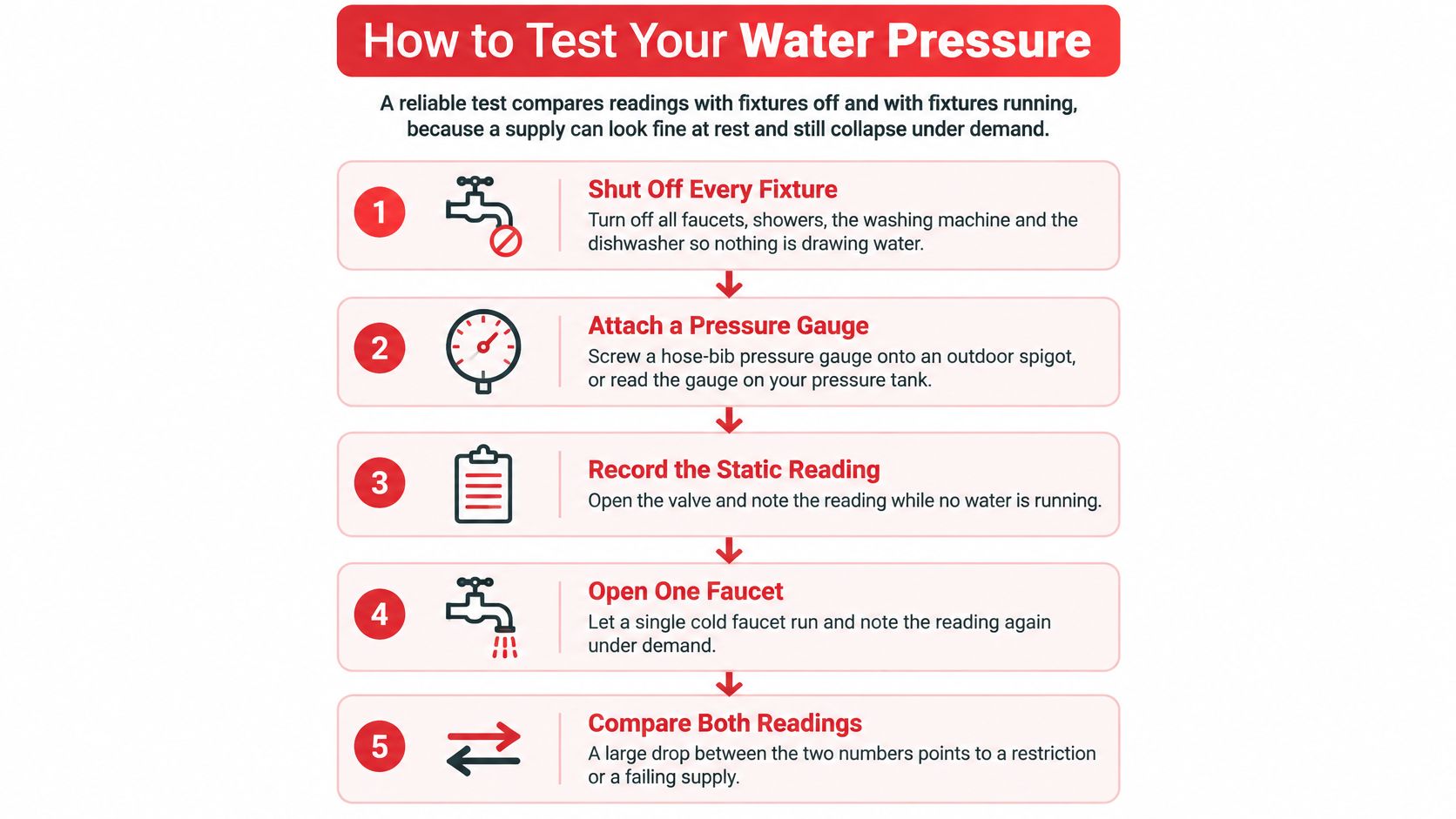
The six readings, in order
- Shut everything off. Close every faucet and shower, and make sure the dishwasher, washing machine and ice maker aren't filling. Wait a few minutes so the system settles, because a lingering fill cycle will drag your baseline down and send you chasing a fault that isn't there.
- Attach the gauge on the meter side. Use an outdoor hose bib fed before the house branching, or the nearest full-size connection you can reach. Open that bib fully so the gauge sees supply pressure rather than the restriction inside a single fixture.
- Record the static reading. With nothing running, note the number and let it sit for a minute. This is your supply pressure, and a needle that creeps downward while everything is closed is information in itself.
- Open one indoor cold faucet fully and read again. Have someone watch the gauge while the tap runs wide open. This flowing number shows whether the supply can meet demand, which is the test most homeowners skip.
- Repeat on the hot side. Test at the water heater drain valve or the nearest hot fixture, so you can separate a hot-only problem from a whole-house one. If cold reads fine and hot doesn't, the restriction sits at or after the heater.
- Test again at peak hours. Take the same pair of readings early morning and during evening use. Intermittent complaints only show up when the neighborhood is drawing water at the same time you are.
Here's the sequence in visual form.
Reading the gap between the two numbers
A small drop from static to flowing is normal, since moving water always loses some pressure to friction. A large collapse means something between the street and your gauge can't pass enough volume, and no fixture replacement will change that. If the gauge holds steady while a faucet runs but the flow at that faucet is still weak, the restriction is downstream of the test point, in the branch or the fixture itself.
Field rule: a normal static reading with a weak flowing reading is a restriction problem, not a pressure problem. Turning up a regulator won't push water through a blocked screen.
What to write down before you call anyone
- Both numbers: static pressure and flowing pressure, in psi, from the same test point.
- Time of day: note whether the reading was taken at peak use or with the neighborhood quiet.
- Which fixtures ran: one cold tap, a shower, or several at once, since demand changes the answer.
- Size of the drop: flag whether the fall was slight or dramatic, and whether the needle kept sliding with everything off.
- Hot versus cold: record whether the weakness follows one side or both.
That short list turns a vague complaint into a diagnosis a plumber can act on in minutes.
Match Your Symptom to the Likely Cause
Low pressure isn't one fault. It's a handful of distinct faults that happen to feel the same at the shower head, and the pattern of the symptom narrows them faster than any part replacement. Note whether the problem hits one fixture or all of them, hot, cold or both, and whether it's constant or comes and goes.
The table below matches what you notice to the first check worth running.
| Symptom | Likely cause | First check |
|---|---|---|
| Weak flow at one faucet only | Clogged aerator, partly closed stop valve or worn cartridge | Unscrew the aerator and open the stop valve fully |
| Low pressure at every fixture, hot and cold | Partly closed main valve, PRV problem or restricted service line | Gauge reading at an outdoor hose bib |
| Only hot water is weak | Water heater inlet, sediment or mixing valve | Compare pressure at the heater inlet with the cold line |
| Pressure drops when no fixture is running | Hidden leak | Watch the meter with all fixtures off |
| High pressure at rest, collapses under flow | Clogged PRV strainer or undersized supply | Take static and flowing readings together |
| Change that comes and goes through the day | Morning demand or utility work | Repeat readings at peak and off-peak times |
Why Las Vegas homes start at the aerator
Local water is hard enough to change the odds. The Las Vegas Valley Water District's water pressure guidance reports hardness of about 291 parts per million, or 17 grains per gallon, and lists clogged aerators, water softeners, pressure-reducing valves and on-site leaks as separate causes rather than one blanket problem. At that mineral load, scale builds inside aerator screens, valve seats, heater nipples and softener components, so a fixture that ran fine when the house was new can choke years later while the supply stays unchanged.
The same district guidance points to a softener bypass as a practical isolation test. Put the unit into bypass, run a cold tap, and see whether flow returns. If it does, you've found your restriction without spending a dollar on parts. If pressure is weak at every fixture with the softener bypassed, the search moves to the regulator, the service line or a leak.
Raising pressure or adding a pump before you test can hide a restricted valve, a failing softener, a concealed leak or a deteriorating service line. The fault keeps working while the symptom goes quiet.
When the symptom comes and goes
Intermittent complaints deserve a different kind of patience. Phoenix Water Services guidance on general service issues notes that morning demand can temporarily reduce pressure and that some fluctuation is normal, while persistent low pressure points to a customer-side or utility-side problem. That's why readings taken at three different times beat one reading taken when you happen to notice the shower feels weak.
For landlords and HOA managers, the timing note matters twice over. A unit can feel weak at 7 a.m. and read perfectly at noon, and a tenant report without timestamps gives a technician nothing to work with. Match the pattern first, then touch a valve.
Fix Weak Flow at a Single Fixture
Say the upstairs shower sprays like a misting bottle while the kitchen tap runs hard enough to splash the counter. That combination almost never means the house supply is failing. It means the restriction lives in the shower head, its arm, or the valve behind the wall, and the fix costs a bottle of vinegar or a cartridge.
Work the fixture in the order a plumber would, cheapest and most likely first.
Clean, then open, then inspect
Unscrew the aerator from the faucet spout, usually by hand or with pliers wrapped in tape to protect the finish. Drop the parts in white vinegar for an hour, scrub the screen with an old toothbrush, rinse, and hold it up to the light. If you can't see through the mesh, replace the aerator rather than fighting it.
Shower heads get the same treatment on a larger scale. Bag the head in vinegar, let it soak, then clear each nozzle with a pin or a straightened paper clip, because scale plugs the individual outlets even after the internal screen is clean.
Next, look under the sink at the stop valve on the supply line. Turn it fully open, then check the flexible connector for kinks, bulges or a cracked crimp, and replace it if the braiding is damaged. A stop valve left partway closed after a repair cuts flow sharply while the rest of the house runs normally.
If only the hot side is weak at that one fixture, suspect the cartridge or the mixing valve before you blame the supply. Cartridges wear and collect debris on the hot port first, and a pressure-balancing spool that sticks will throttle hot flow while cold stays strong.
What won't work, and why
Pulling the flow restrictor out of a shower head or cranking up the regulator won't repair a single restricted fixture, and it can push the rest of the house into a pressure range that shortens appliance life. Fixture flow limits are written into standards, not chosen at random. The International Plumbing Code chapter on water supply and distribution sits alongside federal fixture rules that cap faucets at 2.2 gallons per minute at 60 psi under the DOE's 1998 standard, while WaterSense lavatory faucets are certified at 1.5 gpm or less at 60 psi and must still deliver at least 0.8 gpm at 20 psi.
That last figure explains a common disappointment. A certified low-flow faucet is designed to work at low pressure, so swapping an old faucet for a new efficient one won't rescue a house-wide supply problem. The fixture was never the bottleneck.
Confirm the fix with the gauge
Run the repaired fixture and judge the flow, then recheck the hose bib. The house readings should be unchanged, because a fixture repair doesn't move supply pressure. If other fixtures are still weak, the problem was never local, and the search belongs upstream.
Check the PRV, Main Valve and Service Line
A pressure-reducing valve can fail in two opposite directions. It may throttle the whole house too low, or it may stop regulating and pass street pressure straight through. That is why the order of checks matters. Adjusting a valve before you know where pressure drops usually aims the fix at the wrong part of the system.
Start with the free checks. Confirm the main shutoff is fully open, since it is routinely left partway closed after plumbing or landscaping work. Check the meter-side screen for grit. If a softener or whole-house filter sits ahead of the house branching, exercise its bypass and compare gauge readings again.
Test the regulator before condemning it
Find the valve near where the supply enters the house, often with a strainer upstream of it. Attach your gauge downstream, then read static and flowing pressure. Compare both against the range printed on the valve or its tag. Clean the strainer before you decide the valve has failed. A plugged screen produces the same low-flow symptoms as a dead regulator.
Adjust only within the manufacturer's range, a quarter turn at a time. Check the gauge after each move, and retighten the locknut when you are done. Raising the setting to mask a restriction elsewhere puts stress on fixtures and piping while the blockage stays in place. I would treat that as a temporary diagnostic move only, never the repair.
EPA WaterSense technical guidance on pressure notes that water-supply pressure can reach 100 psi or more. High pressure damages pipes, fixtures and appliances while increasing water use and leak risk. Most U.S. plumbing codes require a PRV when supplied domestic pressure exceeds 80 psi, with incoming service pressure set between 45 and 60 psi.
The decision rule is direct. If static pressure looks acceptable but flowing pressure falls sharply, suspect a clogged regulator, an undersized service line or a restriction upstream of the house. If pressure stays low everywhere after the valve, meter and leak checks come back clean, ask the utility to verify the street-side supply before buying equipment.
| Reference | Pressure | What it means for the fix |
|---|---|---|
| EPA WaterSense operating target | 45–60 psi | Target range for fixtures and system protection |
| Code threshold for a PRV | Above 80 psi | Pressure must be reduced to 80 psi or less |
| City of Lincoln fixture design | About 50 psi | Municipal supply can reach 150–200 psi, so regulation may be needed |
The City of Lincoln's water pressure regulator page explains the point behind that last row. Fixtures are designed around a modest working pressure, while the main feeding the property can arrive far above it. A high reading at the hose bib is not proof of a healthy system.
When the service line is the restriction
An older supply line can pass enough water to hold a normal static reading and still starve the house under demand. Scale and corrosion narrow the inside diameter over the years. In that case the regulator is innocent, and adjusting it masks the loss.
The location of the pressure drop decides the repair. If the drop appears before the house branching, the service line, meter path or street supply belongs ahead of the PRV on the checklist. If the drop appears after the valve under flow, the regulator, strainer or downstream piping becomes the focus. That sequence keeps a failed valve from being blamed on a restricted line, and keeps a restricted line from being "fixed" with a new regulator.
MG Plumbing Services LLC handles main water line replacement in Las Vegas with Wirsbo AquaPEX, along with PRV and booster pump work. The same plumber can carry the job from line testing through repair, including water service replacement, PRVs and booster pumps when the service line is the restriction.
Rule Out Leaks, Scale and Booster Pumps
The reflex to buy a booster pump first is the expensive mistake in this whole subject. A pump raises pressure in a system that may be losing water through a slab leak or choking on mineral scale, and it makes the symptom disappear while the fault keeps running. Test for loss before you add power.
The leak test most homeowners skip
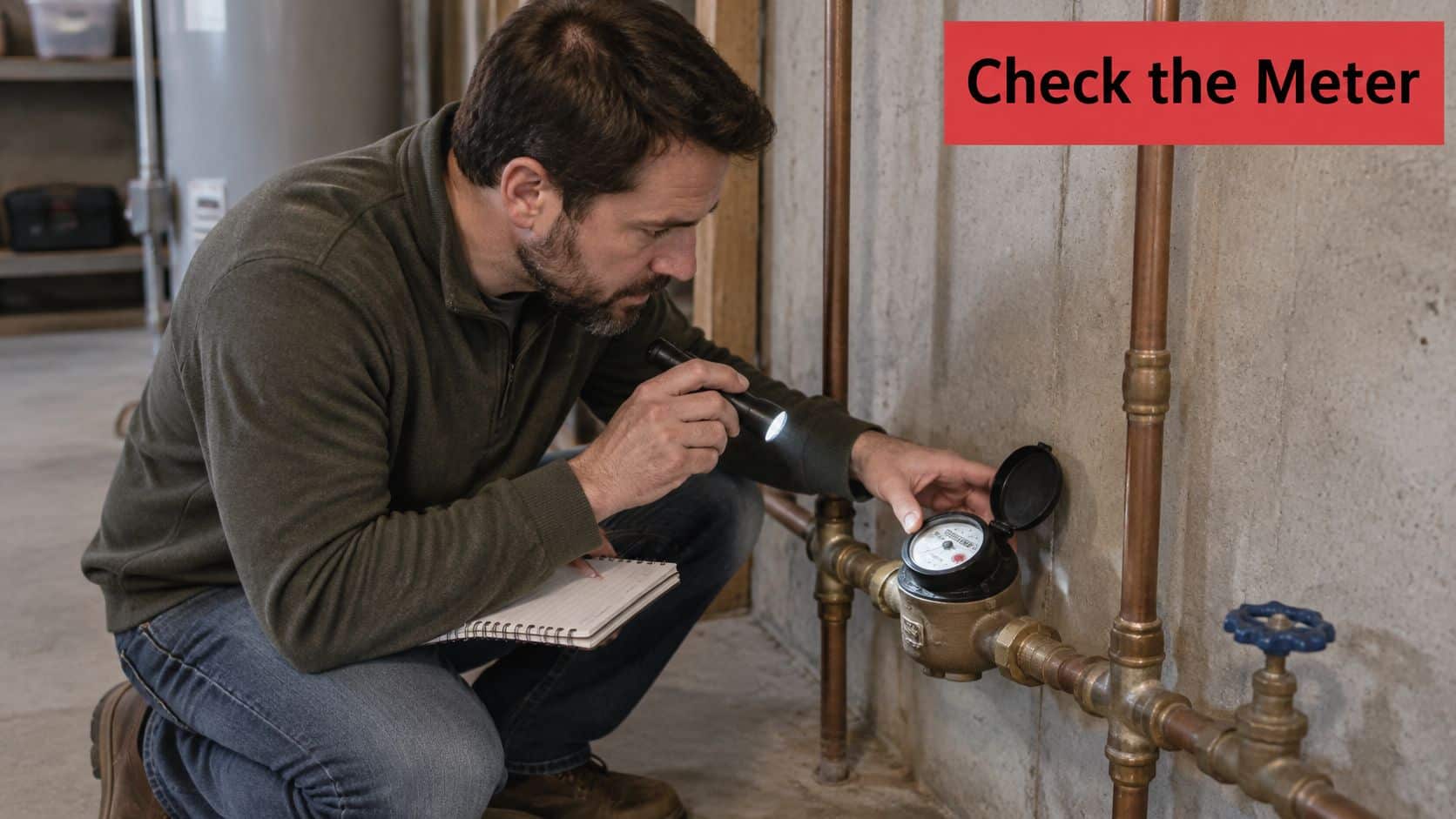
Shut every fixture and appliance, write down the meter reading and the gauge reading, then leave the house alone for at least an hour. A moving meter register or a sliding gauge needle means water is leaving the system somewhere. EPA WaterSense guidance on leak testing explains that pressure dropping during a controlled test indicates a leak, and calls for checking water-using fixtures, appliances and equipment as part of the same inspection.
In Las Vegas homes that loss often hides under the slab or in a copper pinhole, and the clues are a warm patch of floor, a damp baseboard, or a bill that climbed without a change in habits. Isolate and locate the leak before touching a regulator setting. Our water leak detection service follows four steps: confirm the leak, isolate the line, pinpoint it with tracer gas, then report and repair.
Scale, and what a pump can't fix
Hard water narrows the working diameter of aerators, valve seats, heater nipples and older piping a layer at a time. Descaling restores flow where a new fixture would not, because the new fixture screws onto the same restricted supply. Where scale is bonded to pipe walls, mechanical descaling or jetting removes it rather than punching a hole through the middle.
A booster earns its place only when the incoming supply is weak after the leak, scale, valve and service-line checks come back clean. DOE technical guidance on residential water pressure frames the sizing job correctly: calculate simultaneous fixture flow, the residual pressure needed at the highest or farthest fixture, elevation loss, pipe friction and available inlet pressure, then select a pump for that combined flow at that total dynamic head, not for a target psi. Undersize it and you get cycling, noise, weak showers and early failure.
A complete installation also needs a properly sized storage or pressure tank where required, backflow protection, isolation valves, a check valve, a pressure switch or electronic controller, a dry-run safeguard, and confirmed electrical capacity.
What the repairs typically cost
Treat these as national figures for comparison, not Las Vegas quotes. The NSP Plumbing service record reports a median invoice of about $490 for low-pressure calls, with the middle half of invoices between $150 and $1,050, and HomeFixx's 2026 pressure cost guide estimates installed ranges for the two main hardware fixes.
| Repair | Typical cost | Source note |
|---|---|---|
| Median low-pressure service call | About $490 | Range $150–$1,050, NSP Plumbing record, 2025 |
| PRV replacement | $350–$650 installed | HomeFixx estimate, 2026 |
| Whole-house booster system | $800–$2,200 installed | HomeFixx estimate, 2026 |
The spread tells you why diagnosis pays. A regulator replacement and a booster system are different jobs at different prices, and choosing between them before testing is a coin flip with your money. Get a written estimate after the cause is located, priced against your house layout rather than a national average.
Decide When to Call a Las Vegas Plumber
Plenty of this work is safely yours. Cleaning an aerator, soaking a shower head, opening a stop valve fully, confirming the main shutoff is open, and taking gauge readings at a hose bib are all homeowner jobs with no special tools. If you can't find the main shutoff, we'll walk you through locating and operating it while your appointment is being scheduled.
The boundary is clear, and it's worth respecting.
- The meter moves with everything off. That's water leaving the system, and it needs isolation and location, not a regulator adjustment.
- A visible leak or damp area appears. Slab moisture, a warm floor patch or a wet baseboard means the loss is already doing damage.
- Pressure is high at rest and collapses under flow after the regulator checks. That pattern points to a service-line or upstream restriction.
- Pressure stays low at every fixture after the utility verifies the street side. The remaining causes sit inside your property and need testing equipment.
- Pressure swings with no clear cause. Unexplained transients can damage fixtures even while a shower feels weak.
If your gauge reads fine at rest and the house still can't run two fixtures at once, stop adjusting and start isolating.
Those situations call for leak detection, regulator evaluation or service-line testing. Our leak process pinpoints the location with tracer gas before anyone opens a floor, and we give a written estimate after locating the leak, so the price reflects the actual repair rather than an exploratory guess. We repair slab leaks, supply lines and underground pipe in-house, which means the plumber who found the problem is the one who fixes it.
MG Plumbing Services LLC is a local, family-owned and owner-operated residential plumbing company serving Las Vegas, Henderson, North Las Vegas, Summerlin and the surrounding valley. Owner Miguel Garcia is a Nevada-licensed C-1d plumbing contractor and journeyman plumber with more than 25 years in the trade, and the company is licensed and insured. We recommend only what the job needs, explain what we found, and skip the upselling.
Bring your notes to the visit: static and flowing readings, the times you took them, whether the meter moved with fixtures off, and any damp areas you've noticed. A technician starting from your numbers spends the appointment confirming a cause instead of hunting for one. We offer same-day appointments for water leak detection and book during business hours, so schedule ahead rather than treating us as a 24/7 emergency service. If you'd like a same-day plumbing appointment in Las Vegas, call 702-480-8070. Se habla español.
MG Plumbing Services LLC tests pressure, locates hidden leaks, services pressure-reducing valves and replaces failing water lines across the Las Vegas Valley, so the repair matches the reading instead of a guess. If your gauge shows a big drop between static and flowing pressure, or the meter keeps moving with every fixture off, bring us those numbers and we'll tell you plainly what the system needs. Visit MG Plumbing Services LLC or call 702-480-8070 to request service, in English or Spanish.