

You're walking barefoot down a Henderson hallway while the air conditioner runs, but the tile still feels warm. Then you open the water bill. It's higher even though your showers, laundry, and household routine haven't changed.
That combination deserves checking, but it doesn't prove there's a broken pipe beneath your floor. Learning how to tell if you have a slab leak starts with separating a suspicious symptom from evidence of unexplained water flow.
Table of Contents
- What a Hidden Slab Leak Feels Like at Home
- Slab Leak Warning Signs and How Strong They Are
- Where the Water Goes Under a Concrete Slab
- How to Run a Shutoff Water Meter Test
- Slab Leaks Versus Other Plumbing Problems
- Las Vegas Homes Where the Clues Mislead
- Mistakes That Turn a Clue into Damage
- When to Call a Licensed Las Vegas Plumber
What a Hidden Slab Leak Feels Like at Home
A slab leak is a leak in plumbing beneath your home's concrete foundation. Homeowners usually use the term for a pressurized water-line leak, although a drain beneath the slab can leak too. Those problems need different tests.
Your job isn't to find the exact break. It's to work out whether water is escaping somewhere you can't see, rather than through a toilet, hose bibb, irrigation valve, or water heater.
A missing puddle doesn't clear the house. Water can soak into soil beneath the concrete without ever reaching your flooring. In Las Vegas, evaporation can also erase outdoor dampness before you notice it.
Start with evidence: A warm floor is a hint. A warm floor combined with unexplained meter movement justifies professional investigation.
The sign-strength table below helps you weigh those hints. The house-shutoff test then separates loss downstream of that valve from loss along the yard service line or another upstream branch. Neither test pinpoints a break under concrete.
That distinction matters before anyone discusses demolition. Many valley homes built after about 1980 have post-tension slabs, with stressed cables embedded in the concrete. Cutting on a guess can hit one. Start with the signs, not a repair opening.
Slab Leak Warning Signs and How Strong They Are
Slab leak signs by strength
| Sign | What you notice | Strength alone | Rule out first |
|---|---|---|---|
| Meter moves with all use off | Low-flow indicator or reading advances during a 15-to-30-minute watch | Strong | Running toilet, irrigation valve, hose bibb |
| Warm floor on the hot path | Tile or carpet warmer than the slab beside it | Moderate | Sunlit slab, recent hot-water use |
| Unexplained higher bill | Usage up with the same household routine | Moderate | Irrigation schedule, silent toilet, rate change |
| Hissing in a quiet house | Running-water sound near the floor, not a fixture | Moderate | Pressure-reducing valve, fill valve, water heater |
| Cracks, odor, or damp base | New cracks, musty smell, or soft flooring | Weak to moderate | Ordinary settling, AC condensate |
| Yard spot that vanishes | Damp soil gone by late afternoon | Weak outdoors | Irrigation, AC drain, pool autofill |
| Low hot pressure or rusty water | Hot side weaker than cold, or sudden discoloration | Weak alone | Hard-water scale, aging heater |
Use the meter as the anchor
Read across each row: what you notice, how much it means alone, and what else could explain it. “Strong” means investigate the same day, not authorize concrete cutting.
The meter row carries the most weight because it checks actual water flow rather than heat, sound, or appearance. Every faucet, shower, ice maker, irrigation zone, and other automatic water user must be off for that observation to mean anything.
A higher bill needs a closer look too. Compare billed water usage, not just the amount due. A rate change can raise the charge without any additional water passing through your meter.
Weigh combinations rather than dramatic symptoms
Moderate signs become useful when they agree. A warm strip through a shaded hallway, unchanged household use, and persistent hissing make a stronger case than a warm patch beside a sunny patio door.
Weak signs are easy to misread. A musty baseboard near an air-conditioning closet may come from condensate, while rusty hot water may originate in an aging heater. Pressure loss can come from mineral restrictions rather than escaping water.
- Check location: Heat that follows a plumbing route means more than warmth spread across a sunlit room.
- Check timing: A noise that starts when a toilet refills points somewhere different from a steady floor-level hiss.
- Check the system: Sewage odor and several slow drains belong to a drain investigation, even when the supply meter stays still.
A drain leak isn't scored as a pressurized supply leak. Wastewater can escape beneath the house only when fixtures discharge, so a quiet supply meter doesn't rule it out.
Two moderate signs plus unexplained meter movement outweigh one dramatic warm spot. They still establish a reason to locate the leak, not permission to guess where it is.
Where the Water Goes Under a Concrete Slab
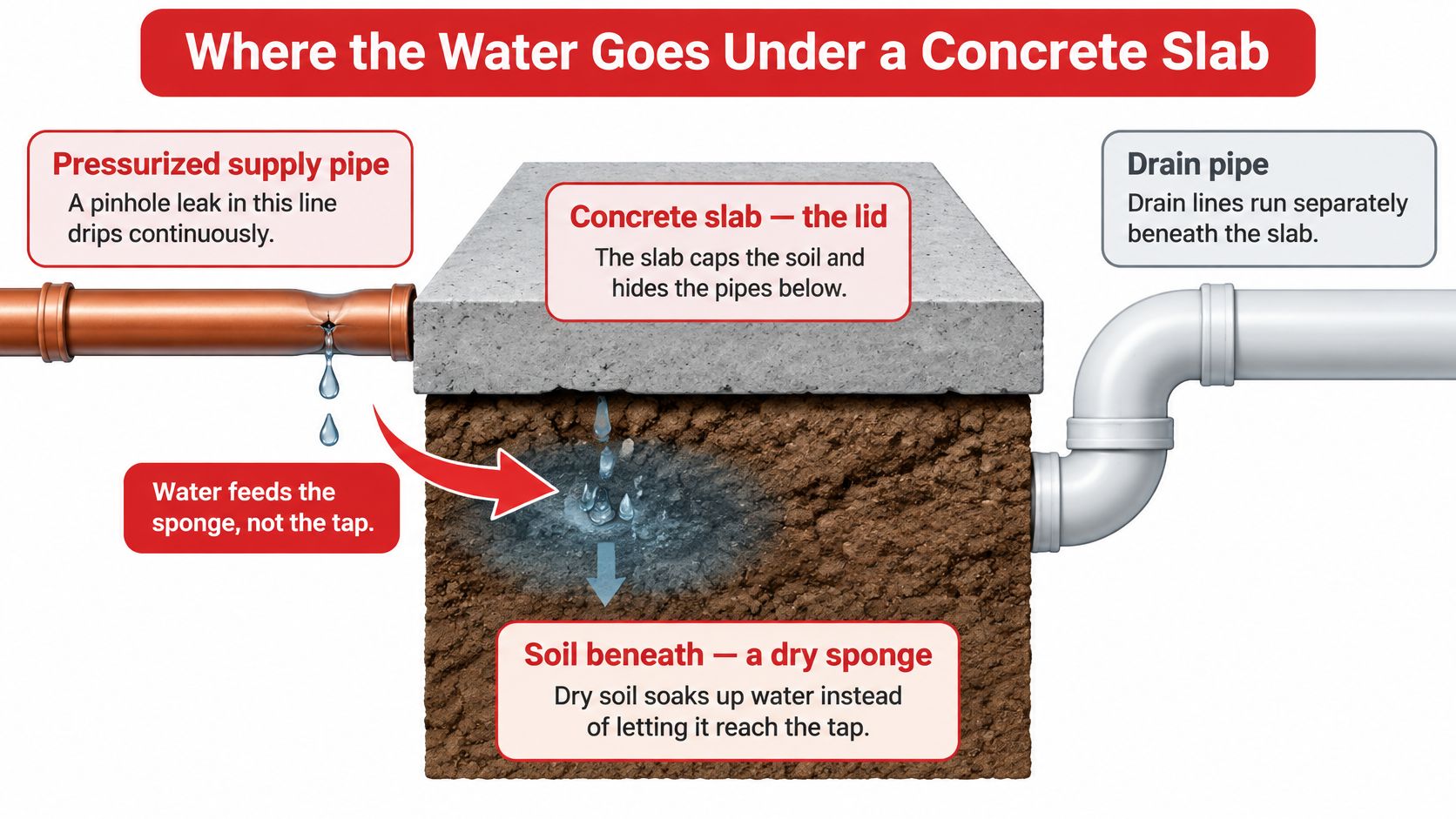
Think of the concrete as a lid and the dry soil beneath it as a sponge. A pinhole in a buried water pipe can feed that sponge instead of delivering all the water to your faucet. The floor above may remain dry while the soil absorbs the loss.
This cross-section shows why the surface can look normal.
Supply pipes and drains behave differently
A hot or cold supply pipe stays under pressure while the water service is on. When that pipe leaks, replacement water passes through the meter even though nobody opens a faucet. A hot-line leak can transfer heat into the slab; a cold-line leak may leave no temperature clue.
Drain and sewer pipes carry used water separately. A damaged drain can release water after bathing or laundry without causing continuous supply-meter movement. Odor, repeated backups, or several slow fixtures call for drain diagnosis, not just supply-line testing.
The same distinction matters when interpreting a wet area. Clean water beneath flooring and sewage near a drain route may require very different equipment and repair plans.
Why the visible wet spot can mislead
Aging copper can develop pinholes in Southern Nevada's hard-water environment, although hardness alone doesn't identify the cause of copper corrosion. Plastic piping can leak at fittings, and older cast-iron drains can deteriorate, crack, or separate. A drain can also sag into a belly that holds water and debris.
Where expansive soils are present, wetting and drying can move the ground around buried plumbing. Soil movement and temperature changes can stress vulnerable joints. The house's construction and pipe material determine which conditions matter most.
Water also follows easier paths through old pipe trenches and loose fill. It can travel before appearing at a slab edge, so the dampest spot isn't necessarily above the break.
A surface stain tells you where water appeared, not where the pipe failed.
The video provides another visual reference for concealed plumbing leaks.
A professional must locate the pipe and account for embedded cables before planning access. Among these concealed pipe failures, a pressurized supply leak is the one expected to keep the supply meter advancing between household uses.
How to Run a Shutoff Water Meter Test
Use this procedure when everyone at home can leave the plumbing alone. Find the homeowner-operated house shutoff first. Don't operate the utility's valve or force a seized valve.
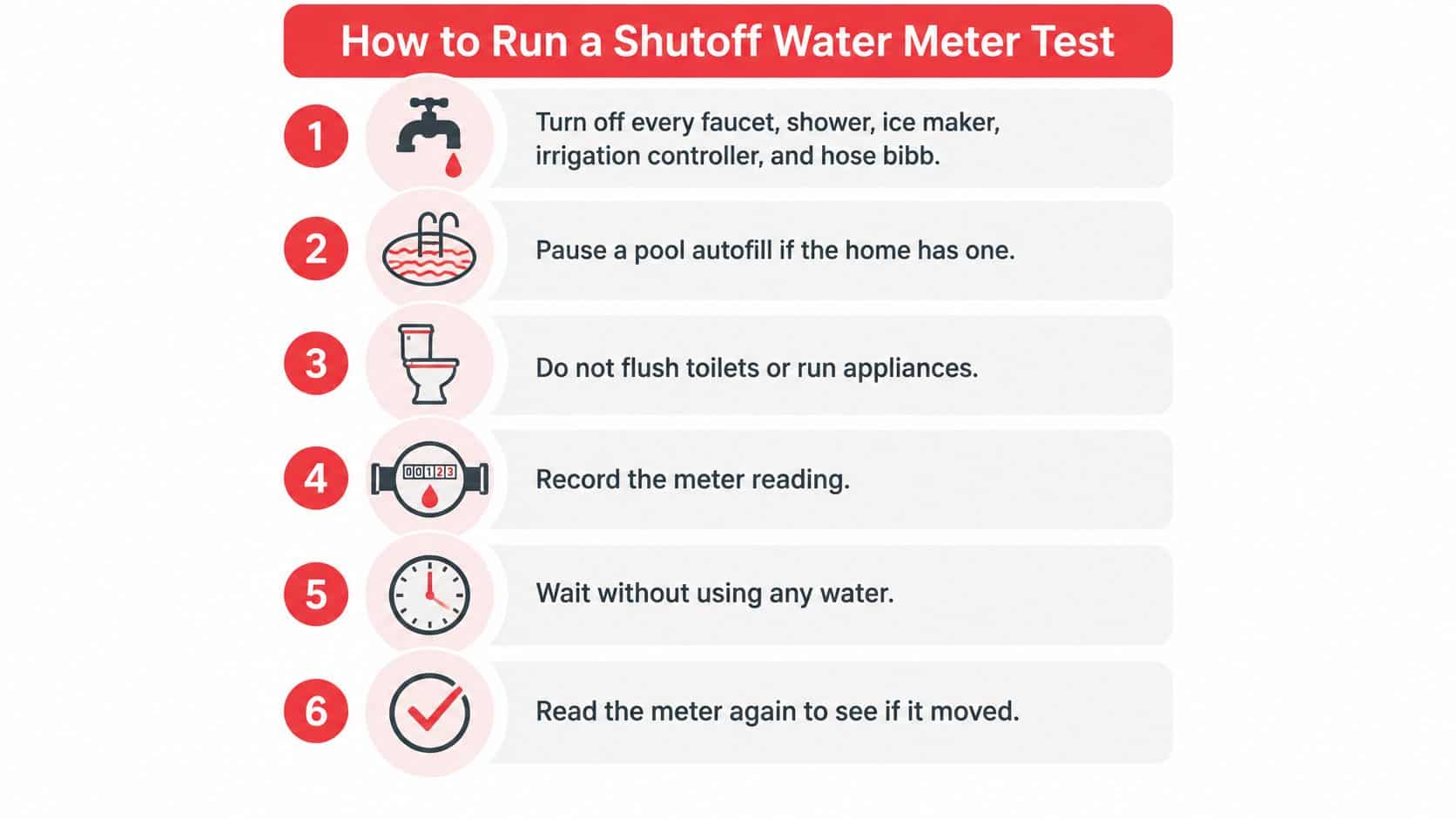
The illustration summarizes the no-use meter check; the numbered instructions add the house-valve isolation needed to interpret it.
Isolate normal use before interpreting movement
Stop all intentional and automatic use by turning off faucets, showers, ice makers, irrigation, and hose bibbs, pausing any pool autofill, and ensuring the water softener isn't regenerating, because automatic equipment can imitate a leak.
Don't flush toilets or run the dishwasher or washing machine during the test, because any refill invalidates the no-use observation.
Record the meter reading and watch for 15 to 30 minutes, checking the low-flow triangle, sweep hand, or digital flow display, because a small continuous loss may be easier to recognize through a changed reading than a quick glance.
Close the house shutoff downstream of the meter and observe again, because that valve separates the plumbing it supplies from the service piping before it.
If the meter stops, record the loss as downstream of the house valve, because closing it removed that portion of plumbing from service; the source could still be a fixture, wall pipe, heater connection, or under-slab line.
If the meter continues moving, record a possible loss between the meter and the closed valve or on a separately supplied branch, because irrigation and pool plumbing may connect before the house shutoff.
Reopen a functioning house valve slowly, let toilet tanks finish filling, then add food coloring to each tank and wait 15 minutes without flushing, because color reaching a bowl identifies tank-to-bowl leakage, commonly through a flapper or flush-valve seal.
Compare floor temperatures along the suspected hot-water route with a shaded area of the same slab and a sunlit patch, because afternoon solar heating can make an innocent floor feel suspicious.
Stop without opening drywall or cutting concrete, because these checks classify the problem but don't establish a safe excavation point.
Record what the plumber needs
Keep a short note with these observations:
- Meter behavior: Whether the low-flow indicator moved during the observation period.
- Valve response: Whether movement stopped after the house shutoff closed.
- Toilet result: Whether dye appeared in any bowl.
- Floor comparison: Which rooms felt warmer along a possible hot-water path than shaded flooring nearby.
A valve that doesn't fully close makes the isolation result uncertain. House-side loss with clear toilet tests calls for locating; continued movement with a confirmed closed valve points toward service piping or another upstream branch.
Slab Leaks Versus Other Plumbing Problems
Treating every mystery as a slab leak can send a repair in the wrong direction. Match the overall pattern across the table rather than choosing a diagnosis from a single symptom.
Which problem the pattern fits
| Pattern | Supply under slab | Drain under slab | Fixture or heater | Irrigation or yard line |
|---|---|---|---|---|
| Meter moves, all fixtures off | Yes | Usually no | Yes if a toilet or valve passes water | Yes if a zone or service line leaks |
| Meter still moves after house valve closes | No | No | No | Yes, if upstream of that valve |
| Warm floor along a pipe path | Often on the hot line | No characteristic warm supply path | Heat usually stays at the heater closet | No characteristic indoor warm path |
| One noisy fixture or tank | Not the usual pattern | Not the usual pattern | Yes | Not the usual pattern |
| Several slow drains | No | Yes | Only the clogged fixture | No |
| Sewage odor indoors | No | Yes | Possible at that fixture or trap | No |
| Wet yard in desert heat | Possible if water travels out | Possible after heavy drain use | Not typical | Common |
Choose the test that fits the system
Meter movement that stops at the house valve, clear toilet dye tests, and a warm floor route support investigating a hot supply pipe beneath the slab. They don't exclude a concealed wall leak. Visible connections and accessible plumbing still need checking.
A still meter with sewage odor and several slow drains suggests a drainage problem. A sewer camera can reveal deterioration, separated joints, or retained water associated with a belly. A blockage or venting problem can produce overlapping symptoms, so that pattern doesn't prove the drain is broken.
A wet heater closet, tank rumbling, or rusty water limited to hot taps shifts attention to the water heater. Hard-water scale can restrict hot-water flow without causing the meter to register use after fixtures shut off.
Account for outdoor branches
Continued flow with a confirmed closed house valve puts the service line and any upstream irrigation or pool branch under suspicion. If testing confirms damaged service piping, main water line replacement in Las Vegas may be relevant rather than opening an interior floor.
The valve's actual location matters. A shutoff near the front wall may leave a length of pipe beneath a porch or attached area upstream, so house-side and yard-side are useful shorthand, not a guaranteed map.
Before approving access: Identify which column best matches the evidence, then have the suspected pipe located.
If no column fits cleanly, more testing is the answer. An uncertain diagnosis isn't a reason to make a larger hole.
Las Vegas Homes Where the Clues Mislead
A warm hallway in North Las Vegas
Say a North Las Vegas homeowner notices a sharply higher bill despite unchanged routines. There's no puddle, but the meter advances with water use off and stops when the house valve closes. The toilet dye tests stay clear.
A hallway also feels warmer than the shaded slab beside it. Comparing that strip with a broad sunlit patch helps separate possible pipe heat from afternoon warming. Together, those observations support locating a hot supply leak, although they don't establish its exact position.
The dry flooring doesn't contradict that possibility. In this scenario, the valve test identifies downstream loss, while the temperature comparison makes sunlight a less convincing explanation.
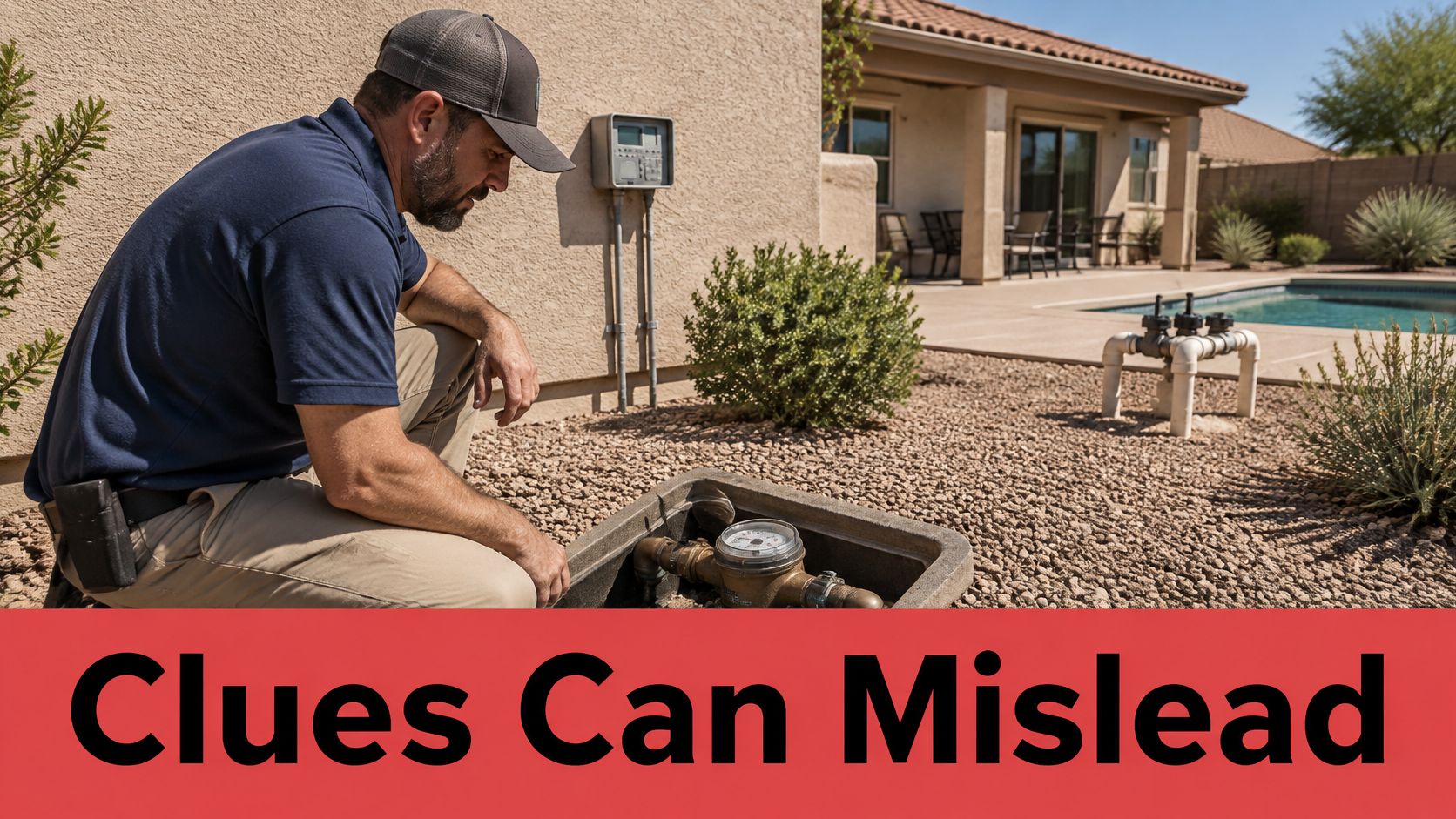
A meter inspection helps establish which part of the plumbing needs further testing.
Sewage odor in Henderson
Consider a Henderson house with sewage odor and two slow tubs, but no meter movement during the no-use check. That combination calls for drain inspection. A damaged or bellied drain is possible, but a camera must distinguish it from a shared blockage or another drainage fault.
An AC condensate problem near a closet generally creates localized moisture and a musty smell rather than explaining multiple slow tubs. The supply test doesn't clear the drainage system. Findings from a camera inspection determine whether sewer line repair in Las Vegas is appropriate.
A disappearing wet spot in Summerlin
Now consider a Summerlin sidewalk that's damp at noon and dry by midafternoon. The meter continues advancing after the homeowner closes a functioning house valve.
That result directs attention toward the yard service line or a separately supplied pool autofill, not automatically beneath the living-room floor. Pausing the autofill and checking the irrigation branch can narrow the next inspection.
Desert heat explains why the surface dries; it doesn't explain away the measured water loss. In this scenario, the valve test is more useful than the appearance of the yard.
Mistakes That Turn a Clue into Damage
A phone app or an ear pressed against tile isn't professional locating equipment. Sound travels through pipes and concrete, and a noisy pressure-reducing valve can imitate a concealed hiss.
Leaving the main valve off for days isn't a repair either. It interrupts household water service while the original defect remains. If you must isolate an active leak, avoid operating water-dependent equipment and get guidance on safely shutting down the water heater.
Avoid fixes aimed at the wrong system
- Don't treat cracks as a diagnosis: Ordinary settling can crack finishes without a plumbing leak.
- Don't rely on lawn color: Desert landscaping may have no grass to reveal escaping water.
- Don't pour drain cleaner at a supply problem: Chemicals can't seal a pressurized pipe.
- Don't request jetting without assessing pipe condition: Hydro jetting cleans drains; it won't correct a belly, and a collapsed or severely cracked pipe can suffer further damage.
The expensive shortcut is opening concrete to search. Post-tension cables require deliberate identification and cut planning. Hydro jetting through an appropriate cleanout isn't the cable hazard; cutting into the slab is.
Your useful stopping point is documented symptoms, a toilet dye check, and a house-valve test, not exploratory demolition.
When to Call a Licensed Las Vegas Plumber
A meter test that confirms water loss after toilet dye checks is a strong reason to call, especially if you also notice a warm floor or rising water use. Sewage odor and several slow drains point to a possible sewer problem under the slab, even when the supply meter remains still.
If water is actively damaging flooring, close the house valve if you can reach it safely, then arrange service. Avoid cutting concrete or leaving the water shut off as a long-term fix.
Locate first, then choose the repair
MG Plumbing Services LLC is a licensed, owner-operated residential plumbing company serving the Las Vegas Valley, led by Miguel Garcia. It offers water leak detection and slab leak repair.
The detection process is to confirm the leak, isolate the line, pinpoint it with tracer gas, then report and repair. Tracer gas can locate a leak within roughly a 3-foot area. After locating it, MG Plumbing Services provides a written estimate and plans concrete access around post-tension cables. A close location narrows the search, but the slab still needs careful assessment before cutting.
The same plumber handles locating and in-house repair. The water leak detection service has same-day appointment availability during business hours, not overnight or 24/7 emergency service.
For homeowners, the key distinction is whether the clue comes from a supply line or the drain system. Leak detection helps locate hidden water leaks, while a sewer camera inspection can help determine whether a broken sewer pipe is causing unexplained water under the slab. The right diagnosis can guide a targeted repair or reroute instead of exploratory demolition.
Call 702-480-8070 or visit the website to request service. Se habla español.