A washing-machine hose lets go before breakfast, and the garage floor in a Summerlin or Henderson house is already slick. Towels feel useful. They are not the first move. Knowing how to turn off water to house, on the property side of the meter and not in the street box, is what stops a spray from soaking drywall, outlets, and the heater closet.
Table of Contents
- Why the House Main Comes Before the Mop
- Where Las Vegas Homes Hide the Main Shutoff
- How to Close the Main and Prove the Water Stopped
- Water Heater and Power Safety After Shutoff
- What to Do When the Valve Will Not Close
- Test and Label the Shutoff on a Calm Day
- Call for Help When the Property Valve Fails
Why the House Main Comes Before the Mop
Say it is Saturday and the washer supply line is fanning water across the garage. The floor drain is losing the race. Someone is already reaching for a mop. Leave the mop. Stop incoming water at the house main before you trace the drip, because every minute the service line stays open is another minute of water you cannot put back.
An angle stop under a sink, behind a toilet, or at the washer is enough only when that fixture is obviously the source and the rest of the house stays dry. The main shutoff is the safer choice when water is spreading, the leak is inside a wall or slab, or outlets and appliances may get wet. A quiet leak is worth isolating too. In 2024, the U.S. Environmental Protection Agency reported that the average household's leaks can waste nearly 10,000 gallons of water per year, about 300 loads of laundry.
Stop the supply, then look for the source. A wet floor is not a diagnosis.
If the water is coming from a slab, a yard line, or a pipe you cannot see, a fixture valve will not save the rest of the house. That is the job for water leak detection after the flow is off, not while it is still running.
What you do next is simple in order, even when the garage is a mess. Find the property-side valve. Close it the way that valve is built. Prove the flow has stopped. Protect the water heater. Get help if the handle will not move. The motion itself is short. A round handle turns clockwise until it stops. A lever swings a quarter turn until it sits across the pipe.
Where Las Vegas Homes Hide the Main Shutoff
Look on the property side of the meter before you open a street box. The Las Vegas Valley Water District identifies several common locations for the main shutoff on valley homes: the front yard near the sewer-riser cap, the garage, or the home's manifold system. Those are the places an ordinary occupant can reach. The curb stop is not one of them.
Walk them in that order. In the front yard, look near the sewer-riser cap for a property-side valve in the meter area. On a garage wall, look for a wheel or a lever on the pipe that enters the house. If the garage is bare, check the utility room or the exterior wall where the service pipe comes in, before the line splits. Newer homes often hide the control in a manifold panel, a row of labeled valves feeding hot, cold, and sometimes irrigation.
Hardware tells you the type. A wheel handle is usually a multi-turn gate valve. A straight lever sitting in line with the pipe is an open ball valve. Older valley houses often tuck that valve low on a garage wall, behind storage bins that have not moved in years. Newer houses often use a manifold so hot, cold, and irrigation can be shut separately. If there is no single main on that panel, the house is off only when every branch is closed.
| Place | What you see | Use it when |
|---|---|---|
| Front yard near sewer-riser cap | Property-side valve near the meter area | Outdoor first check on many LVVWD homes |
| Garage wall | Wheel handle or lever on the incoming pipe | Most common indoor main |
| Utility room or entry wall | Valve before the pipe branches | No valve is visible in the garage |
| Manifold panel | Row of labeled zone valves | Close the main feed, or every branch if there is no single main |
| Anti-siphon valve | Outdoor vacuum breaker on the irrigation line | Annual test only, not the house main |
The meter triangle and the anti-siphon valve
The meter check belongs here, after you have a house valve in hand. LVVWD recommends turning off all indoor and outdoor water first, then watching the red or white flow-indicator triangle on the water meter. If that triangle keeps moving after the home shutoff is closed, the leak is likely in the underground section between the meter and the shutoff valve.
The anti-siphon valve is a different device. It sits outside on the irrigation line as a vacuum breaker. LVVWD says anti-siphon valves should be tested once per year. That yearly test does not shut the house off, and it will not stop a washer hose.
Leave the curb box alone. A street-side valve is hard to turn, and local rules decide who may operate it.
If the only handle you can find is down in the curb box, stop. Improvised tools on that valve are how a shutoff becomes a second leak in the parkway. Call the water provider.
How to Close the Main and Prove the Water Stopped
Stand at the property-side valve you already found. The job is finished only when one open faucet goes quiet. FEMA basic preparedness guidance puts the main on the incoming service line, commonly in a garage, near where the pipe enters the house, or in the meter box, and it treats a valve that was never tested as a valve that may still leave the house pressurized.
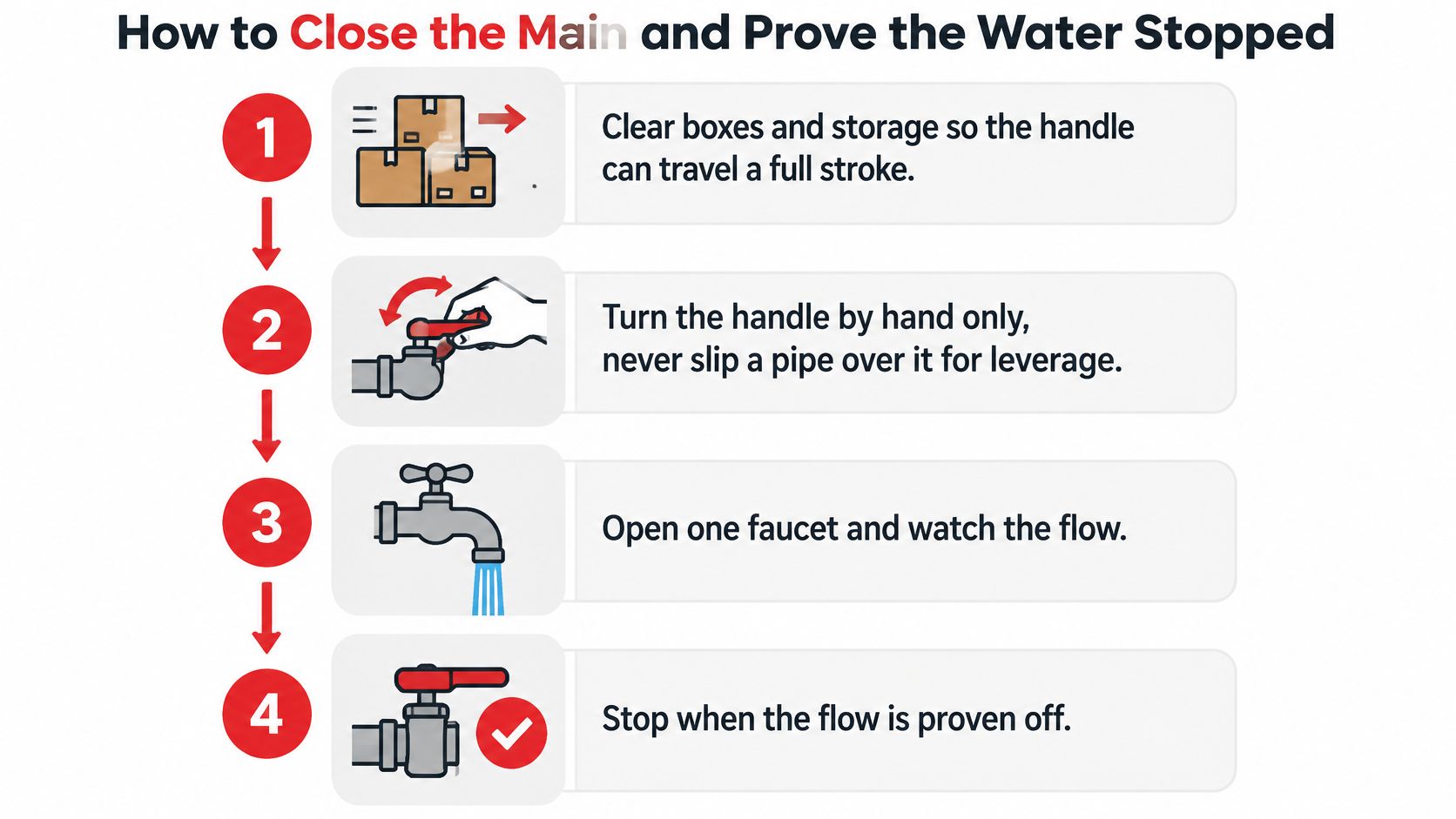
Work this sequence and stop when flow is proven off.
- Clear the stroke. Move boxes and storage so the handle can travel its full arc. Do not slip a pipe over the handle for extra force.
- Close a gate valve by hand. On a wheel-style gate valve, turn clockwise until it stops. These valves take several turns. A handle that merely feels tight can still pass water.
- Close a ball valve a quarter turn. Rotate the lever until it sits perpendicular to the pipe. A lever that is only partly across the pipe is still open.
- Prove it at one faucet. Open a bathtub or sink, preferably on the highest floor. Wait until the stream falls to a drip or stops. That open faucet also bleeds pressure.
- Leave the rest closed. Open more fixtures only if a repair requires the lines to be drained. Toilets, appliances, and irrigation stay off.
- Tag it and tell the house. Mark the valve and make sure everyone knows not to use a faucet, a toilet, an appliance, or the sprinklers until you say the supply is back.
Two false finishes
A gate valve can feel seated and still pass a stream. A ball valve that never reached a full quarter turn is not closed. If the high faucet keeps running, you do not have a shutoff yet.
If the stem resists, stop. FEMA's guidance is direct on this point: do not force a resistant valve or use excessive force, because you can break the stem or the packing and turn the emergency shutoff into an active leak. Pliers and a pipe wrench belong in the same category. I would rather call for a new valve than snap the one that is still holding.
If the valve you found is at the utility meter or the curb, rather than on the property-side service line, local ownership rules may apply. Contact the water provider before you operate it.
Water Heater and Power Safety After Shutoff
The main is closed. The next damage is often the heater, or a breaker you reach by stepping into water. Washington Suburban Sanitary Commission guidance is clear that equipment comes before any real drain-down.
Electric and gas heaters
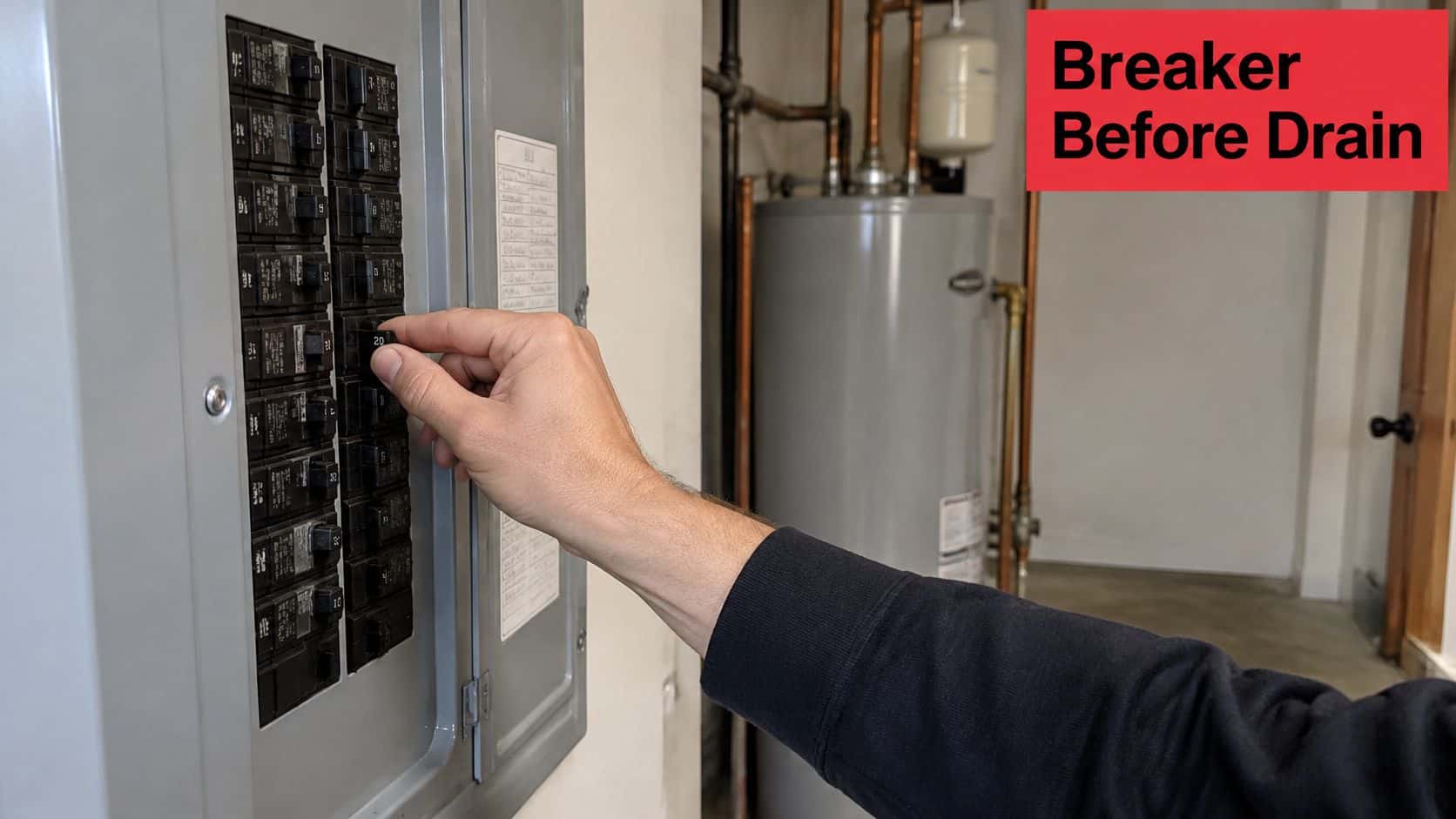
An electric storage heater should be de-energized at its dedicated breaker before you drain it in any serious way. A gas heater goes to pilot only. Shut the gas supply if the tank itself will be emptied. Those steps stop elements or burners from running without water, which overheats the tank and ruins it.
If the leak is the heater, also close the cold-water valve on the heater supply. That isolation sometimes lets the rest of the house come back later without feeding a bad tank. Heater work after that point, including a tank that has been run dry, belongs with water heater repair and installation.
Wet floors and gas appliances
Power is a separate problem from the water valve. FEMA recommends turning off the home's main electrical power and water after a serious water event, and it warns residents not to use gas appliances until a professional has inspected them. If water is near a panel, a washer, or a disposal, disconnect power only from a dry, safe location. Do not step into standing water to reach a breaker. After a serious flood, do not relight gas appliances until a qualified person has checked them.
Putting water back
Restoration is slower than the shutoff.
- Close what you opened. Shut the faucets used to bleed the system.
- Look before you fill. Check the heater pan, the supply connections, and the valve you just used.
- Crack the main. Reopen it slowly. A gate valve may need several counterclockwise turns. A slow refill lets air leave through a faucet instead of slamming the pipes.
- Prove normal flow. Confirm a nearby hose bib or a kitchen tap, then look under sinks, at the heater, and around the valve for new seepage.
A valve that still passes water, weeps at the stem, or will not seat is defective. Replace it or have it isolated. Another hard twist is not a repair.
What to Do When the Valve Will Not Close
Valley water leaves mineral scale on stems, and a tired gate valve often turns a little and then binds. Generic instructions skip that moment. Ready.gov draws a hard line between the house's main valve and the difficult-to-turn street valve in the curb box, and it recommends confirming that the household valve closes completely and replacing it if it does not.
Read the outcome, then use the table. Do not add a tool because the handle disappointed you.
| What you find | What it means | Safe next move |
|---|---|---|
| Handle turns and the high faucet goes dry | Main is closed | Leave it closed until the repair |
| Water still runs after a full turn | Valve not seating | Stop forcing and call a plumber |
| Handle stops partway | Partial close or worn gate | Do not add a cheater bar |
| Water weeps from the stem | Bad packing or cracked body | Stop turning and isolate professionally |
| Handle will not move | Seized stem | Call a plumber or the utility |
| Only a curb-box valve is accessible | Street-side control | Do not improvise; call the water provider |
| Meter triangle still spins | Flow between meter and house valve | Report a service-line leak |
Who should stop, and who should call
A handle that moves and a high faucet that goes dry means the shutoff worked. Leave it. Anything short of that is unfinished. A stem that weeps as soon as it moves can become the new leak through bad packing or a cracked body. An old gate valve that will not budge can snap if you add a cheater pipe, channel locks, or hammer taps.
Renters should call the landlord or property manager before forcing anything. HOA and community managers should use the documented house valve, not a neighbor's irrigation shutoff. Once the emergency is contained, replace a valve that is rusted or will not close all the way. Trusting it for the next Saturday is how the same garage floods again.
Finding a valve is not preparedness. Preparedness is whether an ordinary occupant can shut the property-side valve without creating a second failure.
A seized, broken, missing, or still-flowing house valve goes to a licensed plumber or the water utility. More force does not belong in that phone call.
Test and Label the Shutoff on a Calm Day
The useful test happens while the house is dry, and it takes about ten minutes. Do it once or twice a year. Exercise the handle gently. Do not slam it shut.
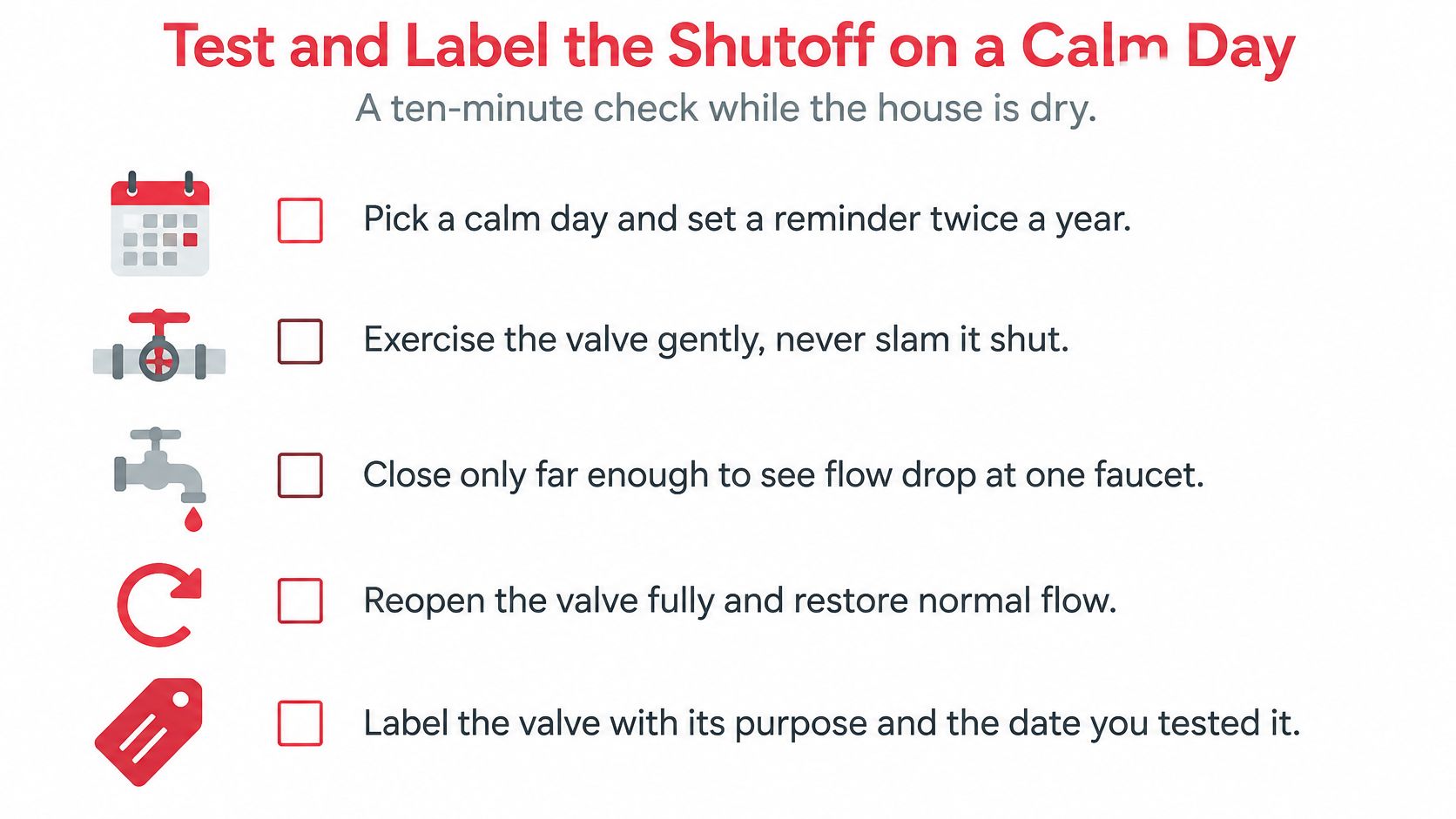
Close the valve only far enough to see flow drop at one faucet, then reopen it fully so a gate valve is not left half seated. If it grinds, weeps, or needs unusual force, schedule a replacement before hard-water scale locks the stem. A stronger tool is the wrong answer to a failed test.
Label the handle in plain words, photograph it, and put that photo where a tenant, a housesitter, or a property manager can find it. Write down whether the yard has its own shutoff, so a sprinkler leak does not require killing the house, and a house leak is not mistaken for a sprinkler valve. Landlords and HOA contacts should document the valve for each unit instead of assuming builder-grade hardware still works.
A valve nobody has operated is an unknown, not a plan.
An automatic shutoff is an optional later upgrade for people who travel. It does not replace knowing the manual valve and proving it will close.
A short walk-through of the handle motion helps if you want to see the quarter turn before you try it on your own valve.
Call for Help When the Property Valve Fails
Call the water utility when the only reachable control is the meter or the curb stop, or when the meter triangle keeps spinning after the house valve is fully closed. That spinning triangle means the leak is on the service line between the meter and the shutoff. Call a licensed plumber when the house valve is seized, broken, missing, or weeping at the stem, when fixtures still run after a full close, or when a slab, yard, or heater-supply leak will not hold.
A failed valve is a control problem, not a reason to keep twisting. On older gate valves, force can snap a brittle stem or break the packet at the wall, turning a shutoff problem into an active leak. Ball valves usually close with a quarter turn, but a stuck handle still needs care. Close it only if it moves freely. If it does not, leave it alone and make the call.
While the visit is being set, MG Plumbing Services LLC will walk you through locating and operating the main water shutoff. Before arrival, close the main only if it moves freely, turn off the water heater, clear a path to the valve, and stop using drains and toilets if sewage is backing up. If sewage is backing out of a drain, stop running water and call as early in the day as possible.
MG Plumbing Services LLC is an owner-operated residential plumbing company. Owner Miguel Garcia holds a Nevada C-1d Plumbing Contractor license and has been a plumber in the trade since 2000. The company provides drain cleaning, hydro jetting, sewer camera inspection, water heater repair and replacement, water leak detection, main water line replacement, PRV and booster pump service, and general plumbing repairs. It serves Las Vegas, Henderson, North Las Vegas, Summerlin, and surrounding valley areas.
Hard-water scale, recurring drain blockages, sewer line problems, hidden leaks, and aging valves are common in Southern Nevada homes. The right diagnostic method depends on the symptom. Cable machines handle standard stoppages, root cutters handle tree roots, and chain knockers or jetters handle hard-water scale. Hidden leaks are located with hydrogen tracer gas, acoustic equipment, and thermal imaging, then the line is isolated, pinpointed, and reported before repair. A failed house valve or a service line that will not hold may lead to main water line replacement in Las Vegas when repair is no longer enough.
Call 702-480-8070 or visit mgplumbingservices.com to request service. Se habla español.
If the property-side valve will not close, or water is still moving after you proved the faucet, MG Plumbing Services LLC can help you shut the supply down safely and repair the valve, the heater supply, or the service line. MG Plumbing Services LLC provides residential service only and will talk you through the shutoff while the appointment is scheduled. Visit MG Plumbing Services LLC or call 702-480-8070 to request service.