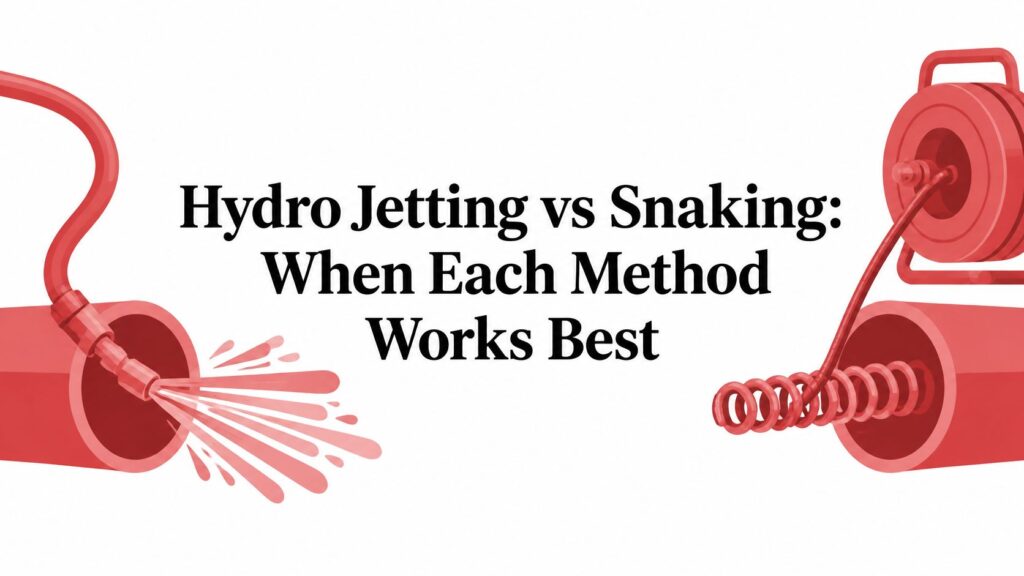
The loudest advice about hydro jetting vs. snaking is often that the more powerful method must be better. That's the wrong test. A snake can restore flow without cleaning the pipe wall, while a jetter can scour buildup but may be unsafe for a damaged line. The right choice depends on what's inside the pipe and whether the pipe can withstand the cleaning method.
For a single sudden sink clog, snaking is often the sensible first move. When blockages keep returning, the next step isn't automatically a bigger machine. It's finding out why they return, preferably with a camera inspection before applying high-pressure water.
Table of Contents
- Hydro Jetting and Snaking Side by Side
- How Each Method Physically Clears a Drain
- Which Method Works on Grease, Scale and Roots
- When Pipe Condition Rules Out Jetting
- What Each Method Costs in the Las Vegas Valley
- Decide the Method After the Camera Shows the Problem
Hydro Jetting and Snaking Side by Side
Snaking opens a passage through a clog; hydro jetting cleans the pipe wall. That difference decides what stays behind in the line after water starts moving again, and how soon the same drain slows down.
Hydro Jetting and Snaking at a Glance
| Factor | Hydro Jetting | Snaking |
|---|---|---|
| What it clears | Scale, grease, roots and debris across the pipe wall | An opening through the clog; wall deposits often stay |
| Force used | Pressurized water in the low thousands of PSI, matched to pipe material; the jetter runs at 3,000 PSI for grease and heavy buildup | Rotating steel cable and cutting head; no water pressure |
| Best fit | Recurring grease, mineral scale, or root intrusion after cabling | A single localized clog, hair, foreign object, or urgent opening |
| Pipe risk | Can worsen cracks, collapse, or fragile joints | Lower hydraulic stress, though aggressive heads can damage weak walls |
| Camera check | Strongly recommended before cleaning | Useful when the cause is uncertain |
| Typical company price | $258 to $361 for a branch line; $534 for a 4-inch main | $267 to cable a main up to 100 feet |
A single hair clog at a bathroom sink is a 10-minute snaking job at a fraction of the jetting price, so reaching for the jetter there wastes money. The opposite holds for a kitchen line that backs up every few months. Punching the same hole through the same grease buys a short reprieve each visit, and the repeat calls can cost more than one cleaning that scours the wall.
Pipe condition sets the ceiling on either choice. A collapsed or severely cracked line rules out jetting entirely because the pressure worsens the damage, which is why a camera inspection belongs ahead of the hose rather than after a failure.
The prices in the table are MG Plumbing Services LLC flat rates for Las Vegas Valley residential work, confirmed in an itemized written estimate before work begins. Camera verification after jetting is available as an $83 add-on for homeowners who want the cleaned wall on video.
A cable can reopen the route through a clog. Jetting is meant to clean more of the pipe that surrounds that route.
How Each Method Physically Clears a Drain
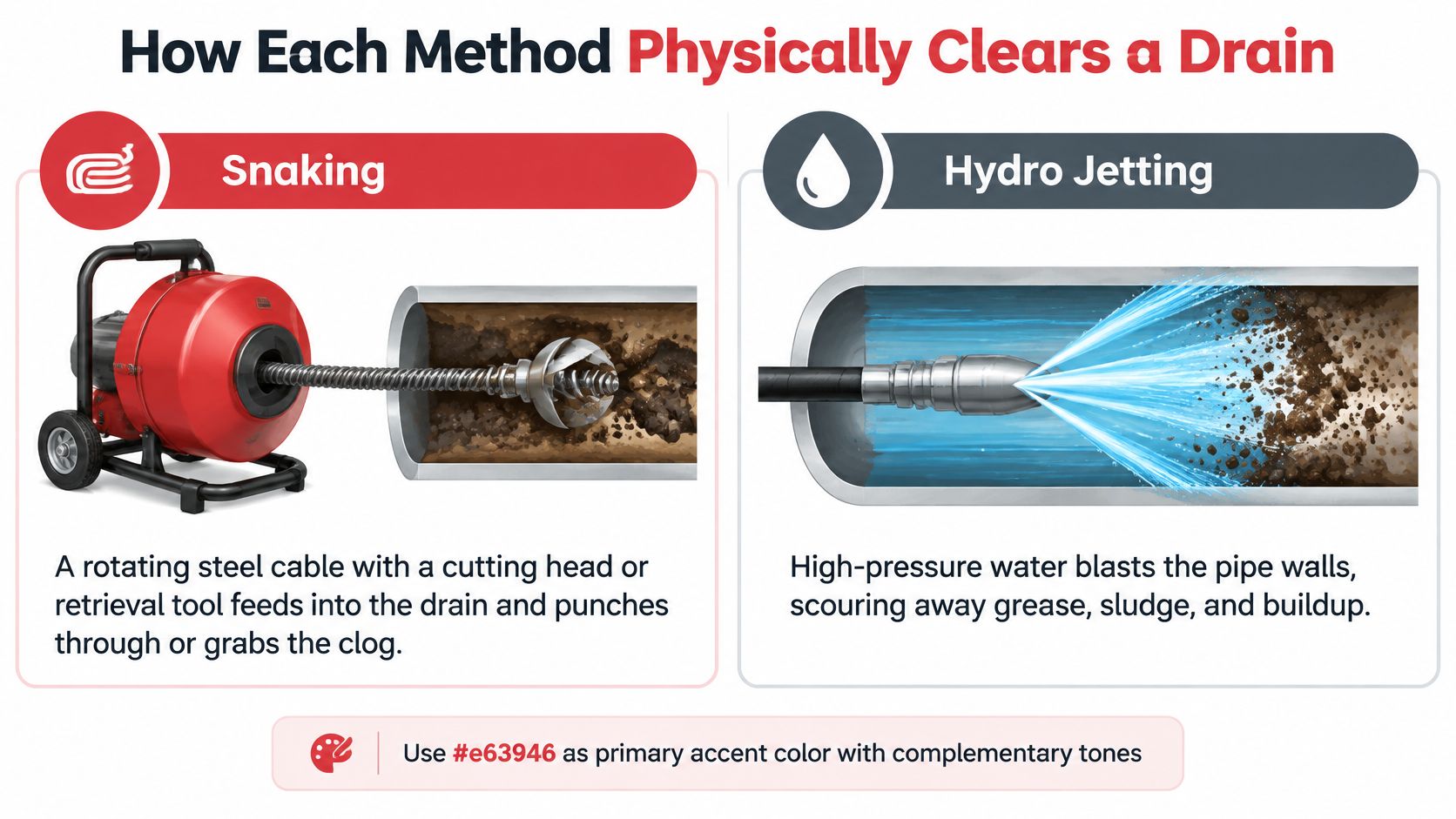
A cable machine and a hydro jetter don't apply force in the same way. One puts a cutting or retrieval tool against a localized obstruction; the other directs water through a nozzle to scour the inside of the pipe and carry loosened debris away. The comparison of drain-cleaning methods from Calculated Home describes that difference as opening a passage versus cleaning a larger portion of the pipe wall.
A cable engages the clog
With snaking, a motorized machine feeds a rotating steel cable into the drain. The plumber selects a cutting head or retrieval tool for the suspected obstruction. The cable can punch through material, break it apart, cut into roots, or grab an object so it can be pulled back.
This mechanical action can get water moving quickly, but it may leave grease, mineral scale, sludge, or root fragments attached to the walls. The drain can seem clear even when buildup still narrows the pipe. That's why restored flow and a clean pipe aren't the same result.
A jetter works along the pipe interior
For hydro jetting, a hose and selected nozzle are fed through the existing sewer cleanout. The setup doesn't require digging or trenching when the cleanout provides suitable access. The nozzle directs pressurized water along the line, scouring deposits and flushing loosened material downstream.
Pressure, measured in PSI, supplies the cutting and scouring force. Flow, measured in GPM, transports the loosened material out of the pipe. Equipment settings and nozzle choice should suit the pipe, including whether the line is cast iron, ABS, PVC, or clay.
Nozzles serve different jobs. Penetrator nozzles target roots, chain knockers work on hard mineral scale, and flushing nozzles move grease and loosened debris. MG Plumbing Services uses a motorized cable machine with cutting heads for standard clogs, a root cutter for tree roots, a chain knocker for hard-water scale, and a hydro jetter for grease and heavy buildup.
The service scope also matters. Pipe jetting targets an individual branch line, while sewer jetting targets the main from the house to the city connection. Descaling adds a mechanical head that grinds hard mineral and rust scale from cast-iron pipe walls. Each process addresses a different part of the job, from the fixture branch to the main line.
Which Method Works on Grease, Scale and Roots
Grease is the largest category in the reported sewer blockage breakdown: it accounts for 47% of reported blockages. The same EPA breakdown cited by Clemson University also reports grit, rock, and other debris at 27%, roots at 22%, and combined roots and grease at 4%, according to the sewer-maintenance guidance citing the EPA figures.
Reported Sewer Blockage Causes
| Blockage cause | Share of reported blockages |
|---|---|
| Grease | 47% |
| Grit, rock and other debris | 27% |
| Roots | 22% |
| Combined roots and grease | 4% |
These shares describe reported public-sewer blockage events, not the failure rate of a Las Vegas home. They help compare the kinds of material that can restrict sewer lines, but they don't predict what's blocking a particular drain.
Grease favors a wall-cleaning approach when the line is sound. A cable may punch a path through a grease mass while leaving grease attached to the pipe. As grease and other deposits collect, the restriction can return. Jetting is designed to dislodge buildup around the interior and flush it downstream, rather than just opening a narrow channel.
Roots need a careful sequence. A cutter can penetrate a compact root mass; jetting can then flush loosened fibrous material from the line. For fine roots, MG Plumbing uses a root-cutting nozzle that directs angled water jets at the pipe interior. Heavy root intrusion may call for a cutter attachment, followed by camera verification. Roots can continue entering through cracks or defective joints, so cleaning alone may not resolve the underlying entry point.
Scale is a separate challenge. Hard-water mineral deposits can narrow the pipe, and a cable may not remove a coating spread along the wall. A chain knocker or descaling head may be used to grind hard scale from cast iron, with the cleaning method selected for the pipe's condition.
The contrast is a single hair clog at one bathroom sink. Snaking is usually the practical choice, and that job takes about 10 minutes with MG Plumbing Services, at a fraction of jetting's cost. For help with a localized stoppage or recurring blockage, see the clogged drain service in Las Vegas.
Match the deposit to the method, then confirm the result with a camera.
When Pipe Condition Rules Out Jetting
More pressure doesn't automatically mean better cleaning. The pipe, not the clog, sets the pressure limit. A nozzle can remove deposits, but high-pressure water inside a cracked, displaced, or deteriorated line can worsen an existing defect.
Independent sewer-cleaning guidance recommends adjusting pressure to both material and structural condition. For sound plastic pipe, it gives a maximum of 180 bar, about 2,600 PSI. Where the material is unknown or the line has fractures, deformation, or displaced sections, the recommended maximum drops to 130 bar, about 1,900 PSI. The same BPF Pipes Group guidance on drain and sewer cleaning recommends assessing pipe material, diameter, condition, deposits, and flow, and favors low-pressure, high-volume jetting where possible.
What the camera needs to establish
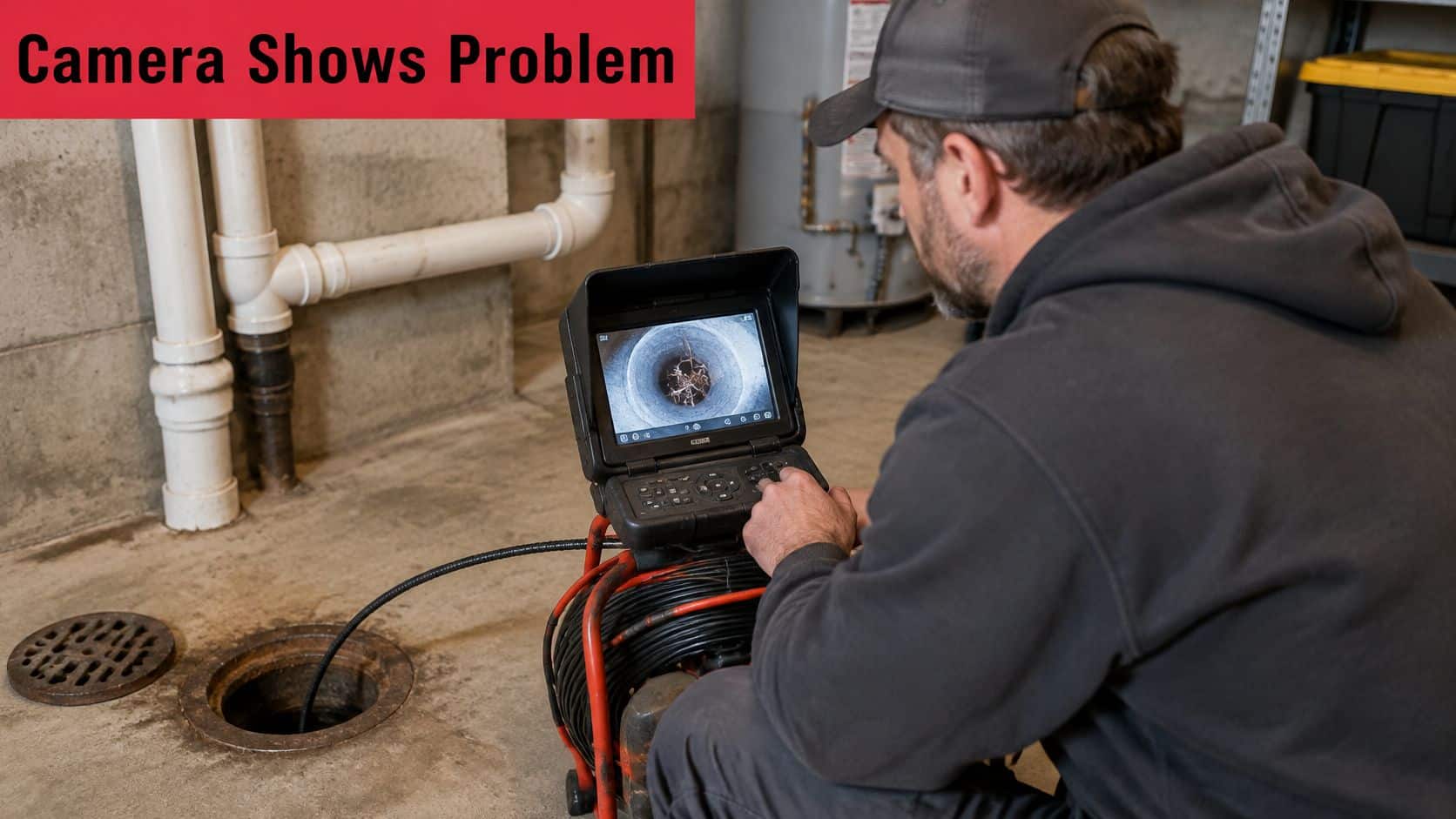
A camera can show cracks, offsets, bellies, thinning, roots, scale, and other conditions that a surface-level symptom can't identify. An older cast-iron pipe isn't automatically unfit for jetting if it remains aligned and serviceable, but its condition should be reviewed first. For older cast iron in sound condition, residential cleaning is commonly done in the 1,500 to 2,500 PSI range after that review.
A collapsed or severely cracked line shouldn't be jetted. MG Plumbing Services won't jet a pipe in that condition because the water can worsen the damage, and a camera inspection is used to catch the problem first. Jetting cleans a line; it doesn't restore a collapsed section or seal a fracture.
Snaking generally creates less hydraulic stress, so it can be the safer initial way to open a questionable cast-iron or clay line. But it isn't risk-free: an aggressive cutting head can damage weakened pipe walls. The plumber still needs to match the equipment to what the camera and other condition checks show.
Cleaning may also expose a failing pipe without having caused the failure. Once deposits are removed, a camera can reveal damage that buildup had obscured. That distinction matters when deciding whether the next step is more cleaning or a repair.
Before high-pressure work, get clear answers to three questions:
- Is the material known?
- Is the line aligned?
- Is it free of fractures and collapse?
What Each Method Costs in the Las Vegas Valley
Line length, buildup severity, and cleanout access affect the scope and price of a drain job. Here are MG Plumbing Services LLC flat rates for Las Vegas Valley residential work, ordered from a localized opening to more involved cleaning.
Flat-Rate Prices for Common Drain Jobs
| Service | Price | Scope and notes |
|---|---|---|
| Snaking a single sink clog | A fraction of jetting cost | About 10 minutes |
| Cable clearing a main sewer up to 100 feet | $267 | Includes a flow test |
| Cable clearing a main sewer from 100 to 150 feet | $427 | Longer runs |
| Hydro jetting a branch line | $258 to $361 | Single branch line; camera verification add-on is $83 |
| Hydro jetting a 3-inch drain line | $427 | Includes equipment setup and cleanup |
| Hydro jetting a 4-inch main sewer at 3,000 PSI and 4 GPM | $534 | Main line flat rate |
| Hydro jetting a main with heavy grease | $641 | Camera inspection recommended |
| Hydro jetting a main with light to moderate root intrusion | $747 | Camera inspection strongly recommended |
A single hair clog at a bathroom sink usually calls for a snake, not a main-line cleaning. The short service is less involved and costs a fraction of jetting. By contrast, a longer main or a line with heavy grease or root intrusion takes different equipment and more work.
The $83 camera verification add-on is available for branch-line jetting. It's particularly useful when the pipe's condition is unknown, because the inspection can help establish whether the line is suitable for jetting and show what remains afterward. You can review drain and sewer service cost estimates.
Quotes are flat-rate, itemized, and provided in writing before work starts, with no after-the-fact add-ons. That makes it easier to compare the actual scope, not just the headline price. Ask what the proposed service clears, whether inspection is included, and what the price covers.
The cheapest visit isn't necessarily the least expensive way to solve a recurring problem. If a cable opening is followed by another backup a few weeks later, repeated service can cost more than a visit that diagnoses and treats the cause. The price difference matters only when the method solves the actual problem.
Decide the Method After the Camera Shows the Problem
The right choice depends less on the clog than on the pipe around it. Judge each method by what it leaves on the wall and by whether the line can hold the result:
- One isolated stoppage: snake first. A hair clog at a bathroom sink takes about 10 minutes.
- Repeated slow drainage or a quick return after cabling: inspect with a camera, then jet if the pipe is sound.
- A structural defect: repair or replace the affected section before any aggressive cleaning.
A cable breaks through or retrieves a localized obstruction. Jetting removes deposits bonded to the interior. Neither one straightens a displaced joint, rebuilds a collapsed section, or seals a crack. That is why repeated snaking can reopen the same passage on every visit without touching the residue or defect that closes it again.
Read the camera findings before choosing equipment
Cracks, offsets, and thinning walls are conditions to weigh before any pressure goes into the line. Roots point to an entry path: a cutter or jet clears material from the flow path, but a defective joint still admits new growth. Scale and grease on a sound line are the opposite case, because those deposits justify a full wall cleaning rather than another hole punched through them.
A belly or back-pitched section needs particular attention. Jetting clears the buildup, but the low spot keeps holding water and material, so the clog returns. MG Plumbing Services recommends repair over cleaning when the line has a belly or back-pitch.
Camera inspection requires no digging. The line is accessed through a cleanout or drain opening, which matters in homes with drains beneath the slab. For buyers looking at older Las Vegas neighborhoods, where cast-iron drain lines under the slab are common, a pre-purchase camera inspection shows the pipe's condition before the sale closes.
| Situation | First step | Why it matters |
|---|---|---|
| One sink or tub clog with no earlier backups | Snaking | Fast, low cost, and the usual first tool for a single stoppage |
| Repeated slow drains or quick return after cabling | Camera inspection, then jetting if the pipe is sound | Clears wall deposits a cable leaves behind |
| Grease-heavy kitchen line | Cable opening, then jetting after camera review | Grease stays bonded to the wall and restricts flow again |
| Tree roots in the main line | Root cutter, jetting, then camera verification | Roots regrow through defective joints |
| Collapsed, cracked, or back-pitched line | Camera and repair, no jetting | Pressure worsens structural damage and cleaning cannot correct slope |
| Older home with unknown pipe material | Camera before high-pressure work | Confirms material and condition, which set a safe pressure |
Follow a condition-led work sequence
- Inspect first when the cause or material is uncertain. A camera shows whether the problem is a clog, wall deposits, roots, or structural damage. MG Plumbing Services performs sewer camera inspections in Las Vegas for exactly this step.
- Match the nozzle and pressure to the pipe. Penetrator nozzles handle roots, chain knockers handle hard scale, and flushing nozzles handle grease, with PSI adjusted for cast iron, ABS, PVC, or clay. Pipe condition matters more than the strongest setting.
- Jet from the existing sewer cleanout. With suitable access, the hose enters the line without digging, trenching, or disturbing the yard.
- Open a fully blocked line mechanically if needed. A cable restores enough passage for water to drain so the camera or jetter can work.
- Verify the result. A post-job camera pass checks for remaining deposits or roots and shows whether a structural problem still needs attention.
Most residential hydro jetting jobs run 1 to 2.5 hours including jetting and post-job verification. MG Plumbing runs a single truck with the jetter, camera, and nozzle set on board, so there is no equipment rental delay and the plumber who quotes the job is the plumber who does it.
MG Plumbing Services LLC provides residential snaking, hydro jetting, sewer camera inspections, and drain and sewer diagnosis across the Las Vegas Valley. If a clog keeps returning, call 702-480-8070 or visit MG Plumbing Services LLC for a camera-led recommendation and written pricing. Service is available in English and Spanish across Las Vegas, Henderson, North Las Vegas, Summerlin, and nearby communities; the company does not offer 24/7 emergency plumbing.