Hydro jetting is safe for an old pipe when a camera inspection shows the pipe is structurally sound and the pressure is matched to its material and condition. Moderate buildup in a sound line is commonly cleared at 2,500 to 3,000 psi, while a pipe with a documented structural failure shouldn't take full-pressure water at all.
The number that decides the outcome isn't the year the house was built. It's the wall thickness, the joint condition, and the setting on the pump.
Take two Las Vegas homes on the same block, both with cast iron laterals. One went in during 1962 and still has a clean bore with tight joints. The other was patched twice in the 1990s and has a crown eaten down to a thin shell that holds together mostly out of habit. Pipe age files them in the same drawer. A camera puts them in different ones.
That's why Is hydro jetting safe for old pipes has no single yes-or-no answer, and why any company that quotes a pressure before it looks inside is selling you a coin flip. The work is matching the tool to the pipe that's under the slab.
Table of Contents
- When Hydro Jetting Is Safe for Old Pipes
- Why Pipe Age Alone Does Not Decide the Answer
- When Another Cleaning Method Is Safer
- Pressure and Nozzle Settings That Protect Old Lines
- Signs an Old Line Needs Repair Instead
- Book a Camera Inspection Before You Jet
When Hydro Jetting Is Safe for Old Pipes
Hydro jetting is neither safe nor unsafe because a line is old. It's safe when a camera confirms the pipe still has the structural capacity to carry the water load, and the pressure is dialed to the material. Skip the inspection, run the pump at full output, and you're guessing with a machine that can deliver far more force than a failing pipe will tolerate.
The verdict splits by condition, not by decade.
| Pipe condition | Jetting verdict | First action |
|---|---|---|
| Structurally sound cast iron, clay, or PVC with grease or scale | Safe when pressure is matched to the material | Camera inspect, then jet with a flushing nozzle |
| Condition unknown or not yet inspected | Do not assume it is safe | Camera inspection before any high-pressure pass |
| Corroded, thinned, or brittle walls | Risky; jet only at the lowest effective pressure, or not at all | Review the camera findings with the technician before jetting |
| Cracked, open, or displaced joints | Risk of enlarging the defect | Plan the repair before cleaning |
| Belly or back-pitch in the line | Clears the clog, but the clog returns | Repair the slope |
| Collapsed or severely cracked section | Do not jet | Repair or replace the section |
The first row is where most of the work happens, and it's also where the pressure question matters most. Moderate buildup in a structurally sound pipe is commonly addressed at 2,500 to 3,000 psi, while pipes with documented structural failure shouldn't receive full-pressure water cleaning, according to GetEco's hydro jetting guidance.
Row two is the one homeowners skip. An uninspected line isn't a neutral case, it's an unknown one, and the honest answer is that nobody knows until a lens goes in. Arrow Sewer & Drain's drain-cleaning guidance recommends camera inspection before jetting and puts interior residential drain lines in the 1,500 to 2,500 psi range, with exterior sewer pressure calibrated to the camera findings rather than set as a default.
The rule I'd give a homeowner: no camera, no jetting. The inspection costs a fraction of a repair, and it's the only thing that tells you which row of this table your line belongs in.
Las Vegas has one useful wrinkle here. For post-tension slab homes built after 1980, jetting through cleanouts above the slab is safe, and the risk sits in concrete-cutting work rather than in the jetting itself.
A drain that runs clear when the technician packs up tells you water went down. It doesn't tell you the pipe is sound.
Why Pipe Age Alone Does Not Decide the Answer
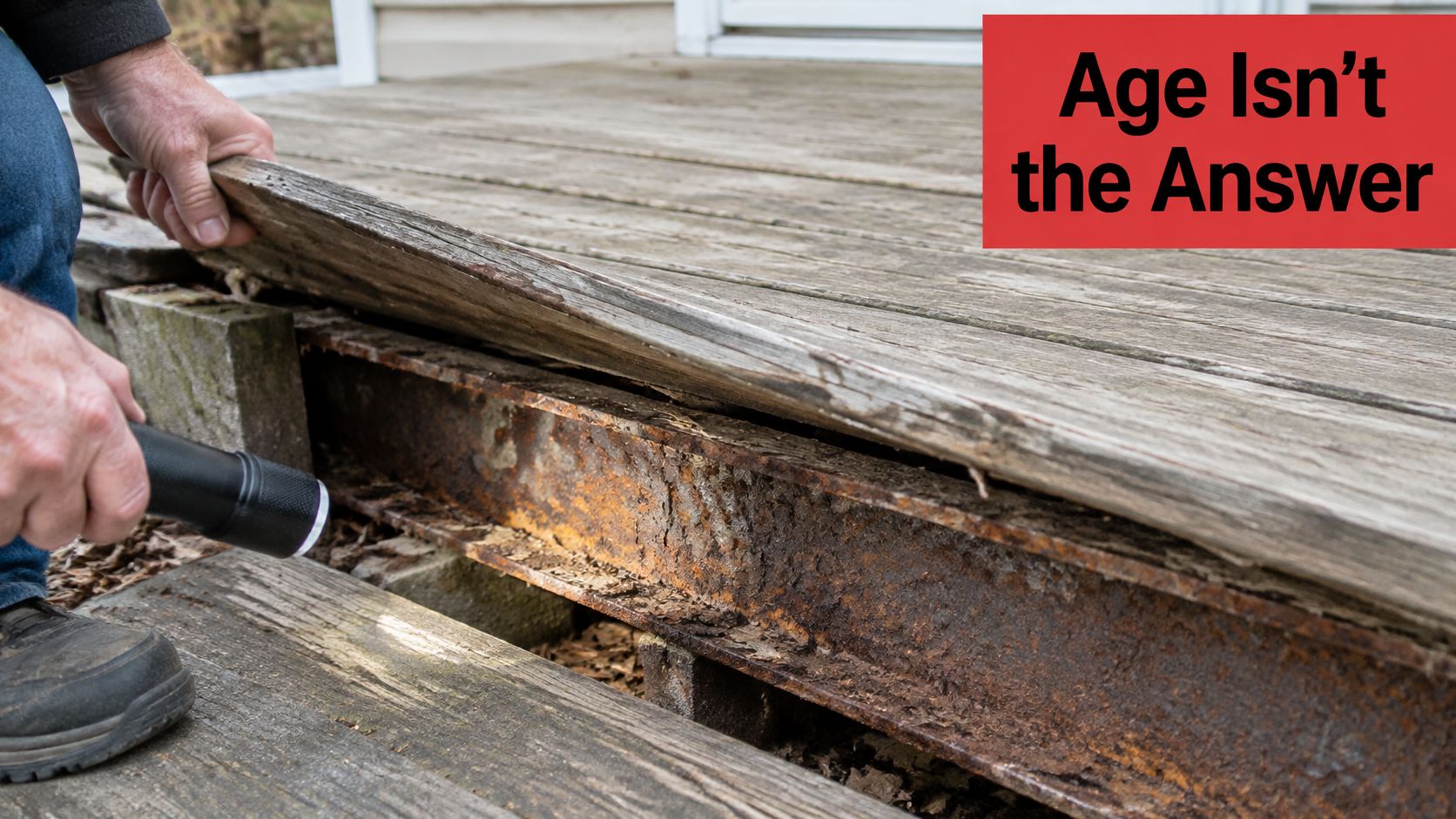
Pipe age is a weak proxy for pipe condition, and the two get confused constantly. A wooden deck makes the point. The boards look fine from above. Underneath, a beam has rotted or rusted through, and the deck holds right up until somebody parks a grill and a crowd on it. The jetter is that crowd. It adds load to a structure that was already carrying less than it appeared to.
The second thing age hides is what the buildup is doing besides blocking flow. Grease, scale, and root mats fill cracks, bridge open joints, and pack into low spots. Some of that material is sealing a defect. Scour it out and you haven't created the problem, you've revealed it, and sometimes you've loosened a fragment that had been sitting tight for years.
The timeline for that weakness has almost nothing to do with a build date. A WaterWorld report on aging infrastructure notes that corrosion can cause some pipe materials to fail in as little as 10 years, while a study it cites identified 531 utilities in the United States and Canada with cast-iron pipe more than 100 years old, with 13 still running cast iron beyond 150 years. The same report cites Boston data showing pit cast-iron water mains averaged 83 years before breaking between 1987 and 1997. Century-old lines that still work and young lines that don't are both entirely normal.
That range is why a technician should never pick pressure from machine capacity. A camera has to answer several questions before the hose goes in.
What the camera has to document
Each finding carries its own decision, and the decision isn't negotiable after the fact.
- Pipe material: cast iron, clay, PVC, or ABS. Material sets the ceiling before condition does.
- Corrosion and wall thinning: a pitted crown means reduce pressure hard or defer entirely. Thin walls don't announce themselves from the surface.
- Cracks, holes, and fractures: these get a repair plan, not a cleaning pass.
- Open or displaced joints: another defect that worsens under force.
- Bellies and low spots: the line clears, then fills again. That's a slope problem, not a cleaning problem.
- Root penetration: note whether roots are bridging a separated joint, since that changes the nozzle choice.
- Partial collapse: stop. Nothing downstream of this decision is cleaning.
Municipal sewer programs already work this way. Triumph Water and Sanitation District's sewer system management plan sends sections back for CCTV inspection whenever the jetter struggles to pass, damage shows up, or roots are present, and it logs repeat hot spots for more frequent inspection and cleaning. A house lateral deserves the same discipline.
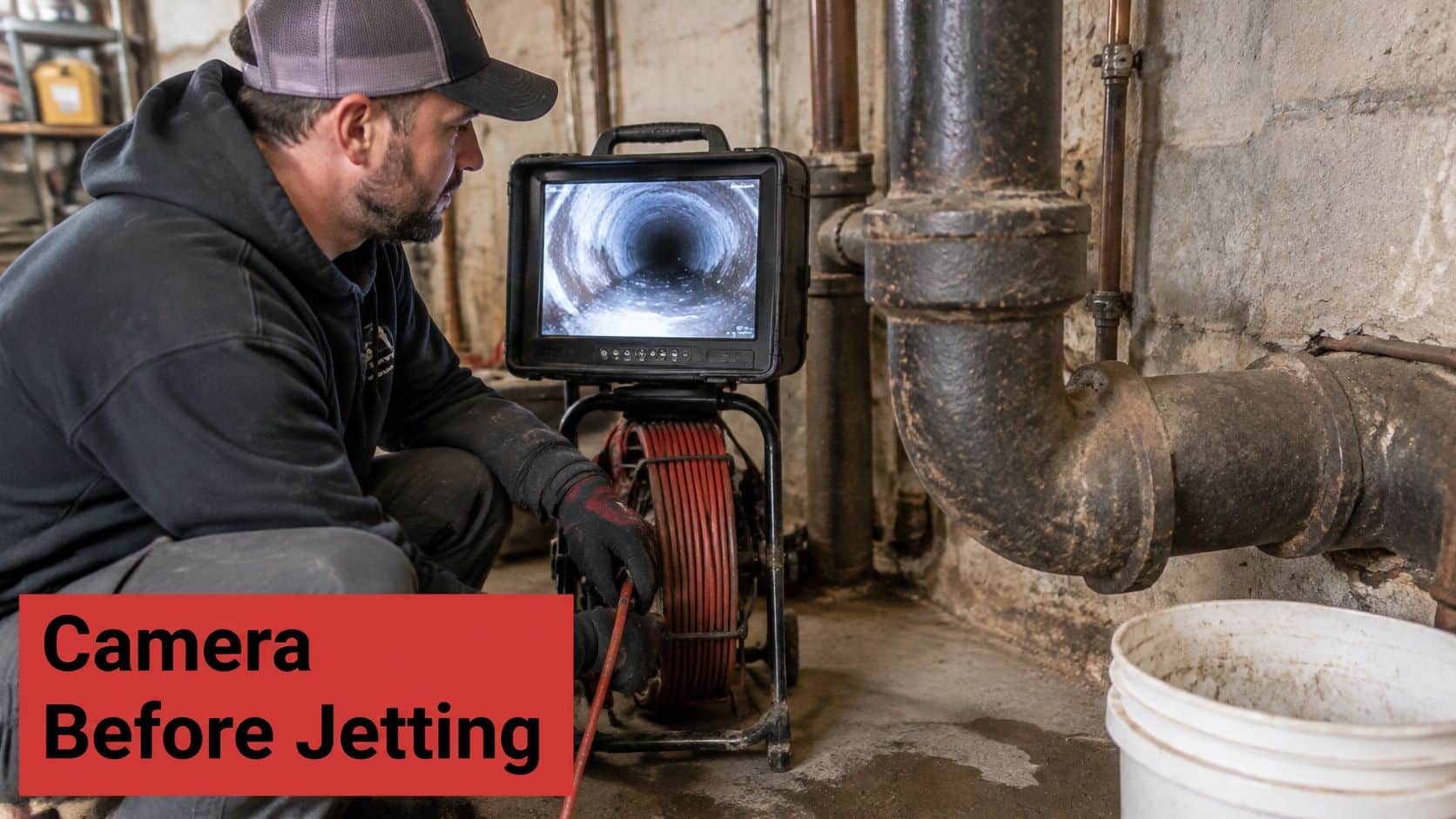
The camera is the gate, not the upsell. If a technician offers jetting first and inspection second, the order is backwards.
Our own process runs that way by default: camera inspection first, pressure matched to the pipe material, jetting from the existing sewer cleanout with no digging, and optional post-job camera verification. When the camera shows wall thinning, cracks, or collapse, the recommendation is repair rather than jetting. A collapsed or severely cracked pipe never gets a pass, because force makes it worse.
Ask for the video, the written findings, and a post-job recording. Those three items are the difference between a cleaning and a diagnosis.
When Another Cleaning Method Is Safer
Use the least force that clears the blockage, then stop. That principle settles most of these calls before anyone unloads a jetter.
A cable punches a channel through the clog. That's enough for a single hair clog at a bathroom sink, which is a ten-minute snake job rather than a jetting call. It's also why a cable can leave grease and scale coating the wall behind it, so the line flows and then slows again within months. Jetting is the right tool when a cable isn't enough and the buildup coats the full circumference.
Where a cable is the better tool
Cable drain cleaning is safe for the older cast iron drain lines common in 1960s and 1970s Las Vegas homes. High-pressure jetting needs more care on damaged or corroded pipe, which is exactly why a camera inspection runs before jetting on older lines. When we handle drain cleaning in Las Vegas, the method follows the blockage, not the equipment on the truck.
What chemical cleaners actually cost you
Store-bought drain cleaner looks like the cheap option and usually isn't. They generate heat that damages PVC joints, corrode cast iron, rarely remove the full clog, and leave caustic water sitting in the line that makes a later camera inspection harder to read. A bottle of lye doesn't clear a root mat or a grease shelf. It just makes the next visit more complicated.
The order of operations is short:
- Locate the blockage. Which fixture, which branch, which section of main.
- Inspect with a camera when the line is old, has been jetted before, or backs up repeatedly.
- Choose the method that fits the defect. Cable for a simple stoppage, jetting for full-wall buildup in a sound pipe, repair when the camera shows the pipe is the problem.
A practical comparison: a cable answers "can I get through?" Jetting answers "can I clean the wall?" A camera answers "should I do either?" Only one of those questions is about the pipe's future.
Repeated snake calls on the same line are a signal, not a solution. When the same drain stops twice in a season, the next visit should start with a lens rather than an auger.
Pressure and Nozzle Settings That Protect Old Lines
Pressure is a decision, not a default. These are the reference points that matter for residential work.
| Job or pipe case | Nozzle | Pressure reference |
|---|---|---|
| Soft debris and light grease in a sound line | Flushing nozzle, low pressure and high volume | About 60 bar (870 psi) |
| Heavier deposits in a sound line | Flushing or descaling head | 80 to 120 bar (about 1,160 to 1,740 psi) |
| Unknown or defective pipe condition | Low pressure, high volume | Maximum 130 bar (about 1,885 psi) |
| Plastics and other pipe materials | Nozzle sized to pipe diameter | About 120 bar (about 1,740 psi) |
| Cured-in-place or rehabilitated lines | Shallow-angle, moving stream | Do not exceed 2,000 psi; operating range about 870 to 1,450 psi |
| Root intrusion | Root penetrator or cutter, then camera check | Start at the low end and raise only as the camera warrants |
| Hard mineral scale on cast iron | Chain knocker or descaling head | Descaling head grinds the scale; keep pressure at the low end of the material range |
Those lower figures come from European pipe-industry best practice collected by TEPPFA: roughly 60 bar (870 psi) is typically enough for soft debris, 80 to 120 bar may be needed for heavier deposits, 130 bar (about 1,885 psi) is the recommended maximum when pipe condition is unknown or defective, and about 120 bar is generally sufficient for plastics and other materials.
The ceiling for rehabilitated pipe is even tighter. A trade publication reviewing waterjetting guidance for cured-in-place pipe reports that nozzle pressure should not exceed 2,000 psi because damage may occur, with a recommended operating range of about 870 to 1,450 psi in the cited manual, and it warns operators not to stop the nozzle in one position and to keep the water-stream angle shallow, per Cleaner magazine's pipe-material guidance. The same article notes that vitrified clay may need more than 5,000 psi at over 125 gallons per minute before a stream turns damaging, which is the whole argument against one universal setting.
Why the gauge lies
The pump gauge reads system pressure, not the pressure reaching the nozzle. Hose length, hose diameter, flow rate, and friction losses all eat into working pressure before the water gets there. A machine showing 4,000 psi at the manifold may be delivering a good deal less at the head, and a technician who sets the job by the number on the dial is working from the wrong number.
Sewer and drain cleaning equipment commonly operates at 10.5 to 28 MPa, roughly 1,500 to 4,000 psi, at flow rates of 30 to 300 liters per minute, and some machines reach 70 MPa, about 10,000 psi, according to a Water Jetting Association of Australia technical paper. Capability is not a target. That same paper ties damage risk to operating parameters and pipe material, not to what the pump can produce.
Match the nozzle to the job
Nozzle choice does as much work as pressure. Penetrator nozzles cut roots, chain knockers break up hard scale, flushing nozzles move grease and sludge, and a descaling head grinds mineral and rust scale off cast iron walls. Pressure gets adjusted for the material underneath: cast iron, ABS, PVC, or clay all behave differently.
Root work deserves its own caution. A cutter shears fine roots off the inside wall, and a heavier cutter attachment handles dense intrusion, but both concentrate force on a small area. Run the camera first to see whether roots are bridging a separated joint, then verify with the camera afterward.
Pipe jetting and sewer jetting aren't the same job either. Pipe jetting targets a single branch line, sewer jetting runs the main from the house to the city connection, and descaling adds a mechanical head to grind hard mineral and rust off cast iron. Each one changes the nozzle, the pressure, and the risk.
Start at the lowest pressure that clears the blockage, and ask the technician to name the pressure and the nozzle before the first pass. A number offered after the work is finished is a description, not a decision.
Signs an Old Line Needs Repair Instead
Picture a homeowner in an older neighborhood who clears a backed-up cast iron lateral in March. The line runs fine. In August it backs up again and jets clear in twenty minutes. By the following spring it's happening every ten weeks, and each pass buys a shorter stretch of peace. The camera finally shows a belly where wastewater sits between cycles. The jetting was never the problem. It was also never the fix.
That pattern is the clearest signal that a line has moved from dirty to failing. The gap between backups shrinking after each cleaning means you're managing a structural defect, not a clog.
The findings that redirect the job
- A belly or back-pitch: jetting clears the buildup, then gravity brings the clog back. Repair the slope.
- Corrosion or measurable wall loss: the pipe is losing section, and cleaning accelerates the loss.
- Separated or displaced joints: force widens the gap and lets soil in.
- Cracks, holes, or a broken section: water finds the soil around the pipe and starts eroding bedding.
- Backups that return sooner each time: the interval is the diagnostic.
A clean line and a sound line are two different results. Jetting can restore flow for months while a defect keeps growing, and that's how a repair becomes a replacement. When the camera shows a failing section rather than a clog, the answer sits in the same family as main water line replacement: you replace the bad length instead of cleaning it again.
Let the camera set the interval, not the calendar
Maintenance schedules should follow pipe condition. Homes with cast iron lines or recurring backups benefit from jetting every 18 to 36 months. Newer ABS or PVC lines often go 5 years or more between passes. Homes with mature trees near the lateral may need a yearly root cut and jet.
That's a starting point, not a subscription. If the record shows the interval contracting, the next step is a repair plan, not another cleaning on a tighter schedule. Fix the slope or the defective section first, then rebuild the maintenance interval from what the camera shows afterward. A root-prone lateral can carry a repeat schedule safely, but only once the camera confirms the pipe can take it.
Jetting is a maintenance tool for sound pipes and a diagnostic risk for failing ones. Knowing which you have is the entire job.
Book a Camera Inspection Before You Jet
The next step is a camera inspection, not a quote for jetting. Ask for four things in writing before anyone runs a hose into the line.
- The pipe material identified on the recording, not guessed at the cleanout.
- Documented defects, with locations measured from the access point.
- The proposed pressure and nozzle, stated before the first pass.
- A post-job video showing the cleaned line, not just a verbal all-clear.
Those four answers tell you whether jetting is appropriate, at what setting, or whether a repair has to come first. Most residential hydro jetting jobs run 1 to 2.5 hours including the post-job verification, so the inspection adds time to the visit rather than a second appointment.
MG Plumbing Services LLC handles this as one job. Owner Miguel Garcia is a Nevada-licensed C-1d plumbing contractor and journeyman plumber with more than 25 years in the trade, and the company pairs jetting with a sewer camera inspection so the pipe condition is documented before any high-pressure pass. When the camera shows structural damage, the recommendation is repair, not a cleaning that buys six weeks. Residents can book a sewer camera inspection in Las Vegas and get the findings in plain language.
Residential hydro jetting in Las Vegas typically runs between $258 and $670 depending on line length, buildup severity, and cleanout access. That range assumes the pipe can take the work. A camera first is what decides whether it can.
Call 702-480-8070 or visit mgplumbingservices.com to schedule. Se habla español. MG Plumbing Services LLC serves homeowners in Las Vegas, Henderson, North Las Vegas, Summerlin, and the surrounding Las Vegas Valley, and works residential calls rather than commercial or 24/7 emergency service. Book the camera first. Then decide on jetting.
If your line is backing up again and you're not sure whether it needs cleaning or repair, MG Plumbing Services LLC can run a sewer camera inspection first and tell you which one you're facing before any high-pressure work begins. Miguel Garcia and the team jet only what the camera shows can handle it, and they'll put the findings and the proposed pressure in writing so you can approve the job with real information instead of a guess. Visit MG Plumbing Services LLC or call 702-480-8070 to get the line looked at.