Hydro jetting is worth it when inspection shows grease, scale, sludge, or manageable roots coating a structurally sound residential line. It's not worth it for a one-time localized clog, or for a pipe that's cracked, offset, bellied, or collapsed.
Popular advice treats a cleaner pipe as a fixed pipe. It isn't. If you're asking is hydro jetting worth it, start with pipe condition, not pressure, and don't pay for a longer clean on a line that needs repair.
Table of Contents
- When a Repeat Backup Raises the Jetting Question
- Situations Where Hydro Jetting Is Worth the Cost
- How a Jet Differs from Cable Cleaning
- Why the Camera Decides Before Any Pressure
- Grease Scale and Roots the Jet Can Strip
- Book a Camera Before You Pay for Jetting
When a Repeat Backup Raises the Jetting Question
Say a Las Vegas Valley house gets a cable cleaning, drains fine for a couple of months, then the kitchen sink slows and the tub gurgles again. That's the moment jetting enters the conversation. A clogged drain service in Las Vegas should explain why the clog returned before selling a stronger cleaning.
If the pipe wall still holds a film of grease or a crust of hard-water scale, a cable can reopen the middle while leaving the material that catches the next load. Jetting scours that wall. That's a real difference, and it's where the extra money can pay.
A Clean Is Not a Repair
The contrarian point is simple. Jetting doesn't straighten a belly, close an offset joint, or rebuild cast iron that's thinned from corrosion. Scouring a failing lateral can restore flow for a while and still leave you buying another backup, plus the repair you delayed.
Flow restored and pipe repaired are two different jobs. Get the proposal to say which one you're buying.
Southern Nevada homes make this distinction harder because problems travel together. Hard-water mineral narrows older cast iron. Kitchen grease sticks to that rough surface. A main line can back up repeatedly even though no single object caused the stoppage.
Your first task isn't comparing a snake price with a jet price. Match your last clog to a situation in the table that follows. One isolated plug points one way. Repeated slow fixtures, a greasy kitchen branch, or scale around the full circle point another way.
If several fixtures share the symptom, think about the run they share, not the fixture where you noticed it first. A tub that gurgles when a toilet flushes is telling you the restriction sits downstream. That's useful information before anyone brings equipment inside.
Situations Where Hydro Jetting Is Worth the Cost
| Situation | Worth hydro jetting | Better move | Why |
|---|---|---|---|
| One hair, paper, or small-object clog at a single fixture | No | Cable or snake | Opens a local plug for a fraction of the cost and time |
| Grease or sludge film, kitchen line or several slow fixtures | Yes, if the pipe is intact | Hydro jet the affected run | Scours residue a cable leaves on the wall |
| Hard-water scale on cast iron with continuous walls | Often yes | Jet with a descaling head after camera review | Grinds mineral and rust scale; stop if the wall is already failing |
| Soft roots, joints otherwise sound | Often yes, then plan the joint | Root-cutting jet, then repair or root control | Removes the mass inside; does not close the entry |
| Heavy roots with cracked clay or open joints | No as a lasting fix | Camera, then repair or replace | Cleaning exposes the defect and roots return |
| Belly or back-pitch | No | Correct the slope | Low flow lets grease and debris settle in the sag again |
| Collapsed, severe offset, or badly corroded pipe | No | Spot repair, lining, or replacement | Pressure cannot rebuild missing pipe and can worsen the break |
| Repeat main-line backups, camera shows deposits, pipe intact | Yes | Jet from the cleanout and verify | Restoring the full opening outlasts punching a hole through the center |
The Rows Homeowners Misread
Scale on cast iron tempts people in both directions. A continuous wall with mineral and rust crust can justify a descaling pass because you're removing material from a pipe that still has structure. A flaking, paper-thin wall can't spare more material. The camera separates those two pipes, and age alone doesn't.
Soft roots are a conditional yes, not a cure. A root-cutting nozzle can shear fine roots and flush them out of an otherwise round pipe. Roots entered somewhere, usually a joint, so plan repair or root control after cleaning. If you don't, you've trimmed the plant and left the doorway open.
A belly is the clearest no. Water slows in the sag, grease and solids drop out, and the low spot refills no matter how clean you leave it on day one. Jetting a belly buys an interval, not a solution. Correcting slope is the lasting spend.
Run a Payback Test With Real Quotes
Don't assume a clean lasts multiple years. Slope, grease habits, root pressure, and hidden defects set the interval. Price the decision with two local numbers, one cable visit and one jetting visit, using current cost estimates as a starting reference for the comparison.
- Repeat frequency: Two or three cable calls for the same run change the math fast.
- Damage risk: Add flooring, cleanup, and sewage exposure from a backup that reaches living space.
- Scope match: Jetting a whole greasy run beats repeatedly clearing one soft spot in it.
If one jetting visit costs less than the repeated cleanings and mess you're already paying for, and the pipe is sound, it's rational. If it's a first, single-fixture clog, it isn't.
Keep your row in mind. The tool matters only after you've named the material and the condition of the pipe holding it.
How a Jet Differs from Cable Cleaning
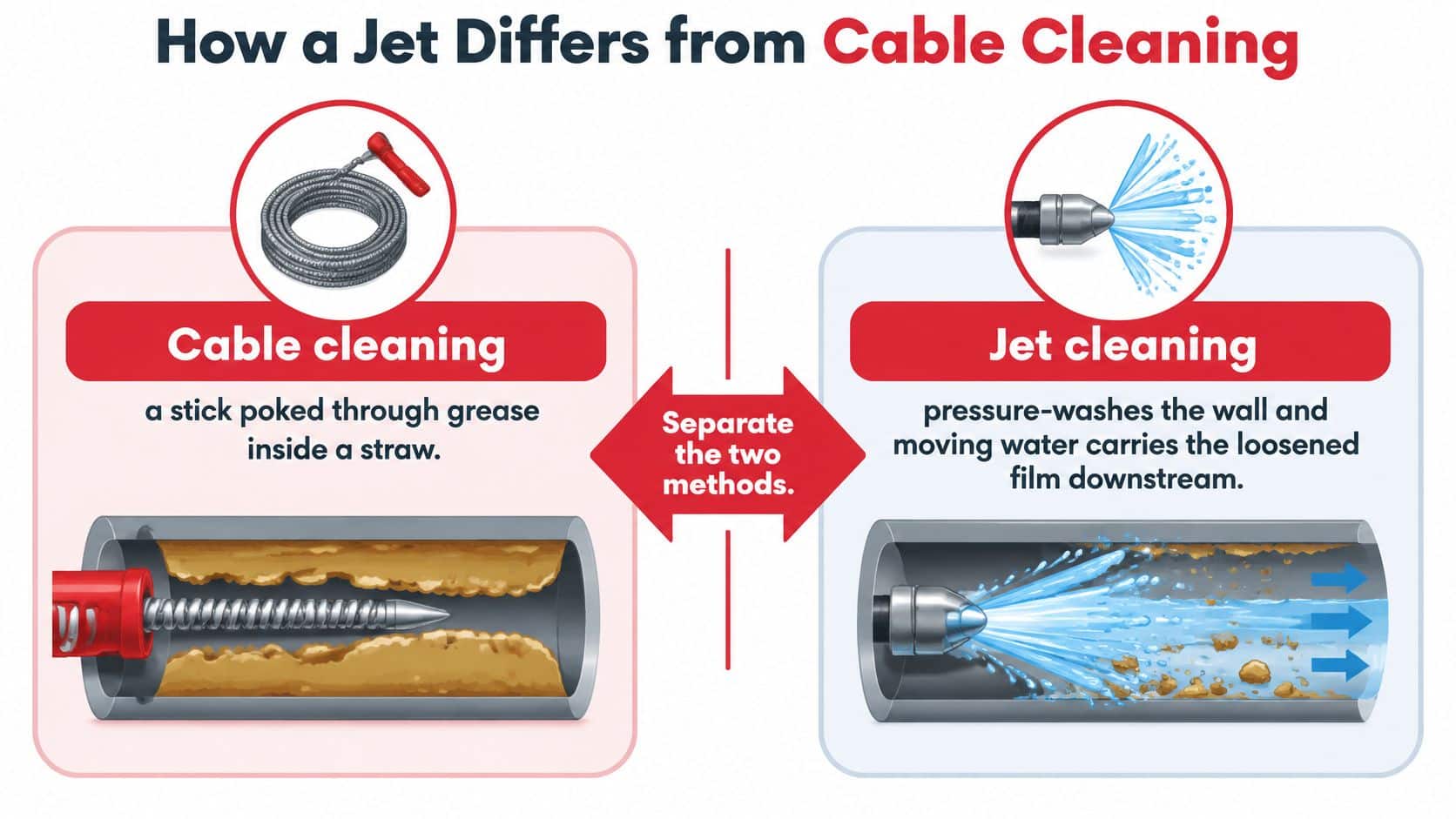
Think of grease inside a straw. A cable is a stick poked through that grease. You get a hole, flow returns, and most of the grease stays on the wall. A jet pressure-washes the straw while moving water carries the loosened film downstream.
The visual below separates those two actions before the numbers get into it.
Pressure Cuts and Flow Carries
Those are separate jobs. Pressure supplies cutting and shearing force at the nozzle. Flow transports what you've loosened so it doesn't settle a few feet later and form a new dam. A high pressure number with weak flow can cut a plug into chunks and leave the chunks in the line.
A wastewater-collection training guide identifies approximately 1,500 to 2,500 PSI and 50 to 80 GPM as standard operating ranges for municipal 6 to 12 inch sewer mains. The same guidance gives roughly 1 to 1.5 GPM per inch of pipe diameter for effective flushing, so a 12 inch line needs about 12 to 18 GPM to transport scoured solids.
Don't copy those municipal figures onto a 3 or 4 inch house line. They're useful because they prove the principle, pressure plus volume, not because your kitchen branch needs a city main setting. Residential work scales pressure, flow, and nozzle to cast iron, clay, ABS, or PVC and to what the camera showed.
Nozzle choice carries as much weight as the gauge. Penetrator tips open a blocked run, flushing tips move grease, and descaling heads attack hard mineral. Angled rear jets pull the hose forward and scour behind it. The wrong tip at the right pressure still does the wrong job.
The U.S. Environmental Protection Agency describes jetting in its sewer cleaning appendix as most effective in smaller, slow-flowing pipes generally below 15 inches in diameter. Municipal specifications in that material set the objective at cleaning until the line is at least 95% open. For a house, translate that plainly. You're paying to restore the opening, not to poke a tunnel through the middle.
This short video shows the nozzle working inside a line, which makes the wall contact easier to judge than any pressure claim.
Cable Cleaning Versus Hydro Jetting
| Criterion | Cable or snake | Hydro jetting |
|---|---|---|
| What it does | Punches a channel through the center | Scours the wall and flushes loosened material downstream |
| Best material | Hair, paper, or one small object | Grease, sludge, mineral scale, or soft roots along a run |
| Where it fits | Fixture branches and short local plugs | Smaller, slower lines generally under 15 inches, including house branches and residential mains |
| How long it holds | Film left behind can catch the next clog | Longer interval only if the pipe is sound and the source is reduced |
| Main risk | Clears the symptom and leaves the cause | Backup into the house or damage if pressure, volume, or route is wrong |
A cable isn't an inferior tool. It's the right tool for a bathroom hair clog, a wad of paper, or a small object near one fixture. Bringing a jetter to that job adds setup, cost, and water volume for no extra result.
Jetting earns its place when residue covers the wall along a run. Grease collars, compacted sludge, and mineral crust don't care that a cable opened the center yesterday. They keep narrowing the pipe until ordinary use can't get through.
Worthwhile jetting is controlled scouring of a known, intact pipe. Maximum pressure on an unknown pipe is just a faster way to find its weak point.
Route matters too. The operator confirms the cleanout, the direction of flow, and where loosened material will go. Sending a hose the wrong way or adding more water than a blocked line can accept can push sewage back into the house. Good jetting starts with access and outlet control, not with the trigger.
Why the Camera Decides Before Any Pressure
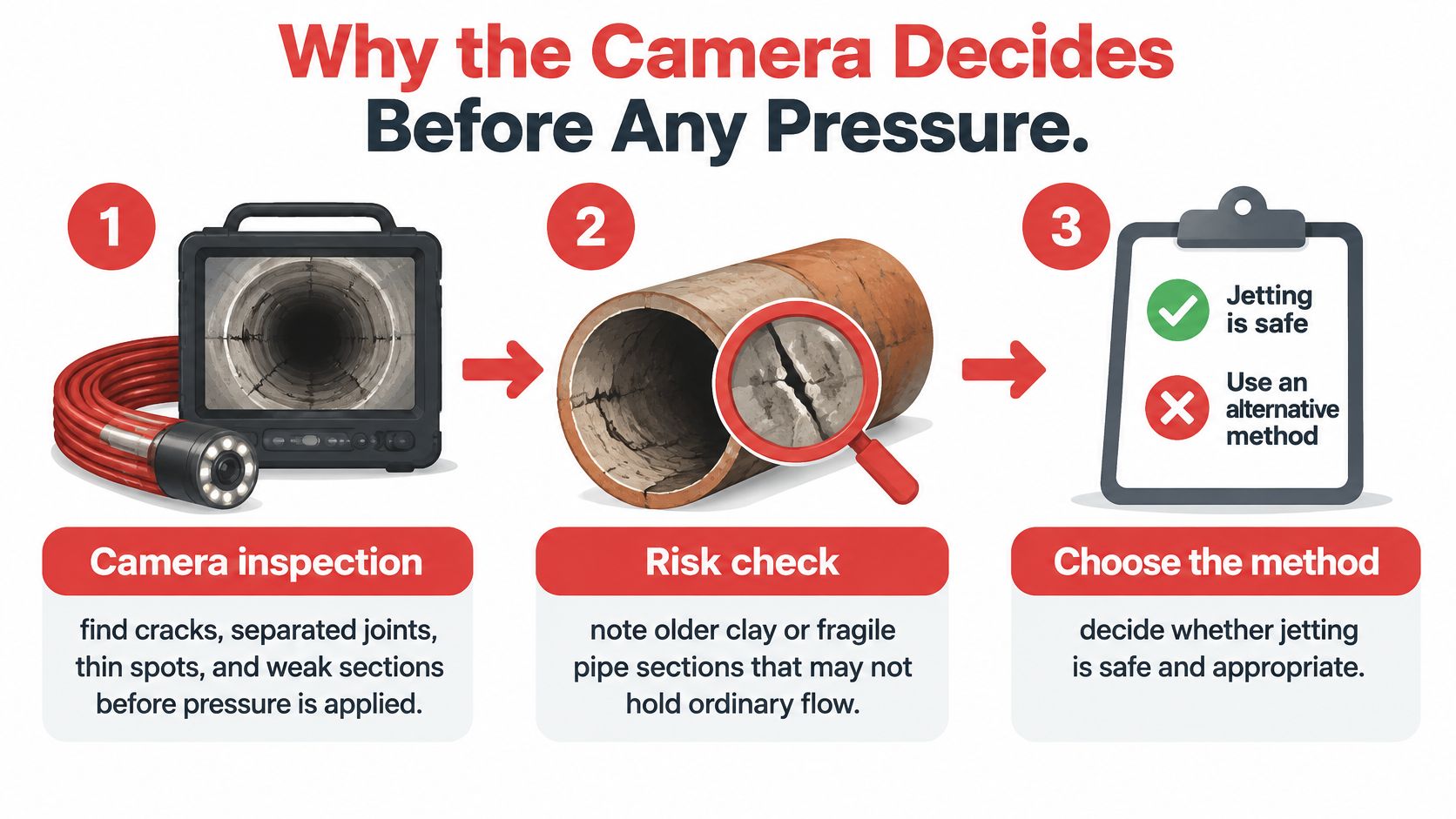
Jet pressure bears on exactly the places a bad pipe can't defend. Cracks open under load. Separated joints leak water into surrounding soil. Thin, corroded spots that barely hold ordinary flow can split when you pressurize them and work a nozzle past.
That's not an argument against jetting. It's an argument against jetting blind.
The sequence in the diagram puts inspection where it belongs, before anyone chooses a nozzle.
The Five Step Sequence to Expect
- Find the cleanout: Use existing access rather than opening the yard or pulling fixtures without reason.
- Run the camera first: Record cracks, offsets, bellies, corrosion, collapse, pipe material, and what the buildup is. A sewer camera inspection in Las Vegas should produce footage you can review, not just a verbal verdict.
- Name the job in writing: State whether the proposal restores flow or repairs pipe. Those scopes carry different prices and different lifespans.
- Jet only a serviceable barrel: Match pressure, flow, and nozzle to cast iron, clay, ABS, or PVC and to the deposit the camera named.
- Verify after cleaning: Run the camera again when heavy buildup hid the wall on the first pass, because a clean pipe can reveal damage the grease was covering.
Older laterals raise the stakes. EPA material on private sewer laterals notes private laterals were estimated at about 40% of infiltration and inflow in one regional assessment, and that vitrified-clay laterals are prone to root intrusion, cracking, joint misalignment, and leakage. Jetting that clay can shave roots and expose the joint. It doesn't seal the joint.
Refuse a Fixed Maximum Setting
Ask a direct question before work starts. Which nozzle fits the material you saw, and what setting fits this pipe? An operator who answers with one maximum number for every house hasn't matched the job to your line. Intact PVC and cracked clay shouldn't get the same treatment because a gauge can reach it.
A belly with perfect cleaning is still a belly. Slow water in a sag lets grease stay put and build again.
Inexperienced jetting creates a second risk inside the house. Too much introduced water, or a hose routed into the wrong connection, can send water back through fixtures. Confirming route and outlet before the jet starts prevents a cleaning call from becoming a cleanup call.
The fork after the camera is clean. Deposits inside a sound line go to jetting. Cracks, severe offsets, collapse, or a wall that's lost its structure go to spot repair, lining, or replacement. Don't let a cleaning quote blur that fork.
Grease Scale and Roots the Jet Can Strip
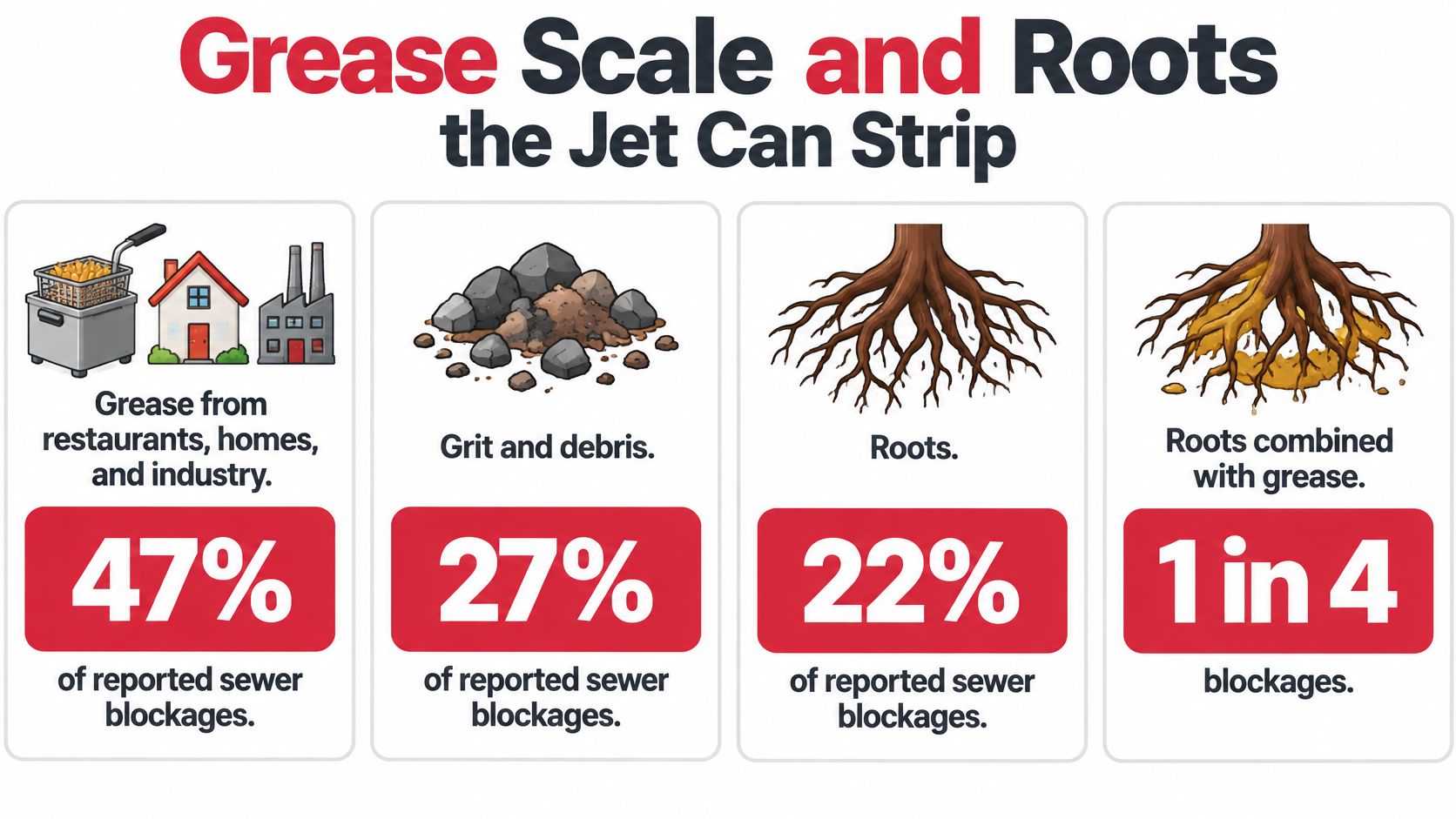
The case for jetting rests on what blocks sewers. In a U.S. Environmental Protection Agency report to Congress, grease from restaurants, homes, and industrial sources accounted for 47% of reported sewer blockages. Grit, rock, and other debris accounted for 27%, roots for 22%, and combined roots-and-grease blockages for 4%.
Translate that to a house. Jetting targets the deposit share. It doesn't fix the break share, and it doesn't change what your household sends down the drain tomorrow.
The panels below put those four causes side by side so you can see how much of the problem is material on a wall.
Three Deposits You Can Match to Your Drain
A grease collar in a kitchen line builds slowly. Bacon grease, oily pans, and food residue cool on the wall and form a soft ring. A snake opens the center, the sink drains, and the remaining ring catches the next load of rice, grounds, and fat. Scouring the full circle removes the catching surface.
A scale crust in older cast iron behaves differently. Hard Las Vegas water leaves mineral behind, rust roughens the surface, and the crust narrows the whole pipe instead of plugging one spot. Flow gets slower across every use. A cable hole through that crust doesn't restore the diameter you lost.
Fine roots at a joint sit on the edge. A tree sends hair roots through a small opening, they thicken in the moisture, and they trap paper and grease. A root nozzle can shear them if the barrel is still round. That root mass is also evidence. Something opened enough to let roots in.
What the Jet Cannot Stop
Household habits refill a clean pipe. Fats, oils, and grease go back on the wall if pans still get rinsed with hot water and hope. Wipes, pads, and tampons don't break down like toilet paper, and a spotless pipe still has joints and bends where they can lodge. Jetting strips what's stuck today. It isn't permission to keep sending the same material.
- Cool and trash grease: Pour cooled pan grease into a container, wipe residue, then wash.
- Trash wipes: Flush only toilet paper, even when packaging uses softer language.
- Watch the pattern: A clog that returns at the same interval points to roots, slope, or a defect, not bad luck.
Roots deserve the hardest look because they blur cleaning and repair. Roots alone plus roots combined with grease make up roughly one-quarter of reported blockages in the EPA split. Cutting them out proves you can clean the pipe. It doesn't prove the pipe is closed to the next root.
Read the camera frame yourself. Grease collar, scale crust, or root hairs point to cleaning. A broken barrel points to repair.
That single distinction decides where your money lasts. Strip deposits from a serviceable line and you've restored capacity. Strip them from a cracked line and you've documented, at jetting prices, why the line keeps failing.
Book a Camera Before You Pay for Jetting
Jetting is worth the price when a camera shows buildup inside a sound pipe. If the video shows a crack, offset, belly, or collapse, cleaning may restore flow temporarily, but it will not fix the defect. Choose repair for a damaged line.
What Our Jetting Visit Includes
MG Plumbing Services LLC recommends a camera inspection before jetting. The technician adjusts pressure for the pipe material and works through the existing sewer cleanout, with no digging. Optional post-job camera verification shows what the cleaning removed and what condition the pipe is in.
Residential hydro jetting in Las Vegas typically costs $258 to $670, depending on line length, buildup severity, and cleanout access. Each job has a flat price, not an hourly rate, and the price is shown before work starts.
Bring Three Facts When You Call
- Which fixtures are affected: One sink may point to a branch line. Several affected fixtures may indicate a shared run or main.
- How often the backup returns: Recurring backups can point to buildup or a pipe defect.
- What has already been tried: Mention whether a snake cleared the line briefly. That history can help guide the next recommendation.
MG Plumbing Services LLC is a licensed, owner-operated residential plumbing company serving the Las Vegas Valley. Miguel Garcia has worked in the trade since 2000. The company offers same-day appointments Monday through Saturday, 7:00 AM to 5:00 PM, and bilingual service in English and Spanish.
Before approving jetting, ask for the camera inspection and a written, flat-rate estimate. If the footage shows deposits in a sound line, cleaning is a reasonable choice. If it shows structural damage, request a repair recommendation instead. Visit MG Plumbing Services LLC to request a camera inspection.