When both bowls of a double kitchen sink back up at the same time, a single clog is stopping both of them. The blockage sits downstream of the point where the two bowl drains join: the shared waste connection, the P-trap, the trap arm, or the branch drain behind the wall. That shared run is short, which is why one deposit of grease or food waste shuts down both basins at once.
Soapy water sits in both bowls. You bail the left side and it refills from the right. The disposal hums, the water doesn't move, and the dishwasher is still half full of dirty plates.
That one detail, both sides together, is the most useful diagnostic clue in the kitchen, and it costs nothing. It narrows the search from the whole drain system to a stretch of pipe you can usually reach with your hands. Run water in the left bowl and watch the right. If it rises there, the two drains have already merged above the blockage and the clog is past that join.
Which kind of kitchen sink clogged both sides problem you have decides which tool you reach for first, and whether you reach for one at all.
Table of Contents
- What a Clog on Both Sides Usually Means
- Safe Checks to Run Before Calling a Plumber
- Vent and Dishwasher Problems That Mimic a Clog
- Choosing the Right Cleaning Method for Both Bowls
- Why Grease and Scale Keep Both Bowls Clogged
- Confirm the Next Step for Your Sink
What a Clog on Both Sides Usually Means
A one-bowl clog and a two-bowl clog have different addresses. When the disposal side alone drains slowly, the restriction usually sits inside that bowl's own parts: the strainer basket, the disposal outlet, or the short tailpiece feeding the shared fitting. When both sides stop together, water you run down one bowl rises in the other, which means the two drains have already merged and the blockage is past that merge point. The drain troubleshooting guide from Armadillo lists the suspects in the order worth checking: the shared waste connection, the P-trap, the trap arm, then the branch drain farther inside the wall.
What a simultaneous backup does not prove is that the main sewer has failed. A grease-plugged P-trap under the cabinet produces an identical symptom at a fraction of the cost. Multiple slow fixtures are the tell, and so is a bathroom sink that gurgles or a floor drain that bubbles when the kitchen runs. In those cases a sewer camera inspection in Las Vegas shows where the line is narrowed instead of guessing from the cabinet.
Find the row that matches what your sink is doing:
| Backup pattern | Most likely location | First check |
|---|---|---|
| Both bowls back up together | Shared waste connection, P-trap or branch drain after the bowls join | Inspect and clear the shared trap |
| Only one bowl or the disposal side drains slowly | Disposal outlet, strainer or that bowl's tailpiece | Check the strainer and disposal outlet |
| Both bowls drain slowly and gurgle | Vent restriction or trap-arm grade problem | Listen for gurgling and note whether a dishwasher triggers it |
| Both sides clog and other fixtures also back up | Branch drain or main sewer line | Run water from other fixtures to compare flow |
| Sewage odor or backup at floor drains | Sewer line, possibly a belly or root intrusion | Stop using water and call a plumber |
Hold off on any tool until you've matched your row to a likely location. A plunger aimed at the wrong pattern moves water around, wastes twenty minutes, and can drive a soft grease plug deeper into a shared branch that was only partly closed.
Safe Checks to Run Before Calling a Plumber
These are the checks that don't risk a leak or a cracked fitting. Before any of them, if sewage is rising into a bowl or a nearby floor drain is bubbling, stop running water and call as early in the day as you can. That's the advice we give on the phone, and it's the difference between a drain call and a cleanup.
The steps below are the same sequence we run in the field, slowed down for a homeowner with a bucket and a pair of gloves.
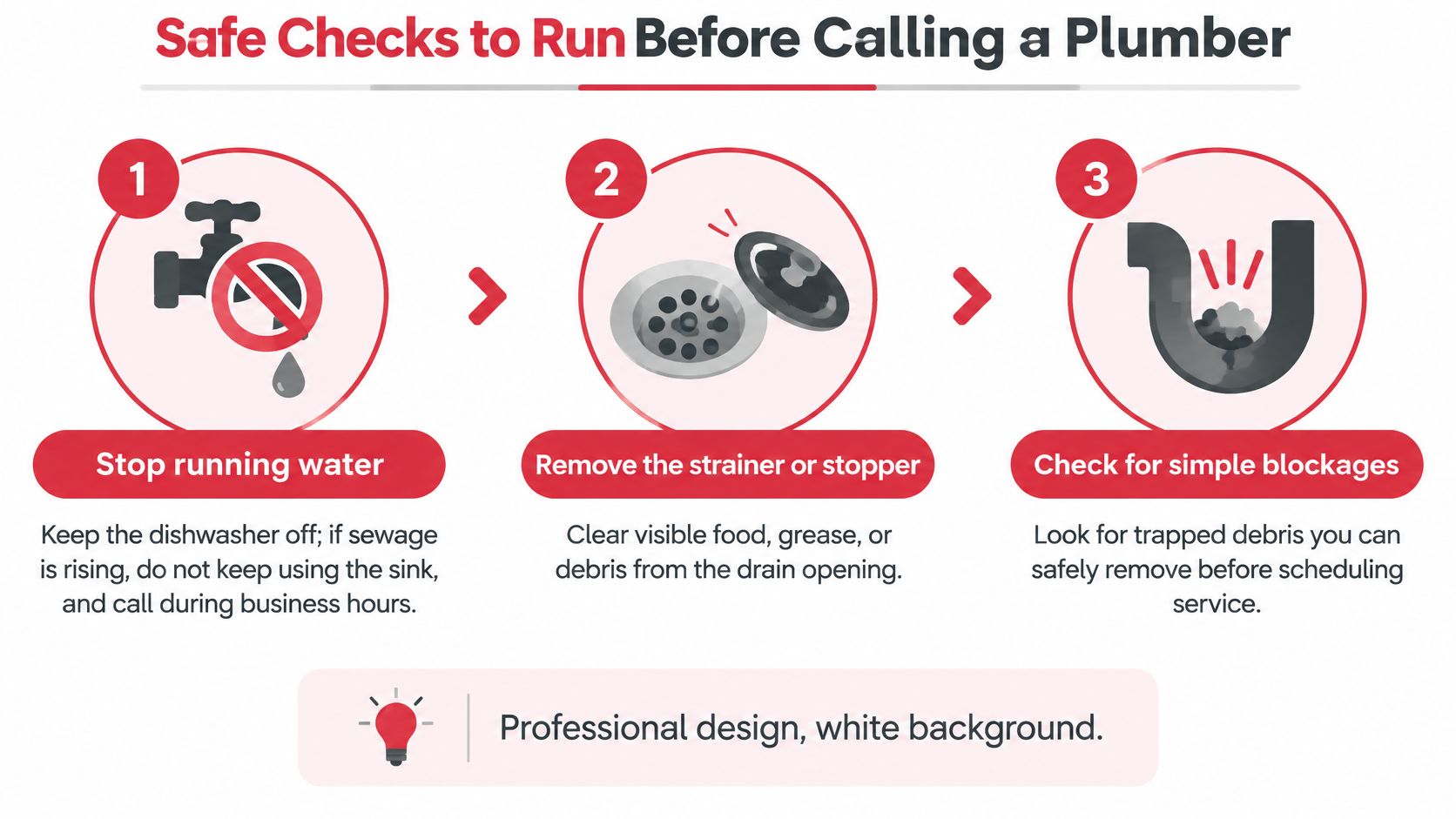
Stop adding water. Shut off the faucet and leave the dishwasher off for now. Every gallon you add has to go somewhere, and if the branch is holding, it comes back through the lowest opening it can find.
Clear the opening you can see. Pull the strainer or stopper, then lift out food scraps, coffee grounds and congealed grease with a paper towel into the trash, not the drain. It's the cheapest thing to rule out, and a strainer sitting in standing water tells you what the inside of the pipe is likely coated with.
Get under the sink with a bucket. Set a shallow pan under the P-trap, loosen the slip nuts by hand, and lift the trap off. Both bowls discharge through that one fitting, so a shared trap packed with grease and food particles stops both basins at once. A trap that runs clear end to end rules out the entire cabinet in one move.
Inspect the branch tailpiece and the shared baffle or wye fitting. A blockage at this junction restricts both fixtures, while debris confined to one tailpiece normally affects only that bowl. Run a bottle brush through what you can reach and rinse the parts in a utility sink or outside with a hose, not back down the kitchen drain.
Reassemble and test each bowl on its own. Tighten the slip nuts hand-tight plus a quarter turn, then run hot water in one bowl while you watch the other. If the trap was clear and water still stands in the wall-side pipe, the restriction is past the cabinet. While the trap is off, sight along the pipe run into the wall: a section that dips or sags holds grease and will reproduce the clog no matter how often the trap gets cleaned. Anything past that point is cable and camera work, not bucket work.
Write down what you found. Note whether the trap held black sludge or pale soap-like material, whether solids came out, whether other fixtures drained slowly, and whether you heard gurgling. Black sludge points to decomposing food and organic buildup, while pale, waxy material is usually hardened grease or soap. Those four notes let a technician start with evidence instead of repeating your work.
Practical rule: Plastic slip nuts crack when you force them with pliers on a corroded trap. If a nut won't turn by hand, stop. A snapped trap under a full sink cabinet is a worse afternoon than the clog.
Continue on your own only if the trap is easy to reach, dry, and comes apart by hand. Anything else, including a trap that's glued, corroded, or buried behind a disposal, is a job to hand off. A clog sitting past the wall stub-out and affecting both bowls usually means buildup coating the branch line, and that takes a cable machine to clear at the source rather than more plunging at the fixture.
Vent and Dishwasher Problems That Mimic a Clog
A venting defect rarely fills a sink on its own, but it makes a partial restriction behave like a full clog: slow drainage, gurgling, water levels that rise and fall without pattern. A sink that drains fine one day and stalls the next is often breathing badly, not blocked solid.
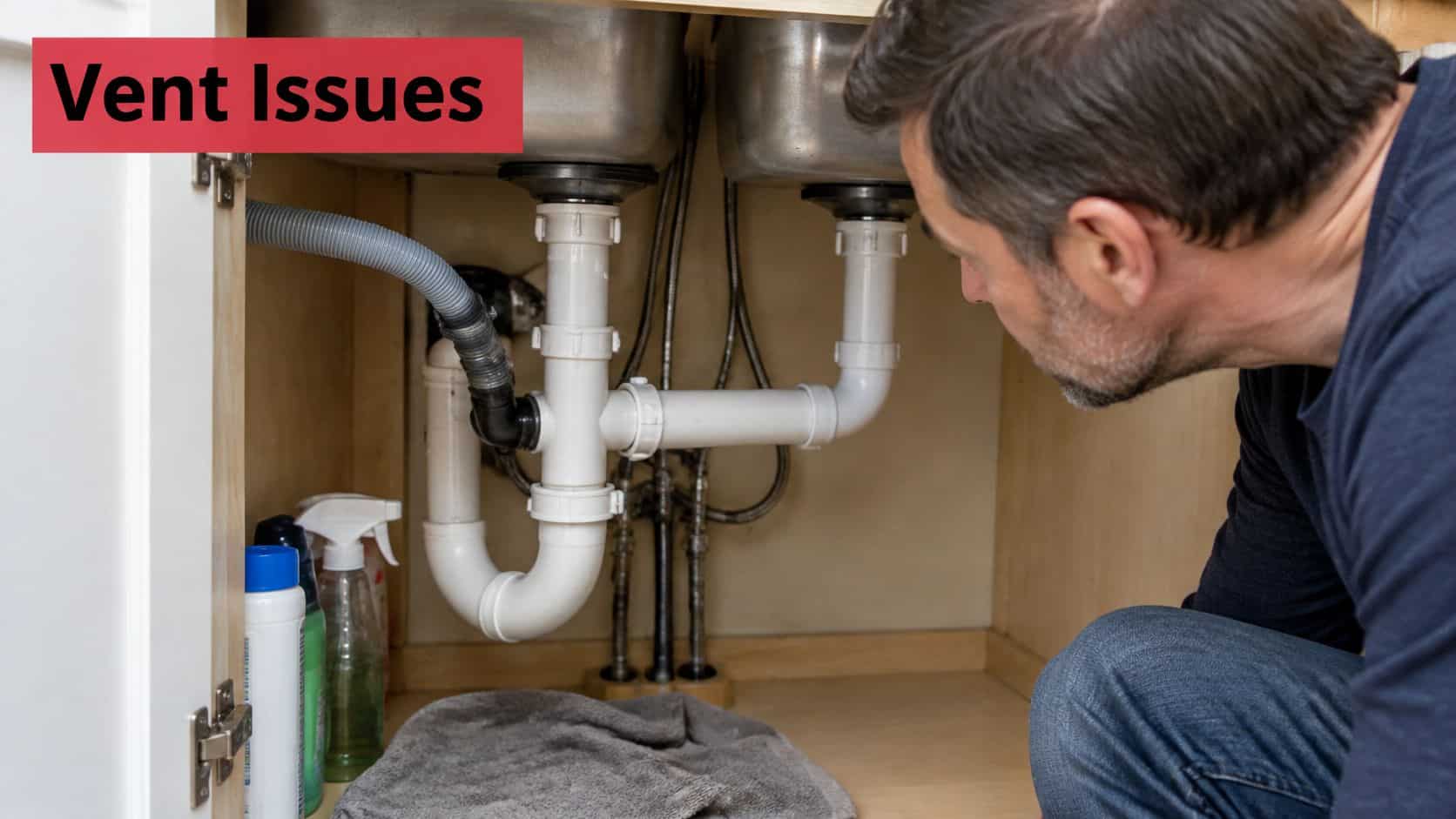
The International Plumbing Code venting chapter limits the pressure differential across a trap seal to no more than 1 inch of water column (249 Pa) and sets code limits on trap-to-vent slope and developed length. For a 1-1/2-inch trap arm, commonly cited residential limits run about 42 inches of maximum developed length at a uniform 1/4-inch-per-foot slope, though the governing local code and the actual fitting arrangement decide the final number.
The triage signs are specific. If both bowls gurgle when the dishwasher discharges, if drainage briefly improves after a cleanout or vent is opened, or if the sink drains normally until another fixture empties, suspect the vent path alongside the branch drain. A plain clog does not improve when you open a fitting. A vent-starved line does.
Dishwasher behavior during a backup is the second check, because a two-sided backup can push contaminated water the wrong way. Do not run the dishwasher while the sink is backed up, and look for dirty water in the tub or at the air-gap fitting on the counter. Local code rules for dishwasher backflow protection vary, but an air gap or another approved method only stops wastewater from siphoning back into clean dishes. It does not clear a blocked shared drain. And never disconnect a dishwasher hose while the sink is full.
One last caution before the fix. In a line already starving for air, confirm the fitting arrangement, the trap-arm grade and the location of the accessible cleanouts before high-pressure equipment goes in. Restoring flow in a vent-restricted line buys a few days at most, then the gurgle returns because the cause sat upstream of the blade.
Choosing the Right Cleaning Method for Both Bowls
Match the method to the location of the restriction, not to how dramatic the backup looks. A sink that fills in ninety seconds and a sink that drains sluggishly for three weeks can both be a shared-trap problem, and they can both be a branch-line problem. The tool that works is the one that reaches the actual blockage.
| Method | Best for | Limit |
|---|---|---|
| Hand snake | Single slow bowl with hair or food near the opening | Cannot clear grease or scale deep in a shared trap |
| Trap removal and manual cleaning | Both bowls back up and the shared trap is suspected | Reaches only the trap and short arms |
| Cable machine | Solids blocking the shared branch | May punch through scale or grease without removing the layer |
| High-pressure hydro jetting | Grease, scale and recurring kitchen backups | Does not correct a belly or back-pitch; slope repair may be needed |
| Sewer camera inspection | Unclear cause, repeat backups or several fixtures slow | Diagnosis only; repair is a separate step |
| Chemical drain opener | Not recommended for two-sided backups | Does not clear solids and can harm old pipe |
Where Each Method Stops Working
A hand snake is useful for a single slow bowl with hair or food close to the opening, and it's the right first purchase for a renter. It is close to useless against a grease collar fifteen feet into a branch, because the coil follows the pipe instead of scraping the wall.
Removing and cleaning the trap reaches the shared connection both bowls use, which is why it's step three in the checks above. A cable machine then handles solids in the shared branch, but the cutting head can open a channel through scale or grease and leave the coating intact, which is why the same sink plugs again in six weeks.
High-pressure hydro jetting is the method that removes the layer. Our hydro jetting service in Las Vegas uses it for exactly that reason on grease, scale and repeat kitchen backups. It still won't fix a belly or a back-pitched section, where the pipe holds water and the grease settles back out.
What the job should look like: diagnose the clog, quote a flat rate in writing before any work starts, clear the line with a cable machine or hydro jetting, then test-flush from several fixtures to confirm full flow, with photos and any warranty on the paid invoice.
Chemical openers deserve a blunt warning for a two-sided backup. They don't remove solids, they sit against the blockage and heat up, and they attack older pipe and fittings. A sink that's already holding water gives the chemical nowhere to go but back up around your hands.
Why Grease and Scale Keep Both Bowls Clogged
Fat, oil and grease are the main reason a shared branch closes up, and the mechanism is more interesting than "grease is sticky". A peer-reviewed study of building drainage systems published in Water Science & Technology reported that FOG deposits are an important cause of blockages in kitchen drains and lateral house connections, with financial, health and environmental costs. Chemical analysis identified the deposits as calcium salts of fatty acids, which means grease doesn't stay grease after it enters the drain. It reacts.
That finding explains the pattern homeowners describe. Hot water and dish soap soften the fat enough to get it past the trap, the sink runs clear for a day, then the cooled residue adheres to the pipe wall and catches food particles and mineral deposits farther along the shared line. The study also noted that the transformation can happen over short distances within the sewer network, so the damage doesn't need to travel far.
How a Thin Film Becomes a Plug
Household behavior is measurable, and a British study summarized by the Chartered Institution of Water and Environmental Management put numbers on it. Researchers monitored 15 households and found that 13, about 87%, disposed of small quantities of fat, oil or grease through the kitchen sink drain. The common habit was placing frying pans or baking trays straight in the sink and rinsing them under hot water with washing-up liquid. Two of the 15 households, roughly 13%, sent very large quantities of FOG down the drain after a Sunday roast.
Both patterns matter here, and for different reasons. Repeated small discharges accumulate in the shared branch serving both basins. A single large discharge can push a partly blocked line over the edge in one evening.
Southern Nevada adds a second layer. The U.S. Geological Survey notes that hard-water scale builds up in plumbing, fixtures and water heaters, and that it can clog pipes and reduce equipment life. Calcium and magnesium leave a rougher internal surface, and a rough surface grabs grease the way sandpaper grabs paint.
Rule of thumb: If the same sink plugs twice in a season, stop hunting for a new blockage. You're looking at a coating.
Recurring clogs usually mean buildup lining the pipe walls rather than a fresh, one-time obstruction, and here in the Las Vegas Valley that buildup is often hard-water calcium scale. Descaling or hydro jetting removes the layer a cable machine punches through.
Habits That Keep the Shared Line Open
- Scrape before you rinse. Pans go into the trash or compost, then to the sink. The CIWEM-monitored households were doing the opposite.
- Wipe greasy cookware with a paper towel before it ever touches water. A dry wipe removes more fat than a hot rinse.
- Keep a basket strainer in both bowls and empty it after prep, not at the end of the night.
- Never pour cooking oil down the drain, hot water or not. It cools in the trap, and the chemistry above does the rest.
- Run a full basin of hot water through the shared trap weekly to move soft residue along before it sets.
If backups continue after a month of those habits, schedule an inspection of the shared drain instead of clearing the same stoppage a third time.
Confirm the Next Step for Your Sink
The decision rule is short. If only one bowl is slow and the trap is clear, a hand snake on that bowl is a reasonable next move for a one-time hair or food clog near the opening, and a hardware-store snake often handles it. If both bowls back up together, the shared trap or branch needs professional attention, and repeating the same plunge only redistributes the problem.
If other fixtures back up or gurgle, or the clog returns within weeks of clearing, book a camera inspection before authorizing any repair. The cause may sit deeper in the branch or the main line, and the clogged drain service call should start with locating it, not with a cable in the dark.
Professional kitchen sink drain cleaning with a cable machine is a flat rate of $214 and includes a flow test; interior line cleaning generally runs $160 to $214 and comes with written notes on what was found and removed, so you can compare the next call against the last one.
Bring four things to the phone call: whether one bowl or both back up, whether the dishwasher triggers gurgling, which other fixtures are slow, and what came out of the trap when you checked. Those notes let the technician start with evidence. Pricing is discussed openly before work begins, so you decide with numbers in hand rather than after the fact.
Next action: call 702-480-8070 to schedule. MG Plumbing Services is a family-owned residential company serving Las Vegas, Henderson, North Las Vegas, Summerlin and surrounding areas, and it isn't a 24/7 emergency service, so if sewage is rising, stop using water first and then call during business hours. Se habla español.
When both bowls fill at once, the fix starts with locating the shared restriction instead of guessing at it, and that's the work MG Plumbing Services LLC does across the Las Vegas Valley with cable machines, hydro jetting and camera inspection on residential lines. Owner Miguel Garcia is a Nevada-licensed C-1d contractor with more than 25 years in the trade, and every call starts with a written flat-rate estimate and ends with a flow test. Call 702-480-8070 to schedule a visit.