
You're standing in a Summerlin driveway with a dead water heater, a wet garage floor, and two quotes that don't look remotely related. One plumber says $2,100 to replace the 50-gallon gas unit. Another says $4,650. Both appear to include removal, installation, and testing.
That gap doesn't automatically mean one plumber is dishonest. Each company may be pricing labor, overhead, materials, warranty exposure, code work, access problems, and callback risk differently. The homeowner's real problem is that the quote rarely explains which assumptions created the number.
Plumbing flat rate pricing can solve part of that confusion. It gives you an agreed price before work begins, but it isn't automatically the fairest model for every repair. The right question isn't, “Is this flat rate?” It's, “Does this job have a clear enough scope for a fixed price to protect me?”
Table of Contents
- Why Two Plumbers Can Quote the Same Job at Wildly Different Numbers
- What Flat Rate Plumbing Pricing Actually Means
- Flat Rate vs Hourly Billing, A Side by Side Comparison
- What Is Usually Included and What Gets Carved Out
- When Flat Rate Quietly Costs Homeowners More
- How to Read a Written Flat Rate Estimate Locally
- A Simple Decision Framework for Your Next Plumbing Quote
Why Two Plumbers Can Quote the Same Job at Wildly Different Numbers
The Summerlin homeowner with the two water-heater quotes needs more than a price comparison. The homeowner needs to know whether both plumbers are offering the same installation.
One quote may include a standard replacement with existing accessible connections. The other may include a different heater, expanded warranty coverage, permit handling, code corrections, upgraded fittings, an expansion tank, haul-away, and a larger allowance for difficult access. The numbers look like they describe one task, but the written scopes may describe two different jobs.
Three pricing models appear in residential plumbing
Hourly billing charges for time worked, usually with parts and other charges listed separately. It can be transparent when the problem is exploratory, but the final total remains uncertain until the plumber finishes.
Flat-rate pricing assigns one price to a defined task before work starts. The price book typically combines labor, materials, overhead, and profit into that line item. Contractor-industry coverage describes this model as an offshoot of up-front customer pricing that moved from the auto industry into the trades, migrated into home services during the 1980s, and gained widespread uptake in the 1990s. That history is summarized in ServiceTitan's price book overview.
Hybrid or time-and-materials pricing with a cap starts with hourly billing but limits the homeowner's exposure to a stated maximum, unless the scope changes or the customer approves additional work. It takes more explanation than a single flat number, but it can be the most sensible option when the plumber can't see the whole problem yet.
Flat rate is designed to remove the argument over how long a routine repair should take. That's useful when the task is repeatable and the assumptions are visible. It becomes less useful when the fixed number includes a large cushion for conditions nobody has inspected.
Kitchen-table rule: Compare the scope, not just the total. A lower quote with vague exclusions can cost more than a higher quote that clearly includes the work your home actually needs.
What Flat Rate Plumbing Pricing Actually Means
Flat-rate plumbing pricing means one agreed price for one defined task. The plumber presents the number before work begins, and you approve it before the repair starts. The amount commonly reflects labor, standard materials, business overhead, and profit rather than a running clock.
A legitimate flat-rate line item should answer three questions:
- What task is being performed?
- What materials and access assumptions apply?
- What conditions would create a change order?
How a price book creates the number
A contractor generally builds each line item around a specific job description. The entry may identify the expected labor, the material allowance, the equipment involved, and the conditions under which the price applies. The business then adjusts the result for its operating costs and local market.
That structure matters because “water heater replacement” is too broad by itself. A quote should identify the heater type and capacity, the fuel source, the work included, and the items excluded. It should also say whether permit work, code corrections, disposal, and unusual access are included.
A 2026 national reference lists these sample ranges for common plumbing tasks: a standard toilet replacement at $325 to $475, a 50-gallon gas water-heater replacement at $1,450 to $2,250, and a main water shutoff replacement at $350 to $600. Those figures come from the LeadDuo 2026 plumbing flat-rate price book reference.
| Plumbing Task | Typical Flat Rate Range (2026) | What's Usually Bundled |
|---|---|---|
| Standard toilet replacement | $325–$475 | Labor, standard toilet installation, basic connections, testing |
| 50-gallon gas water-heater replacement | $1,450–$2,250 | Removal, replacement installation, standard fittings, testing |
| Main water shutoff replacement | $350–$600 | Accessible valve replacement, standard fittings, testing |
Those are reference ranges, not promises for a Las Vegas property. Local labor, equipment, permit requirements, access, manufacturer selection, and existing plumbing conditions can move a quote outside a national guide.
The most important protection is the scope-change rule. If the job takes longer because the technician works slowly, a true flat-rate price shouldn't increase for that reason alone. The number can change when the actual work differs from the agreed scope, such as concealed damage, inaccessible piping, required correction work, or a customer-approved upgrade. That change should be explained and approved in writing before the added work begins.
Flat Rate vs Hourly Billing, A Side by Side Comparison
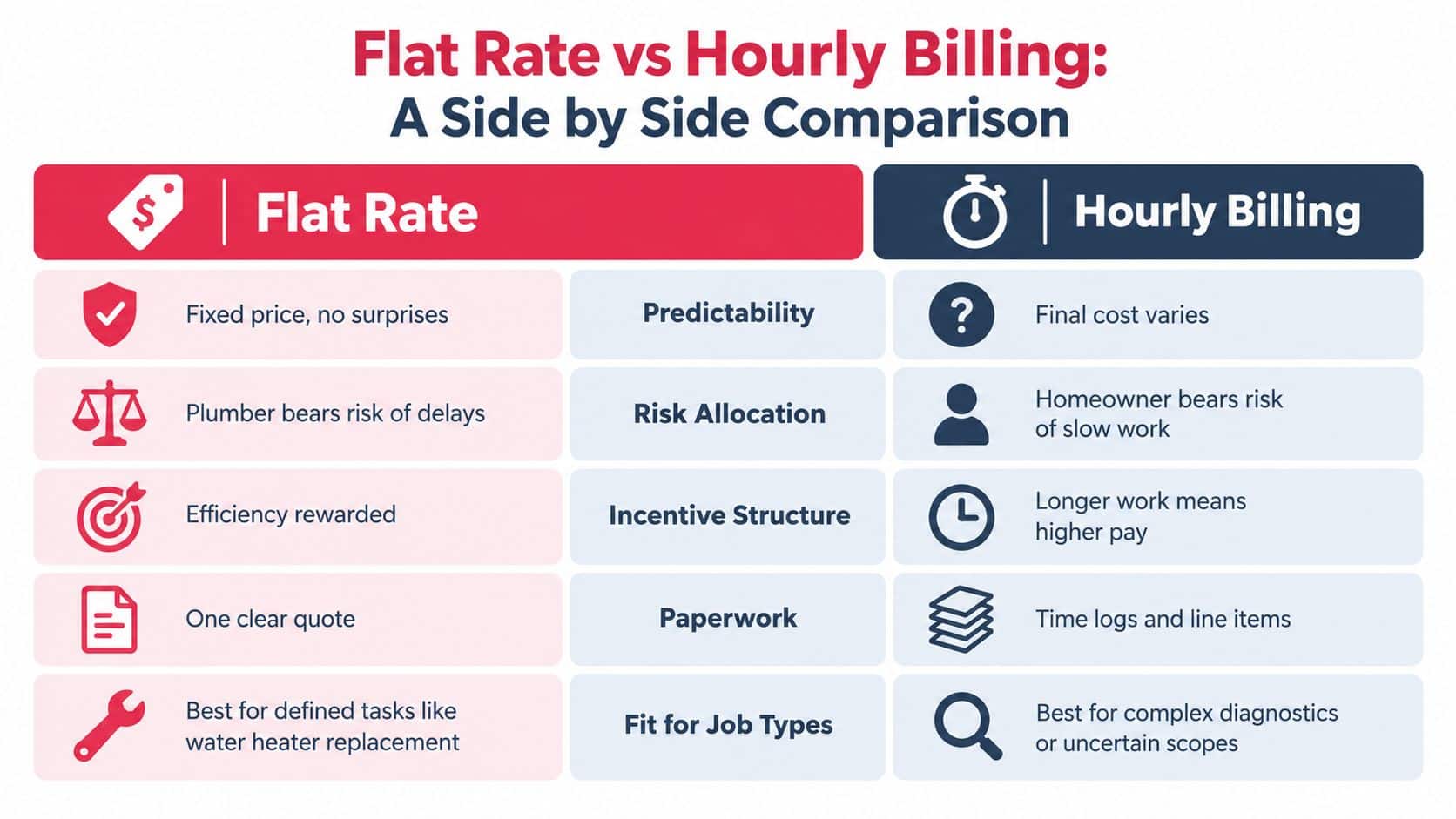
Flat rate and hourly billing place risk in different hands. With flat rate, the plumber carries more risk if a defined task takes longer than expected. With hourly billing, the homeowner carries more of the risk because the bill grows with time.
Consider a Las Vegas shop charging $185 per hour to diagnose a kitchen drain clog. If the technician clears the blockage quickly, the labor charge may stay limited. If the technician spends two hours investigating access, trying equipment, and working through a stubborn line, the homeowner pays for that time even if the underlying problem is still unresolved.
A flat-rate drain-clearing price works differently. The homeowner pays the quoted amount whether the clog takes 20 minutes or two hours, provided the work remains within the agreed scope. That protects the customer from a slow process, but it can also mean paying the same price for a simple blockage that clears quickly.
The homeowner's decision rule
| Factor | Flat Rate | Hourly Billing |
|---|---|---|
| Predictability | Strong, if the scope is complete | Limited until the work ends |
| Risk of delays | Usually carried by the plumber | Usually carried by the homeowner |
| Speed incentive | Efficient completion helps the plumber | Longer labor increases the bill |
| Best fit | Defined, repeatable repairs | Diagnostics and uncertain access |
| Main danger | Overpaying for a simple job or exclusions | Paying for extended investigation |
Choose flat rate for work with a defined failure mode and predictable access. Toilet replacements, water-heater replacements, garbage-disposal installations, and hose-bibb replacements often fit this model well.
Ask about hourly billing or a hybrid cap for slab-leak investigation, concealed leak location, sewer-line diagnosis, cast-iron problems under a slab, or reroutes behind walls. In those jobs, the unknown condition is often the job.
Practical rule: If the plumber can describe exactly what will be removed, installed, tested, and left behind, flat rate is easier to judge. If the plumber is still trying to discover the problem, ask how the diagnostic time is controlled.
Before approving a hybrid arrangement, get the hourly rate, parts policy, starting diagnostic charge, not-to-exceed amount, and approval process in writing. A cap without a clear definition of included work isn't much protection.
What Is Usually Included and What Gets Carved Out
A flat-rate quote is only as useful as its inclusion list. Most routine line items bundle labor, standard parts, and the work required to complete the named task under ordinary conditions. The exclusions are where homeowners often discover that “replacement” meant less than they assumed.
For a 50-gallon gas water-heater swap, ask whether the line includes the heater itself, removal and haul-away, standard water and gas connections, fittings, expansion-tank work, testing, venting, and required inspection coordination. In Southern Nevada, hard-water buildup and aging components can also affect valves, nipples, flex connectors, and shutoffs. Those conditions don't belong in a vague “miscellaneous” category.
Read the carve-outs word for word
Common exclusions include permit charges, after-hours premiums, code upgrades, drywall repair, cabinet removal, excavation, slab access, and corrections to existing work. A water-heater quote may exclude seismic straps, vacuum breakers, vent modifications, or other code-required corrections. A slab-leak quote may cover detection but exclude opening and restoring the slab.
A 2026 plumbing pricing guide lists metro-market customer prices of $139 to $175 for a service call or diagnostic fee, $225 to $295 for standard drain cleaning, $850 to $1,200 for water-heater installation, and an added after-hours premium of $85 to $125. These examples show why “one price” may still depend on time of service and the exact line item, as shown in One Flat Rate's plumbing pricing guide.
Look for language such as:
- “Excludes permit.” You need to know whether the contractor obtains it, charges it separately, or expects you to handle it.
- “Price based on accessible piping.” This usually means walls, floors, cabinets, or slabs may create additional work.
- “Not included: any code-required correction.” Ask which likely corrections the plumber has identified.
- “Additional work requires approval.” Confirm that approval must be written before the added work starts.
| Common Job | Usually Included in the Flat Rate | Usually Carved Out, Extra Cost |
|---|---|---|
| Gas water-heater replacement | Unit, removal, standard installation, testing | Permit, vent changes, code upgrades, difficult access |
| Toilet replacement | Toilet installation, standard connection, testing | Floor repair, flange reconstruction, unusual shutoff work |
| Main shutoff repair | Accessible valve replacement, fittings, testing | Wall or slab opening, pipe reroute, restoration |
| Slab-leak service | Detection and stated repair method | Excavation beyond allowance, concrete or drywall restoration |
| Drain cleaning | Listed cable or jetting service within stated scope | Excavation, pipe replacement, extensive access work |
The exclusions aren't automatically hidden fees. They're written limitations. Your responsibility is to read them before signing, and a contractor should explain them without becoming defensive. You can also review the company's plumbing frequently asked questions before requesting a quote.
When Flat Rate Quietly Costs Homeowners More
A fixed number can feel protective while charging you for uncertainty. That happens when a contractor can't yet determine the access, pipe condition, or extent of damage but still places the job into a broad price-book category.
A slab leak is the obvious example. Finding the leak and repairing the leak aren't always the same task. The break may sit beneath concrete, the repair may require opening a finished area, or a reroute may make more sense than a direct penetration. A flat price that includes every possible risk may be expensive if the actual repair turns out to be simple.
Main sewer work carries a similar problem. A camera can identify blockage, root intrusion, cracks, or a deteriorated section, but the repair scope still depends on location, depth, access, and what the inspection reveals beyond the immediate obstruction. Cast-iron piping under a slab can create the same uncertainty during a reroute or replacement.
Ask what the number assumes
Before accepting the quote, ask:
- What exact condition justifies this price?
- What did the inspection confirm, and what remains unknown?
- What happens if the pipe is cast iron, inaccessible, or damaged beyond the stated area?
- Which added work requires my approval?
- Could hourly diagnostic work or a capped hybrid arrangement be fairer?
There's also a workmanship risk. A technician paid from a fixed task price may feel pressure to finish quickly, especially when the price book rewards completion rather than careful investigation. Speed isn't a problem when the work is done correctly. It becomes a problem when the technician skips camera inspection, pressure testing, leak verification, or a proper cleanup because those steps weren't clearly included.
The uncomfortable question: What part of this quote pays for risk, and what part pays for work you already know is necessary?
Flat rate is strongest when the contractor has already diagnosed the job and defined the access. It's weakest when the contractor is guessing at the scope and presenting the guess as certainty.
How to Read a Written Flat Rate Estimate Locally
A Las Vegas homeowner should treat the estimate as a work document, not a sales receipt. The page needs enough detail for you to compare contractors and identify what happens if the first assumption proves wrong.
Start with the contractor. Verify the license through the Nevada State Contractors Board and confirm that the classification matches the work. Nevada's C-1d plumbing subclassification covers sanitary water and waste/vent systems, roof drainage, hydronic heating up to 200,000 BTU, irrigation, potable-water heating, permanent gas supply systems, compressed-air, vacuum, and medical-gas piping, plus water and gas piping from a building edge to the utility meter. The classification is described in this Nevada C-1d license reference.
Run this document checklist
- License and insurance: Confirm the license number, liability insurance, and workers' compensation coverage.
- Business identity: Look for a physical business address, not only a phone number or post-office box.
- Scope: Require plain-language descriptions of removal, installation, testing, cleanup, and restoration.
- Materials: Identify the manufacturer, model, capacity, fuel type, pipe material, valve type, or fixture being installed.
- Warranty: Separate labor coverage from manufacturer material coverage, and ask who handles each claim.
- Schedule: Require stated start and completion dates or a clearly described service window.
- Payments: Confirm the deposit, progress payments, final payment, and accepted payment methods.
- Change orders: Make sure added work requires your approval in writing before it starts.
Nevada homeowners should also pay attention to contracts signed at home. The plan for a residential contract should include the three-day right of rescission, with that right stated in writing. Don't rely on a verbal promise that you can cancel later.
The quote should also state how long the price remains valid. A line such as “price honored for” a stated number of days prevents the contractor from treating an undecided estimate as expired without telling you.
For a practical starting point, review the company's cost-estimate information and compare its written scope against any competing proposal. A reputable estimate should make the price easier to understand, not harder.
A Simple Decision Framework for Your Next Plumbing Quote
Use this rulebook before you approve the next plumbing estimate.
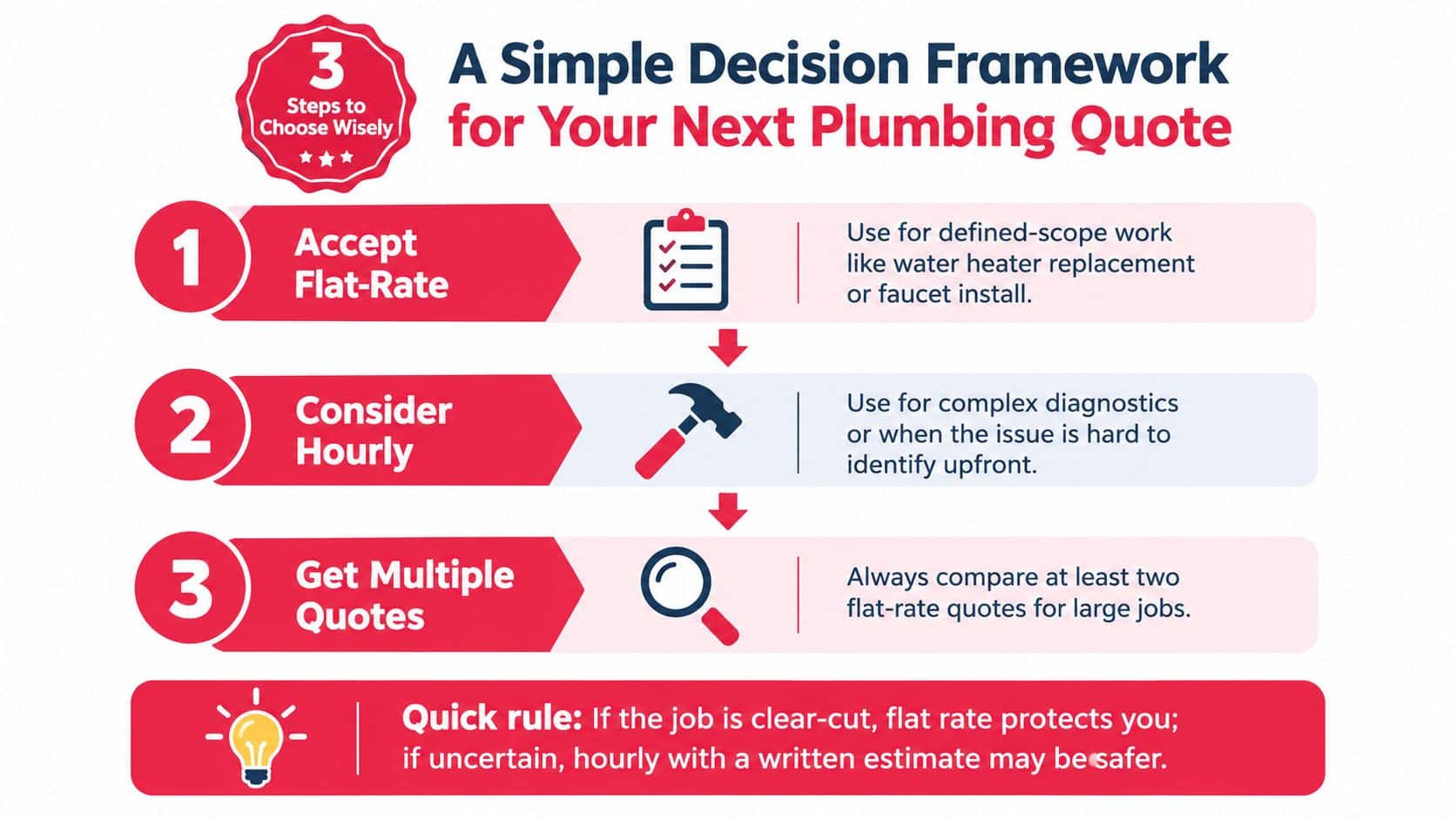
Accept flat rate for defined-scope work. Water-heater replacements, toilet installations, garbage-disposal installs, faucets, and hose bibbs are usually easier to price when the existing connections are visible and the replacement is clearly specified. Ask, “Exactly what parts, testing, disposal, permits, and code work are included?” Walk away if the answer stays vague.
Consider hourly or hybrid billing for uncertain work. Slab leaks, mystery leaks, sewer-line problems, concealed piping, and under-slab cast-iron repairs need diagnosis before anyone can know the full scope. Ask, “Can you set a not-to-exceed cap and explain what would change it?” Treat pressure to approve a large fixed number before inspection as a warning.
Reject incomplete paperwork. A quote missing the license number, scope breakdown, exclusions, warranty terms, payment schedule, or change-order process isn't ready for approval. Ask the contractor to put the missing terms in writing. If the contractor refuses, end the conversation.
For larger work, compare written proposals and inspect the contractor's customer reviews for comments about diagnosis, communication, and completed repairs, not just star ratings.
MG Plumbing Services LLC provides residential plumbing repairs, drain cleaning, hydro jetting, sewer camera inspections, leak detection, water-heater service, water treatment, and general plumbing work across Las Vegas, Henderson, North Las Vegas, Summerlin, and surrounding Las Vegas Valley communities. Call 702-480-8070 or visit MG Plumbing Services LLC to request a written estimate based on an on-site diagnosis, and ask about service in English or Spanish.