

You open the bathroom cabinet to find a damp towel and a bead of water hanging from a gray plastic fitting. The immediate question is how to stop the drip. The bigger question is whether that fitting is the only problem.
Polybutylene pipe problems need both answers. Before anyone replaces a connector or recommends a repipe, identify the material, document what's visible, and separate the active leak from the condition of the remaining system.
Table of Contents
- How to Identify Polybutylene Pipe in Your Home
- Warning Signs of Polybutylene Pipe Failure
- What Causes Polybutylene Pipe to Fail
- How Polybutylene Leaks Turn Into Water Damage
- Repair, Partial Replacement or Full Repipe Compared
- Insurance, Disclosure and Resale Questions
- Confirm Your Pipe Type and Book an Inspection
How to Identify Polybutylene Pipe in Your Home
Flexible gray supply tubing in a home built or repiped roughly between 1978 and the mid-1990s is a strong candidate for polybutylene, a material used in as many as 6–10 million U.S. homes, according to InspectApedia's plumbing reference. The home's age is a screening clue, not proof.
Start at the water heater connections, under sinks, and where the main supply enters the house. Check exposed utility-room or basement piping and accessible crawl spaces, if your home has them. Don't enter a flooded crawl space or remove finished walls just to identify a pipe.
Match the pipe and its connections
Use a flashlight and wipe dust away with a damp cloth. Photograph the printed text without twisting or bending the tubing. Color helps narrow the possibilities, but the stamped material designation and fitting style matter more.
Polybutylene pipe identification checklist
| Component | What to look for | Where to check |
|---|---|---|
| Pipe body | Flexible gray tubing, sometimes black or blue, with a smooth surface | Water heater connections, under sinks, basement, crawl space |
| Printed marking | Repeated text such as PB2110 or PB 2110 along the pipe | Exposed runs; wipe off dust to read the print |
| Plastic fittings | Insert or crimp fittings, often white, gray, or black, usually with copper crimp rings | Valve, fixture, and branch connections |
| Transition fittings | Brass or copper adapters where PB joins rigid pipe | Water heater, main shutoff, meter area |
| Age and records | Built or repiped during the historical installation period | Permit history, seller's disclosure, original builder records |
| Look-alike materials | PEX, usually red, blue, or white with metal or plastic connection components; cream or tan CPVC stamped CPVC; copper | Compare color and stamped text before concluding it's PB |
A newer braided connector under a sink doesn't establish what's behind the wall. Follow the visible connection back toward the building supply without disturbing it. A home can contain several pipe materials after previous repairs.
Use records to fill the gaps
The polybutylene settlement FAQ identifies qualifying interior systems and yard service lines installed from January 1, 1978, through July 31, 1995, and describes a $1 billion fund subject to the settlement agreement's eligibility terms. Those historical facts aren't a promise of present-day compensation.
Compare permit history, seller disclosures, and builder records with what you can see. Keep photographs labeled by room and location, including an overview and a close-up of each marking and fitting.
Documentation rule: Record confirmed PB, suspected PB, and inaccessible piping separately. An unseen run shouldn't be recorded as inspected.
Warning Signs of Polybutylene Pipe Failure
A drip at a plastic fitting may be the first visible warning. Don't tighten a crimp connection or flex the pipe to see whether the drip changes. Catch the water, protect nearby belongings, and arrange an inspection.
The table gives a starting point for urgency, not a diagnosis. An increasing leak, water near electricity, or a sagging ceiling requires immediate action rather than routine scheduling.
Polybutylene failure signs, meanings and urgency
| Warning sign | What it usually means | Urgency |
|---|---|---|
| Drip or weep at a plastic fitting | Fitting embrittlement or stress; the tube may be degrading too | Schedule within days if contained and stable; shut off water if worsening |
| Wet drywall, ceiling stain, or bubbling paint | Possible concealed leak inside a wall or ceiling | Urgent: shut off water and call |
| Warm, soft, or spongy flooring | Possible leak under the floor or in a slab run | Urgent: shut off water and call |
| Rising water bill or meter moving with no fixtures running | Possible hidden leak somewhere in the system | Within days; sooner if water loss is substantial |
| Low or fluctuating water pressure | A developing leak, restriction, or pressure-control problem | Schedule an inspection |
| Flakes or particles in aerators, strainers, or shower screens | Possible interior material shedding, mineral scale, or debris from another component | Schedule an inspection |
| Repeated repairs in the same run | Possible systemic deterioration; nearby runs may be affected | Plan a full evaluation |
| Musty odor or mold near pipe runs | Possible long-term moisture behind walls or under floors | Urgent: shut off water if a supply leak is suspected and call |
Why a fitting leak deserves a broader diagnosis
Plastic Pipe Institute technical guidance attributes some North American failures to polyacetal, or POM, plastic fittings and others to tubing resistance problems involving hot chlorinated water or slow crack growth. A wet joint can therefore involve an embrittled connector, stress at the connection, damaged tubing, or a combination.
Replacing the connector stops one escape point. It doesn't establish that the adjoining tube or concealed branches are sound.
Symptoms also overlap. Particles don't prove PB deterioration, and low pressure doesn't prove a leak. Save debris in a clean container and note whether the symptom affects hot water, cold water, or both.
What a useful inspection includes
A sewer camera evaluates drain piping, not the interior condition of pressurized PB supply lines. Supply-line diagnosis instead uses targeted exposure, pressure and flow observations, repair records, and sometimes laboratory examination of removed material.
- Record the pattern. Note which fixtures are affected and whether symptoms occur continuously or only during use.
- Preserve the failed parts. Ask the plumber to identify the failure location before discarding removed tubing or fittings.
- Check automatic water use. Irrigation, ice makers, water softeners, and toilet refilling can explain meter movement that initially looks mysterious.
What Causes Polybutylene Pipe to Fail
A leak at one fitting raises a bigger question: what condition are the rest of the pipes in? Polybutylene (PB) can look sound on the outside while chemical changes weaken it from within.
Chlorinated water continually contacts the inner wall. Over time, chlorine exposure can reduce the plastic's resistance to oxidation. As that protection declines, oxidation can weaken the material and, in advanced cases, produce multiple cracks that extend through the pipe wall. This is a gradual process, not a calendar age at which every pipe suddenly fails.
From internal change to a through-wall leak
The damage develops from the water-facing surface outward:
- Protection declines. The inner wall becomes less resistant to oxidation.
- The plastic weakens. Oxidation changes the material and reduces its ability to withstand stress.
- Cracks develop. Small defects can grow and extend through the wall.
- Water escapes. Household pressure pushes water through a crack.
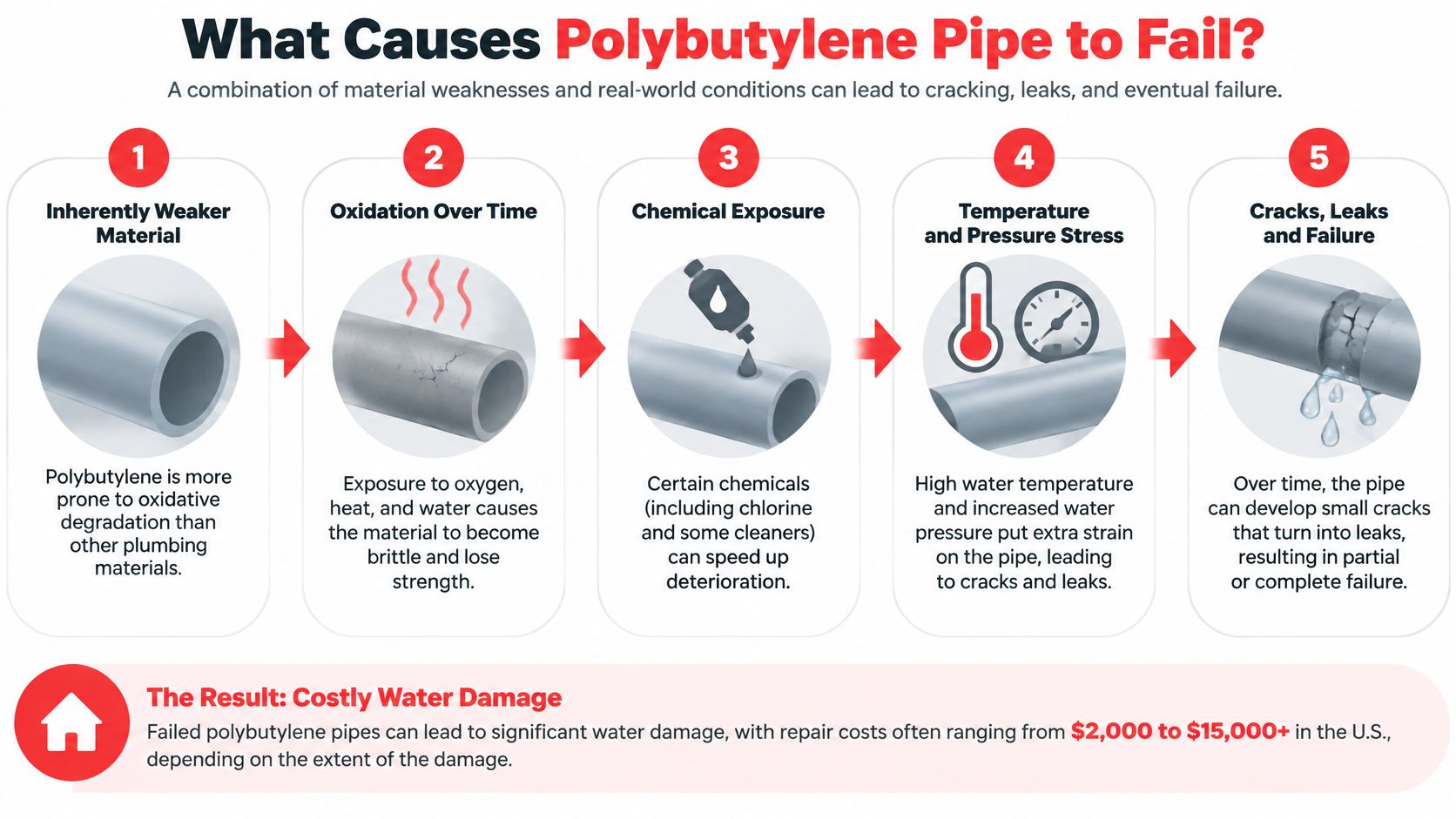
The speed and location of deterioration can vary across one home. Hot-water branches and connections near a water heater may face different operating conditions from cooler runs, so matching ages do not necessarily mean matching condition.
Pressure is another part of the picture. A plumber can check whether household pressure is excessive, but correcting pressure cannot reverse damage that oxidation has already caused.
A clean exterior or a short pressure test cannot establish how much service life remains in concealed PB. Testing can help assess current operation and locate a leak; it cannot certify every hidden section as sound. Before deciding whether to repair one point or replace more pipe, document the pipe type, visible routes, and known leak locations so the failure can be considered in the context of the whole system.
How Polybutylene Leaks Turn Into Water Damage
Say a slow leak starts inside a bathroom wall and continues for weeks. Water follows the pipe downward, wets the bottom plate, and spreads into the cabinet base and subfloor before a stain appears on the ceiling below.
An opened wall can reveal damage that wasn't visible from the bathroom.
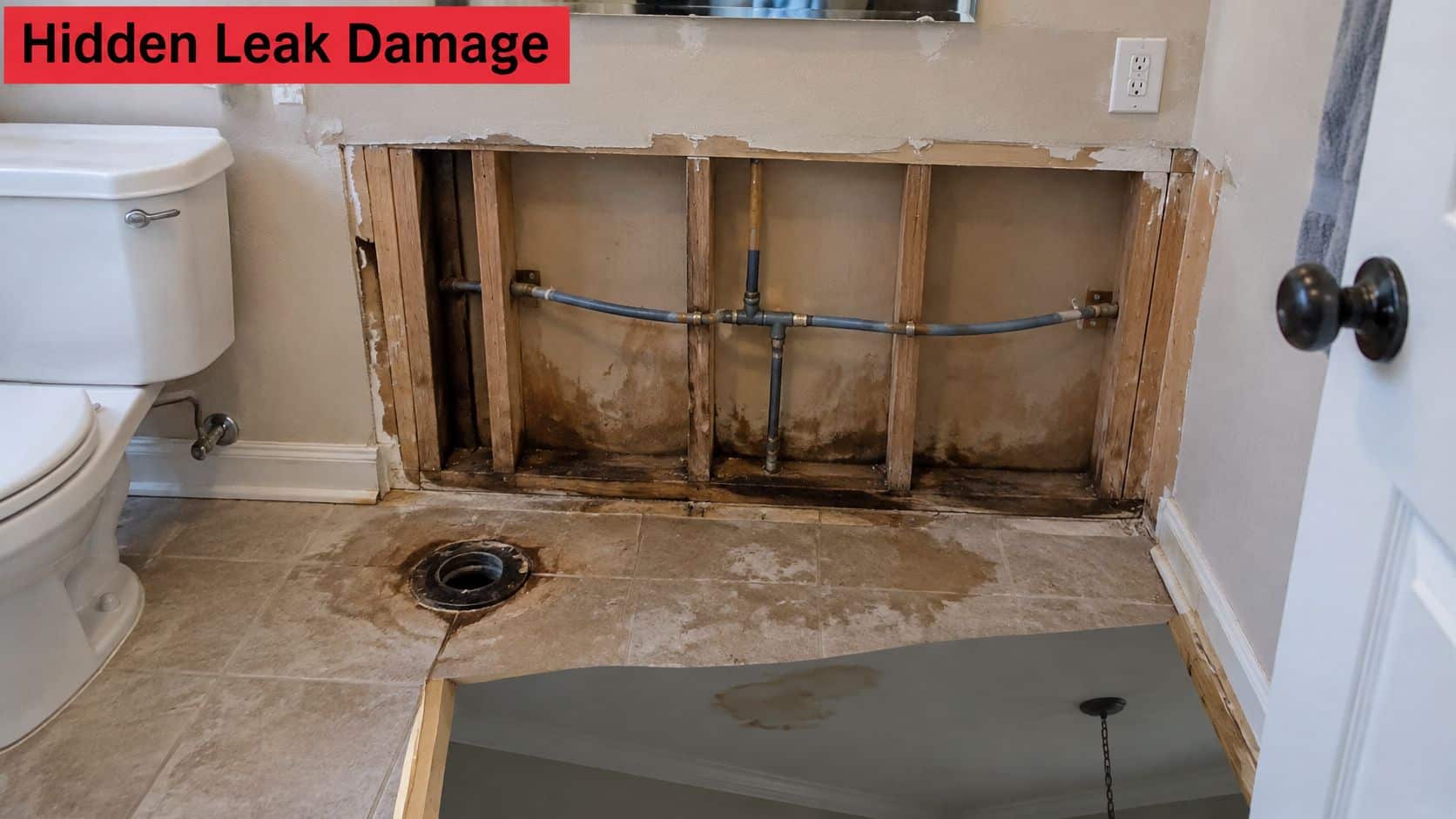
Wood can swell and soften as it stays wet. Drywall and insulation retain moisture, while enclosed damp surfaces can support mold growth. Cabinets may separate at their edges, and flooring can lift even when the visible drip seems minor.
The repair extends beyond the pipe
A water-damage estimate may include several distinct jobs:
- Structural work. Evaluate and repair damaged framing or subfloor.
- Finishes and flooring. Replace affected drywall, cabinets, trim, and floor coverings.
- Moisture and mold work. Dry concealed spaces and obtain appropriate remediation when needed.
- Personal property and access. Address damaged belongings and the disruption of opening and restoring walls or floors.
The opening needed to reach a small leak can be much larger than the failed fitting. Accurate water leak detection helps define where plumbing access is needed, although it doesn't eliminate restoration work.
This video offers an additional visual reference for the plumbing concern.
Stop investigating when the area becomes unsafe
Hot-water leaks and concealed slab or under-floor runs deserve particular caution because homeowners may notice them late. Don't pull down a bulging ceiling, walk on softened flooring, or touch electrical devices near wet materials.
Shut off the water from a safe location. If water has reached wiring or electrical equipment, keep clear and obtain qualified help. Photograph damage safely and retain invoices because coverage and claim documentation can affect the eventual repair decision.
Repair, Partial Replacement or Full Repipe Compared
One leak doesn't automatically require whole-house replacement, but one successful repair doesn't clear the rest of the system. The decision starts with where the failed pipe sits and how much uncertainty remains elsewhere.
Separate accessible fixture-supply tubing from exposed utility-room piping and concealed branch or slab runs. For each area, document the material, fitting type, failure location, previous work, and access needed.
Repair or replacement by situation
| Situation | Usually reasonable response | What drives the choice |
|---|---|---|
| Single leak at an accessible fitting, rest of run appears serviceable | Repair the fitting or short section with approved PB-compatible transition components | Inspect the accessible remainder without claiming proven remaining life |
| First leak in exposed basement or utility-room tubing | Targeted repair and monitoring | Easy access and documented location |
| Repeated leaks in the same run or at multiple fittings | Partial replacement of the affected run | Pattern of failures along one line |
| Leak in a concealed branch or slab run | Pinpoint the leak, then replace affected runs | Access cost weighed against uncertain remaining life |
| Gray PB throughout with leaks in several locations | Whole-system repipe using a modern approved piping system | Inaccessible runs and shared chemical exposure |
| Pending sale, insurance renewal, or claim | Written evaluation; replacement if required by the transaction or insurer | Written insurer and buyer requirements |
| Hot-water branches only | Evaluate separately; often prioritize replacement | Temperature-related deterioration |
Compare complete scopes, not just plumbing totals
The American Society of Home Inspectors notes that the pipe itself can deteriorate, not only its fittings, and reports that some insurers have withdrawn from or canceled coverage after major claims. A fitting swap therefore doesn't settle the long-term question.
Untouched runs may have shared similar water exposure, although temperatures can differ by branch. Replacing a fitting and ignoring that exposure leaves the homeowner without a system-level assessment.
Use these decision criteria:
- Access cost. Include wall opening, slab access, rerouting, and finish restoration.
- Leak history. Distinguish an isolated incident from failures across several locations.
- Water-loss consequences. Consider finished rooms, occupancy, and concealed routes.
- Resale and disclosure. Preserve an accurate record of what remains.
- Insurer requirements. Obtain the actual conditions in writing.
Require a clear boundary for the work
Interior distribution piping and the buried service line aren't necessarily the same project. A main water line replacement evaluation should identify where the proposed work begins and ends.
Request a written assessment naming the affected runs, inaccessible or untested runs, and repair or replacement options with their costs. It should also identify who handles permits, patching, and restoration rather than leaving those responsibilities assumed.
Insurance, Disclosure and Resale Questions
Start with your insurer when a sale, rental, renewal, or claim involves confirmed PB. Ask whether the policy application or renewal requires pipe-material or plumbing-age information, and request a written explanation of any replacement conditions.
Don't assume that an accepted premium means every plumbing-related loss is covered. Ask the insurer to explain applicable exclusions, claim requirements, and whether a partial replacement satisfies its conditions.
Build a property record people can use
For a sale, document the confirmed pipe type, visible locations, repair history, and remaining concealed areas. Disclose what you know through the appropriate transaction documents rather than leaving a buyer to discover an unexplained patch or invoice.
- Sellers. Keep photographs, permits, repair invoices, and the plumber's scope together.
- Landlords. Record affected units, accessible runs, tenant-reported symptoms, and completed repairs.
- Buyers. Ask the inspector to confirm material at the water heater, under-sink connections, and main supply, then request prior repair records.
An invoice for a bathroom repair isn't evidence that the entire property was repiped. The document should identify exactly what was removed and what remains.
Put a scope behind the negotiation
Treat confirmed PB as a condition that needs pricing, not an automatic reason to abandon a purchase. Written plumbing cost estimates help distinguish a limited repair allowance from a replacement project with access and restoration work.
If an insurer or buyer requires replacement, use that written requirement to define the scope before work starts. Ask which completion records are needed so the plumber can document the correct work.
A useful transaction file shows both completed work and remaining uncertainty. Don't turn an inaccessible pipe into a claim that the whole system is sound.
Confirm Your Pipe Type and Book an Inspection
If you find gray tubing or a leaking fitting, document what you can see before deciding whether to repair one spot or replace more of the system. A single leak may be an isolated problem, or it may be the first visible sign of trouble elsewhere.
Do not cut, bend, or pressure-test suspected polybutylene pipe yourself. If water is actively leaking, shut off the main supply and drain the affected line through a suitable faucet if it is safe to do so. Do not wait for a scheduled inspection while water continues to flow.
Before the appointment, photograph pipe markings, fittings, stains, and damp areas. Note the home's build or repipe date, past repairs, and any unexplained water-bill changes or meter movement. These details help the plumber compare the visible pipe with the property's repair history.
Use this visual checklist to organize your next steps.

What an assessment involves
A leak assessment can confirm whether water is escaping, isolate the affected line, pinpoint a concealed leak with tracer gas, then report findings and repair options. Tracer gas can help locate leaks in plastic pipe, deep underground lines, noisy settings, and cases where the leak is too small to make a sound. Written pricing lets you review the proposed scope before work begins.
MG Plumbing Services LLC is a licensed, owner-operated residential plumbing company serving the Las Vegas Valley, including Henderson, North Las Vegas, and Summerlin. Owner Miguel Garcia has worked in the plumbing trade since 2000. The company provides flat-rate, written estimates and same-day appointments during business hours.
Its residential services include drain cleaning, hydro jetting, sewer camera inspections, water leak detection, water heater repair and replacement, main water line replacement using Wirsbo AquaPEX, cast iron to ABS pipe replacement, and general plumbing repairs. Sewer cameras, pipe locators, and electronic leak detection help identify the condition and location of a problem before repair recommendations are made.
MG Plumbing Services LLC repairs slab leaks, supply lines, and underground pipe in-house. If a fitting is leaking, the assessment can help determine whether the repair should address that point alone or a wider section of the system. Visit MG Plumbing Services LLC to request an inspection and written assessment. Se habla español.