
Most Las Vegas homeowners should expect a price to repipe a house of about $4,500 to $15,000 for a typical 1,500 to 2,500 square foot home, with PEX usually landing on the low end and copper or slab-heavy work pushing the bill up. That's the honest range, and in the Valley, the number depends more on access and restoration than on pipe length alone.
If your water pressure is dropping, your copper is pinholing, or your home keeps springing leaks in new places, you're not looking at a small repair. You're looking at a system replacement, and in Las Vegas that usually means slab-on-grade construction, hard-water scale, and a lot of labor hidden behind the walls.
Table of Contents
- What a Whole-House Repipe Actually Costs in Las Vegas
- Copper vs PEX and Why Material Choice Drives the Bill
- How Home Size and Fixture Count Shape Your Estimate
- Labor, Slab Access, and the Variables Contractors Add
- Phased Repipe vs Full-House Repipe
- Permits, Inspections, and Las Vegas Code Requirements
- Red Flags, Hidden Costs, and How to Read a Written Estimate
- Getting an Accurate Repipe Quote in the Las Vegas Valley
What a Whole-House Repipe Actually Costs in Las Vegas
A typical Las Vegas homeowner should budget $4,500 to $15,000 for a whole-house repipe. Larger homes, slab-on-grade construction, and difficult access push the total higher because the crew may need to cut concrete, open walls, and restore finished surfaces. National guidance shows a similarly broad range, with whole-house repiping averaging about $7,500, depending on job size and access (HomeAdvisor cost guide).
A true whole-house repipe covers every hot and cold supply line, from the meter feed through the home and out to each fixture. The scope includes branch lines, the main shutoff, fixture shutoffs, and replacement hose bibs where required. A spot leak repair or water heater replacement covers only part of that plumbing system.
Practical rule: one opened wall and one repaired leak indicate a repair. An estimate covering every supply line indicates a repipe.
Las Vegas conditions affect the final number. Aging copper may be narrowed by hard-water scale, while slab-on-grade layouts can turn pipe routing and concrete access into major labor items. Ask the contractor to identify those conditions before work begins, not after demolition starts.
Your written estimate should name the pipe material, fixture reconnections, shutoff valves, permit, pressure test, and drywall or concrete restoration. It should also state what happens if the crew finds damaged framing, unusually thick slab, or inaccessible lines. Missing scope often returns as a change order. MG Plumbing Services' cost estimate page provides a useful example of the written cost breakdown homeowners should request from every contractor.
The rest comes down to five things: material, house size, access, phasing, and code requirements. Those variables determine whether the work stays a controlled plumbing project or expands into substantial restoration.
Copper vs PEX and Why Material Choice Drives the Bill
Material choice can move a Las Vegas repipe estimate by thousands. In 2026 pricing guidance, PEX repiping averages about $7,000, CPVC commonly falls between $4,500 and $7,500, and copper can reach $7,500 to $18,000 or more on larger homes (Benjamin Franklin Plumbing cost guide). Another market summary places PEX around $4,000 to $10,000 and copper around $8,000 to $15,000 for typical homes (FUSE Service cost guide).
Those national ranges need a Las Vegas adjustment. Slab-on-grade construction can make access expensive, and hard-water scale can reduce the working diameter of aging copper. The pipe material affects both the purchase price and the labor required to route and connect it.
What copper brings to the job
Type L and Type M copper cost more up front. Copper is rigid, so installers generally need more fittings and more time around tight chases, attic transitions, and slab-related routing. Some Las Vegas contractors still choose copper where the existing layout, access conditions, or project requirements make it a practical solution.
Copper also deserves a hard-water warning. Scale buildup can contribute to pinhole failures in aging copper, especially where the existing system has already narrowed internally. Ask the contractor to inspect the old pipe and explain whether copper replacement addresses the cause of the failures or just restores the same material.
Why PEX keeps winning on price
Wirsbo AquaPEX is the local default for many residential repipes. It bends around obstacles, routes efficiently through accessible spaces, and typically requires fewer fittings than rigid copper. Those installation advantages often reduce labor, which is where a large share of the savings comes from. The Angi cost guide also shows the broad price difference between PEX and copper installations.
Cost is only half the decision; in Las Vegas hard water, scale attacks copper pinholes faster than it affects PEX, so the pipe's aging behavior in this climate matters as much as the price. A smaller PEX project can stay near $4,500, while a same-footprint copper repipe can exceed $8,000 without changing the house.
| Factor | Copper (Type L) | PEX (Wirsbo AquaPEX) |
|---|---|---|
| Material cost | Higher | Lower |
| Install speed | Slower | Faster |
| Fittings needed | More | Fewer |
| Hard-water behavior | Scale can accelerate pinholes | Less vulnerable to scale-related corrosion |
| Best fit in Vegas | Complex or code-sensitive layouts | Most standard residential repipes |
How Home Size and Fixture Count Shape Your Estimate
A bigger house usually costs more to repipe because it needs more pipe, more tie-ins, and more labor. A smaller home can still outrun a larger one if it has multiple bathrooms, laundry hookups, hose bibs, and extra fixture lines. In Las Vegas, that matters even more on slab-on-grade homes, where every branch run has to be worked through tight routes instead of an easy open crawlspace.
Fixture count is where homeowners get surprised. Two homes can share the same square footage and still land in very different price ranges because one has a simple bath count and the other is loaded with sinks, showers, washer boxes, and outdoor lines. That is why the price to repipe a house should be treated as a range, not a promise.
The broad guides say the same thing. Repiping can run from $1,500 to $15,000, with many estimates landing closer to $3,100 to $5,500 once access and layout are factored in (Networx cost guide). The useful lesson is simple. Size sets the base, but fixture count and routing decide how much work the plumber has to do.
Where most Las Vegas homes land
| Home Size | Baths | PEX Range | Copper Range |
|---|---|---|---|
| 1,000 to 1,500 sq ft | 1 to 1.5 | $4,500 to $7,000 | $7,000 to $10,000 |
| 1,500 to 2,500 sq ft | 2 to 3 | $7,000 to $12,000 | $10,000 to $15,000 |
| 2,500 to 3,500 sq ft | 3 to 4 | $12,000 to $18,000 | $15,000 to $22,000 |
| Larger custom homes | 4+ | $18,000+ | $22,000+ |
Those bands are practical, not theoretical. A two-story layout often adds 15 to 25 percent over a similar single-story home because of vertical runs and tighter chase access, so a ranch house quote and a stacked-floor-plan quote will not line up cleanly.
A homeowner gets a sharper estimate by counting every sink, toilet, shower, laundry box, hose bib, and appliance line before the plumber arrives.
Each fixture adds a branch run, a shutoff, and a test point. Miss a few on the walk-through, and the number looks low at first, then climbs once the full scope is clear.
Labor, Slab Access, and the Variables Contractors Add
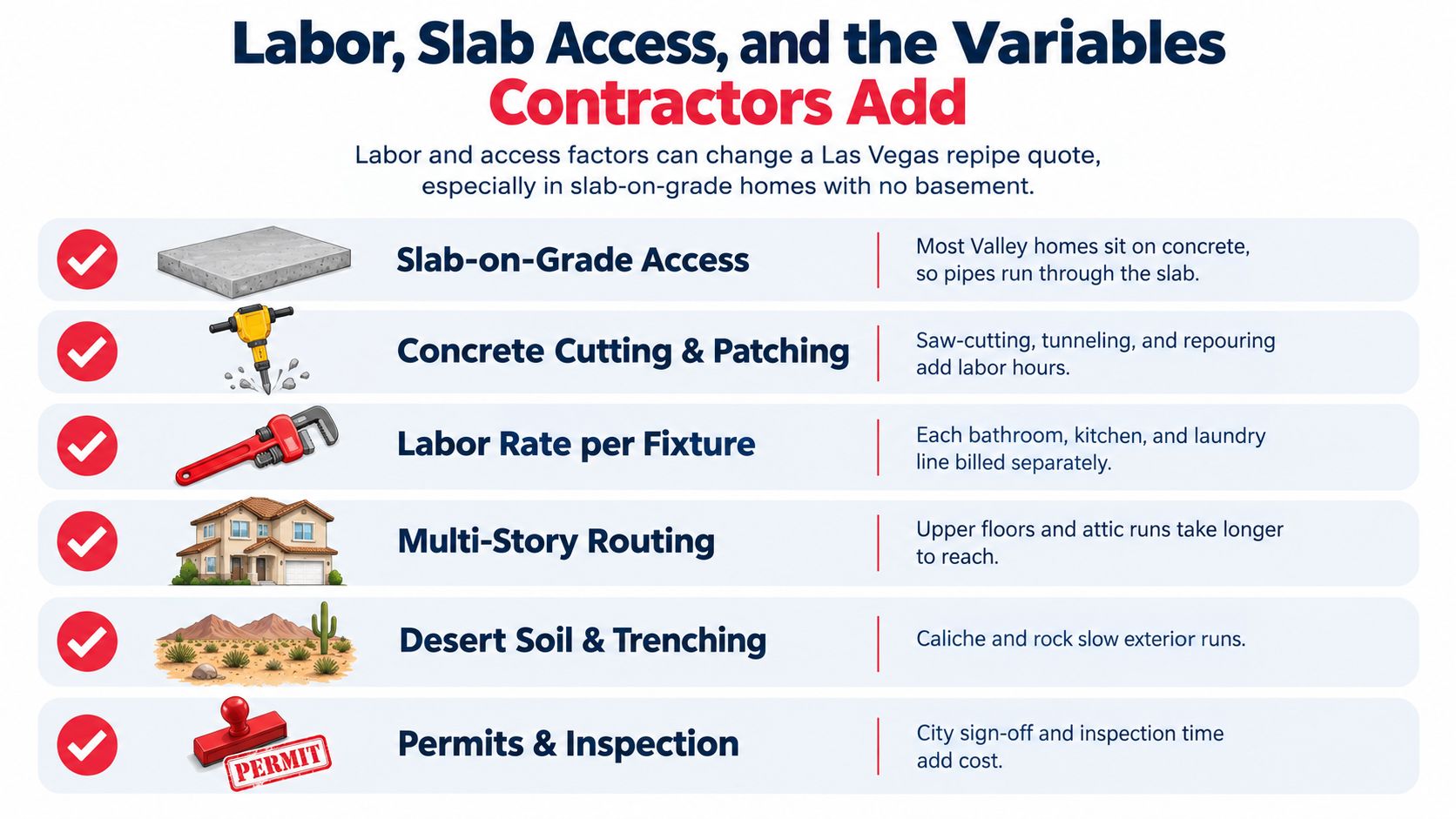
A Las Vegas repipe starts with the slab. Most Valley homes sit on slab-on-grade foundation, so there is no crawlspace to make the work easy. Contractors usually run new lines through the attic, open drywall, or cut concrete when the old route is buried where no clean access exists. That is why two houses with the same square footage can still produce very different bids.
Concrete access changes the job fast. A slab leak or full repipe can mean saw-cutting, tunneling under the foundation, or rerouting lines overhead. Hidden pipes cost more because every access move adds labor hours, patching work, and inspection time. Multi-story homes add their own burden, since second-floor risers mean longer runs and more wall openings.
The labor items that move the quote
- Slab access: Concrete cutting and restoration cost more than attic-only routing.
- Fixture count: Every bathtub, hose bib, washer box, or outdoor kitchen line adds labor and material.
- Wall finish: Drywall patches are simple, but older Venetian plaster needs more finish work.
- Desert soil and trenching: Exterior runs slow down when caliche and rock fight the trench.
- Permits and inspections: City sign-off takes time, and time costs money.
That access problem shows up in pricing. In local jobs, slab homes often come in noticeably higher than easier-access homes, and the gap can be wide enough to change whether a homeowner should repair one section or replace the whole system. For homes with under-slab routing or a main line issue, main water line replacement details are worth reviewing before you accept a vague plumbing quote.
Las Vegas also makes the material choice matter in a practical way. On aging copper, hard-water scale and failed joints often push the work toward Wirsbo AquaPEX as the default replacement, but the bill still rises or falls on access, not just pipe type. If a contractor quotes a slab home without saying how they will reach the lines, ask whether the routing stays in the attic or requires concrete cutting, and get that answer in writing.
Phased Repipe vs Full-House Repipe
A phased repipe replaces the worst line or section first, often the hot-water side or a known slab-leak zone, while leaving the rest of the system in place. A full-house repipe replaces every supply line in one project. For a Valley home with aging copper, hard-water scale, and repeated failures, the full replacement usually delivers the cleaner long-term result.
Phased work makes sense when leaks remain isolated, the rest of the system is stable, or the homeowner expects to sell within a few years. It can also buy time in a newer home with only a small number of copper pinholes. In the Las Vegas jobs I see, phased work usually lands between $2,500 and $7,000, depending on the section replaced and the access required.
When I'd push for the full repipe
I recommend a full repipe for homes with aging polybutylene, leaks in different rooms, or original 1990s copper showing scale and joint failures. A remodel with the walls already open is another good opportunity. Paying to open and patch the same areas twice wastes money, especially in slab-on-grade construction where access can require more invasive routing.
| Factor | Phased Repipe | Full-House Repipe |
|---|---|---|
| Best use case | Isolated leak area, short-term ownership | Aging system, recurring leaks, remodel work |
| Up-front cost | Lower | Higher |
| Long-term efficiency | Limited | Strong |
| Risk of future wall opening | Higher | Lower |
| Fit for older Vegas homes | Sometimes | Usually better |
Phasing has a predictable hidden cost. Opening one side of the house now and another later means paying for separate access, restoration, and disruption. You may also be replacing older copper in stages while hard-water scale continues affecting the untouched lines.
Choose the phased route when the budget requires it and testing shows the remaining piping is serviceable. Choose the full repipe when failures are spreading, the home is already opened for renovation, or you want one coordinated installation, commonly using Wirsbo AquaPEX for the Valley's aging copper systems. A typical full-house project in Las Vegas runs about $4,500 to $15,000, so phased work saves money only when the rest of the system can reasonably stay in service.
Permits, Inspections, and Las Vegas Code Requirements
A whole-house repipe in the Las Vegas Valley requires a plumbing permit through the City of Las Vegas or Clark County Development Services. In Clark County, the plumbing permit is calculated from job value, so a $10,000 repipe carries a different permit line than a $5,000 project. Ask the contractor to show that fee on the written estimate. Do not pull the permit yourself unless you understand the responsibility you are accepting.
The permit supports required inspections. During the rough-in inspection, the new lines are pressure-tested before walls or ceilings close. The final inspection checks the completed installation, connections, and code compliance. That paper trail matters when you sell the home or need warranty documentation.
What code-compliant work should include
- Nail plates on studs where pipes run close to framing edges.
- Proper hangers and support spacing to prevent sagging, rubbing, and noise.
- Isolation valves at fixtures so future repairs do not require shutting off the entire home.
- Pressure ratings matched to local water-heater and supply conditions.
Las Vegas slab-on-grade construction makes routing and access important, but code hardware and inspections apply whether the lines run through walls, ceilings, or accessible areas. Hard-water scale on aging copper also makes clean transitions and properly supported Wirsbo AquaPEX installation important.
Treat the permit as part of the plumbing scope, not vague overhead. The estimate should identify who obtains it, who schedules inspections, and whether inspection-related corrections are included. If those responsibilities are missing, get them in writing before approving the repipe.
Red Flags, Hidden Costs, and How to Read a Written Estimate
A written estimate gives you the only reliable basis for comparing Las Vegas repipe bids. Two totals that look close can describe completely different jobs if one hides drywall, permit fees, and fixture reconnections inside a lump sum.
The quote should separate materials, labor, drywall and finish repair, slab penetrations, permit and inspection fees, and fixture reconnections. It should name the PEX brand or copper type, show the manifold location, and state whether the main shutoff and water-heater connections are included. For leak-related work before a repipe, MG Plumbing Services' leak detection page shows the kind of diagnostic scope that should connect clearly to the plumbing proposal.
Red flags I would not ignore
- Cash-only pricing with no written record.
- Square-foot pricing with no fixture count or routing plan.
- No permit line item or unclear responsibility for inspections.
- A vague drywall allowance that leaves patching costs open-ended.
- Time-and-materials billing without a defined scope and spending limit.
Practical rule: require the contractor to state exactly what gets opened, patched, tested, and reconnected before you approve the work.
Slab-on-grade construction makes access a major Las Vegas cost driver. A quote should identify whether the crew will route Wirsbo AquaPEX through walls and ceilings, cut concrete, or leave slab work outside the base price. Aging copper with hard-water scale may also require extra preparation at transitions and connections.
In my experience reviewing Valley bids, two identical-looking totals can differ by $2,000 to $4,000 once you read the scope line by line. Compare access work, restoration, fixtures, inspections, and cleanup before choosing the lowest number. A low bid with missing allowances can become the most expensive option after walls and floors are open.
Getting an Accurate Repipe Quote in the Las Vegas Valley
Bring real home details to the estimate. A contractor needs square footage under living area, the exact bath count, water heater age, whether the home is single-story or two-story, and any known slab leaks or prior pipe repairs. If you already know the home has hard-water scaling, aging copper, or previous reroutes, say it up front.
Get two to three in-home written quotes from licensed Nevada contractors who pull permits in Clark County or the City of Las Vegas. Ask whether the crew handles repipes every week or just takes them occasionally, because specialization matters when the job turns into a wall-opening project. Also ask whether drywall comes back to paint-ready condition or just patch-ready, because that difference changes the cost of the job.
What I'd confirm before signing
- License status with the Nevada State Board of Plumbing Examiners.
- Warranty on both material and labor.
- Permit handling and inspection scheduling.
- Local repipe references, not just general plumbing reviews.
- Inclusion of shutoffs, hose bibs, and water-heater connections.
For homeowners comparing contractor options, MG Plumbing Services LLC is a local, family-owned residential plumbing company serving Las Vegas, Henderson, North Las Vegas, Summerlin, and the rest of the Valley, and it offers written estimates, residential repipes, leak detection, drain work, water heaters, and water-line services. That kind of scope is useful because it lets one contractor diagnose the problem and quote the fix without bouncing you between vendors.
Most full PEX repipes are scheduled and completed within a few weeks once approved, but the cleaner timeline is the one that starts with a real in-home inspection and a written scope. If you want the right number, don't shop by guesswork. Shop by who will show you exactly what gets replaced, what gets patched, and what the final bill covers.
If your home is showing leak history, low pressure, or aging copper, call MG Plumbing Services LLC for a straight answer and a written repipe estimate. They serve the Las Vegas Valley, they work residential plumbing only, and they can walk you through what a full repipe means for your house. Visit MG Plumbing Services LLC to request service and get the conversation started.