

You turn on the kitchen faucet and get rusty water. The shower feels weaker than it used to, and the water heater seems packed with scale. In a hypothetical 1970s Las Vegas slab home, that combination can make a whole-house repipe sound inevitable. The year built is a clue, not a verdict.
Repiping an old house should start with finding which system is failing and why. A restricted valve, a leaking buried supply run, and a deteriorated sewer line need different repairs. The right scope protects the house without replacing sound plumbing just because it's old.
Table of Contents
- Signs That Point to a Repipe
- Supply, Service Line, and Drains Are Different Jobs
- What to Inspect Before Any Pipe Comes Out
- Copper PEX and Galvanized Side by Side
- How Much a Repipe Disrupts the House
- Pressure and Hard Water After the New Pipe
- Questions to Settle Before You Hire
Signs That Point to a Repipe
A pattern across the house matters more than a single symptom. Brown water at every cold tap deserves a different investigation from discoloration at one bathroom faucet. Likewise, a shower that improves after cleaning the cartridge doesn't establish that the supply piping needs replacement.
Start by recording where each problem occurs, whether it affects hot or cold water, and whether it happens after water sits unused. Photograph stains and exposed pipes before cleaning or covering them. Those details help separate a fixture problem from a branch restriction or an upstream failure.
Old-house plumbing signs and the next step
| Sign | Likely system | What it usually means | Next step |
|---|---|---|---|
| Brown, rusty, or metallic water | Interior supply or old service metals | Corrosion particles or scale letting go | Identify materials and test water before replacing pipe |
| Weak flow at several fixtures | Supply branches, service line, or PRV | Restricted bore, failing regulator, or a bottleneck upstream | Measure static and flowing pressure, then trace materials |
| Pinholes, wet drywall, or ceiling stains | Copper or mixed supply | Localized corrosion or a fitting failure | Find the leak; repair the branch if the rest of the system is sound |
| Warm spots, high bill, or slab moisture | Under-slab supply | Concealed leak, not a fixture drip | Locate before opening floors; repair or reroute the failed run |
| Galvanized pipe at the heater or main | Older supply | Scale, thread leaks, and possible legacy metals | Plan replacement of failed galvanized, not a patch as the long-term fix |
| Repeat backups or sewer odor | Drain and sewer, often cast iron | Waste-line failure, belly, roots, or grease | Camera the drain; don't treat it as a drinking-water repipe |
Why Las Vegas symptoms need local interpretation
The Las Vegas Valley Water District classifies local water as very hard, approximately 291 parts per million, or 17 grains per gallon, primarily from naturally occurring calcium and magnesium carried from the Colorado River through Lake Mead. The district explains that these minerals aren't a health hazard, but they can form deposits that later dislodge from plumbing and fixtures.
That makes scale a practical diagnostic issue here. Deposits can restrict older piping, valve openings, heater connections, and aerators. Aging metal and mineral buildup can occur together, so replacing pipe without checking the fixtures may leave part of the complaint unresolved.
Practical rule: A symptom tells you where to investigate. It doesn't tell you how much pipe to replace.
Repeated leaks in separate branches, widespread internal restriction, and deteriorated material support a broader replacement discussion. An isolated failed fitting with sound surrounding pipe supports a smaller repair. Before anyone prices a whole-house job, mark only the rows you can document, and bring those observations to the inspection.
Supply, Service Line, and Drains Are Different Jobs
Think of the drinking-water system as a tree: interior branches are the twigs inside the walls, and the private service line is the trunk running from the meter to the house. Drains are a separate downhill path carrying wastewater away. They never deliver drinking water.
That distinction changes what a repipe quote covers. An interior supply replacement may leave the buried service untouched. A drain replacement may involve concrete removal without changing any pressurized water piping.
The boundaries are easier to understand when they're drawn separately.
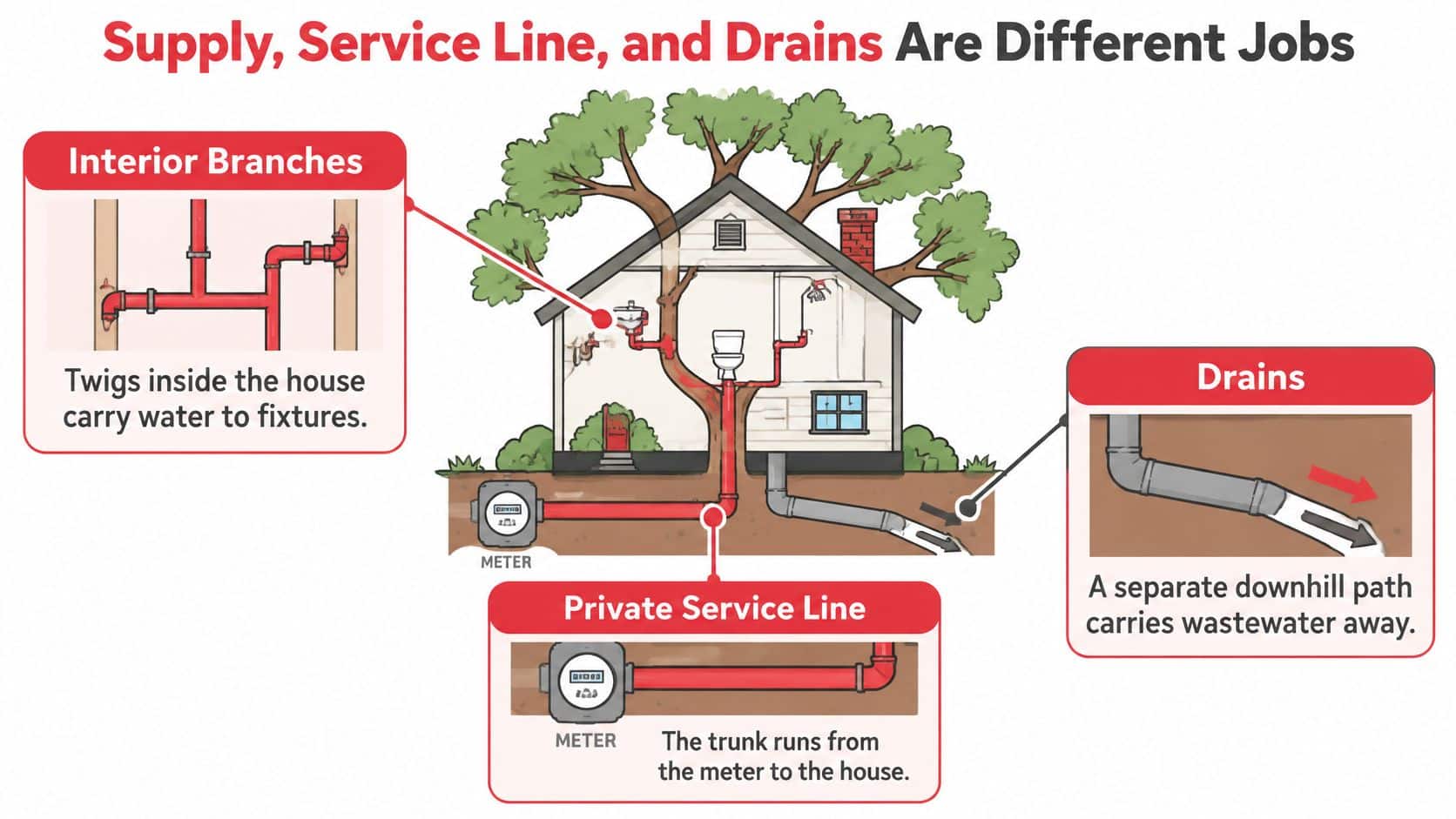
Follow the complaint to the correct system
Say a homeowner has poor shower flow and recurring toilet backups. New interior supply branches might improve water delivery, but they won't correct a sewer belly. Replacing the sewer won't improve the shower either.
A corroded service line can also remain the bottleneck after attractive new piping goes into the walls. The scope for main water line replacement in Las Vegas should identify the meter-to-house run separately from indoor distribution. Confirm the utility's ownership boundary rather than assuming every buried section belongs to the homeowner.
Use different evidence for each system:
- Interior supply: Inspect exposed tubing, connections, fixture behavior, and water quality.
- Private service: Combine utility records, accessible material checks, pressure testing, and leak location.
- Drains: Use camera footage to assess visible wall condition, joints, blockages, and standing water.
Use construction history without making it the diagnosis
The EPA's lead-rule fact sheet identifies 1986 as the prohibition milestone for new lead pipe and describes the 2024 rule's 10-year replacement requirement for water systems. Millions of legacy lead connections remain nationally, but that context doesn't establish what's buried at a particular Las Vegas property.
Earlier houses warrant closer investigation of service materials and plumbing history. Later construction doesn't excuse unknown service sections, older retained components, or lead-bearing fixtures from inspection.
A sound modern supply system can sit above deteriorated cast-iron waste piping. In our local diagnostic work, cast-iron failure is a concern in valley homes built before the mid-1980s, but the camera findings still determine the recommendation.
Name the system, material, and failure pattern before discussing a whole-house tear-out. A quote that only says repipe leaves too much room for misunderstanding.
What to Inspect Before Any Pipe Comes Out
Replacing the pipe beside a wet spot can stop a leak without explaining why it happened. Calling that work a repipe doesn't make it a system diagnosis. Moisture can travel along framing or a slab, so the visible stain may be well away from the failed connection.
A useful inspection maps both the source and the route. That's especially important before cutting finished floors or opening a tiled shower wall.
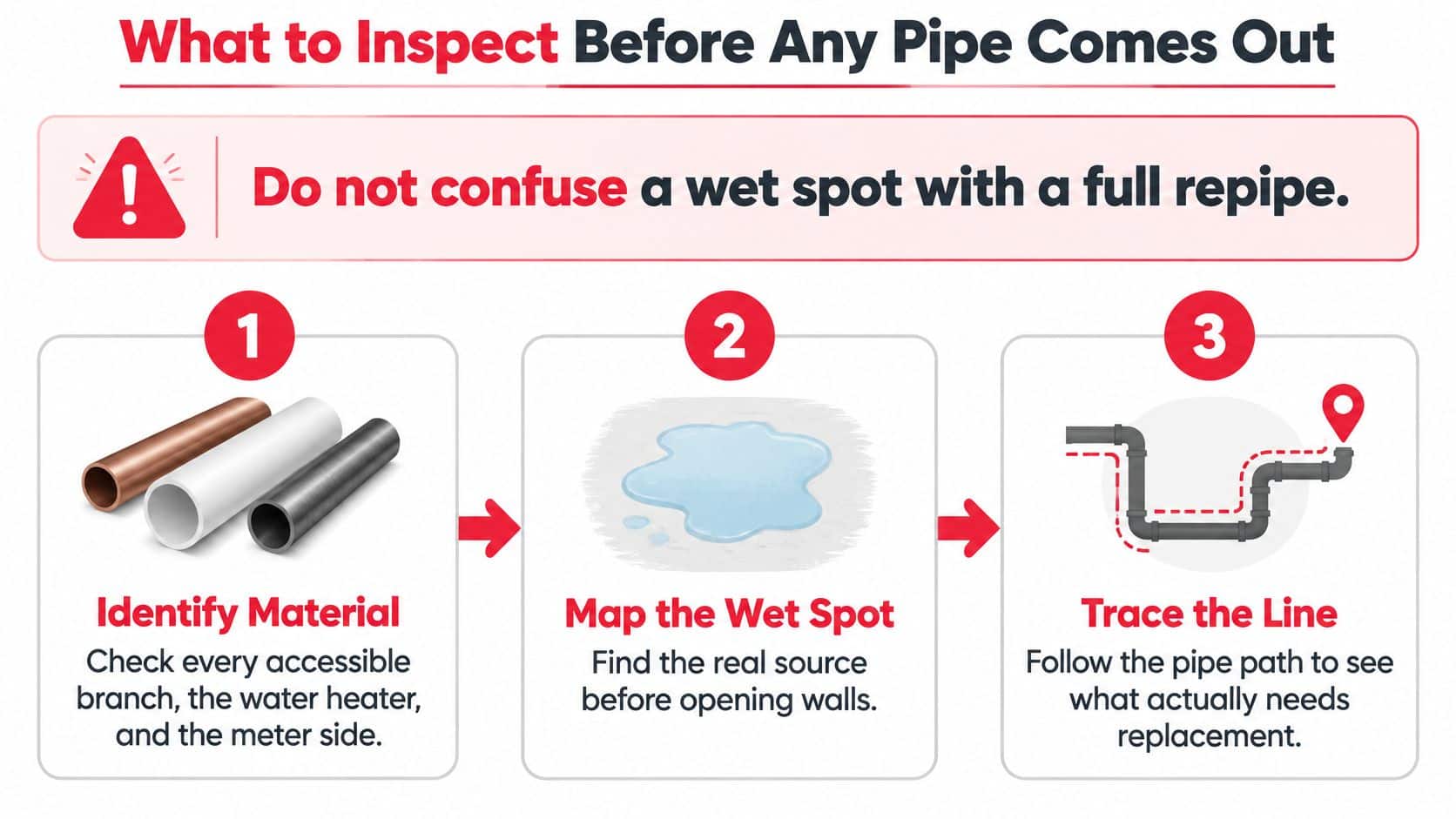
Build the inspection in a deliberate order
Identify accessible materials. Record the pipe at each visible branch, the water heater, the building entrance, and the accessible meter-side connection. Don't assume that copper at the heater means copper throughout the house.
Inspect transitions. Note galvanized-to-copper connections and whether appropriate dielectric isolation or listed transition fittings are present. Check for crusting, damp threads, unsupported connections, and evidence of previous patchwork.
Check older joints and water-quality concerns. The EPA's drinking-water lead questions identify homes and fixtures built before 1990 as more likely to contain lead solder or other lead-bearing components, and homes built before 1986 as more likely to contain lead pipe. Appearance alone can't establish whether solder or brass contains lead.
Measure pressure under different conditions. Attach a gauge at an accessible hose bib for static pressure, then measure while water flows. Compare performance at a distant fixture to help distinguish a local restriction from a problem affecting the whole supply.
Investigate drains when they're part of the complaint. Camera inspection before jetting helps assess whether the line is structurally suitable for aggressive cleaning. At MG Plumbing Services, our process is to recommend repair instead of jetting when visible wall thinning, cracks, or collapse indicate damaged pipe.
Write the boundaries. Separate house distribution piping, the building supply, fixture stops, water-heater connections, and the pressure regulator. Identify which components remain.
Explain the failure before choosing the repair
Galvanized steel can fail hydraulically and mechanically. Internal corrosion deposits reduce the usable opening, while threads and mixed-metal connections develop leaks. Its zinc coating may also contain trace lead, and accumulated corrosion scale can hold metals that later enter the water.
For concealed moisture, water leak detection should establish the leak location before demolition. Acoustic equipment, isolation testing, meter observations, and moisture mapping help narrow the search; none should be treated as a reason to open an entire floor without a defined target.
Keep the evidence, not just the estimate. Material notes and test results make competing repair scopes easier to compare.
The homeowner should finish with material notes by branch, static and flowing pressure readings, camera findings when drains are involved, and explicit exclusions. Replacement piping should be jurisdiction-approved and lead-free, with accessible shutoffs and service points. If an old service line remains, the estimate should explain whether it still limits the proposed work.
Copper PEX and Galvanized Side by Side
The right material matches the failure, installation route, and water conditions. Comparing only the purchase price of tubing misses the cost of fittings, access openings, restoration, and future service. A flexible reroute through accessible spaces is a different job from rebuilding rigid piping inside finished walls.
Repipe materials and where each belongs
| Material | Typical problem in older homes | Sensible role | Limit to plan for |
|---|---|---|---|
| Galvanized steel | Scale, weak flow, thread leaks | Replace failed supply rather than patch long term | May have absorbed lead from an older connected line; log every section |
| Copper | Pinholes, joint leaks, hot-water wear | Long-life supply where access and water chemistry suit it | Needs correct transitions away from galvanized; chemistry still matters |
| PEX | Not original pipe in most pre-1980s homes | Whole-house supply and many reroutes with fewer joints | Sunlight, fitting quality, and jurisdiction approval |
| CPVC | Brittle pipe and failed glue joints | Leave sound short branches; limited repairs | Poor default for a full potable repipe |
| Cast iron drain | Thin walls, cracks, bellies, roots | Camera, then spot repair or ABS replacement | Not drinking-water pipe; cleaning won't fix a bad slope |
Galvanized steel isn't a material to keep extending with new copper as a permanent strategy. The transition might be repairable while the remaining steel is still internally restricted. A successful connection doesn't prove that the old run deserves continued service.
Copper can be a sensible choice where the water chemistry, workmanship, and access suit it. PEX often allows longer continuous runs and fewer concealed joints, but it still needs proper supports, protected penetrations, compatible listed fittings, and protection from sunlight. Neither material excuses careless installation.
Galvanized doesn't mean free of lead risk
A Town of Culver public-water notice explains that galvanized material can accumulate lead and remain a source of drinking-water contamination. That matters when galvanized pipe was previously connected to lead piping, even if the surviving pipe itself isn't lead.
A short replacement near the water heater doesn't resolve an undocumented service history. Log the materials from the utility connection through the interior branches, including unknown sections. Where that history raises a concern, arrange appropriate water testing before and after the work, with particular care for households with infants, children, or pregnant people.
- If galvanized remains: Identify its location and whether its history calls for further investigation.
- If only branches change: Record what remains upstream, rather than describing the result as complete replacement.
- If water quality prompted the job: Include post-work flushing and follow-up sampling in the closeout plan.
Retain sound pipe when the evidence supports it
For a short CPVC repair, cutting back to sound material can be reasonable. I wouldn't choose it by default for a full-house replacement to reduce the material bill. Brittle existing pipe needs careful handling, and solvent-welded repairs require the correct preparation and cure conditions.
Cast iron belongs in the waste-system decision. Paper-thin walls call for replacement, while an isolated defect may support a spot repair; neither condition justifies replacing potable branches.
Inspection should decide full replacement versus failed branches only. Don't demolish sound plumbing to make every material in the house match.
How Much a Repipe Disrupts the House
Disruption follows the access route, not the word repipe. Before agreeing to work, trace the proposed route through the actual rooms, cabinets, ceiling spaces, and yard. A route that looks simple on an estimate may cross a tiled wall or an inaccessible roof cavity.
An exposed-wall installation shows why routing and finish restoration need separate planning.
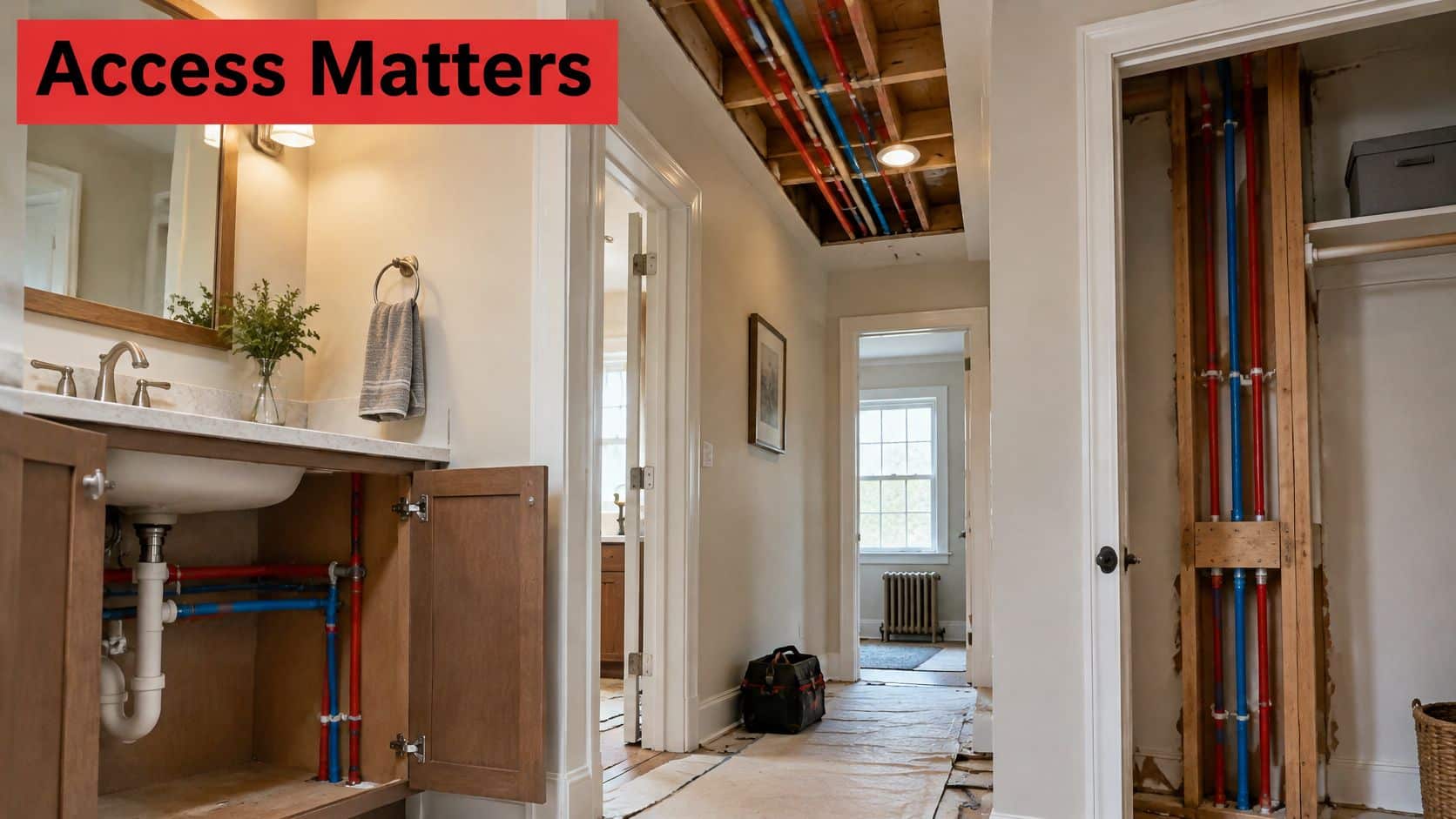
Different access routes create different household problems
An accessible reroute can carry new supply overhead or through cabinets and closets, with localized openings near fixtures. That may keep occupied rooms usable and allow planned shutoff windows. Overhead piping still needs protection from heat exposure, physical damage, and unconditioned-space conditions.
An open-wall ranch-house job requires cuts at fixture groups and along connecting routes. Dust containment, floor protection, and keeping tools out of walking paths become part of the daily plan. Drywall patching, texture matching, and painting are separate work unless the estimate includes them.
An under-slab repair may require targeted excavation, a feasible tunnel, or abandonment of a failed supply run in favor of a reroute. A drain that must maintain gravity slope may need replacement in place through an open trench. Those choices affect concrete, landscaping, and toilet availability differently.
This video provides another visual reference for discussing the work before access openings begin.
Put daily living arrangements in the estimate
Don't accept a general promise of minimal disruption. Confirm where the main shutoff is, when hot water will be unavailable, and which bathroom can remain usable. A temporary feed is only an option when the plumber can provide an approved potable-water arrangement, not an improvised garden-hose connection.
The estimate should name:
- Openings: Rooms, cabinets, floors, and exterior surfaces affected.
- Outages: Planned water interruptions and any overnight loss of service.
- Restoration: Who handles drywall, paint, flooring, concrete, and landscaping.
- Abandoned piping: Which runs will be disconnected, drained, and capped.
- Closeout: Pressure testing and required inspections before concealment.
The plumbing price and the patch-and-paint price are different lines. Settle both before demolition, not when the water is back on and the walls are still open.
Pressure and Hard Water After the New Pipe
New pipe followed by the same weak shower is frustrating. So is a replacement system installed without addressing the conditions that damaged the old one. Material, chemistry, temperature, contact time, and protective scale all affect corrosion; the house's birthday doesn't explain the mechanism.
Set pressure deliberately
EPA WaterSense guidance says supply mains can reach 100 psi or more, notes that most U.S. plumbing codes require a pressure-regulating valve above 80 psi, and recommends incoming service pressure of approximately 45–60 psi, with the regulator downstream of the source connection. Excessive pressure stresses piping, fixtures, and appliances and increases leak risk and water use.
The Los Angeles Department of Water and Power's pressure guidance describes regulator adjustments of 50–70 psi and notes that older houses may lack regulators because they predate current requirements. That's a useful comparison, not a substitute for the applicable Las Vegas-area requirements and the property's measured conditions.
After adding a PRV, evaluate thermal expansion. A closed system needs an appropriate way to accommodate expanding heated water; the water heater's relief valve shouldn't become the routine outlet.
Commission the system rather than just turning it on
- Flush systematically: Clear installation debris before normal use.
- Clean fixture screens: Remove and rinse aerators, then check shower cartridges and inlet screens when flow remains uneven.
- Check the heater: New supply tubing won't remove existing sediment or scale.
- Discuss treatment: Consider softening based on household needs and equipment maintenance, without confusing softening with lead removal.
The EPA's drinking-water lead information identifies public-system regulatory benchmarks of 0.015 mg/L for lead and 1.3 mg/L for copper. These aren't a house-specific diagnosis or a guarantee of safe water at every tap; sampling needs to match the concern being investigated.
Completion check: Confirm performance at the fixtures, not just a leak-free connection at the new pipe.
Two incomplete jobs illustrate the problem. A drain belly can collect waste again after cleaning because the slope remains wrong. A scaled service line can starve brand-new branches because the upstream restriction remains.
Questions to Settle Before You Hire
A proposal that just says "repipe" leaves the scope undefined. One contractor's whole-house job covers interior supply only, while another's includes the service line and skips the drains entirely. A useful proposal connects an observed failure to a defined repair, so settle these questions before signing:
- Which systems are included? Interior supply, the private service line, and drains are separate scopes, and the proposal should name which ones it covers.
- What stays in the walls? Request the material map and the location of any retained galvanized or unknown sections.
- What pressure was measured? Record the static and flowing readings, the PRV decision, and its intended setting.
- What did the camera establish? The footage should separate a cleaning job from a spot repair or replacement for structural deterioration.
- How will the house be opened? Name the access routes, the water outages, and who restores the finishes.
- Can you decline after diagnosis? The written, itemized scope should arrive before you authorize any repair.
A local residential option with a defined process
MG Plumbing Services LLC is a licensed, owner-operated residential plumbing company serving Las Vegas, Henderson, North Las Vegas, Summerlin, and surrounding valley areas. Owner Miguel Garcia holds a Nevada C-1d plumbing contractor license and has worked in the trade since 2000, and he runs every call himself rather than sending subcontractors or rotating technicians. Estimates are flat-rate, itemized, and delivered in writing before work begins.
The company's residential work covers drain cleaning, hydro jetting, sewer camera inspection, and leak detection, plus tank water heater installation, faucet repair, toilet replacement, fixture installation, and remodel rough-in. Cast-iron-to-ABS drain replacement under the slab or by open trench, main water line replacement with Wirsbo AquaPEX including PRV and booster-pump service, and slab-leak repair are handled in-house, so the same plumber follows the job from inspection through repair.
That setup answers the questions above directly. When a camera inspection shows a line needs repair, the customer gets the footage and a written estimate, then decides whether to move forward; the written cost-estimate process shows how that pricing is built. Recommendations stay limited to what the job needs. On one service call, Miguel arrived ready to replace a water heater another plumber had condemned, found that only the rod inside needed replacing, drained the tank, swapped the rod, and left everything clean. Same-day appointments run Monday through Saturday, 7:00 AM to 5:00 PM, with service in English and Spanish. Se habla español.
MG Plumbing Services LLC handles the diagnosis that decides whether repiping an old house calls for a branch repair, service-line replacement, drain work, or a broader supply replacement. Request a visit through MG Plumbing Services LLC, and have your symptom notes and photos ready so the work starts with your problem rather than a default tear-out.