You flush the toilet, run the shower, and the water in the tub starts to burp back at you. Or you're in escrow on a house in Henderson and someone says, “You might want to scope the sewer line before closing.” Most homeowners know that means trouble somewhere underground. Fewer know what the camera tells you, or why one inspection can lead to a simple cleaning while another points to repair or replacement.
A sewer camera inspection matters because it replaces digging and guessing with a direct look inside the pipe. The camera goes through an existing access point, usually a cleanout, so the plumber can inspect the line before anyone starts trenching up a yard or opening concrete. That non-invasive approach is the basic reason the service exists. It helps answer the question: what is wrong, where is it, and what is the smallest repair that will solve it?
That question is especially important in the Las Vegas Valley. Local homes deal with very hard water, mineral buildup, aging drain materials in older neighborhoods, and access challenges that can change both the inspection plan and the bill. A sewer camera inspection in Las Vegas isn't just about getting a video clip on your phone. It's a decision tool.
Table of Contents
- Introduction Why a Camera Beats Guessing in Las Vegas Homes
- What a Sewer Camera Inspection Is and How It Works
- Signs You Need a Sewer Camera Inspection in Las Vegas
- What to Expect During Your Sewer Camera Inspection Visit
- Common Findings and What Each Means for Your Repair Options
- How Much a Sewer Camera Inspection Costs in Las Vegas
- How to Choose a Licensed Contractor and Book With MG Plumbing Services LLC
Introduction Why a Camera Beats Guessing in Las Vegas Homes
A lot of sewer calls start the same way. Someone already paid to clear a line once, maybe twice. The drain worked for a while, then the backup came back. At that point, the main problem isn't “how do I get water moving today.” The problem is that nobody has confirmed why it keeps happening.
Las Vegas has a long sewer history, and the way local systems developed still matters. The valley's modern sewer era accelerated in the 1950s. The Clark County Sanitation District was created in 1954, began treating county wastewater two years later, and by 1957 the City of Las Vegas had installed a new sewer system and relocated its wastewater-treatment plant. Those changes pushed wastewater discharge toward the Las Vegas Wash and shaped the infrastructure network plumbers and homeowners still deal with today, as described in the Las Vegas Wash history chapter.
That history shows up in practical ways. Some homes have older lines. Some neighborhoods have repairs layered over repairs. Some properties have cleanouts in easy spots by the side yard. Others have buried access, remodeled patios, or landscaping that makes diagnosis harder than it first appears.
Practical rule: If the same drain problem keeps returning, stop paying for repeat guesswork and get eyes inside the pipe.
A camera inspection helps in two common moments:
- Recurring trouble at home: You have repeated backups, slow drains in more than one fixture, or sewer odor that comes and goes.
- A property decision: You're buying, selling, remodeling, or trying to decide whether to clean, repair, reline, or replace a sewer lateral.
That second point gets missed. A sewer camera inspection isn't only for emergencies. It helps people avoid over-repairing a line that only needs cleaning, and it helps them avoid under-reacting to a line with structural damage.
In the Las Vegas Valley, one owner-operated residential company that uses this approach is MG Plumbing Services LLC, a local, family-owned and owner-operated plumbing company serving Las Vegas, Henderson, North Las Vegas, Summerlin, and surrounding areas. The company handles residential plumbing repairs, drain cleaning, sewer and drain services, hydro jetting, sewer camera inspections and locating, water leak detection, water heater repair and replacement, water treatment, and general plumbing services.
What a Sewer Camera Inspection Is and How It Works
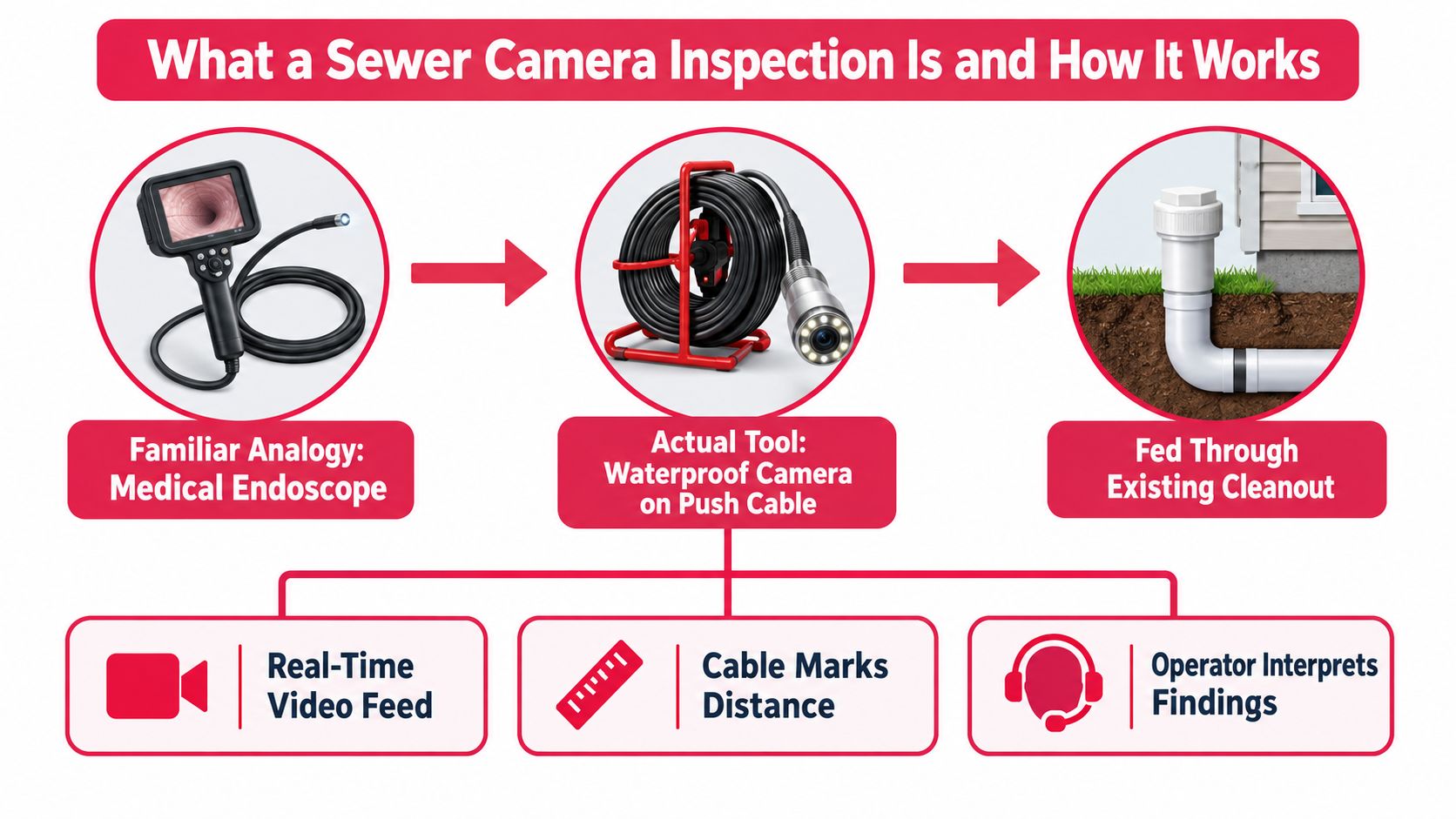
A medical scope for a pipe. A doctor doesn't guess what's happening deep inside the body when a camera can show it directly. A plumber works the same way with a drain line.
A sewer camera inspection uses a waterproof camera mounted on a flexible push cable. The cable is fed through an existing access point, usually a cleanout, so the plumber can inspect the inside of the underground drain or sewer line without digging first. That basic mechanic is what makes the method non-invasive, as described in this explanation of camera inspections through an existing cleanout.
What the plumber is actually using
The tool isn't just a tiny camera taped to a wire. A professional setup usually includes a monitor, a push cable with distance markings, a camera head with lights, and a locator that helps mark where the camera is from above ground.
Public inspection standards show how precise this work has become. Major CCTV specifications commonly require pan-and-tilt camera heads, bright internal illumination, and NASSCO PACP-certified operators, with some standards calling for video resolution of at least 470 horizontal lines and inspection speeds no faster than 30 feet per minute. Some standards also require distance measurement accuracy within 1% of actual distance, which is why a trained operator can do more than say, “There's something down there.” They can identify where the issue begins and where it ends, based on the CCTV inspection standards manual.
What you can and can't learn from the video
A good inspection can reveal:
- Structural issues: Cracks, separated joints, offsets, sags, and collapse.
- Flow issues: Grease, debris, scale, wipes, and packed blockages.
- Location clues: How far into the line the problem appears, and where it sits in the yard or slab area.
What it can't do is magically fix the line by itself. The camera is a diagnostic tool. If the line is packed full of waste or heavy buildup, the image may be limited until the plumber clears enough material to see the pipe wall.
The camera answers a different question than a drain snake. A snake asks, “Can I punch a hole through this blockage?” A camera asks, “What created the blockage in the first place?”
Why this matters to a homeowner
When the operator narrates the inspection live, you can usually see whether the pipe is round and stable or rough and deteriorated. You may also get a recording, still images, or a written summary. That documentation matters when you're deciding between a simple cleaning and a larger repair, or when a real estate transaction needs something more concrete than a verbal opinion.
Signs You Need a Sewer Camera Inspection in Las Vegas
Not every slow drain needs a camera. A single bathroom sink that drains sluggishly might just need routine cleaning. The pattern changes when several symptoms start lining up.
Signs that call for prompt scheduling
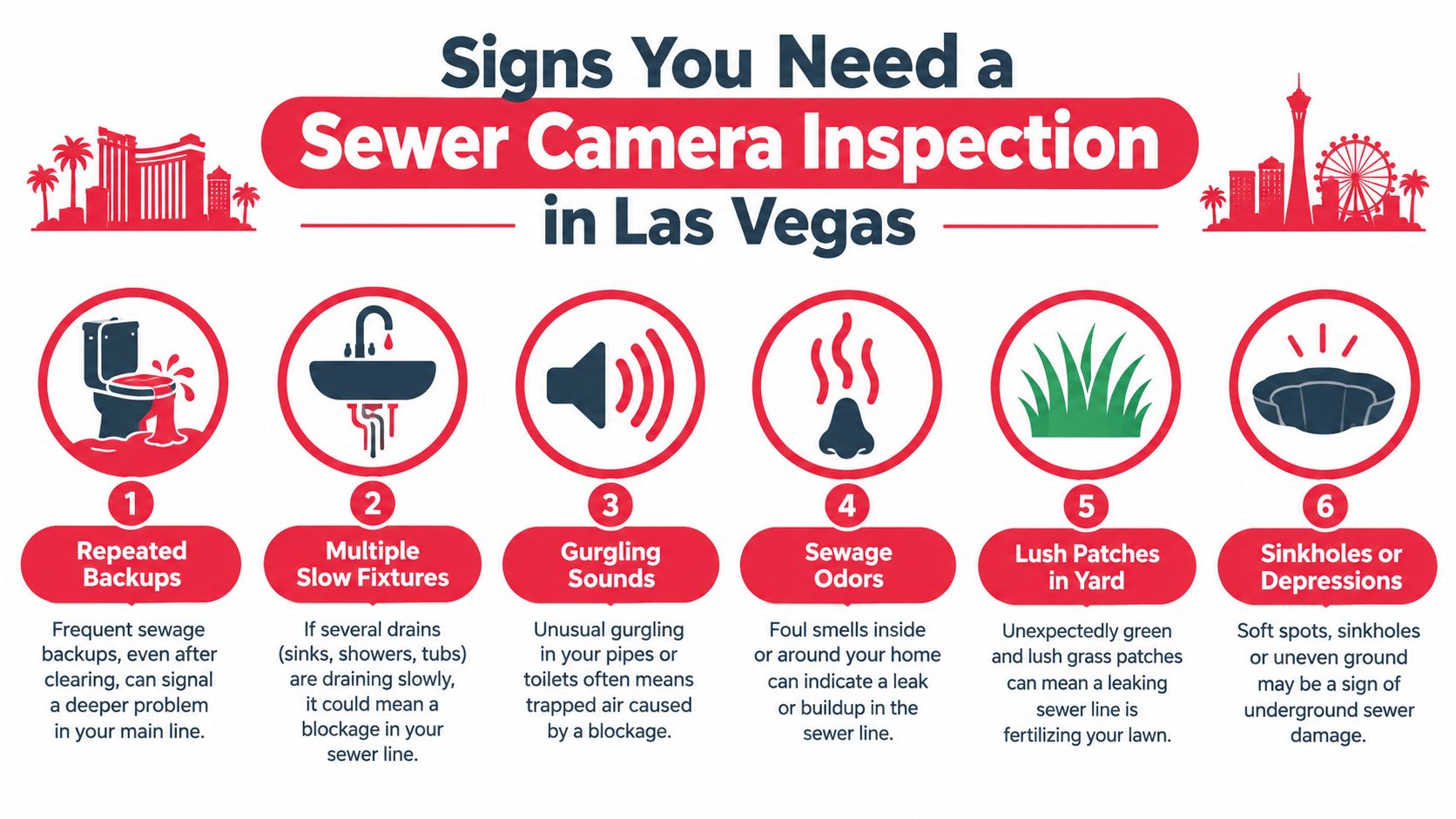
These usually point to a main drain or sewer issue, not a simple local clog:
- Repeated backups: The line gets cleared, works briefly, then backs up again.
- Multiple slow fixtures: A tub, toilet, and shower all act up around the same time.
- Gurgling sounds: Air is getting trapped because wastewater isn't moving cleanly.
- Sewage odors: Smell inside the home or near the yard can mean waste is not flowing where it should.
- Yard changes: Extra-green patches, soft soil, or depressions can point to an underground leak or break.
Las Vegas conditions add another layer. The Las Vegas Valley Water District says local water is very hard, measured at 291 parts per million, or 17 grains per gallon, and identifies calcium and magnesium as the minerals responsible. Those minerals are not a health risk, but they can leave deposits in pipes and fixtures, which is why scale-related plumbing trouble is such a familiar issue in the valley, as explained in this summary of Las Vegas hard water conditions.
That matters because a line that keeps clogging may not just have “stuff in it.” It may have narrowed over time from scale, especially in older drain systems.
Here's a short visual explainer if you want to see the warning signs in plain terms:
When you can monitor and when you shouldn't
A one-time slow kitchen sink usually gives you room to watch the pattern. A sewer smell, backup at the tub during toilet flushing, or repeated main line stoppage usually doesn't.
Use this simple triage:
- Monitor: One isolated fixture, mild slowdown, no odor, no history of repeat failure.
- Schedule soon: Repeated clearing, more than one fixture involved, visible yard symptoms.
- Move quickly: Sewage backup, active overflow, or signs the line may be compromised under a slab, walkway, or landscaped area.
If the line has already been cleaned and the same symptom comes back, that's the moment to scope it.
Another common time to schedule a sewer camera inspection in Las Vegas is before buying a home, before replacing sections of line, or after cleaning work when you want to verify the pipe wall condition rather than assume the problem is finished.
What to Expect During Your Sewer Camera Inspection Visit
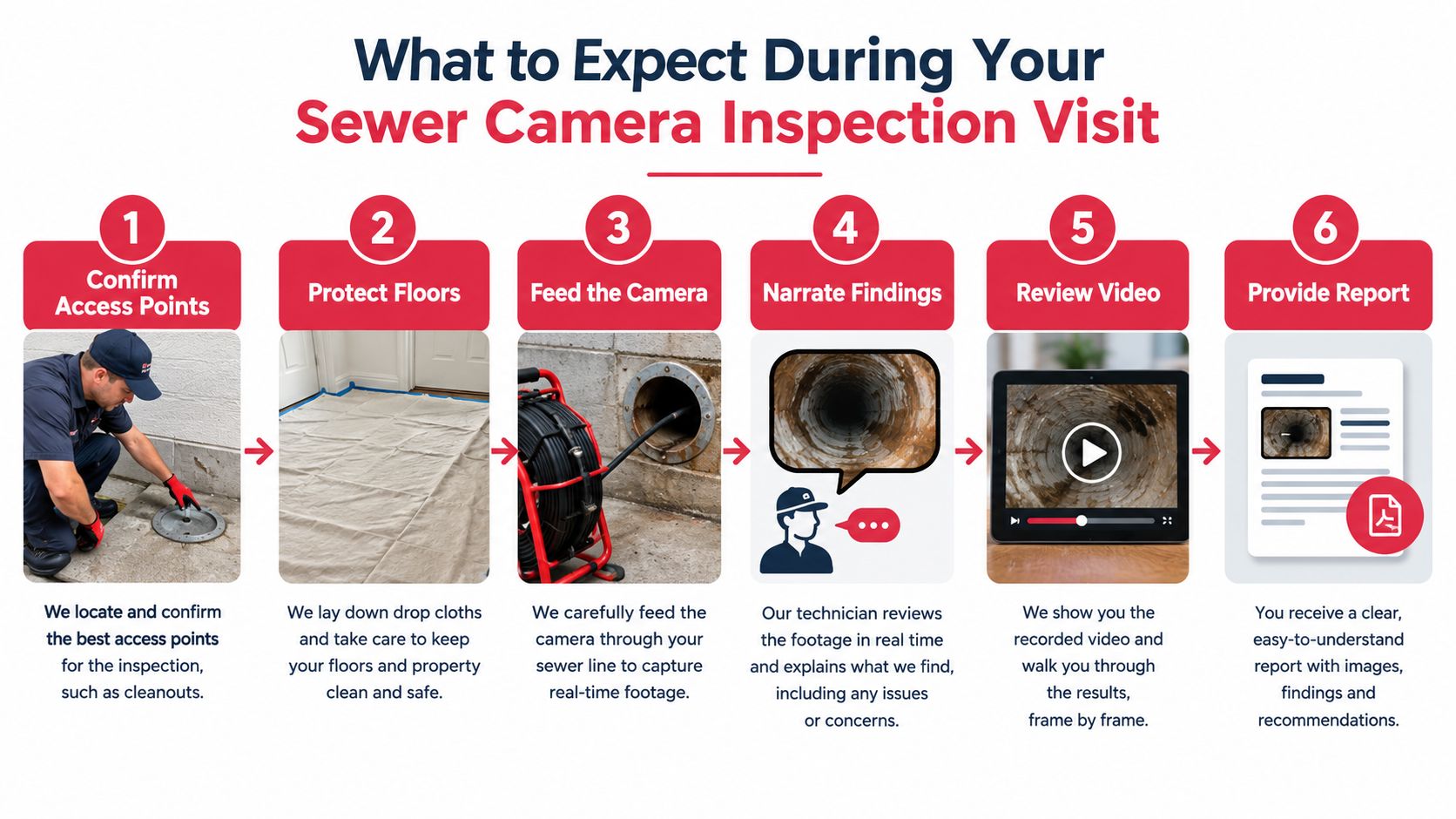
Most homeowners feel better once they know how the visit unfolds. It's usually calm, methodical work. The plumber isn't showing up to start tearing things apart. The first goal is access and visibility.
What happens first on site
The technician typically starts by asking where the symptoms have shown up and whether the line has been cleared before. Then they confirm the best access point. In many homes that's an exterior cleanout. In others, it might be another service opening if the cleanout is buried, blocked, or missing.
A careful plumber also protects the work area. That can mean floor covering, controlled hose and cable routing, and keeping the monitor where you can see the video if you want to watch.
What you're likely to see during the inspection
Once access is open, the camera head goes into the line and the operator advances it slowly while watching the monitor. This isn't a race. Good inspection work depends on moving at a controlled pace and stopping when something important appears on screen.
During the run, the plumber may narrate things like:
- Pipe condition: Whether the walls look smooth, scaled, cracked, offset, or broken.
- Flow marks: Signs of standing water, repeated backup, or past heavy use.
- Obstructions: Grease, wipes, roots, heavy buildup, or debris.
- Distance markers: How far the camera has traveled when it reaches a defect.
If the system includes locating equipment, the plumber can often mark the approximate position of the camera head from above ground. That's what turns video into a repair plan. Instead of saying “the pipe is damaged somewhere out there,” they can narrow the repair area.
A useful inspection doesn't just show a problem. It ties the problem to a location and a repair decision.
What affects how long the visit takes
A straight, accessible line is faster than a line with heavy buildup, turns, standing water, or difficult access. The appointment can also take longer when the homeowner needs written documentation for escrow, insurance discussion, or follow-up repair bids.
Questions worth asking while the camera is running:
- Is this a blockage issue, a structural issue, or both?
- Can you tell where the defect starts and how far it extends?
- Would cleaning improve this line enough to re-inspect, or is damage already clear?
- Will I receive video, stills, or a written summary?
By the end, you should understand what the camera saw, what remains uncertain, and what the next practical step is. That might be cleaning first, spot repair, further locating, or planning for replacement.
Common Findings and What Each Means for Your Repair Options
The video matters because different findings lead to very different repairs. Homeowners sometimes hear “the sewer line has a problem” and assume replacement is the only answer. Often it isn't. Other times, cleaning alone would be throwing money at a line that's already failing structurally.
Buildup versus damage
Some findings are mostly about flow. Others are about pipe integrity.
Grease, paper, sludge, and hard-water scale usually fall on the flow side. They block or narrow the line. A cleaning method such as cabling or, in some cases, hydro jetting for residential drain lines may restore capacity if the pipe itself is still sound.
Cracks, separated joints, offset connections, and collapse fall on the structural side. Those findings often need repair, section replacement, or a larger conversation about the rest of the line.
Common Camera Findings and Typical Next Steps
| Finding on Video | What It Indicates | Typical Repair Consideration |
|---|---|---|
| Heavy scale or mineral buildup | The line diameter has narrowed and debris keeps catching | Cleaning, then re-inspection to confirm wall condition |
| Grease or soft blockage | Flow is restricted, but the pipe may still be intact | Drain cleaning, then review whether recurrence suggests another cause |
| Root intrusion at a joint | Roots entered where the pipe connection opened up | Root removal, then evaluate joint repair or replacement |
| Crack or fracture | The pipe wall is damaged and may worsen with time | Spot repair or section replacement depending on length and location |
| Offset joint | One pipe section no longer lines up cleanly with the next | Repair of the affected section if flow disruption is significant |
| Belly or low spot | Wastewater can sit in the pipe instead of draining fully | Monitoring, targeted replacement, or grade correction depending on severity |
| Corrosion or worn interior | The pipe surface is deteriorating and may keep snagging waste | More cleaning won't solve the underlying condition. Repair planning is usually next |
| Full collapse or major deformation | The pipe can no longer carry flow reliably | Excavation and replacement are commonly considered |
What Las Vegas conditions can change
Hard water changes the conversation. In a valley where water is very hard, scale buildup can make an old line behave like a smaller pipe than it was designed to be. That can turn a manageable drain into a repeat offender.
Soil movement and age also matter. A slight offset in one property may stay stable for a while. In another, it may be the weak point that catches waste every few weeks. This is why the best repair choice doesn't come from the camera image alone. It comes from the image plus the symptom history.
A line can be open today and still be a bad line. If the camera shows structural defects, “it's draining for now” isn't the same thing as “it's fixed.”
What homeowners usually want to know is whether the next dollar should go toward cleaning, targeted repair, lining discussion, or full replacement planning. The camera gives the evidence for that decision.
How Much a Sewer Camera Inspection Costs in Las Vegas
This is the question you might ask first, and it's also the one local content often answers poorly. The problem isn't that nobody publishes prices. The problem is that the ranges don't line up cleanly enough to tell you what your inspection will cost.
One Las Vegas pricing guide lists a standalone sewer camera inspection at $125 to $250, another shows $125 to $400, and a third states $250 to $1,300, with most homeowners paying $400 to $700, according to this roundup of local sewer camera inspection price ranges in Las Vegas. That spread tells you something important. The headline number rarely tells the whole story.
Why two camera inspections can be priced very differently
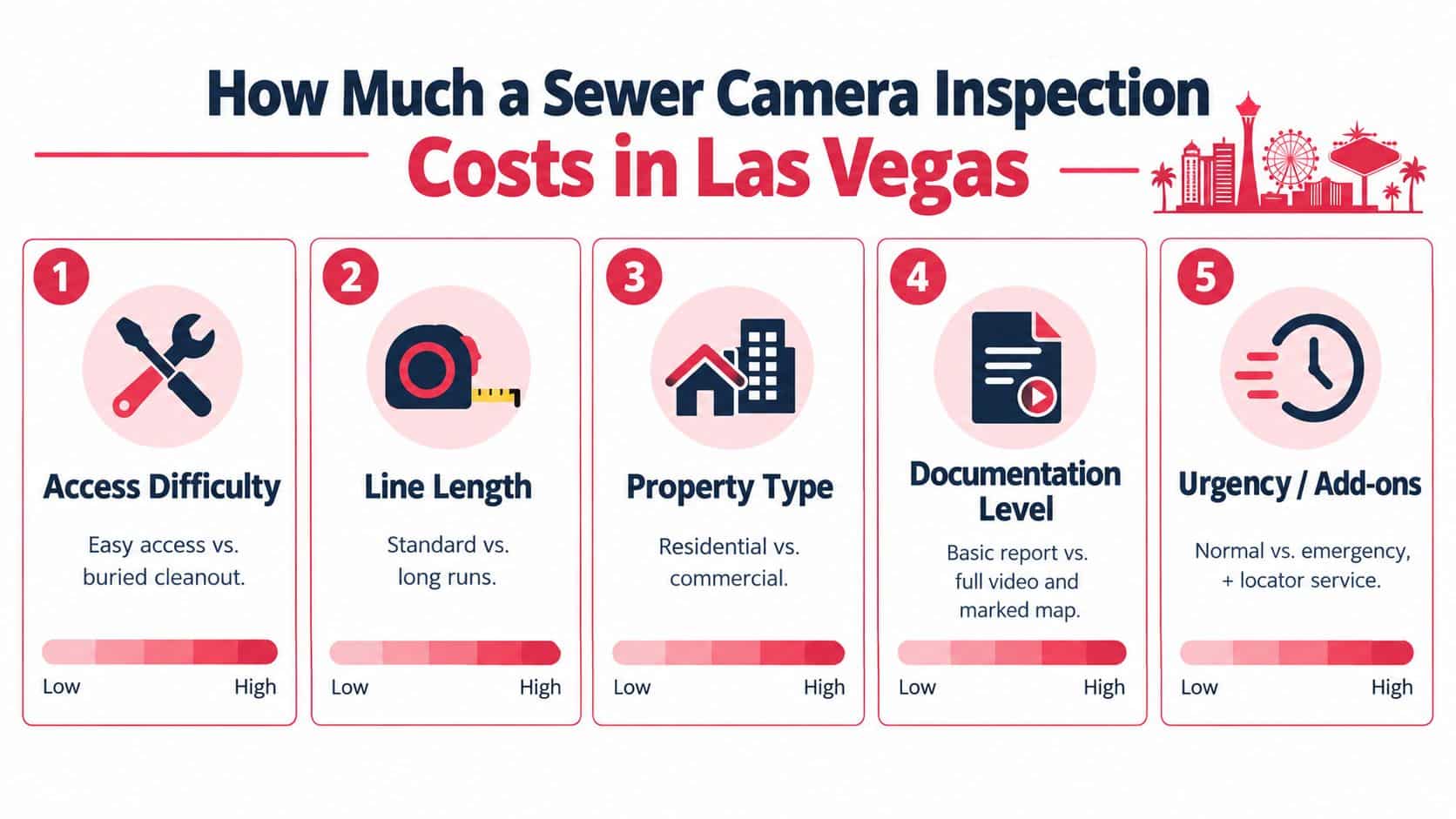
Price usually changes based on the work around the camera, not just the camera itself.
- Access difficulty: An exposed cleanout is simpler than a buried or obstructed one.
- Line length: A short run is different from a long lateral with multiple turns.
- Property type: Residential work is often priced differently than larger or more complex properties.
- Documentation level: Live viewing only is not the same as recorded video, written findings, and marked locations.
- Urgency and add-ons: Diagnostic visits that also require clearing, locating, or follow-up reporting cost differently than a basic scope.
A better way to compare estimates is to ask for itemization. You're not only buying “a camera look.” You're buying access, inspection time, interpretation, and possibly documentation that helps you make a larger repair decision.
How to judge value instead of chasing the lowest number
A cheaper scope can be expensive if it misses structural defects, doesn't locate the issue, or leaves you with no usable record for your next step. A more thorough inspection can be worth it if you're deciding whether to trench, descale, reline, or replace.
Ask these questions before you approve the visit:
- Will the price include locating the problem area?
- Do I receive video or a written summary?
- Is the quote for a standalone inspection or part of a diagnostic service call?
- What changes if the cleanout is buried or the line needs clearing first?
If you want to compare a flat-rate company approach to other estimate styles, review the format on the MG Plumbing Services cost estimates page. The useful part isn't a universal price list. It's seeing whether the quote explains what is and isn't included.
How to Choose a Licensed Contractor and Book With MG Plumbing Services LLC
When you're hiring for sewer work, the first filter should be legal scope and diagnostic ability. In Nevada, the C-1d plumbing classification is defined in state code as covering installation and maintenance of sanitary water and waste systems, drainage systems, hydronic heating systems up to 200,000 BTU, irrigation systems, systems to heat potable water, a permanent means to supply gas, and certain piping for compressed air, vacuum, and medical-use gases. It also allows piping for water and gas from the edge of a building to that building's utility meter, as summarized on the Las Vegas Valley Water District facts page. For a homeowner, the practical takeaway is simple. Verify that the contractor holds the proper Nevada plumbing license for the work being discussed.
A simple hiring checklist
Look for these basics before you book:
- License and insurance: Ask for the Nevada plumbing contractor license and confirm the company is insured.
- Diagnostic equipment: Ask whether they perform camera inspections with locating capability and whether you can review the video.
- Written pricing: Ask for a flat-rate written estimate so the scope is clear before work starts.
- Service model: Confirm whether the company is owner-operated or sends rotating technicians or subcontractors.
- Communication: Make sure they can explain findings in plain language and provide documentation when needed.
Owner Miguel Garcia is a Nevada-licensed C-1d plumbing contractor and journeyman plumber with more than 25 years of plumbing experience. MG Plumbing Services LLC is licensed and insured and focuses on professional diagnosis, straightforward recommendations, honest pricing, and quality workmanship. The company serves residential customers in Las Vegas, Henderson, North Las Vegas, Summerlin, and nearby parts of the valley. It does not market itself as a commercial or 24/7 emergency plumbing company.
The company's core residential work includes clogged and slow drain cleaning, recurring drain problems, main sewer line cleaning, hydro jetting, sewer camera inspections, sewer and drain line diagnosis and repair, water leak detection, water heater service and replacement, toilets, faucets, sinks, showers, garbage disposals, shutoff valves, hose bibbs, water piping, water pressure problems, water softeners, and other household plumbing repairs. Customers who want to schedule can use the MG Plumbing Services online booking page or call 702-480-8070. Se habla español.
If you're dealing with recurring backups, slow drains, or a home purchase that needs a closer look, MG Plumbing Services LLC provides residential sewer camera inspections, drain diagnosis, hydro jetting, leak detection, and general plumbing service across the Las Vegas Valley. To request service or learn more about how the company approaches sewer camera inspection decisions, visit MG Plumbing Services LLC.