You've got wastewater backing up, the drains are gurgling, and the plumber asks where the sewer cleanout is. You walk around the house and find several capped pipes, boxes, and valves, but none clearly says, “Open me.” That confusion is common, especially in Las Vegas homes where front-yard landscaping, slab foundations, and later renovations can hide the access point.
Finding the cap matters, but the cap's location doesn't automatically tell you who owns the sewer line or who pays for repairs. A private building sewer, a property-line cleanout, a public sewer, and an easement may involve different responsibilities. Search methodically, avoid blind excavation, and confirm the route before anyone cuts concrete or replaces pipe.
Table of Contents
- Identifying the Sewer Cleanout Cap
- Common Indoor and Outdoor Locations
- Distinguishing Cleanouts from Other Pipes
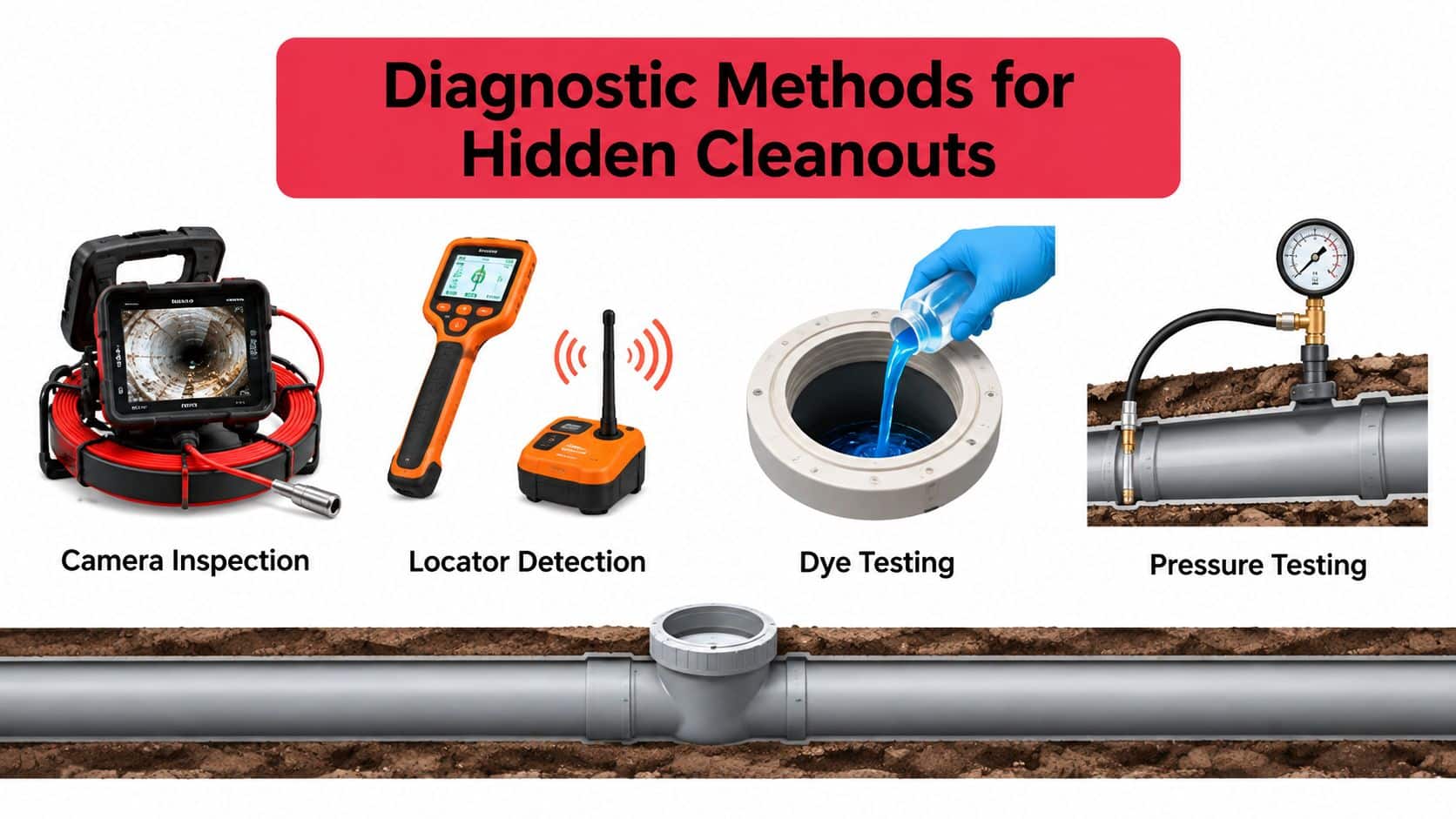
- Diagnostic Methods for Hidden Cleanouts
- When to Call a Professional Plumber
Identifying the Sewer Cleanout Cap
A backed-up main line can leave you searching through decorative rock, beside the slab, or behind a garage wall for one small access point. In Las Vegas, a residential sewer cleanout commonly appears as a capped plastic pipe, often about 3 inches in diameter, protruding near ground level in front of the home. The City of Las Vegas residential sewer information identifies that capped pipe as a typical sanitary sewer cleanout. In the field, decorative rock, artificial turf, irrigation overspray, and added soil routinely bury or conceal these caps.
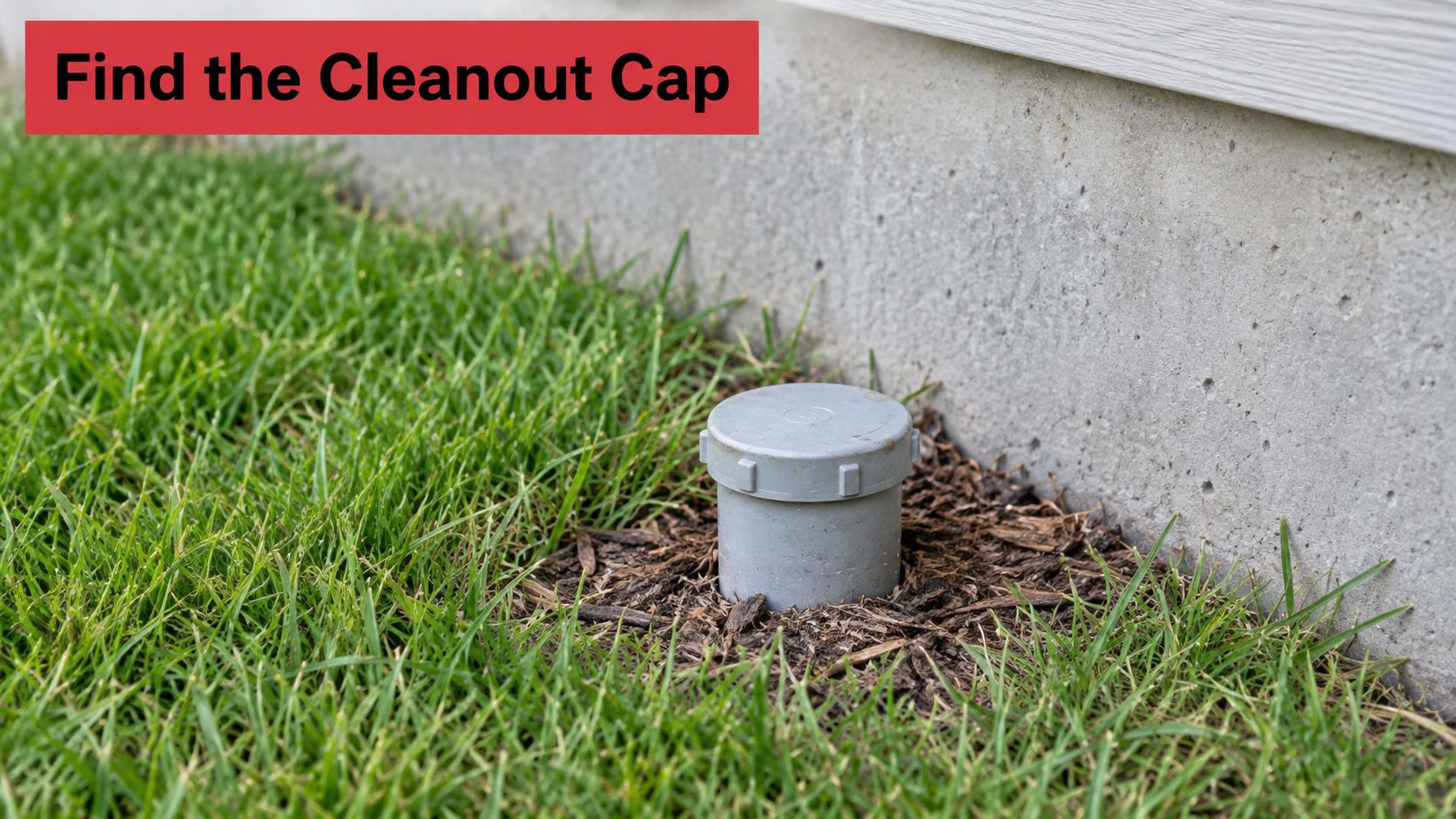
Look for a round threaded cap set on a vertical pipe. Many have a square nut or raised square head for a wrench. The cap may be white, black, gray, or so weathered that it blends with the ground. Older homes may have metal or cast-iron fittings, particularly where the original drainage system was modified.
The fitting can sit above grade, flush with paving, or just below accumulated soil. It does not need to carry a label. Paint, dust, mineral deposits, and irrigation residue can hide markings, while a replacement cap may resemble an ordinary plumbing fitting.
Prepare before touching the cap
Wear gloves and use a flashlight. Clear loose dirt by hand, especially near a foundation, in a garage, or inside a crawl space. Keep your face away from the opening. If the cap is cracked, damaged, or appears under pressure, do not force it.
- Check the shape: A square-headed threaded cap is a strong clue when attached to a larger vertical drain pipe.
- Check the route: Sanitary drainage usually runs away from the building toward the street or sewer connection.
- Check accessibility: Required cleanouts must remain accessible, rather than being sealed inside a wall, floor-ceiling assembly, or unreachable crawl space. Below-grade access should extend to grade, leaving the plug at or above finished grade, as described in the 2024 General Services Administration plumbing code provisions.
- Separate utility boxes: Water meter boxes, irrigation valve boxes, electrical enclosures, and sewer caps may be close together but serve different systems.
Finding the cap does not settle responsibility for the line. A private building sewer and a public connection can involve different repair obligations, so confirm the pipe route and ownership before excavating or cutting concrete. For a blocked main line, Las Vegas drain and sewer service can help identify the correct access point and reduce the risk of opening the wrong pipe.
Common Indoor and Outdoor Locations
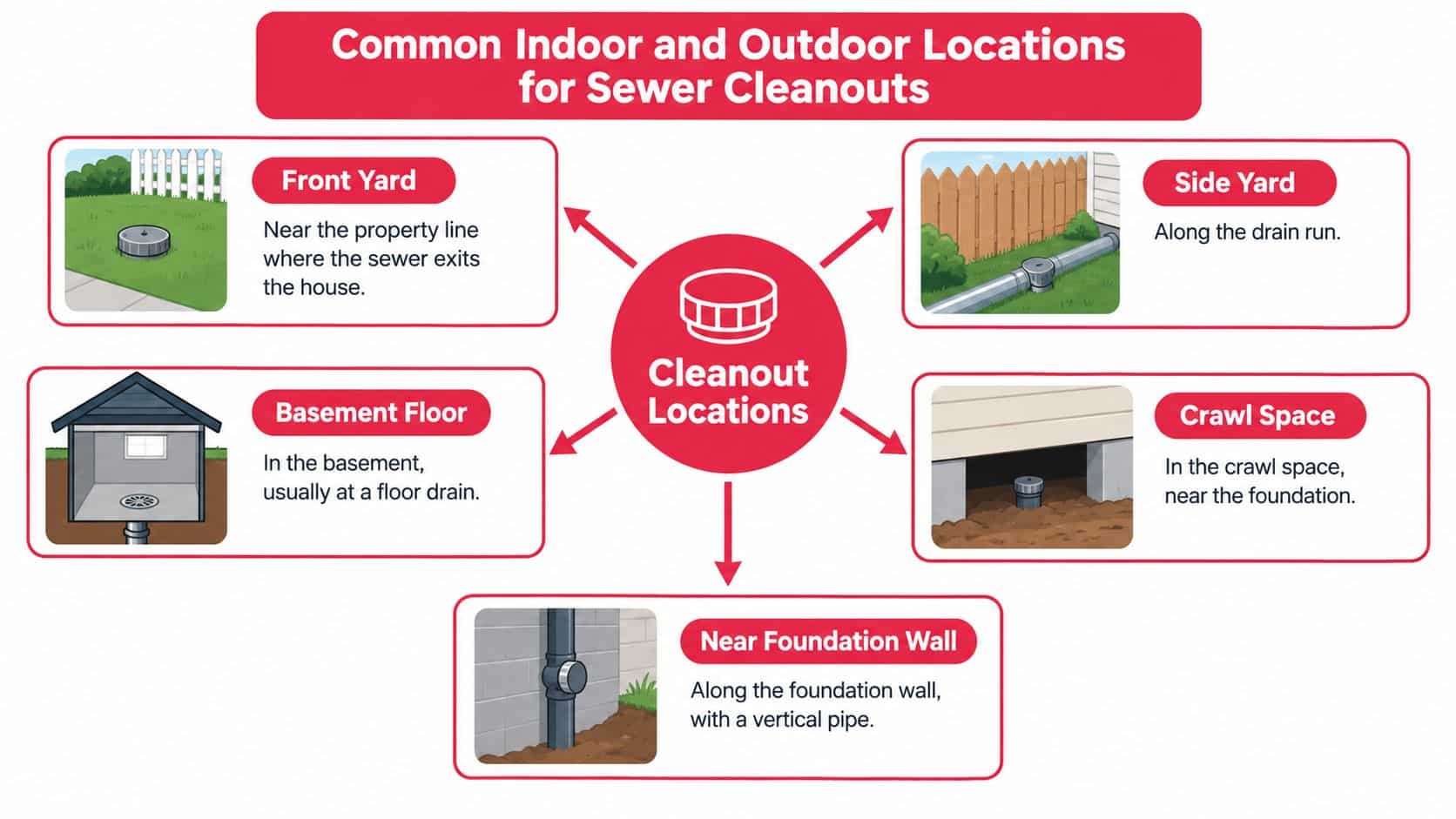
In a Las Vegas slab home, the building drain often passes beneath the foundation before heading toward the street. Begin outside along the wall nearest the bathrooms or kitchen, then follow the likely route toward the front of the property. The cleanout may sit near the structure, farther along the side yard, or close to the property boundary.
Start at the front yard and work outward. Check the planted strip between the house and sidewalk, the side yard beside a fence, and ground near the property line. As noted earlier, the city's typical description of a capped 3-inch plastic pipe near ground level in front of the home makes the front yard a sensible first stop. It does not establish that every house has its cleanout there.
A cap can disappear after decorative rock, pavers, artificial turf, or a raised planting bed is installed. The pipe may remain in its original position, with the new surface covering only the cap. Probe carefully by hand before digging deep, since a buried fitting can be damaged by a shovel.
Walk the route instead of guessing
Older properties and remodeled homes may have more than one access point. A long sewer run can include an additional cleanout, while an addition may have changed the original drainage route. Check these locations in order:
- Front yard: Search between the exterior wall and property boundary, including planted strips and areas near the sidewalk.
- Side yard: Follow the likely line beside fences, garages, and narrow setbacks.
- Near the foundation: Inspect where the building drain appears to leave the structure.
- Garage or utility area: Look for a capped fitting in the slab or near a wall, particularly where several plumbing fixtures are grouped.
- Crawl space or basement: If present, inspect the main horizontal drain before it exits the building.
A historical plumbing benchmark placed cleanouts at the end of building drains 2 feet outside the building. That placement helps explain why older homes often have an access point close to an exterior wall. The benchmark appears in the 2018 Uniform Plumbing Code insert pages, while remodeling and local construction practices can change the location you find today.
Private and public sewer responsibility may divide at or beyond the property line. Confirm the pipe route and ownership before excavating or cutting concrete, because opening the wrong section can leave the homeowner responsible for unnecessary work.
Field observation: A buried cap is often easier to find by tracing the building's drainage direction than by searching every open patch of soil.
Distinguishing Cleanouts from Other Pipes
The wrong capped pipe can waste an afternoon and create a new repair. A cleanout provides access to sanitary drainage. A water meter box measures incoming water, while an irrigation valve or backflow assembly controls watering for lawns and gardens. Their proximity doesn't make them interchangeable.
Don't open a box just because it sits near the suspected sewer route. First, note whether the fitting is threaded, whether a drain-sized pipe enters the ground, and whether the line appears to head from the house toward the street. You can also observe the system during normal use, but don't deliberately release sewage or dismantle a pressurized water component.
| Component | Typical Appearance | Likely Location | Key Identification Feature |
|---|---|---|---|
| Sewer cleanout | Round capped plastic or metal pipe | Near the foundation, front yard, side yard, garage, or drainage route | Threaded cap, often with a square wrench head; connects to sanitary drainage |
| Water meter box | Rectangular or round covered box | Near the street or property boundary | Meter and shutoff assembly; not a drain access fitting |
| Irrigation valve | Small valve box containing plastic valves and wiring | Landscaped areas and planting strips | Multiple small valves, control wires, and irrigation tubing |
| Irrigation backflow preventer | Exposed metal assembly with shutoff handles | Near the water service or irrigation connection | Valves, test ports, and above-ground pressurized fittings |
| Rain or storm drainage pipe | Grate, inlet, or capped pipe | Low areas, driveways, roof-drain routes, and landscaping | Carries surface or roof water, not wastewater from toilets and sinks |
A cleanout may contain standing water because it opens into the sewer line, but don't rely on smell or contact as a test. Sewer gas can be hazardous, and contaminated water can splash when a cap is loosened. If the cap is stuck, cracked, or surrounded by sewage, leave it alone.
A cap is only an access point. It isn't proof that the downstream pipe belongs to the homeowner.
The distinction matters in Las Vegas because the City's design addendum says cleanouts and private manholes must not be placed within the public right-of-way or public sewer easement. A visible cap near a boundary therefore needs to be evaluated alongside property records, easements, and sewer-lateral responsibility. The City of Las Vegas Sanitary Sewer Engineering service can help with general sewer information and the nearest public sewer location, but records don't replace field verification.
Diagnostic Methods for Hidden Cleanouts
Random digging is the least reliable way to find a buried cleanout. Begin with the building drain and work toward the public connection. Review permits, as-built drawings, prior inspection reports, and repair invoices if they're available. Then identify the likely direction from the house to the street or public sewer.
Use a staged search
First, inspect the obvious access zones. Check the exterior wall line, front and side setbacks, garage slab, planted strips, and areas where old repairs or additions meet the original structure. Look for disturbed concrete, a shallow depression, a patch of different soil, or a cap buried just below the surface.
Next, use code geometry as a guide. Under the 2024 International Plumbing Code language used in Iowa, horizontal drainage piping and building sewers smaller than 8 inches generally require cleanouts at intervals no greater than 100 feet of developed pipe length. The building-drain and building-sewer junction is served at the junction or within 10 feet upstream where that provision applies. For a typical residential layout, that makes the building exit and the transition toward the street primary candidates.
For larger building sewers, the GSA provisions shift from ordinary cleanouts to manholes. A sewer 8 inches or larger requires a manhole no more than 200 feet from the building-drain and building-sewer junction, with additional manholes at intervals no greater than 400 feet. Those larger-system rules are usually more relevant to extensive properties than an ordinary single-family lot, but they explain why access planning follows measurable pipe length rather than arbitrary yard locations.
Confirm the pipe before excavation
A professional can feed a sewer camera through a known opening and trace the route with a sonde and surface locator. The camera head can be marked at bends, depth changes, and the suspected property-line connection. This is more dependable than following a straight line from the house because sewer pipes often change direction around additions, driveways, and utility conflicts.
A camera also shows whether the pipe is sanitary sewer, storm drainage, abandoned, cracked, offset, or blocked. EPA guidance identifies closed-circuit television as a standard inspection method for lines from about 4 to 48 inches in diameter, with low-flow conditions preferred for clearer viewing. The EPA sewer inspection guidance recommends positioning the lens near the pipe center so defects such as roots, cracks, offsets, and standing water can be documented.
If you're researching sewer camera inspection in Las Vegas, ask whether the inspection includes locating, depth marking, and confirmation of the suspected access point.
A camera survey is most useful when it answers a property question, not just a blockage question. The technician should identify the pipe route, distinguish private from public segments as far as field conditions allow, and mark the location before anyone breaks concrete.
Never excavate from a surface mark alone. Confirm utility clearance, camera depth, pipe alignment, and applicable Las Vegas-area requirements before digging.
When to Call a Professional Plumber
Stop the DIY search when the cleanout remains hidden after a careful inspection, when the suspected route runs beneath a slab or driveway, or when several fixtures are backing up at once. Those conditions suggest that the problem may involve the main sewer, a buried fitting, or a damaged line rather than a simple missing cap.
Blind excavation carries its own risks. You can cut the wrong pipe, damage irrigation, disturb a public or shared lateral, or open a contaminated line without controlling the discharge. A camera and sonde can often narrow the search to a specific route and depth before concrete or landscaping is disturbed.
Responsibility comes before replacement
Before authorizing major work, verify the property boundary and any recorded easements. A cleanout's apparent position doesn't establish ownership. The downstream segment may cross an easement, connect at a property-line access point, or transition to a public sewer under rules that vary by agency.
Landlords, escrow professionals, and homeowners should collect available permits, sewer-lateral records, and repair history. Older homes, additions, shared laterals, and relocated cleanouts deserve extra caution. Municipal information can supplement a field inspection, but it shouldn't be treated as proof that a buried line is private or public.
MG Plumbing Services LLC is a local, family-owned, owner-operated residential plumbing company serving Las Vegas, Henderson, North Las Vegas, Summerlin, and nearby parts of the Las Vegas Valley. Owner Miguel Garcia is a Nevada-licensed C-1d plumbing contractor and journeyman plumber with more than 25 years of experience. The company uses sewer cameras, locating equipment, drain-cleaning tools, and hydro jetting to diagnose residential sewer and drain problems, and it also handles water leaks, water heaters, water treatment, and general plumbing repairs. For an active backup or difficult main-line access problem, Las Vegas clogged drain service is a practical starting point.
A proper diagnosis should answer three questions: where the line runs, where the blockage or defect is, and which segment is the homeowner's responsibility. That information is worth more than a guessed excavation location.
Call 702-480-8070 or visit MG Plumbing Services LLC to request sewer cleanout locating, camera inspection, drain cleaning, hydro jetting, or residential plumbing diagnosis in the Las Vegas Valley. The team serves Las Vegas, Henderson, North Las Vegas, Summerlin, and surrounding communities, and Se habla español.