
Don't buy another showerhead until you know why the spray went weak. That's the most unpopular advice in the plumbing aisle, and it's the advice that saves Las Vegas homeowners real money. A Shower Head High Pressure label promises force, but the fixture can't manufacture pressure your home isn't delivering. In the Las Vegas Valley, hard water scale, aging valves, and tired pressure-reducing valves steal more showers than builder-grade heads ever did. Diagnose first. Buy second.
Table of Contents
- Why Your Shower Feels Weak and Why a New Head Rarely Fixes It
- What High Pressure Actually Means for a Showerhead
- The Five Things That Actually Cause a Weak Shower
- Three Real Designs Behind High Pressure Showerheads
- Testing and Maintaining Your Shower the Las Vegas Way
- Upstream Fixes Only a Licensed Plumber Should Touch
- A Real Las Vegas Scenario and How It Gets Solved
- What to Do Next and When to Call MG Plumbing Services
Why Your Shower Feels Weak and Why a New Head Rarely Fixes It
You're standing under a spray that barely rinses shampoo, and the fix seems obvious. Unscrew the old head, screw on a new one marketed for high pressure, done. Sometimes that works. Often it buys you a week of improvement before the same weak spray returns, because the restriction was never in the fixture you replaced.
Ask a better question first. Is the showerhead the problem, or is the plumbing behind it? A head can only shape and concentrate the water it receives. If a clogged inlet screen, a partially closed stop valve, a scaled cartridge, or a failing pressure-reducing valve is choking supply, a focused spray pattern masks that choke for a little while and then loses to it.
If cleaning the screen fixes it for a week, you didn't fix the problem. You found where the problem leaves evidence.
Las Vegas makes this distinction sharper than most markets. Hard water leaves mineral scale inside nozzles, screens, shower arms, and cartridges, narrowing passages a little more every month. Older Valley homes add aging supply components and cast iron drainage systems that signal how long the whole plumbing system has been working. Municipal pressure also varies by neighborhood and elevation, so two identical heads can feel completely different a few miles apart.
The Symptom Test That Matters Most
- One shower is weak, others feel fine: Look at that fixture, its screen, its cartridge, and its stop valves first.
- Every fixture feels weak: Skip the fixture aisle. You're dealing with whole-house pressure, a pressure-reducing valve, or a supply restriction.
- Only the hot side is weak: Suspect scale at the water heater connections, the cartridge, or the hot-side stop.
That's the frame for everything that follows. You'll learn what high pressure means in measurable terms, the five causes behind most weak showers, how the three real high-pressure designs differ, and which tests you can run this weekend before spending anything. If the cause sits upstream, you'll know exactly which jobs belong to a licensed plumber and why guessing costs more.
What High Pressure Actually Means for a Showerhead
These three terms get used like synonyms. They're not, and mixing them up is how homeowners buy the wrong fix.
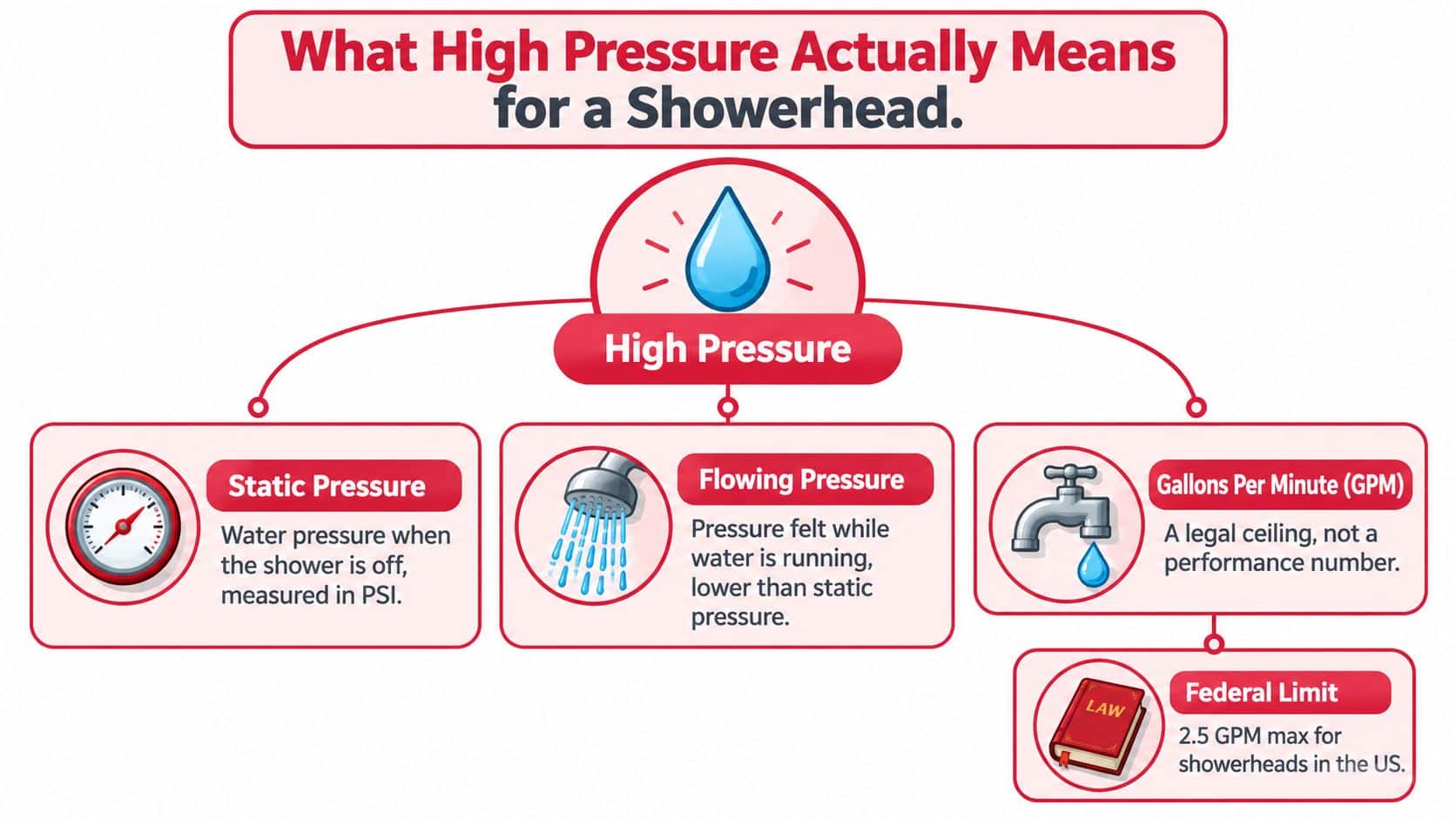
Static pressure is the pressure in your pipes with nothing running. Flowing pressure is what remains once water is moving through valves, elbows, cartridges, and the shower arm. Flowing pressure is always lower, because every fitting and restriction takes a cut while water moves. It's also the number that predicts your shower. A gauge reading taken with everything off can look healthy while the shower itself starves, especially when a dishwasher, washing machine, or second bathroom pulls water at the same time.
GPM Is a Legal Ceiling, Not a Power Rating
Gallons per minute measures volume, and the law caps it. The federal standard limiting showerheads manufactured on or after January 1, 1994, to 2.5 gallons per minute at a flowing pressure of 80 pounds per square inch gauge applies to standard and handheld models. No head sold legally in the United States restores the volume of pre-regulation fixtures. Perceived strength has to come from nozzle design and spray geometry instead.
EPA WaterSense goes further. The WaterSense specification capping labeled showerheads at 2.0 GPM, which is 20% below the federal maximum also tests flow at 20, 45, and 80 psi, so a labeled head has to perform at weak household pressure, not just ideal pressure.
This short video shows how those measurements relate in a real bathroom:
Spray force is what you feel on your skin. WaterSense requires a minimum spray-force threshold of 2.0 ounces-force (0.56 N) at 20 psi, along with minimum flow percentages across the pressure range. Keep the model straight: pressure is what the plumbing supplies, flow is what the fixture allows, and spray force is what you feel. A search for Shower Head High Pressure options makes sense only after you know which of the three is missing.
The Five Things That Actually Cause a Weak Shower
In Las Vegas homes, weak showers trace back to five causes far more often than anything exotic. They run from a five-minute cleaning job to whole-house plumbing work, and the symptom pattern usually tells you which rung you're on.
Fixture-Level Causes You Can See
1. Mineral scale on the inlet screen and nozzles. This is the most common culprit in Southern Nevada. Scale narrows spray openings and coats the small screen where the head meets the shower arm. The decline is gradual, one shower is affected first, and cleaning brings back most of the spray. That's a maintenance fix, not a replacement fix.
2. A failing cartridge or partially closed stop valve. Mixing cartridges accumulate scale and debris, and stop valves behind the wall don't always reopen fully after being touched. The giveaway is one shower misbehaving, sometimes with temperature swings or a hot side that's weaker than the cold. Cleaning the head changes nothing because the choke sits behind it.
System-Level Causes Behind the Wall
3. A pressure-reducing valve set low or failing with age. The PRV where your main line enters the home regulates everything downstream. When it drifts or fails, multiple fixtures lose pressure together, often unevenly through the day. No showerhead corrects a dying PRV.
4. Undersized, corroded, or scaled supply piping. Older Valley homes can carry internal buildup that strangles flow under demand. The static reading looks fine. The moment water moves, friction losses eat the pressure. Homes with recurring drain trouble from aging cast iron often have supply components of the same vintage, and professional water heater repair in Las Vegas visits frequently surface the same scale story on the hot-water side.
5. Whole-house pressure drops under simultaneous demand. Municipal supply, elevation, and competing fixtures stack up. The shower feels fine alone and collapses when the washing machine fills. That's a capacity problem, not a fixture problem.
Decision rule: One weak shower means start at the fixture. Multiple weak fixtures mean start at the system. Buying a head for a system problem is the most expensive way to learn that.
Cost follows that ladder. Cleaning costs you an afternoon. A cartridge or stop valve is a modest repair. PRV replacement and repiping are bigger jobs, but they are the ones that end the complaint instead of renting you a better week.
Three Real Designs Behind High Pressure Showerheads
Once your plumbing checks out, product choice matters. Every Shower Head High Pressure design on the shelf takes one of three engineering paths to make a legally limited amount of water feel stronger. Learn the paths and you can read any product page without getting sold.
Narrow Nozzles and Focused Spray Modes
This is the most common approach. Smaller or fewer spray openings, plus massage or jet settings, trade spray width for jet velocity. Before regulation, showerheads commonly used roughly 5 to 8 gallons per minute, and the California and federal regulatory history that ended that era is why concentration replaced volume. These heads suit a home with decent pressure and an owner who wants a forceful, narrower spray. They frustrate anyone who expects wide coverage from a big rain-style face, because spreading the same water over a larger face weakens it. Red flag: tiny fixed nozzles with no flexible tips. In Las Vegas hard water, they'll scale shut fastest.
Pressure-Compensating Internals
A pressure-compensating flow regulator flexes as supply pressure changes, holding flow and spray force steadier instead of letting the spray surge and sag. The WaterSense performance criteria requiring at least 60% of rated flow at 20 psi and at least 75% at 45 and 80 psi reward exactly this behavior. Choose this design for marginal household pressure, upper floors, or a home where pressure fluctuates when other fixtures run. It frustrates nobody badly, but it can't invent pressure that isn't there. Red flag: marketing that promises to boost your home's pressure. No passive fixture does that.
Air-Induction and Laminar Designs
These mix air into the stream or shape laminar jets so the spray feels fuller and more voluminous without using more water. They suit owners who want coverage and a drenching feel at efficient flow rates. They frustrate people chasing a hard, needle-like jet, because aerated spray feels softer by design. Red flag: sealed internals you can't open or descale. In this valley, cleanability isn't a feature. It's survival.
My recommendation for most Las Vegas homes is direct. Pick a pressure-compensating WaterSense model with flexible, rub-clean nozzles and a removable inlet screen. You'll get tested spray force at low pressure and a head you can maintain instead of replace.
Testing and Maintaining Your Shower the Las Vegas Way
Run these checks before you spend a dollar. They take an afternoon, they cost almost nothing, and they separate fixture trouble from system trouble with evidence instead of opinions.
Measure Before You Touch Anything
- Bucket test: Put a one-gallon container under the shower, run it at your normal setting, and time how long it takes to fill. Write the result down. It isn't lab-grade, but it's your before-and-after baseline for every change you make.
- Gauge test: Screw an inexpensive pressure gauge onto a hose bibb. Read static pressure with everything off, then have someone run the shower while you watch the flowing reading. The gap between those numbers reveals restrictions that only appear under flow.
- Simultaneous-demand test: Shower while the washing machine or dishwasher fills. A spray that collapses under company points upstream, toward capacity or the PRV, not toward the head.
EPA's own testing framework supports this approach, since pressure-compensating designs are evaluated for maintained performance across household pressure conditions rather than at one ideal number. Your home deserves the same treatment.
Clean It Like Hard Water Is Watching
Unscrew the head, pull the inlet screen, and rinse out the grit and scale flakes you'll almost certainly find. Soak the head face-down in white vinegar long enough to soften deposits, scrub the nozzles gently, flex rubber tips to crack loose scale, rinse, and reinstall with fresh thread tape. In Southern Nevada, treat this as recurring maintenance tied to what you see on the screen, not as a once-a-year ritual. When the spray pattern starts spitting sideways, you're already overdue.
Clean, retest with the bucket, and compare numbers. If flow barely moved, stop cleaning and start looking upstream.
Efficiency isn't the enemy of a strong shower, either. EPA WaterSense estimates that replacing showerheads with WaterSense-labeled models can save an average family more than 2,700 gallons of water annually and reduce combined water and electricity costs by about $70 per year, showing that a properly selected efficient fixture can cut water and heating demand without sacrificing spray force. A 10-minute shower at the 2.0 GPM ceiling uses a theoretical maximum of 20 gallons, and every gallon you don't run is a gallon your water heater doesn't have to heat. Keep your test results in a drawer. Landlords and property managers especially benefit from that paper trail, because it proves whether a tenant complaint is a dirty screen or a building problem.
Upstream Fixes Only a Licensed Plumber Should Touch
Some jobs end with a vinegar soak. These don't. If your tests point past the fixture, the following work involves your main supply, your slab, or your sewer, and it belongs to a licensed contractor.
Pressure Regulation and Supply Lines
PRV adjustment and replacement comes first. A failing pressure-reducing valve can starve every fixture or swing pressure unpredictably, and cranking one up blindly can overpressure supply lines, water heater components, and fixture seals. MG Plumbing Services LLC tests static and flowing pressure to determine whether a home needs PRV service or a properly sized booster system, which is one option for homes sitting on the low end of municipal supply or dealing with elevation changes across the Valley. Booster pumps require correct sizing. An oversized pump short-cycles and hammers the system it was meant to help.
Main water line replacement is next when the service line itself is the restriction. Corroded or undersized lines can't be cleaned back to health, and main water line replacement in Las Vegas using modern materials such as Wirsbo AquaPEX restores capacity the right way, with a written estimate before anyone digs.
Leaks, Slabs, and Cast Iron
A slab leak can rob pressure while damaging the foundation, particularly in Valley homes built on expansive soils. Watch for a water meter that moves with every fixture off, warm spots on the floor, or pressure that fades for no visible reason. Professional leak detection locates the break so the repair is a targeted fix or reroute instead of exploratory demolition.
Cast iron to ABS drain replacement under slab or by open trench matters here too. Recurring shower backups alongside weak spray tell a whole-system story about an aging home, and a sewer camera inspection documents cracks, bellies, and scale before anyone recommends replacement.
The pattern that justifies the call is consistent. Multiple fixtures affected, hot-side-only loss, meter movement with no use, or improvement that never survives the week. Those symptoms mean stop shopping and start diagnosing, because raising pressure against an undiagnosed restriction fixes nothing and risks the piping.
A Real Las Vegas Scenario and How It Gets Solved
Consider a representative case we see throughout the Valley. A homeowner in a 1990s Summerlin tract home notices the master shower weakening over several months. The hall bath still feels fine, which initially suggests a fixture problem. She installs a new high-pressure head and cleans the screen. The shower improves for about a week, then fades right back.
That short-lived improvement is the diagnostic clue homeowners miss. Cleaning the screen removed debris, but the debris was being delivered from upstream. Flowing pressure measured at the shower arm reads low while static pressure at a hose bibb looks acceptable, and the gap widens when a second fixture opens.
What the Inspection Found
- An original pressure-reducing valve drifting under load, so pressure sagged whenever the home used water
- Internal scale in aging supply components shedding mineral grit that kept re-clogging the new head's screen
- A cartridge coated in deposits, narrowing the master shower's supply more than the hall bath's
The fix followed the evidence. The PRV was replaced and set correctly for the home. The worst section of scaled supply line was addressed, the cartridge was replaced, and only then was a pressure-compensating WaterSense head installed, chosen because WaterSense showerheads must deliver tested performance across pressure conditions instead of just advertising force. With a flat-rate estimate approved in writing before work began, the scope stayed honest and the shower stayed fixed.
A replacement head that fails within weeks isn't a bad product. It's a message from your plumbing.
Call rather than buy when you see these triggers. Weakness at several fixtures, pressure that comes and goes, temperature swings in one shower, grit returning to a cleaned screen, or any sign of hidden water loss. Each one says the cause lives upstream of the shower arm.
What to Do Next and When to Call MG Plumbing Services
Tape this checklist inside a closet door and work it in order.
| What You Notice | Likely Cause | Your Move |
|---|---|---|
| One shower, gradual decline | Scaled screen or nozzles | Clean, descale, bucket-test again |
| One shower, hot side only | Cartridge or hot-side stop | Inspect or replace the cartridge |
| Several fixtures, sudden or gradual | PRV or supply restriction | Call a licensed plumber |
| Weak only when other fixtures run | Capacity or piping limits | Call a licensed plumber |
| Meter moves, nothing running | Hidden leak | Call immediately |
If cleaning and testing clear your plumbing, replace the head with a pressure-compensating WaterSense model with cleanable nozzles. If the checklist points upstream, MG Plumbing Services serves Las Vegas, Henderson, North Las Vegas, Summerlin, and surrounding Valley communities as a family-owned, owner-operated residential shop. Owner Miguel Garcia, a Nevada-licensed C-1d plumbing contractor and journeyman plumber with more than 25 years of experience, runs every call personally. Call 702-480-8070 or book same-day plumbing service in Las Vegas at mgplumbingservices.com. Se habla español.
If your shower is still weak after cleaning and testing, MG Plumbing Services LLC will measure your home's static and flowing pressure, inspect the PRV, valves, and supply lines, and give you a flat-rate written estimate before any work begins. Don't buy a third showerhead to mask a plumbing problem. Call 702-480-8070, and let's fix the cause instead of the symptom.