
Slab leak detection typically costs $150 to $600, while repair can run from about $630 to $15,000 or more. The difference between a localized spot repair and a full repipe usually depends on how accurately the leak is found before anyone opens the concrete.
You may be hearing water run when every faucet is closed, standing on a warm patch of tile, or watching a meter move with no obvious plumbing problem inside the house. In Las Vegas, Henderson, and the surrounding valley, those clues can point to a leak beneath the slab, but they don't tell you which repair makes sense. A concrete opening, a reroute through the walls or attic, a larger section replacement, and a full repipe all solve different problems.
After 25 years in residential plumbing, I've learned that the hardest part of a slab leak call usually isn't joining new pipe. It's deciding where the failure is, why it happened, and whether the surrounding plumbing is likely to fail next. This guide walks through that decision in practical terms.
Table of Contents
- Why a Slab Leak Is a Decision Problem, Not Just a Repair
- What a Slab Leak Actually Is and Why Las Vegas Homes Get Them
- How Plumbers Find a Leak Without Opening the Floor
- What a Real Diagnostic Visit Looks Like Step by Step
- Comparing the Four Repair Options Homeowners Face
- What Really Drives the Cost in a Las Vegas Slab Leak
- Common Assumptions That Lead Homeowners Astray
- A Practical Checklist Before You Call a Plumber
Why a Slab Leak Is a Decision Problem, Not Just a Repair
A Henderson homeowner notices warm spots on the tile and calls three plumbers. One quotes $1,800, another quotes $4,500, and the third recommends work approaching $9,500. Each contractor may be describing a legitimate repair, but they aren't necessarily solving the same version of the problem.
The starting point is separating detection from repair. A neutral repair guide places slab leak detection at about $150 to $600, often taking 1 to 2 hours in straightforward cases, while repair may range from roughly $630 for a spot fix to $15,000 for a full repipe. The published cost range reflects different scopes, not merely different hourly rates. See the slab leak cost and repair overview for that distinction.
The decision tree under the floor
A sound diagnosis answers four questions:
- What failed? Copper, PEX, galvanized piping, a fitting, or a drain line require different responses.
- Where did it fail? A known, isolated point is a different problem from a leak beneath a cabinet, island, or structural wall.
- What condition is the slab in? Access may be straightforward, or cutting may carry structural and restoration complications.
- What will fail next? A single damaged section in otherwise sound piping can justify a spot repair. A history of pinholes in aging copper may make repeated openings false economy.
A spot repair preserves the existing route and limits the work to the failed area. A reroute abandons the troublesome section beneath the slab and carries a new line through accessible walls, ceilings, or attic space. A full repipe replaces the affected loop or broader system when the pipe itself has become the risk.
Practical rule: Don't approve concrete demolition until the plumber can explain the detection method, the marked repair point, and why that repair path fits the pipe's condition.
The cheapest proposal on paper may not be the least expensive decision over time. The right objective is accurate locating followed by an appropriately limited repair, not just the smallest first invoice.
What a Slab Leak Actually Is and Why Las Vegas Homes Get Them
A slab leak is a leak in a pressurized water line or, in some cases, a drain line embedded in or beneath a concrete foundation. Water may escape into the soil below the home or travel upward through flooring, baseboards, cabinets, or joints. The spot where moisture appears isn't necessarily the point where the pipe failed.
Las Vegas homes face a combination of pipe, water, and ground conditions that can produce different failure patterns. Hard water primarily creates calcium carbonate scale inside pipes, while aggressive water chemistry is more closely associated with copper corrosion. Water with a pH below 7, high chloride, low alkalinity, or high free chlorine residual can be aggressive toward copper, as explained in this guide to hard water and pipe corrosion.

Why the cause changes the repair
An older home with aging copper or galvanized piping may have weak threaded joints, corrosion, or repeated pinhole failures. A newer installation can still develop trouble if PEX was kinked, a line was poorly sleeved, or piping was left rubbing against rebar, gravel, or rough concrete.
Soil movement adds another variable. Desert soils can shift as moisture conditions change, placing stress on rigid pipes at turns, penetrations, and connections. One isolated failure near a known penetration may be suitable for a spot repair. Multiple failures along an aging copper loop, or damage associated with movement, may support a reroute or repipe instead.
A warm floor often suggests a hot-water line because heat can migrate through the slab. A cold-line leak may produce no warm surface and can be harder to isolate without pressure testing, acoustic equipment, or tracer gas. That's why a symptom alone can't determine the repair.
The important question isn't whether the home has hard water or shifting soil. It's whether those conditions have created one repairable defect or a broader failure pattern. The answer comes from examining pipe material, leak location, prior repairs, pressure, and the line's history together.
How Plumbers Find a Leak Without Opening the Floor
Professional slab leak detection works best as a combination of methods. Each tool answers a different question, and each has conditions where it becomes less reliable.
Acoustic listening uses electronic amplifiers and ground microphones to hear pressurized water escaping through soil or around the pipe. It often performs well on copper supply lines, especially after the hot or cold circuit has been isolated. Noise from appliances, traffic, pumps, and other plumbing can mask a small leak, so an experienced technician confirms the sound rather than treating the loudest point as proof.
Thermal imaging reads temperature differences at the floor surface. It's particularly useful for a hot-water leak because warm water creates a detectable temperature anomaly as heat moves through the concrete. It is much less useful on cold lines, and carpet, thick tile, insulation, and other floor assemblies can weaken the visible pattern.
Pressure testing confirms whether a line is losing pressure, but it doesn't locate the leak by itself. Tracer gas, usually a hydrogen-nitrogen mixture used with a sensitive sniffer, can help locate a slow leak when acoustic signals are faint or the environment is noisy. Video inspection is valuable inside drain lines through a cleanout, but a camera doesn't see through the slab or inspect a buried pressurized supply line.
| Method | Best For | Accuracy | Key Limitation |
|---|---|---|---|
| Acoustic listening | Pressurized supply leaks, especially copper | Strong when the line is isolated and conditions are quiet | Noise, rebar, soil, and slab construction can distort sound |
| Thermal imaging | Hot-water leaks and warm surface anomalies | Useful as a confirmation tool | Cold leaks and floor coverings may not produce a clear image |
| Pressure testing | Confirming a leaking hot or cold loop | Identifies the losing circuit, not the exact point | It cannot pinpoint the opening alone |
| Tracer gas | Slow or difficult-to-hear leaks | Can narrow faint leaks when paired with a sniffer | Requires proper isolation and interpretation |
| Sewer camera | Drain and sewer line defects | Shows the interior of an accessible drain line | It isn't a tool for locating a buried pressurized water leak |
A qualified technician may combine acoustic correlation, infrared imaging, tracer gas, and pressure testing rather than relying on one instrument. You can review the scope of professional water leak detection before scheduling an evaluation.
What a Real Diagnostic Visit Looks Like Step by Step
A proper visit starts outside, not with a jackhammer. The plumber checks the water meter while fixtures and appliances are off. If the dial or indicator continues moving, water is flowing somewhere in the system. Closing the main valve helps determine whether the loss is on the home's side of the shutoff, as described in this slab leak detection guide.
The sequence matters
- Confirm the symptom. The technician records warm flooring, sound, pressure loss, moisture, or a meter movement instead of relying on a general description.
- Rule out fixtures. Toilets, water heaters, hose bibbs, softeners, and appliance connections can waste water without a slab leak.
- Separate hot and cold circuits. The plumber isolates the water heater and relevant manifold or shutoff points to identify which side is losing pressure.
- Pressure-test the suspected loop. The requested process may include testing the hot or cold loop at 80 PSI for 15 minutes, but the technician should select a safe test procedure for the home's piping and equipment.
- Pinpoint before cutting. Acoustic listening, thermal confirmation, electronic line tracing, or tracer gas narrows the opening to the smallest practical area.
A pressure test that fails tells you the line is leaking. It doesn't justify opening the floor at the center of the room. The plumber still needs to map the line, account for walls and fixtures, interpret the acoustic or thermal signal, and mark the most defensible access point.

A thorough diagnosis commonly takes 1 to 2 hours, depending on access, line layout, flooring, and the clarity of the signal. Skipping those steps and breaking concrete immediately is often the most expensive mistake because a wrong opening creates restoration work without solving the leak.
A camera inspection belongs to a different diagnostic path. For drain and sewer concerns, a plumber may use a cleanout and a camera to see the interior of the line. That service is separate from under-slab supply-line locating, and sewer camera inspection and locating can help when the symptoms point to drainage rather than pressurized water.
Comparing the Four Repair Options Homeowners Face
Once the leak is marked, the repair decision should account for both the failed spot and the pipe around it. A spot repair, reroute, section replacement, or full repipe can each be correct, but only under different conditions.
Spot repair
A spot repair opens the slab at the marked location and replaces the failed portion. It makes sense when the pipe is relatively sound, the failure is isolated, access is reasonable, and the leak sits where a small opening won't create disproportionate flooring or structural problems.
It is a poor choice when the same copper run has already produced several pinholes or when inspection shows widespread deterioration. Saving demolition today can mean paying for another locate, another opening, and another restoration later.
Reroute
A reroute abandons the leaking section beneath the slab and carries a new line through an accessible route. Walls, ceilings, cabinets, or attic space may need limited access, but the concrete remains intact.
Rerouting can be attractive when the failed line runs under an island, bathroom, or heavily finished area, or when the existing route has a history of movement-related failures. The trade-off is visible access work and possible drywall or ceiling repair.
Section replacement
Section replacement sits between a one-point repair and a full repipe. It replaces a larger run when failures cluster in one area, while leaving healthier parts of the system in service.
This option deserves attention when a plumber finds more than one weak point but the evidence doesn't support replacing the entire loop. The decision depends heavily on pipe material, failure pattern, and how confidently the remaining section can be evaluated.
Full repipe
A full repipe replaces the affected loop or broader supply system. It's often considered when older copper has a pinhole history, multiple areas are failing, or the cost and disruption of repeated repairs no longer make sense.
| Repair Option | Best Pipe Condition | Best Leak Location | Future Leak Risk | Typical Use Case |
|---|---|---|---|---|
| Spot repair | Sound surrounding pipe with one isolated defect | Precisely located, accessible point | Lower when the failure is genuinely isolated | One damaged section in an otherwise reliable run |
| Reroute | Existing route is suspect or difficult to access | Beneath finished flooring, islands, or restrictive slab areas | Reduced on the abandoned route | New accessible line through walls, ceilings, or attic |
| Section replacement | Localized deterioration or clustered failures | A defined portion of the loop | Moderate, based on remaining pipe condition | Replace the compromised run without replacing everything |
| Full repipe | Aging or repeatedly failing system | Multiple locations or an unreliable loop | Lowest for the replaced system, though workmanship and conditions still matter | Broad replacement when spot repairs no longer address the risk |
Pipe material, slab condition, access, and future leak probability should appear in the written recommendation. If the proposal only says “repair slab leak” without explaining the route and remaining risk, ask for more detail before authorizing work.
What Really Drives the Cost in a Las Vegas Slab Leak
A leak call can begin with one sound and end with several possible repair plans. The price depends on where the line sits, how the slab can be accessed, the pipe's condition, and whether the remaining route is likely to fail again.
Hard water can leave calcium carbonate scale inside piping, restricting flow and affecting valves and fixtures. Aggressive water chemistry can contribute to copper corrosion, so the plumber should separate mineral buildup from the conditions associated with pinhole failure. Blaming every copper problem on “hard water” can lead to the wrong repair.
Local conditions that change the scope
- Pipe material and age: Aging copper, galvanized connections, PEX damage, and cast iron drain problems require different materials, methods, and labor.
- Access method: Cutting through tile, stone, cabinets, or a post-tension slab can make a localized repair more involved.
- Structural restrictions: A post-tension slab may require additional review before cutting. The technician must identify the slab type and protect embedded structural components.
- Restoration work: A repipe through an attic or wall may limit concrete demolition while adding drywall, insulation, ceiling, or paint work.
- Soil and foundation movement: Movement can make another spot repair less attractive when the same route remains under stress.
- Pressure conditions: Residential water pressure is commonly targeted around 50 to 70 PSI, with a broader acceptable range often given as 40 to 80 PSI. This pressure-testing reference explains why low pressure can accompany a leak while excessive pressure can stress pipes and appliances.
The marked leak point is only part of the estimate. Concrete breaking, tunneling, flooring removal, disposal, and patching can expand the work. A reroute may avoid slab demolition but add attic access, drywall repair, or longer pipe runs.
A written estimate should identify the repair location, access plan, materials, restoration responsibility, and the response if the marked point does not expose the defect. Those details help compare a spot repair with a reroute, section replacement, or full repipe.
The practical comparison focuses on total disruption and repeat-failure risk, not lowest plumbing price alone. For a clear starting point on written estimates and service planning, review MG Plumbing Services cost estimates. The same questions apply whether you choose that company or another qualified local contractor.
Common Assumptions That Lead Homeowners Astray
A normal water bill does not clear the plumbing. A slow pinhole can remain hidden on a statement while household use changes. Check the meter with fixtures, appliances, and irrigation turned off. The Environmental Protection Agency's WaterSense program describes meter monitoring as a practical way to identify hidden flow. Learn more about leak finders.
Calling a dryout company or tile contractor before locating the plumbing source can send the repair in the wrong direction. Damp flooring and cracked tile show water damage, but they don't identify whether the source is a supply line, drain, water heater connection, or another concealed point. Mold risk and wet baseboards also indicate where water surfaced, not which pipe failed.
Moisture mapping reveals where water traveled. Leak detection finds where it originated.
A successful spot repair does not confirm that the remaining pipe is sound. Aging copper, aggressive water exposure, or a history of pinholes can point to broader trouble along the same run. The next failure may occur elsewhere, although the first leak alone does not automatically justify a repipe. The plumber should inspect the failure pattern, pipe material, and accessible sections before recommending another isolated opening.
Diagnosis and repair belong in the same decision. The locating method affects how much concrete may be opened and where access is practical. The pipe assessment determines whether that opening supports a durable spot repair or whether a reroute or repipe deserves consideration. Local soil movement and water conditions can also change the risk, so the cheapest immediate opening may not be the soundest long-term choice.
A Practical Checklist Before You Call a Plumber
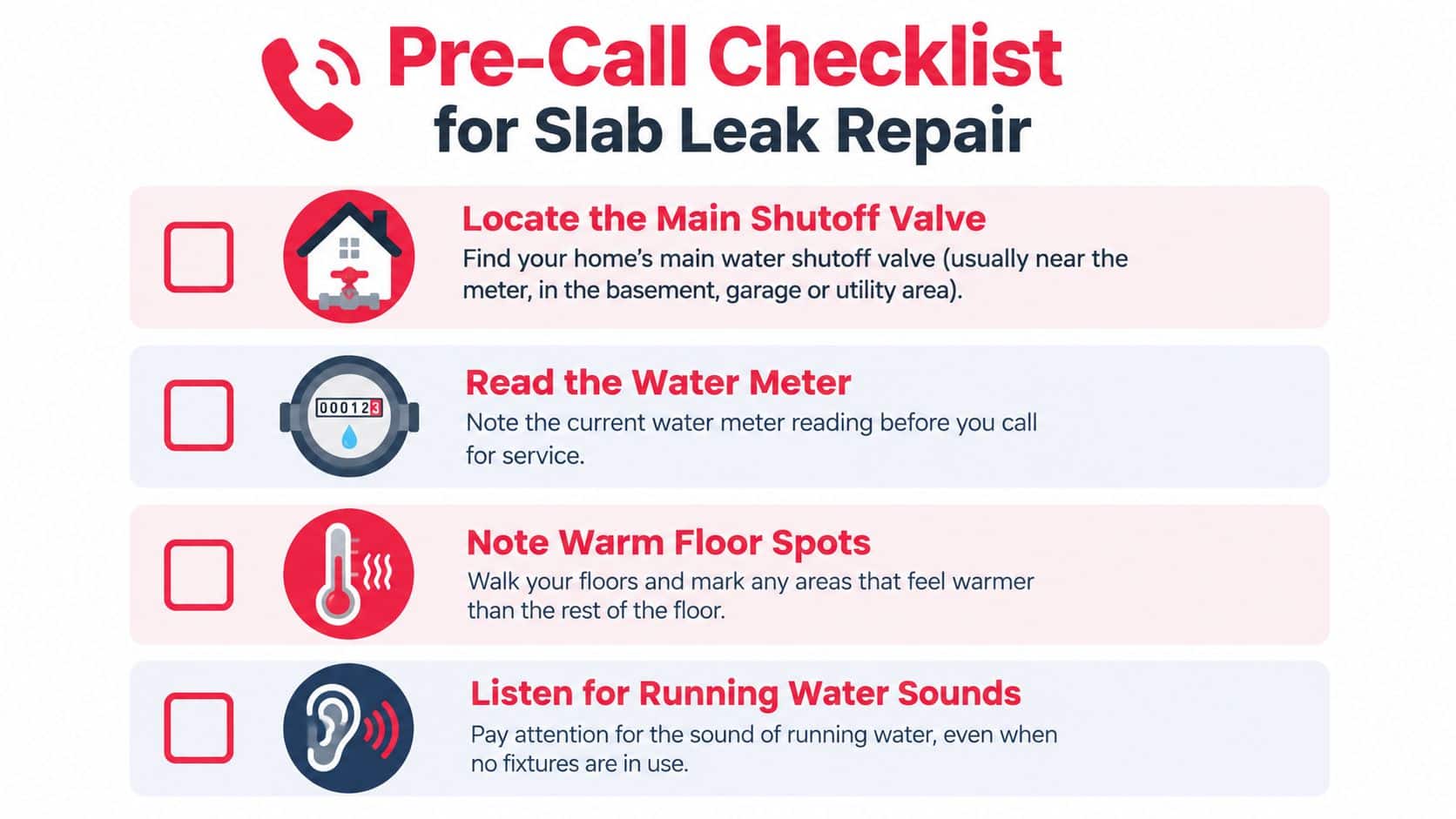
A few observations can make the first appointment more productive. Don't cut into flooring or start removing cabinets before the source is confirmed. Instead, gather information that helps the technician choose the right diagnostic path.
- Find the main shutoff. Know where the valve is and whether it closes fully. This limits damage if the leak becomes active.
- Watch the meter. With fixtures and appliances off, note whether the indicator continues to move. Write down what you see rather than relying on memory.
- Record the first clue. Note a warm floor, running-water sound, damp baseboard, pressure change, cracked tile, or unusual usage.
- Identify the piping if possible. Copper, PEX, galvanized, and cast iron point toward different failure patterns. The home's construction year and any prior leak repairs also matter.
- Mark recent changes. Tell the plumber about foundation work, landscaping, irrigation changes, water heater replacement, softener installation, or remodels.
- Think through access. Consider whether an attic, ceiling, wall, cabinet, or floor route is practical, but don't assume the visible symptom is the access point.
- Ask about the locate. Which methods will be used, and how will the technician confirm the mark?
- Ask about uncertainty. If the first pinpoint is wrong, what is the next diagnostic step and who pays for additional openings?
- Ask for a written scope. Confirm whether the price covers one access point, multiple openings, concrete repair, flooring restoration, and testing after the work.
A licensed local plumber can weigh those details against Southern Nevada's hard-water conditions, soil movement, slab construction, and the home's plumbing history. MG Plumbing Services LLC provides residential water leak detection, targeted slab repairs, reroutes, water pressure service, and related plumbing diagnosis in Las Vegas, Henderson, North Las Vegas, Summerlin, and nearby communities. The owner-operated company is led by Miguel Garcia, a Nevada-licensed C-1d plumbing contractor and journeyman plumber with more than 25 years of experience, and service is available in English and Spanish.
If your meter moves with the water off, you hear water beneath the floor, or a warm spot keeps returning, call 702-480-8070 for a professional evaluation. Visit MG Plumbing Services LLC to request residential slab leak detection and repair, compare a spot repair with a reroute or repipe, and receive a straightforward recommendation for your Las Vegas Valley home.