

The popular advice that homeowners insurance either covers a slab leak or doesn't is too blunt to help you authorize repairs. A single job can include finding the leak, opening the slab, fixing the pipe, and repairing the damage, and the insurer may treat each part differently. Before you approve concrete cutting, you need an estimate that separates those costs, not a promise that insurance will handle everything.
For Las Vegas Valley homeowners looking for slab leak repair covered by insurance, the practical question is which individual charges qualify under the policy. A plumber documents the failure and recommends the repair. The insurer decides coverage, and neither a newly discovered wet floor nor a contractor's assurance guarantees a payout.
Table of Contents
- Which Slab Leak Costs Insurance Usually Covers
- Why Resulting Damage Can Be Covered While the Pipe Is Not
- How Sudden and Gradual Leaks Get Different Treatment
- Policy Terms and Endorsements That Change the Payout
- Claim File Steps and Denial Traps
- Confirm Coverage Before You Authorize Slab Work
Which Slab Leak Costs Insurance Usually Covers
Insurance rarely pays to repair the failed pipe itself, but it may pay for water damage caused by a sudden, accidental leak. The useful distinction isn't whether the pipe sits beneath concrete. It's what each charge accomplishes and whether your policy covers the underlying discharge.
The ClaimWarriors slab-leak claim guide identifies the importance of separating detection, access, pipe repair, and restoration rather than treating the entire plumbing invoice as a covered expense. Ask for that separation before work begins, while the plumber can still document the original condition.
Slab leak cost items and typical insurance treatment
| Cost item | Typical treatment | Condition that decides it |
|---|---|---|
| Leak detection and diagnostic invoice | Usually not paid as a claim item | Confirm reimbursement in writing with the adjuster |
| Emergency water shutoff and extraction | Often covered | Sudden discharge and a reasonable, documented response |
| Slab access and concrete removal | May be covered | Whether the underlying discharge qualifies |
| Repair or replacement of the failed pipe | Commonly excluded | Wear, corrosion, or maintenance |
| Rerouting or elective upgrades | Usually excluded or needs approval | Work goes beyond comparable repair |
| Flooring, drywall, and cabinets | Covered for sudden discharge | Deductible, limits, and depreciation |
| Personal property | Covered for sudden discharge | Deductible, limits, and depreciation |
Read the Estimate by Purpose
A diagnostic charge establishes where the leak is. An access charge pays for reaching it. Neither is automatically the same as replacing the defective plumbing, so don't accept a combined line labeled slab leak repair if you need the insurer to evaluate those tasks separately.
Concrete restoration also deserves its own line. Removing concrete to reach a covered discharge and replacing the concrete afterward may receive different treatment from installing new pipe. Ask whether the adjuster's authorization includes both opening and closing the access area.
Practical rule: An approved water-damage claim isn't approval for every item on the plumber's estimate.
A reroute can be a sound plumbing recommendation without being a covered insurance expense. It may avoid opening finished flooring or address a deteriorated line more effectively than a spot repair, but the insurer may approve only a comparable repair allowance. Get the repair option and any additional elective work priced separately.
Use a written cost-estimate breakdown to organize the conversation. Sort your estimate into the table's rows before calling the adjuster, and attach a reason to each requested charge: diagnosis, mitigation, access, defective-pipe repair, or restoration. That gives the insurer something specific to approve, question, or exclude.
Why Resulting Damage Can Be Covered While the Pipe Is Not
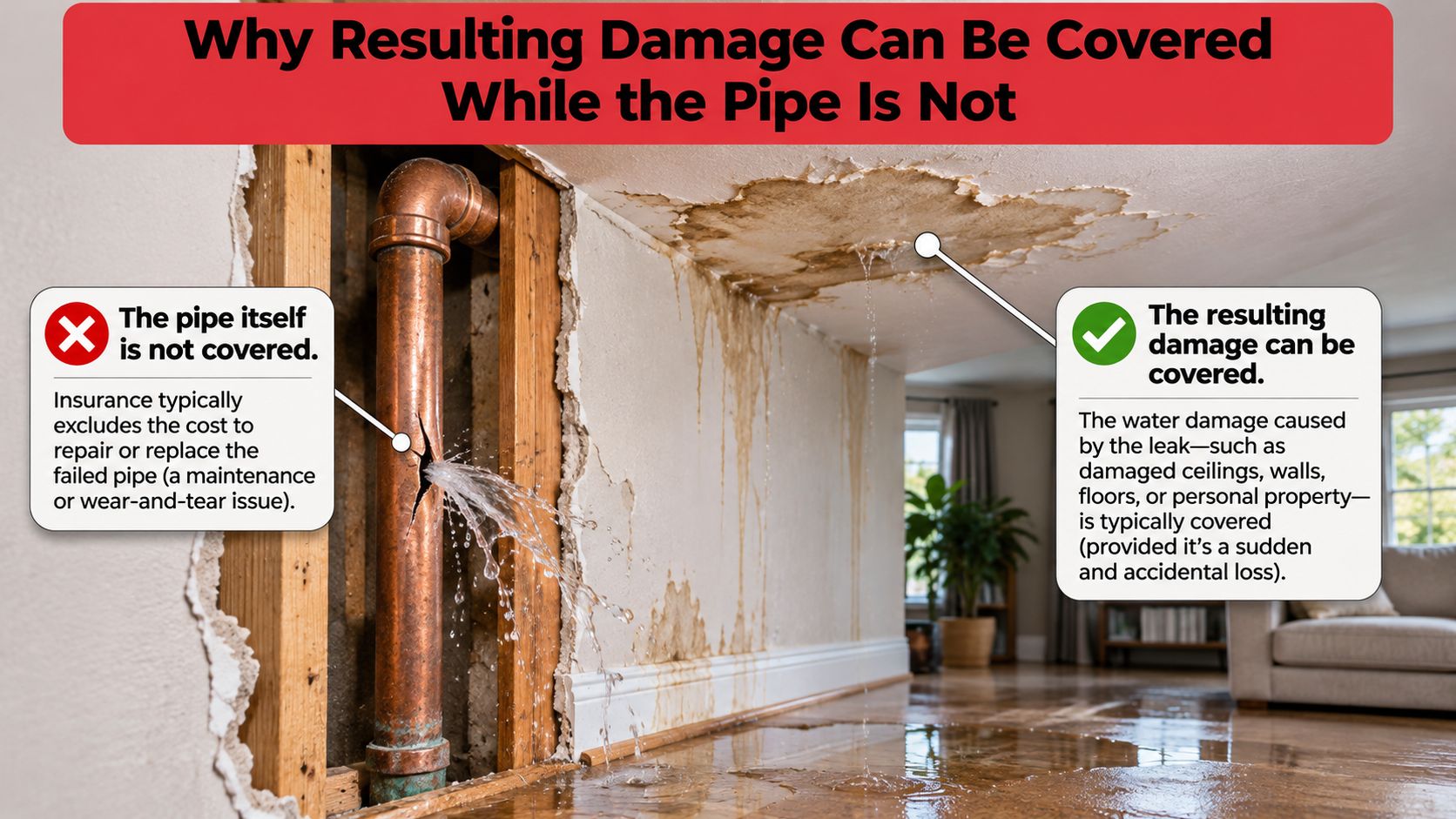
Think of a vehicle's failed water pump and a soaked passenger seat as separate expenses. The mechanic addresses the failed component; an insurer might evaluate the damaged upholstery under an applicable policy. The analogy isn't an auto-coverage rule, but it illustrates why repairing a cause and repairing its consequences aren't interchangeable.
The National Association of Insurance Commissioners homeowners-insurance guide explains that water damage from a home's plumbing is typically covered, while groundwater, rain runoff, and snowmelt generally aren't. With a concealed pressurized-line rupture beneath a slab, the insurer may evaluate damage to flooring, drywall, cabinetry, and belongings even when it excludes the deteriorated pipe.
Separate the Component From the Consequence
Say a concealed supply line ruptures and water reaches a cabinet base and adjoining floor. Replacing the failed section restores the plumbing system. Drying the cabinet area and replacing damaged flooring address the consequences of the discharge.
The insurer can therefore reach different decisions on the same job without contradicting itself. Coverage for those consequences remains subject to the deductible, limits, exclusions, and findings about what caused the damage. Labor performed solely to replace worn or corroded piping may remain the homeowner's responsibility.
The physical evidence should support that separation. Pressure-test results can help establish which line failed, while acoustic or tracer-gas findings can identify the location. Photographs before demolition and a record of moisture migration connect the plumbing failure to the affected finishes.
Build a Claim File the Adjuster Can Follow
Organize the file into these numbered categories:
- Emergency mitigation. Include reasonable water shutoff, extraction, and measures taken to prevent additional damage.
- Leak detection and access. Keep the diagnostic findings separate from concrete removal, even if both sit within this administrative category.
- Repair or reroute of the defective line. Identify the actual plumbing work and distinguish the recommended repair from optional improvements.
- Consequential water damage. List drying and restoration of affected finishes and belongings, with supporting photographs and invoices.
This filing system doesn't turn an excluded item into a covered one. It prevents a legitimate restoration expense from disappearing inside a general plumbing charge and lets the adjuster explain a decision against a defined scope.
Before sending an invoice, label every line with its category number. If a line combines access, replacement pipe, and flooring, ask for a revised breakdown rather than guessing how much belongs to each.
How Sudden and Gradual Leaks Get Different Treatment
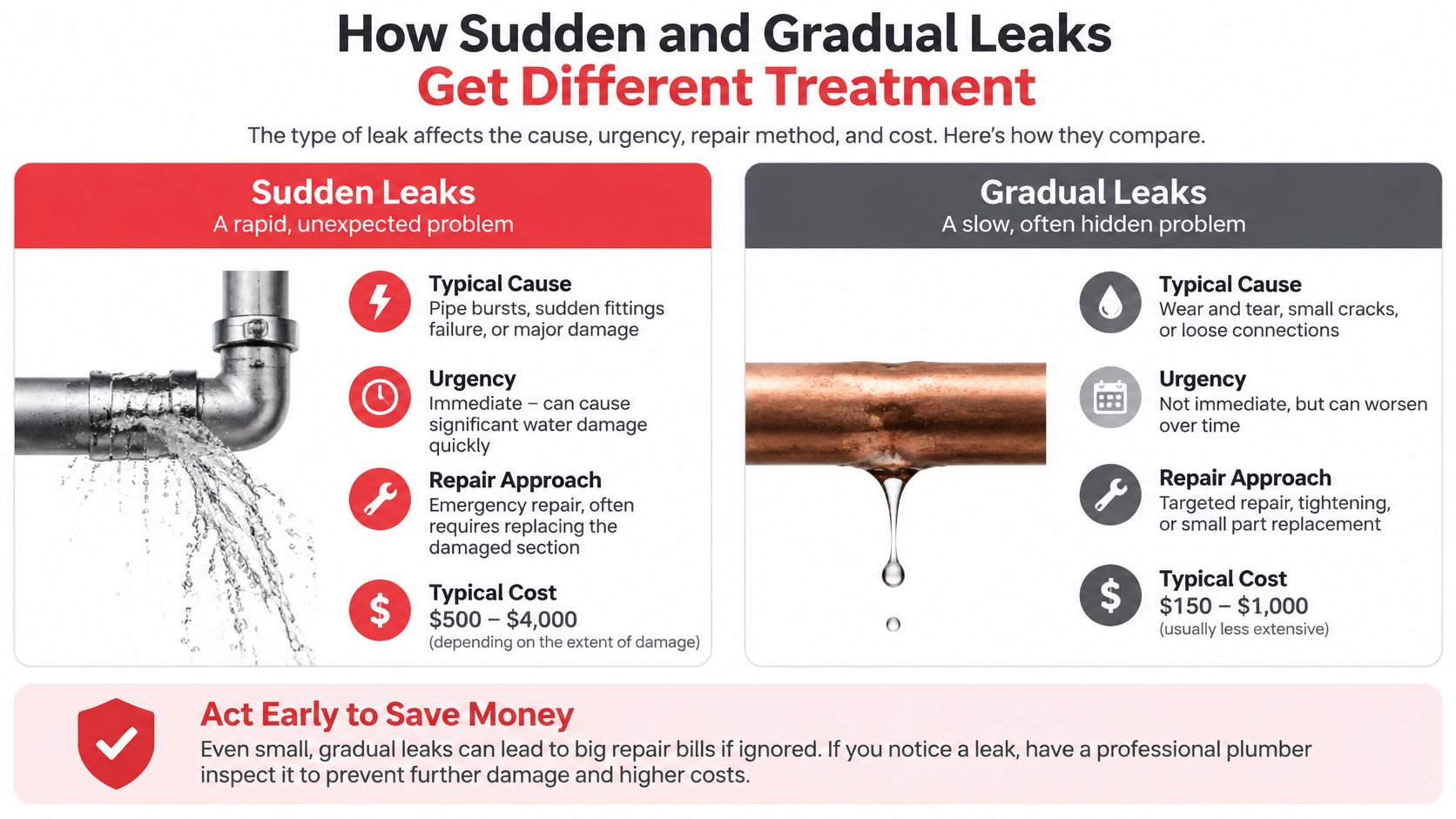
Say a Summerlin homeowner hears a hiss at night, notices a drop in water pressure, and finds soaked carpet the next morning. That sequence suggests an abrupt failure, although the plumber still needs to establish the source and the adjuster must evaluate the evidence.
Now consider a homeowner who notices higher water bills for months, then discovers cracked tile and a musty smell. The visible damage may be new to the homeowner, but the insurer may investigate whether water escaped over an extended period.
The discovery date isn't necessarily the loss date. As This Old House's water-damage overview explains, standard coverage commonly responds to sudden accidental plumbing events while excluding gradual leakage, deterioration, and neglect.
Leak scenarios and likely insurance treatment
| Scenario | Likely treatment | Evidence that helps |
|---|---|---|
| Sudden pressurized pipe rupture | Resulting damage often covered; pipe excluded | Pressure test, leak location, photos before demolition |
| Slow leak noticed on a water bill | Often disputed as gradual seepage | Bill history, moisture readings, first-sign photos |
| Long-term seepage with rot or staining | Commonly excluded | Plumber's cause-and-origin report and moisture history |
| Groundwater or rain entering the slab | Generally excluded under homeowners policies | Review of any flood policy |
Report Observations Without Guessing
A wet floor doesn't establish how quickly the pipe failed. An adjuster may consider staining, deterioration, moisture readings, and the plumber's report when deciding whether the condition developed gradually. Likewise, an unusual water bill is a useful clue, but it doesn't pinpoint the leak's location or prove that all the damage occurred during the billing period.
Give the plumber and adjuster a factual timeline. Describe when you heard water, saw damp flooring, noticed an odor, received an unusual bill, or shut off the supply. Don't describe an event as a sudden burst just because that wording sounds more likely to qualify.
Record what you observed, and let the inspection establish what the evidence supports.
The source of the water matters as much as the timing. Rain or groundwater entering beneath a slab isn't automatically a plumbing discharge, and repairing a supply line won't solve an outside-water problem.
Match your situation to the closest table row before the next call. Gather that row's evidence, including older bills or photographs that might complicate the timeline. An accurate record is more useful than a simplified account the physical findings don't support.
Policy Terms and Endorsements That Change the Payout
The policy form and endorsements can change which parts of a slab leak bill qualify for payment. Separate the estimate into four buckets: finding the leak, opening the slab, fixing the pipe, and repairing resulting damage. The Insurance Information Institute's coverage guide says an HO-3 policy generally covers accidental plumbing discharge, but not gradual seepage, deterioration, or maintenance failures. Sewer-backup coverage can often be added for approximately $50 per year, though limits vary by insurer.
A sewer or drain backup is different from a leak in a pressurized supply line. Ground-level flooding and overflowing rivers generally require separate flood coverage, rather than ordinary plumbing-water coverage.
Policy items that affect a slab leak payout
| Policy item | Typical figure or rule | What to check |
|---|---|---|
| Standard water-damage coverage | Included in most HO-3 policies | Whether the discharge was sudden and accidental |
| Sewer and drain backup endorsement | Approximately $50 per year | Insurer-specific limits and covered backup events |
| Flood coverage | Usually a separate policy | Ground-level flooding and overflowing rivers |
| Deductible | Homeowner's share before an insurer payment | Applicable amount on the declarations page |
Read Beyond the Declarations Page
The declarations page lists coverage limits, the deductible, and attached forms, but it is not the full coverage agreement. Read the referenced forms, water-loss exclusions, and loss-settlement provisions.
A tear-out endorsement may affect the cost of opening the slab to reach a leak. A service-line endorsement may apply to certain line failures. The endorsement name alone does not establish whether a pipe beneath the home's slab qualifies. Check the actual wording for covered locations, causes, exclusions, and repair scope.
Sublimits may cap particular expenses even when the dwelling limit is higher. Depreciation provisions can reduce an initial payment; ask whether withheld depreciation may be recovered after qualifying work. Temporary housing depends on applicable additional-living-expense coverage and its conditions. Wanting to stay elsewhere during repairs does not, by itself, establish coverage.
Compare Covered Costs With Your Deductible
Use only the estimate portions that may qualify for coverage when considering a possible payment. Finding the leak, slab access, pipe repair, and restoration can receive different decisions. If excluded pipe replacement makes up most of the bill, the remaining covered amount may barely exceed the deductible, or fall below it. Keep reasonable mitigation moving while you check the figures.
Before a leak occurs:
- List the attached forms. Identify each endorsement by its exact name on the declarations page.
- Check payment restrictions. Find the deductible, relevant sublimits, and depreciation terms.
- Request written clarification. Ask your agent which access and underground-line provisions apply to your home.
Coverage generally cannot be added retroactively for an existing loss. Reviewing the forms before damage occurs gives you time to identify possible gaps before slab work begins.
Claim File Steps and Denial Traps
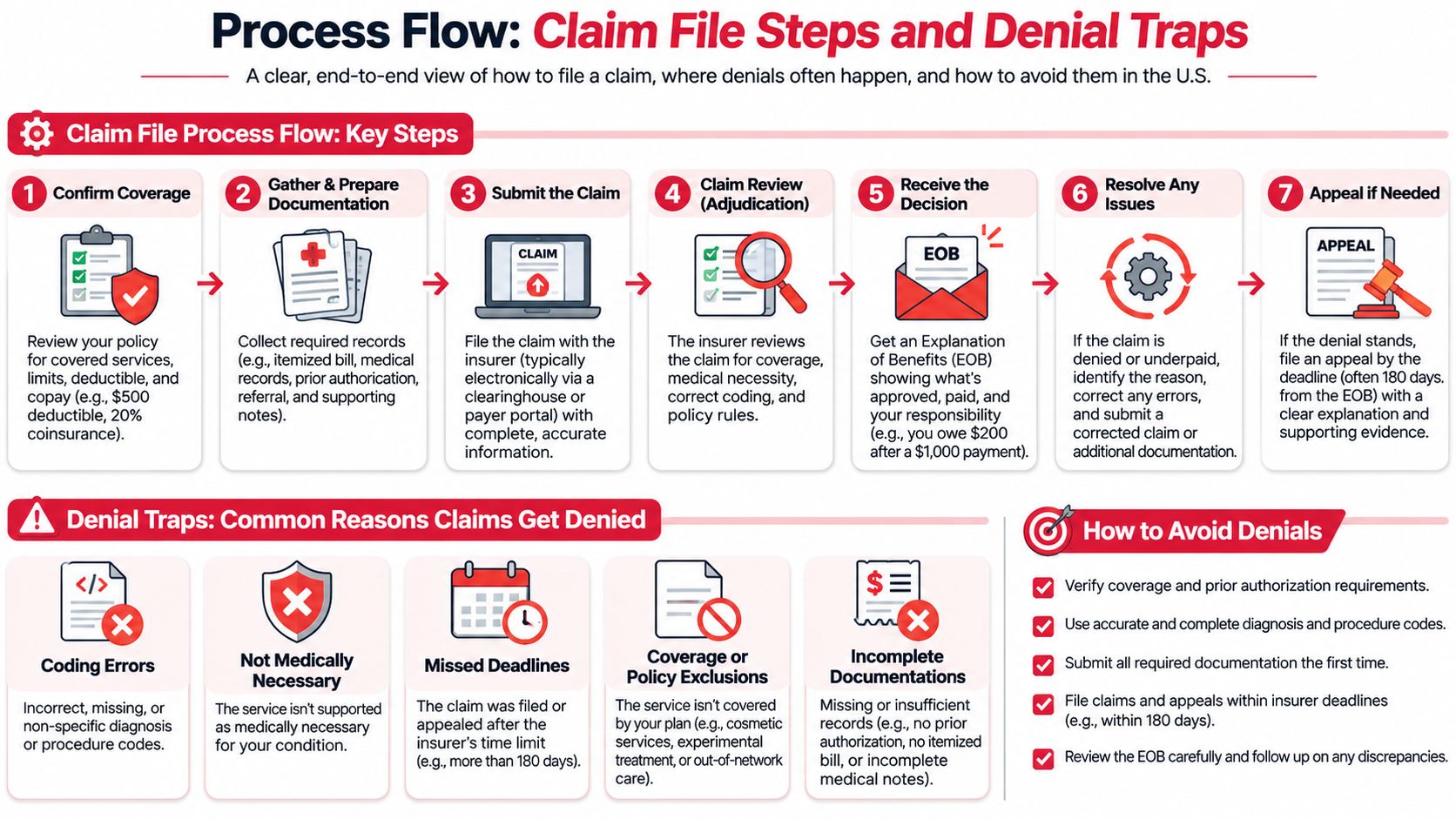
A slab-leak claim can turn on what the file shows, not just what the repair costs. Keep the four bill categories distinct: finding the leak, opening the slab, fixing the pipe, and repairing resulting damage. Insurers may assess each differently, and a plumber's report should document the work without promising reimbursement.
- Stop the water and record when. Shut off the main valve if safe, then note the time. Limiting ongoing flow also establishes when mitigation began.
- Photograph conditions before cleanup. Capture wet areas and the water meter, including its reading at shutoff when safe. Keep the original images.
- Document the diagnosis. Request a written report that explains whether a leak was confirmed, which line was isolated, where it was pinpointed, and what repair is proposed.
- Keep a dated chronology. Record the first signs you noticed and any professional moisture readings. The timeline can help an adjuster assess whether evidence supports a sudden or gradual leak.
- Request an itemized estimate. Separate leak detection, slab access, pipe repair, and resulting damage. These are different claim costs, not one interchangeable plumbing charge.
- Get instructions before non-emergency demolition. Ask whether the insurer needs to inspect or approve the proposed opening. Extensive work can remove evidence and leave costs disputed.
- Retain removed materials. Keep the failed pipe and relevant damaged materials until the adjuster provides disposal instructions, in case further inspection is needed.
Use this checklist to organize the file, not to delay shutting off water or taking reasonable steps to limit damage.
Make the Plumbing Report Useful
MG Plumbing Services LLC's leak-detection process is to confirm the leak, isolate the line, pinpoint with tracer gas, and report and repair. The company uses hydrogen tracer gas, acoustic equipment, and thermal imaging to locate hidden leaks without unnecessary demolition. Its written estimate follows leak location. These findings can describe the affected line and proposed scope, but they do not determine insurance coverage.
When arranging professional water leak detection, have your discovery timeline ready. Ask the report to separate observed conditions from conclusions that would require exposing the pipe. A careful report states what the inspection established and where uncertainty remains, rather than assigning an unsupported failure date.
For another explanation of slab-leak coverage, see this plumbing explanation of slab-leak coverage.
Pair Each Denial Trap With a Fix
- Letting water continue to escape: Shut off the supply, then report the damage with photographs and a record of reasonable mitigation.
- Opening the slab before inspection: Request a site visit or written instructions before non-emergency removal. Photograph conditions during authorized work.
- Treating an elective reroute as ordinary repair: List the proposed alternatives separately and ask for the insurer's position on the added scope.
- Assuming detection will be reimbursed: Ask whether the diagnostic charge qualifies, and keep the written response.
- Relying on the day of discovery alone: Include dated photographs, relevant billing history, and the plumber's findings to document the timeline.
- Accepting verbal assurances: Follow up by email and request a written coverage position tied to the estimate.
Newly visible damage does not establish when a leak began. Do not ask a plumber to alter a technical conclusion to fit coverage language.
Keep one complete record: Store photographs, reports, estimates, receipts, and insurer correspondence together, organized by mitigation, detection and access, pipe work, and resulting damage.
Use dated filenames and retain original photographs. When sending documents, list the attachments in the email so there is a clear record of what the adjuster received.
Confirm Coverage Before You Authorize Slab Work
The lowest slab-leak estimate is not always the best choice, and insurance approval does not automatically cover every line on the bill. Before concrete is cut, get the insurer's written coverage position and a plumber's estimate that separates four costs: finding the leak, opening the slab, repairing the pipe, and restoring resulting damage. Ask the insurer to address each category separately. The plumber's findings should explain why the proposed opening is needed.

Authorize a Defined Scope
- Get the coverage position. Ask what the insurer accepts, excludes, or still needs to investigate, including leak detection and access costs.
- Match it to the estimate. Compare the insurer's position with the proposed concrete opening, pipe work, and restoration. Resolve differences before non-emergency work.
- Choose the repair based on the diagnosis. A spot repair, reroute, or broader replacement should reflect the pipe's condition, not an assumption about reimbursement.
- Question a denial in writing. Request the policy provisions and factual reasons, along with any available appeal steps.
MG Plumbing Services LLC is a licensed, fully insured, owner-operated residential plumbing company serving the Las Vegas Valley. Owner Miguel Garcia has worked in the plumbing trade since 2000. The company provides drain cleaning, leak detection and slab leak repair, water heater service, and water line repair or replacement.
Know What You're Approving
Ask for an itemized scope that makes clear what each charge covers. Leak detection identifies the leak; opening the slab provides access; pipe work addresses the failed line; and restoration repairs damage after access. An insurer may treat these costs differently, so confirm how each is handled before authorizing work.
MG Plumbing Services LLC offers water leak detection for slab leaks and hidden pipes, with leaks located without unnecessary demolition. After locating a leak, the company provides a written estimate. Concrete cuts are planned around post-tension cables. If a sewer camera inspection identifies a line needing repair, the customer receives the footage and estimate and decides whether to proceed.
Review the Las Vegas slab-leak repair information when comparing the proposed plumbing scope. If water is escaping, shut off the main valve and request service during business hours. A plumber can document the findings and costs, but only the insurer can confirm what the policy will pay.