The toilet flushes, the water rises, and everybody in the house freezes for a second.
If that's happening again in the same bathroom, you're not dealing with bad luck. You're dealing with a pattern. In Las Vegas homes, especially older houses in Summerlin, Henderson, and central valley neighborhoods with aging drain lines, repeated toilet clogging usually points to a mechanical problem that keeps narrowing the margin for a normal flush.
This isn't a small issue. A Kohler-commissioned survey reported that 27% of 1,000 U.S. adults had experienced a toilet clog, and 23% of those respondents said it happened one to three times per month, with coverage translating that into roughly 28 million American households dealing with a clog each month in a long-running mainstream household problem, not a rare event (Kohler clog survey coverage). In Southern Nevada, hard water, mineral scale, older toilet designs, and aging cast iron can make that repeat-clog cycle even more stubborn.
Table of Contents
- When the Same Toilet Keeps Clogging Week After Week
- The Three Mechanical Reasons a Toilet Clogs Often
- How Las Vegas Hard Water Quietly Creates Repeat Clogs
- DIY Fixes That Actually Clear a Toilet Clog
- When a Plumber's Tools Beat the Plunger
- Stopping the Next Clog Before It Happens
- Getting a Real Diagnosis in the Las Vegas Valley
When the Same Toilet Keeps Clogging Week After Week
A common call starts the same way. It's a Sunday morning in a 1990s Summerlin house. The hall bathroom toilet backs up for the third time that month, somebody grabs the plunger, and the bowl finally goes down after a few hard pumps.
Then the headache shows up. A nearby sink burps, drains slowly, or leaves somebody cleaning up a secondary mess that seems unrelated until it keeps happening.
The recurring pattern matters more than the single clog
One clog can be random. A child used too much paper. Somebody flushed something they shouldn't have. The toilet had an off day.
A toilet that clogs often is different. At that point, the clog itself is not the main problem. The pattern is the symptom. Something in the fixture or drain system isn't moving normal waste and toilet paper the way it should.
Practical rule: If your plunger “fix” lasts a day or two and the same toilet clogs again, stop treating it like a one-time blockage.
Repeated plunging has a cost, even when it seems cheaper than calling for service. Homeowners wear out flappers by overworking old handles and tank parts. They scratch bowl porcelain with the wrong tools. They also get stuck planning around the problem bathroom, warning guests, flushing twice, and hoping nobody has to use that toilet during a visit.
What I look for first in Las Vegas homes
In Southern Nevada, repeat clogs usually land in one of a few mechanical buckets. The toilet itself may be underperforming. The branch line may be narrowed or partially blocked. Or the problem may sit farther downstream in the sewer line or venting.
The mistake is assuming every recurring clog comes from paper habits.
That's why the right question isn't, “How do I unclog this toilet again?” The right question is, “Why can't this bathroom drain a normal flush without drama?” Once you ask it that way, the next steps get clearer. You stop guessing and start diagnosing the fixture, the line, and the house.
The Three Mechanical Reasons a Toilet Clogs Often
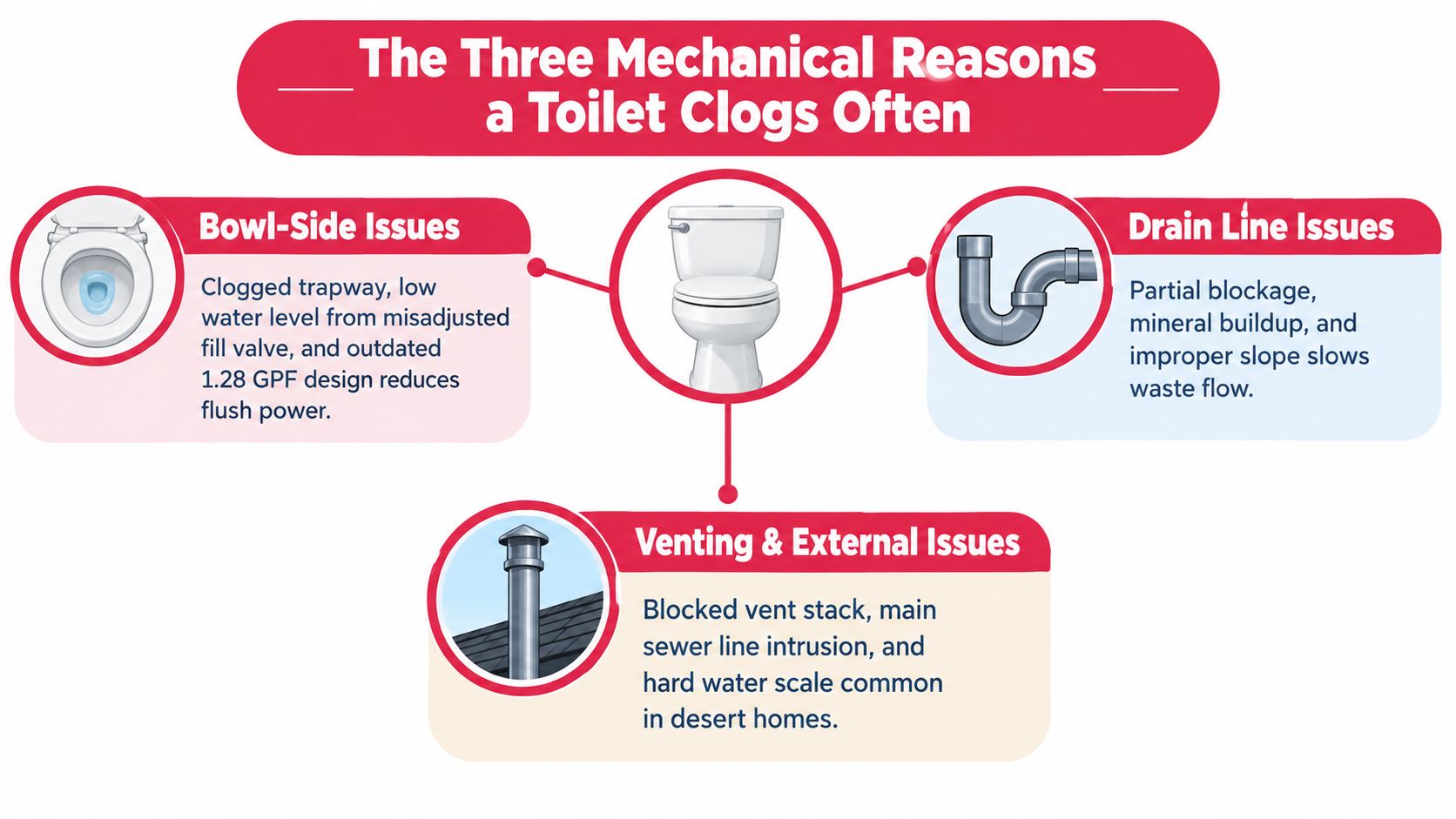
A toilet that clogs often usually falls into three mechanical categories. You can sort most repeat-clog calls by symptoms before you ever touch a machine.
Bowl-side problems
Start with the toilet itself. A partially blocked trapway, weak bowl refill, or low tank water level can turn an ordinary flush into a near-clog every time. Older fixtures and marginal low-flow designs can also struggle when mineral buildup narrows the internal passages.
A consumer survey also reported that more than 57% of respondents had toilets older than 10 years, which tells you a lot of homes still run older fixtures with wear, buildup, or dated flush performance (consumer toilet age survey coverage).
Typical signs include:
- Only one toilet acts up: The rest of the house drains normally.
- The bowl empties weakly: You don't get a strong siphon pull.
- The problem changes with use: Light use seems fine, but normal use clogs it.
Branch drain restrictions
Many repeat problems live here. The toilet flushes, but the line beyond the flange doesn't carry waste away fast enough. Paper catches. Waste hangs up. The next flush piles onto the last one.
A partially blocked branch line often comes from buildup rather than a full stoppage. In Las Vegas, scale and rough old piping make that more common than homeowners think. You can get a toilet that “sometimes” works, which is exactly why people keep misreading it as a toilet-only issue.
If the toilet clears with a plunger but starts acting up again soon after, the line may still be restricted and simply passing enough water to fake a repair.
Mainline or venting problems
The deepest category includes main sewer restrictions and venting failures. Plumbing guidance notes that a toilet that clogs often is commonly linked to three categories: non-flushables or too much paper, a partially blocked toilet trap, or a deeper drain or sewer-line blockage. The same guidance also notes that if multiple fixtures back up, the main sewer line is the likely source rather than the toilet itself (Las Vegas drain and sewer guidance).
Watch for these patterns:
- Multiple fixtures react: A tub gurgles, a shower slows, or another toilet bubbles.
- Laundry makes the bathroom complain: Washing-machine discharge can expose a mainline issue fast.
- Symptoms move around the house: Today it's the toilet, next week it's the tub.
A simple test at home
Try the problem toilet first. If it drains, immediately run the nearest tub or shower and then discharge a larger fixture if practical, such as a washing machine.
If nearby fixtures gurgle, hesitate, or back up, the problem likely sits past the toilet. At that point, more plunging usually buys time, not a fix.
How Las Vegas Hard Water Quietly Creates Repeat Clogs
Las Vegas plumbing has a local enemy that generic toilet articles barely touch. Hard water.
Las Vegas Valley water is classified as very hard, and the Las Vegas Valley Water District states a hardness of 291 parts per million, or 17 grains per gallon, caused by dissolved calcium and magnesium from the Colorado River. The district also notes those minerals are not a health risk (Las Vegas Valley water hardness guide).
Where scale causes trouble inside a toilet
Inside a toilet, scale builds where water slows down or changes direction. That means the jet opening, internal rim passages, the trapway, and the first section of the drain path can all collect mineral deposits over time.
In a newer toilet with clean internal passages, that might not matter much. In an older fixture with a smaller margin for error, a little narrowing changes the flush. The toilet may still move water, but it loses the carrying ability that gets waste and paper all the way through.
Why older Southern Nevada homes struggle more
A lot of Las Vegas Valley homes have older plumbing components, and many still have aging cast iron in at least part of the drainage system. Cast iron doesn't fail the same way plastic does. It gets rough inside. Once scale and residue grab onto that rough interior, paper catches more easily and repeat clogs get started.
Guest bathrooms can be tricky too. They don't get enough regular flow to wash the line aggressively, so deposits have more time to stay put and harden.
| Years in Service | Estimated Trapway Diameter | Typical Symptom |
|---|---|---|
| Newer fixture | Full design opening | Stronger flush, fewer hang-ups |
| Mid-life fixture | Slightly narrowed by scale | Intermittent slow flush or occasional paper hang-up |
| Older scaled fixture | Noticeably restricted | Frequent clogs, weak siphon, repeat plunging |
Hard water usually doesn't create one dramatic clog. It narrows the system a little at a time until normal use starts failing.
That's why toilet clogging often in Las Vegas isn't just about what got flushed this week. It's also about what the water has been leaving behind for years.
DIY Fixes That Actually Clear a Toilet Clog
Most homeowners don't need a lecture. They need the shortest path that works without damaging the toilet.
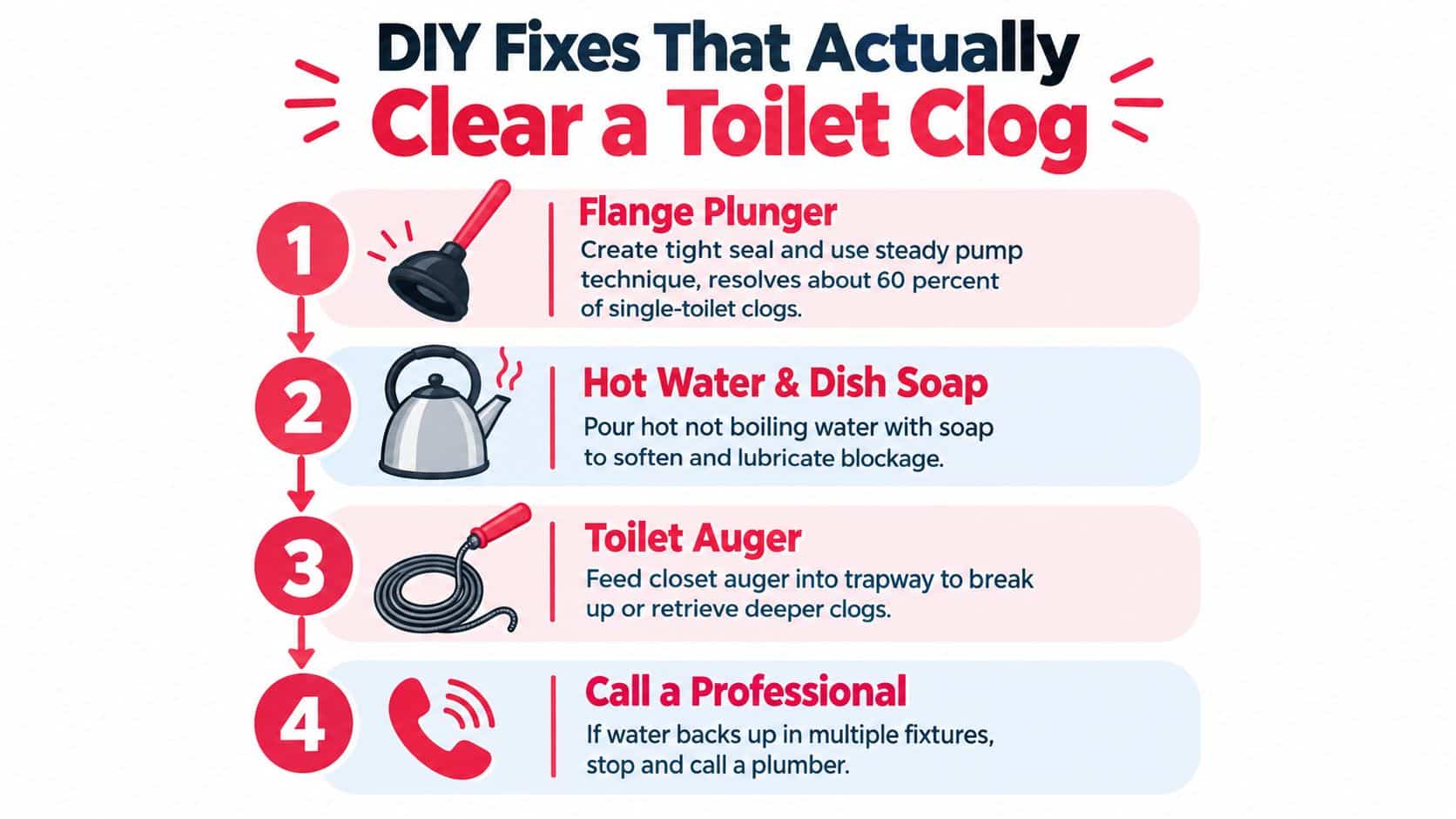
Mechanical clearing beats guessing. Consumer-facing plumbing summaries report that proper plunging resolves roughly 70 to 80% of soft clogs, hot water and dish soap about 60 to 70% of paper clogs, and a toilet auger about 85 to 90% of accessible blockages. The same guidance notes that about 40% of toilet clogs are deep enough that a plunger cannot reach them, and that if a clog returns after an auger pass, the problem is likely beyond the bowl (toilet clog tool performance summary).
Step one with a flange plunger
Use a flange plunger, not a flat sink plunger. The rubber extension on the bottom helps seal into the toilet outlet.
Set the cup fully underwater, press gently at first to burp out trapped air, then use steady controlled strokes. Don't hammer at it. The goal is to move water through the trap, not splash the bathroom and loosen the wax seal.
The hot water and dish soap move
If the bowl drains slowly but isn't fully blocked, add dish soap and then hot, not boiling, water. Let it sit before flushing.
Boiling water is a mistake. Porcelain doesn't like thermal shock, especially in an older bowl. Warm to hot water helps soften a paper-heavy clog and lubricate the trapway without stressing the fixture.
A quick visual guide helps if you want to follow the order correctly:
When the toilet auger is the right tool
A toilet auger, also called a closet auger, is the next real step. It reaches into the trapway where a plunger can't do much. Feed it carefully, keep the protective sleeve against the bowl, and crank with control.
Don't force it. If the cable binds hard, stop and reset. Jamming an auger can scratch porcelain or wedge the obstruction tighter.
Use this order:
- Plunger first: Best for fresh, soft clogs near the bowl.
- Soap and hot water second: Good when paper is the likely culprit and water is draining slowly.
- Toilet auger third: Best when the clog feels deeper or keeps returning.
Field call cutoff: Two auger passes without lasting relief usually means the blockage is farther down the line, not in the toilet.
If the toilet clogs again soon after you clear it, stop buying more chemicals and stop repeating the same plunge cycle. That's where DIY starts wasting money.
When a Plumber's Tools Beat the Plunger
When a toilet keeps clogging, the right professional tool depends on where the restriction lives and what it's made of. Homeowners often hear “snake it” as if that solves every drain problem. It doesn't.
Cable machine versus hydro jetting versus camera
A cable machine works well when the line has a soft blockage, paper buildup, or a localized obstruction. It opens a path. It does not clean the pipe wall completely.
Hydro jetting is different. It uses pressurized water to scour the inside of the line. That matters in Las Vegas homes where long-term scale, sludge, and residue narrow the pipe rather than forming one simple clog. If you want to understand how that service is used in residential lines, hydro jetting for residential drain cleaning is the category to ask about when cable clearing keeps giving temporary results.
A sewer camera tells you what the line looks like after or before cleaning. That's the only way to confirm whether the issue is scale, a belly, a crack, offsets, root intrusion, or a line that never got fully cleared.
| Tool | Best For | Typical Price Range | Limitation |
|---|---|---|---|
| Cable machine | Soft blockages, paper buildup, localized obstructions | Varies by company and access conditions | Opens flow but may leave wall buildup behind |
| Hydro jetting | Scale, sludge, recurring buildup in drain lines | Varies by line condition, length, and access | Not every damaged line is a good jetting candidate |
| Sewer camera inspection | Locating defects, confirming blockage source, verifying condition | Varies by company and whether paired with cleaning | Diagnoses condition but does not clear the line by itself |
Matching the tool to the symptom
If one bathroom toilet keeps acting up and the rest of the house seems normal, a cable machine is often the first logical move after fixture-level checks. If the house has a history of recurring slow drains and old cast iron, jetting may be the better long-term answer. If symptoms keep returning without a clear reason, camera work stops the guessing.
MG Plumbing Services LLC is a local, family-owned and owner-operated residential plumbing company serving Las Vegas, Henderson, North Las Vegas, Summerlin, and surrounding areas of the Las Vegas Valley. The company handles residential drain cleaning, sewer and drain services, hydro jetting, sewer camera inspections and locating, leak detection, water heater work, water treatment, and general plumbing repairs, using professional drain-cleaning, hydro-jetting, sewer-camera, locating, and leak-detection equipment to identify the cause instead of relying on temporary fixes.
Stopping the Next Clog Before It Happens
Prevention is cheaper than repeated cleanup, but only if you focus on the failure points that hit Las Vegas houses.
Historical plumbing context matters here. Commercially produced toilet paper was introduced in the United States in 1857 by Joseph Gayetty, and perforated toilet paper rolls followed in 1890 when Scott Paper Company began selling them. Plumbing systems were built to handle human waste plus toilet paper, but newer products and habits often exceed those limits. The same coverage notes utility and industry findings that wipes and other non-flushables are implicated in a majority of blockage incidents in several markets, including one UK utility summary attributing about 93% of investigated sewer-blockage material to wipes and national reporting citing roughly 300,000 sewer blockages a year costing about £100 million (historical and sewer blockage context).
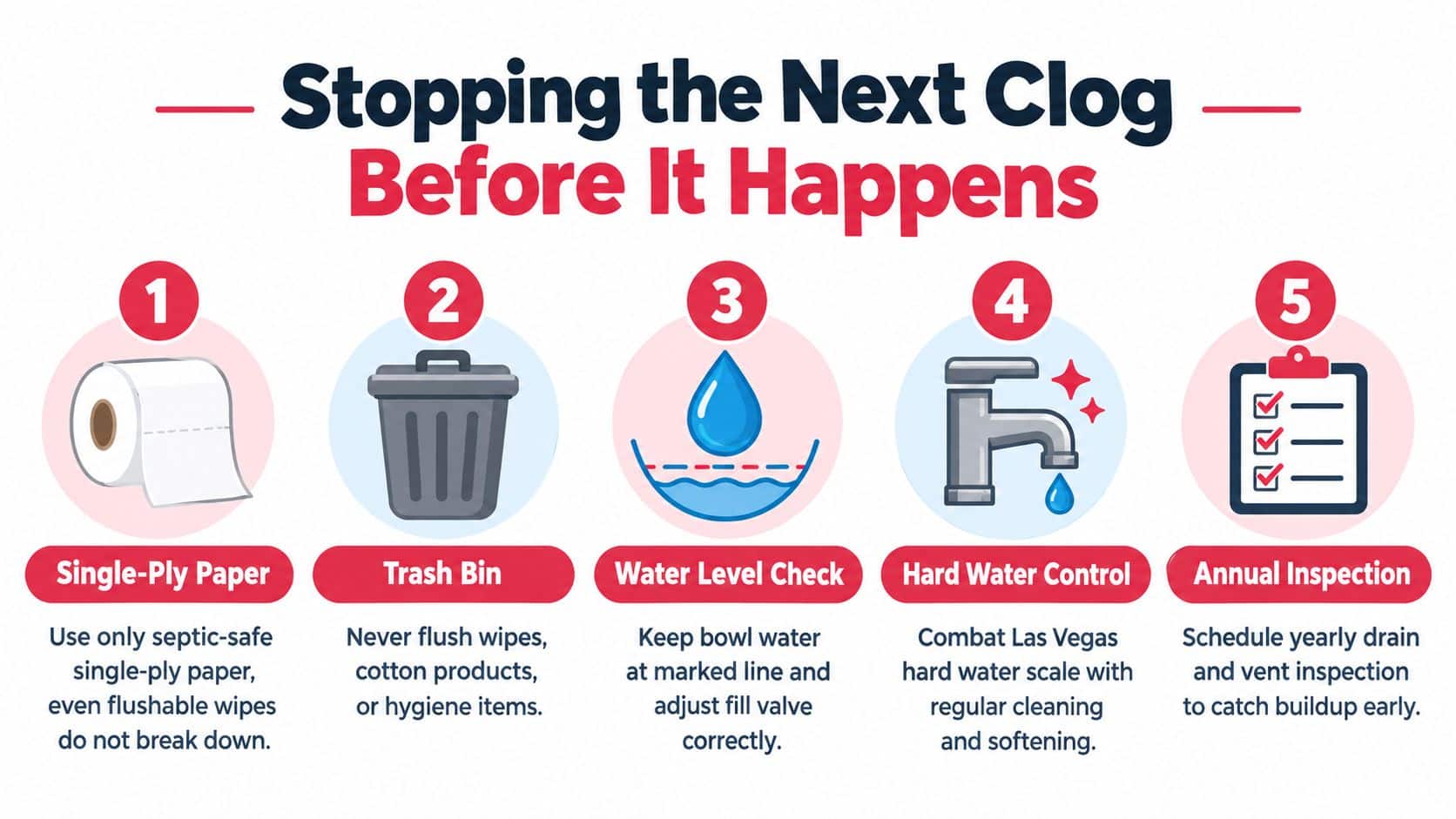
What to change in daily use
- Use plain toilet paper: Septic-safe single-ply is easier on marginal fixtures and older drain lines.
- Keep wipes out of the toilet: “Flushable” on the label doesn't mean trouble-free in real drain systems.
- Watch the tank and bowl water level: A weak refill can mimic a drain problem.
- Clean for scale, not just appearance: A shiny bowl can still have restricted internal passages.
For ongoing drain maintenance, a homeowner dealing with recurring backups should look at residential drain cleaning in Las Vegas as a diagnostic service, not just a one-time unclog.
Warning signs you shouldn't ignore
A clog usually announces itself before the overflow.
- Gurgling nearby fixtures: A tub or sink talking back after a flush points past the toilet.
- Slow shower or tub drain: The bathroom branch may be filling and draining sluggishly.
- Faint sewer odor: Venting or line flow may be compromised.
- Frequent need for a plunger: Normal toilets don't need routine rescue.
Monthly chemical drain cleaner is usually a bad habit, not a maintenance plan. It doesn't diagnose the line, and it can damage parts without solving a downstream restriction.
Getting a Real Diagnosis in the Las Vegas Valley
Once clogs become a pattern, another plunger session usually isn't the smart move. A real diagnosis saves time because it ties the symptom to a specific cause.
What a proper service visit should include
A plumber handling recurring toilet clogging should arrive ready to test, not just poke at the bowl. That means checking fixture behavior, listening for gurgling, evaluating whether the issue is isolated, and bringing the right tools for escalation.
For a repeated-clog call, ask whether the company can inspect the line with a camera if needed. Homeowners dealing with ongoing uncertainty should understand what a sewer camera inspection in Las Vegas is for before approving repeated clearing visits with no explanation.
A proper diagnosis should connect the pattern to one of these causes:
- Trapway restriction at the toilet
- Partial blockage or scale buildup in the branch line
- Main sewer defect or downstream restriction
- Venting issue that changes fixture performance
What to ask before you approve work
MG Plumbing Services owner Miguel Garcia is a Nevada-licensed C-1d plumbing contractor and journeyman plumber with more than 25 years of plumbing experience. The company is licensed and insured, serves residential customers, and focuses on professional diagnosis, straightforward recommendations, honest pricing, and quality workmanship. It does not market itself as a commercial or 24/7 emergency plumbing company.
Whether you call this company or another licensed residential plumber, ask direct questions:
- Are you Nevada-licensed and insured
- Will you explain whether this is a toilet issue or a line issue
- Do you separate clearing from camera work in writing
- Can you show or share the camera findings if the line is scoped
- Are you diagnosing the cause, or only trying to restore flow today
The right service call turns a mystery clog into a documented plumbing problem with a repair path.
Customers can call 702-480-8070 to request service. Se habla español.
MG Plumbing Services LLC handles residential drain cleaning, sewer and drain diagnosis, hydro jetting, sewer camera inspections, toilet repairs, and other plumbing work across Las Vegas, Henderson, North Las Vegas, Summerlin, and nearby communities. If your toilet keeps clogging and you want to know whether the problem is the fixture, the branch line, or the main sewer, visit MG Plumbing Services LLC to request service and get a straightforward residential diagnosis.