Cutting the tree down won't fix tree roots in a sewer line, and neither will pouring root killer down a toilet. That popular advice gets the order backwards. Roots almost never break a sound, sealed pipe. They find a pipe that's already leaking at a crack, a loose joint, or an offset, then they grow into the moisture escaping from that opening. If you only remove the roots, you've restored flow for a while. You haven't closed the hole they used, and that's why the same backup keeps coming back.
Table of Contents
- Signs of Tree Roots in a Sewer Line
- How Roots Enter Through Pipe Defects
- Cleaning Versus Repair Versus Replacement
- Root Problems in Las Vegas Valley Homes
- Prevention Based on Pipe Risk
- Why Cutting Roots Alone Comes Back
- When Las Vegas Homeowners Should Call
Signs of Tree Roots in a Sewer Line
Tree roots in a sewer line almost always mean wastewater is escaping somewhere. Fine roots have followed that moisture through a crack, loose joint, or offset and started growing inside the pipe. A one-time slow drain isn't the pattern. A main line restriction that keeps returning is.
Watch what happens across the house, not just at one fixture. Several fixtures gurgling together, sewage rising in the lowest tub or shower, or a yard cleanout that surges when you flush a toilet all point past a single branch line. A backup that returns weeks or a few months after snaking points the same way. So does what comes back on the cable. A fibrous mat is roots. A greasy slug or a wad of wipes isn't.
What roots do once they're inside
Roots don't stop at the opening. The Traverse City sewer and water department states that roots continue growing at each entry point and can eventually fill the pipe, producing a complete blockage if no remedial action is taken. The same guidance warns that continued growth can exert pressure at the original crack or joint, break the pipe, and contribute to total collapse.
That's the practical change over time. Early on, hair-like roots catch toilet paper and solids and the line drains slowly. Later, the mat thickens, the open diameter shrinks, and normal water use surcharges the line. Repeated symptoms may mean more than one entry point, or a joint that's getting worse.
Southern Nevada homes have look-alikes you shouldn't blame on a tree. Kitchen grease builds up in branch lines. Wipes labeled flushable and paper towels don't break down like toilet paper. Hard-water scale narrows older pipe. Each one can slow a drain without a single root in the line.
A strip of extra-green grass or a soft spot over the lateral is a leak clue, not proof by itself. Irrigation can do the same thing in a desert yard. Note which fixtures failed and how fast the clog returned, then use the pattern below.
Sewer symptoms and what to do next
| Symptom | Likely meaning | Sensible next step |
|---|---|---|
| One fixture slow and the rest of the house fine | Branch-line clog from grease, hair, wipes, or a small root mass | Clean that branch and watch whether it returns |
| Several fixtures gurgle or drain slowly together | Main lateral restricted by roots, scale, grease, or a sag | Stop heavy water use and clear the main line |
| Sewage in the lowest tub, shower, or floor drain | Main line surcharging from roots, a collapse, or a belly | Get the main line cleared the same day |
| Backup returns within weeks or a few months | The entry point is still open and roots or solids have re-formed | Camera the line before cutting roots again |
| Unusually green grass or a soft spot over the lateral | Moisture escaping at a joint or break | Locate the line and inspect it; do not pave over the spot |
| Fibrous mat on a cable or in the cleanout | Roots inside the pipe, not grease alone | Cut or jet the roots, then video the entry point |
Practical rule: If only one fixture is affected, start with that branch. If sewage is in the house, clear the main today. If the stoppage has already come back, get video before you pay for another cut.
How Roots Enter Through Pipe Defects
Think of a sealed pipe like a sealed pot. Roots hit the solid wall and turn aside because there's nothing leaking for them to follow. A cracked pipe or separated joint works like a drip emitter. It leaks moisture and nutrients into the soil, and roots follow that leak the way a plant follows water.
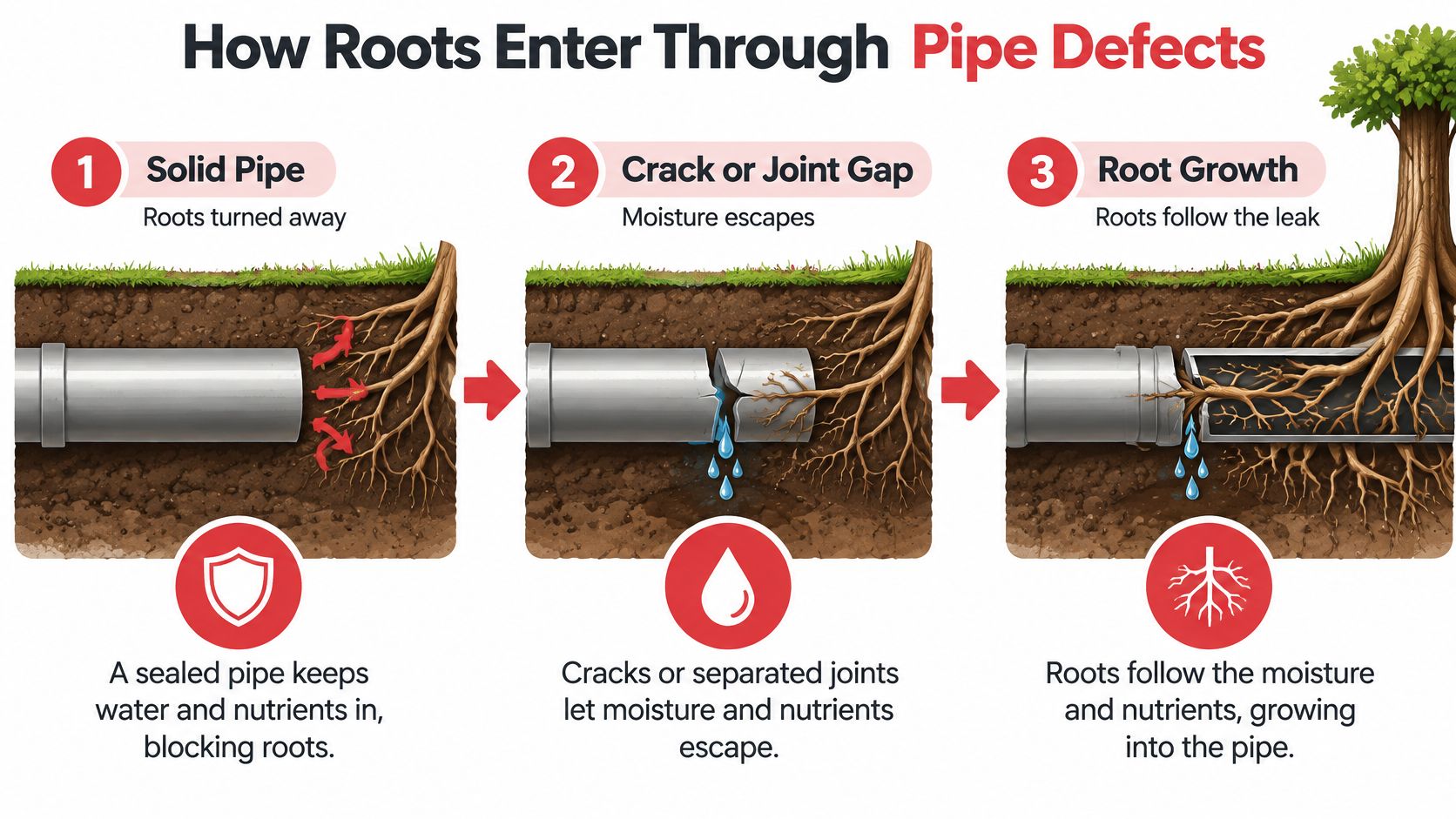
The sequence is consistent. Wastewater vapor escapes at a failed seal, a displaced joint, or a crack. Hair-like roots enter the opening. Inside, they form a mat that screens toilet paper and solids, shrinks the open diameter, slows flow, and makes the line surcharge. Retained solids and repeated surcharge stress the same joint, and thickening roots can widen the defect that let them in.
The defect comes first
Research reviewed by the U.S. Forest Service reports roots as a cause of more than half of sewer blockages and identifies cracked and jointed older systems as particularly susceptible. That doesn't mean roots punched through intact pipe. They exploited openings that were already there, especially cracked pipe, failed or displaced joints, deteriorated connections, and leaking interfaces.
Higher-risk laterals share a profile:
- Many joints: Older clay and cast iron runs have a joint every few feet, and each one is a potential entry.
- Smaller diameter and shallow burial: Roots reach the pipe sooner and a given mat blocks more of the bore.
- Older materials: Cast iron scales and cracks as it deteriorates, while modern gasketed PVC and ABS stay watertight when their seals are intact.
Older Las Vegas tracts with cast iron from before the mid-1980s fit the vulnerable pattern. A newer plastic lateral usually doesn't, unless one repair coupling has separated or a section was poorly bedded. One bad joint is enough.
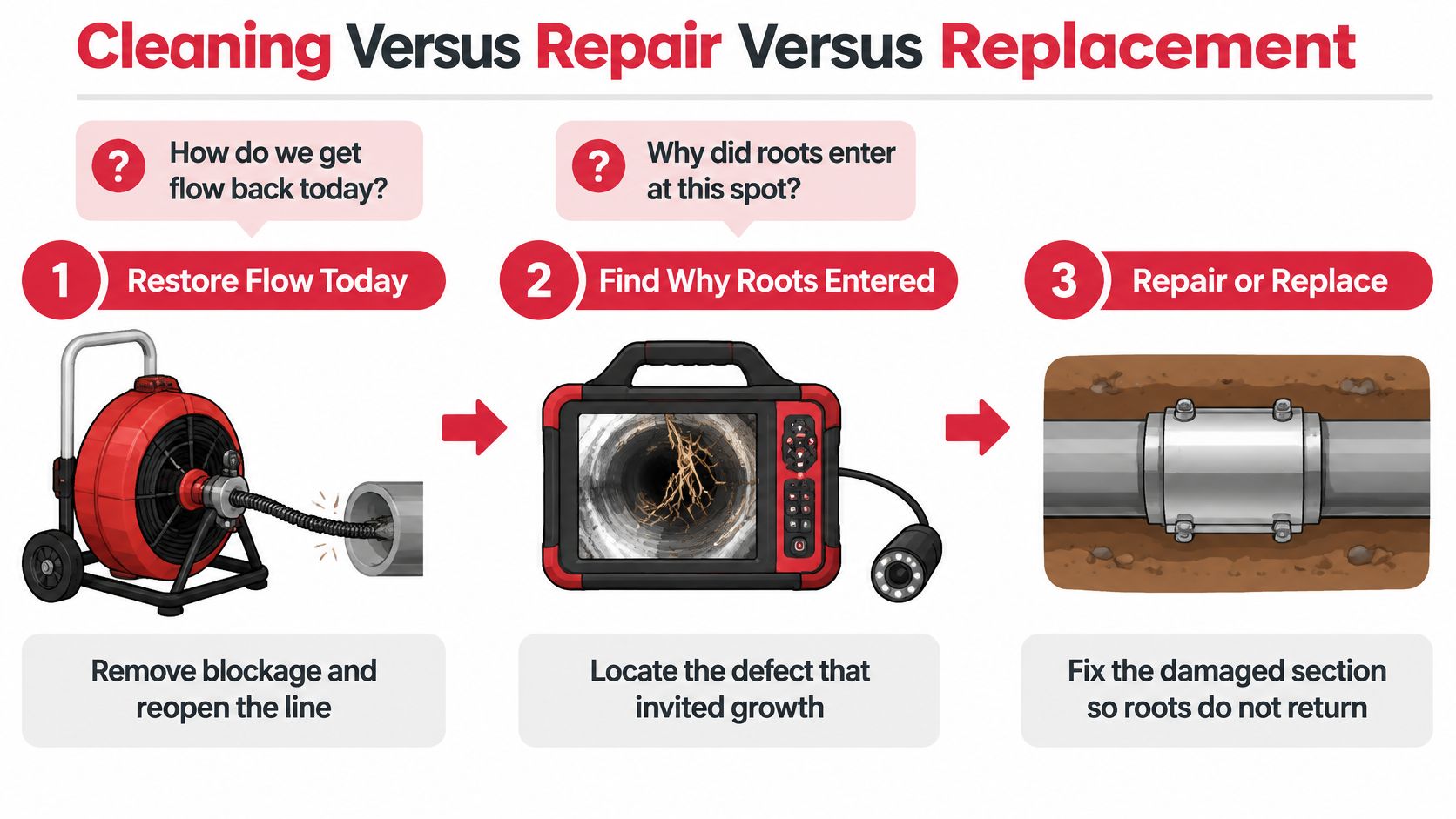
The diagnostic order matters. Clear enough of the obstruction to pass a camera, then record the material, joint condition, cracks, offsets, belly, and distance from the cleanout. That's what a proper sewer camera inspection gives you, and it's the record every later decision should rest on.
Mechanical cutting or jetting restores the hole the water uses. It doesn't close the hole the roots used. A clean line can clog again for exactly that reason, and a returning backup is your signal to treat the recorded defect instead of scheduling endless cutting.
Cleaning Versus Repair Versus Replacement
Don't mix two questions. How do we get flow back today? And why did roots enter at that spot? Cleaning answers the first question. Only repair or replacement answers the second.
Root intrusion options compared
| Option | Restores flow | Closes the entry | Best fit |
|---|---|---|---|
| Cable with a root cutter | Yes, by cutting the mass inside the pipe | No | First clearing when the line is still passable |
| Hydro jetting with a root nozzle | Yes, by shearing fine roots and flushing debris | No | Fine roots plus grease or scale after cabling, or instead of it |
| Chemical root treatment | Slows regrowth if product and pipe allow it | No | A still-round pipe after mechanical cutting, and only where discharge rules allow it |
| Spot repair | Yes, after the bad section is rebuilt | Yes, at that one location | Camera shows a single crack, offset, or separated joint |
| Cured-in-place lining | Yes, if the host pipe can accept a liner | Yes, along the lined run | Several leaking joints, pipe still round, no severe belly or collapse |
| Open-trench or trenchless replacement | Yes | Yes, with a new watertight line | Cast-iron failure, collapse, a long belly, or roots at many joints |
How each option actually works
A cable machine with a root-cutter head sized to the pipe is the usual first clearing when the line is still passable. It shears the mass and reopens the bore. It doesn't seal the joint.
When fine roots, grease, or scale remain on the wall, hydro jetting with a root-cutting nozzle uses angled high-pressure jets to shear growth off and flush debris out. It leaves a cleaner pipe for the camera, which is a real advantage. It still doesn't close the entry.
Chemical root control sits in a narrower place. Where the product and local discharge rules allow it, it can slow regrowth beyond the cut on a pipe that's still structurally round. It's the wrong tool for a collapse, a severe belly, or a line that's breaking apart, because none of those problems is root growth.
Spot repair fits one documented crack, offset, or separated joint. Cured-in-place lining can seal a run of leaking joints when the host pipe is round enough to line and isn't badly bellied or collapsed. Replacement, open-trench or trenchless, fits widespread joint failure, deteriorated cast iron, a long belly, or roots entering at many points. That includes cast-iron-to-ABS replacement under a slab or in a yard trench.
The five-year test
Apply the options to two lines. One isolated defect on an otherwise sound plastic lateral may justify cutting plus a camera recheck, because the rest of the pipe has years left. Roots at joint after joint on old cast iron will outlast repeated cleaning, and you'll pay for emergency clearings while the pipe keeps deteriorating.
Access changes the job too. A usable cleanout is simpler and cheaper than pulling a toilet or going through a roof vent. I would not choose any method from the tree in the yard alone. Choose it from the video.
Root Problems in Las Vegas Valley Homes
In older Las Vegas, Henderson, North Las Vegas, and Summerlin neighborhoods, recurring roots usually trace back to pipe age. Homes built before 1985 often still have cast-iron drains, and those jointed, deteriorating lines are where intrusion shows up. Newer ABS or PVC laterals fail less often unless a coupling has separated, a repair was poorly bedded, or the line has developed a belly.
Access starts at the cleanout, which is often a simple cap in the front yard.
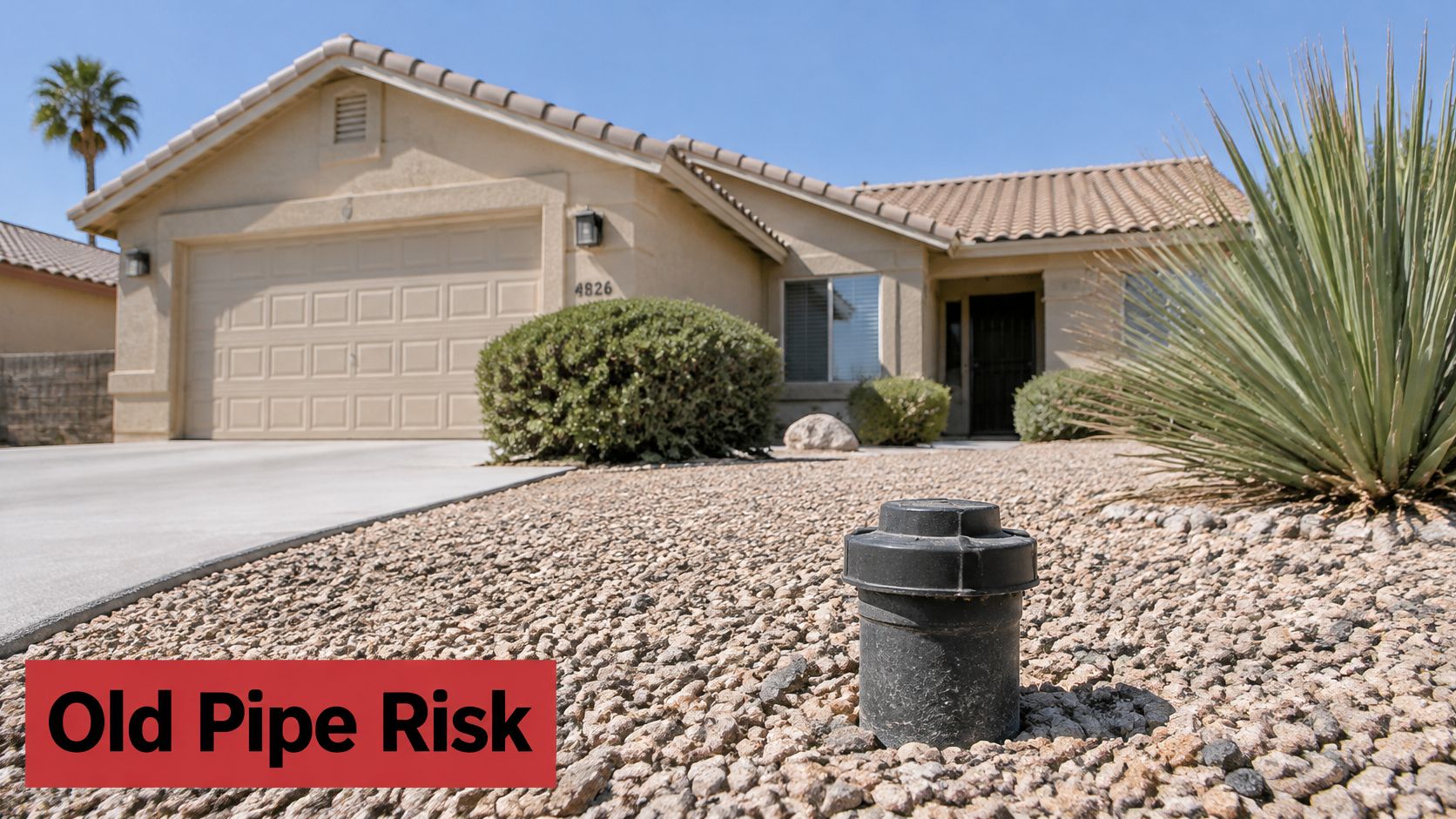
Irrigation is the local twist. Desert trees chase moisture, so a leaking joint under a watered lawn is far more attractive than a dry, sealed pipe. Proximity raises risk, but a tree count isn't a diagnosis. Research summarized in a Phys.org report on Australian sewer networks found sewers near trees were 1.4 times more likely to experience intrusion than sewers without nearby trees, while sewers near three or more trees were 1.8 times more likely to be affected. The same report notes SA Water recorded more than 30,000 cases of tree-root intrusion in 2020, nearly 60% of all sewer failures that year, at approximately $5 million annually.
For a homeowner, that means risk, not fate. Say a hall bath backs up alone and the camera finds a small root mat at one fitting. Cleaning and a scheduled recheck are reasonable. Now say every fixture backs up and the camera shows offset cast-iron joints with roots at several of them. Replacement beats another annual cut, because you're maintaining a pipe that's failing at multiple points.
This short video shows how the work looks in practice before you commit to a repair.
Hard-water scale, grease, and a sag can mimic roots, which is why video matters more than symptoms. One responsibility point is worth settling early. The private lateral is generally the owner's pipe to the public connection, while the city main is not. A camera and locate show which side of that line the defect sits on before anyone argues about a street tree.
Prevention Based on Pipe Risk
The nearest tree is a poor guide to sewer risk. Roots can reach a defective joint or crack even when the tree is not directly above the pipe, so prevention starts with the lateral's condition, not a guessed setback distance.
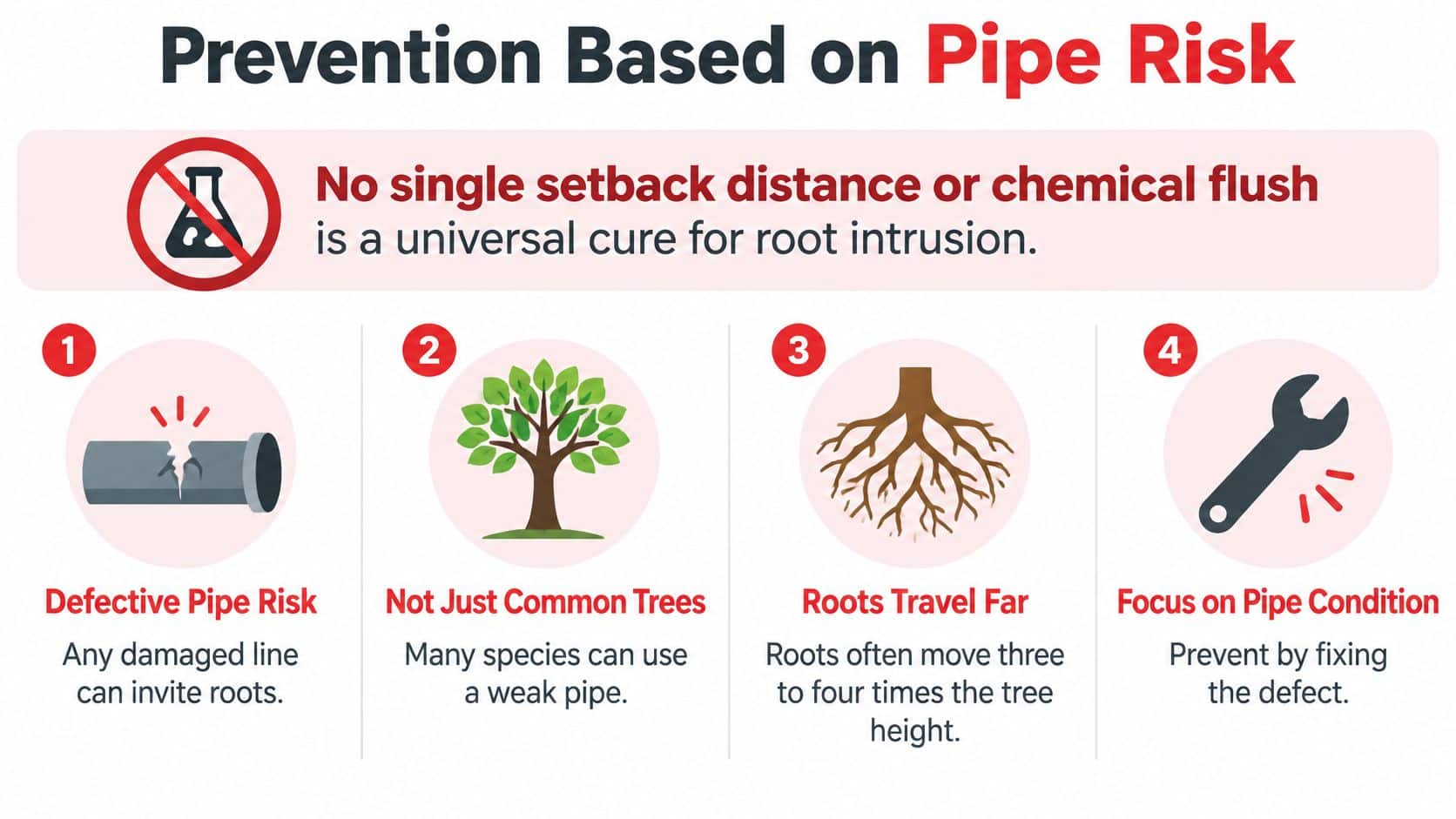
Bismarck's guidance on tree roots in sewer lines says roots may spread three to five times a tree's height. Removing the closest tree may not resolve intrusion if roots from other trees can reach the same line, and roots may keep growing for several years after removal. Tennessee Extension notes that faster-growing trees planted near sewer lines can require replacement sooner than slower-growing species; even slow-growing trees can eventually interfere.
The control order that works
- Locate the lateral: Know where the line and cleanout run before planting or paving.
- Camera the line after cleaning: A clear pipe makes it easier to identify the joint or crack roots entered through.
- Classify the defect: Establish whether the damage is isolated or spread across multiple joints.
- Choose the repair from the camera record: Close the opening, then plan landscaping around a watertight line.
Root cutting restores flow; it does not close the entry point. Until that defect is repaired, maintenance depends on pipe material and recurrence. Homes with cast iron lines or repeated backups may benefit from jetting every 18 to 36 months. Newer ABS or PVC lines often go five years or more between jettings, while a lateral near mature trees may need a yearly root cut and jet until the entry is repaired.
A root barrier may protect a section of soil if it can be installed without harming the tree or pipe. It cannot seal a leaking joint.
Choose plantings based on mature root behavior, and avoid adding thirsty trees over a known defect. Valued shade may be kept if a lining or watertight replacement removes the opening roots are following. Keep the lateral's location on record and schedule the next inspection before another backup forces the decision.
Why Cutting Roots Alone Comes Back
The myth is that a nearby tree broke a healthy pipe. Acting on it costs people twice. They remove shade that cools a Las Vegas yard, and they leave the crack open for the next tree's roots to find.
A second myth says a hardware-store auger or a bottle of copper sulfate is a repair. Neither closes a joint. A product can also be a poor match for the pipe material or for local wastewater rules, and pouring it into a collapsed line treats a structural failure as if it were just growth.
A 2025 review of root intrusion management identifies a shift from reactive methods, mechanical or chemical root removal, toward predictive models that combine tree species, pipe condition, soil, distance, and site characteristics to forecast recurring intrusion. The same body of work notes that repeated mechanical cutting can damage pipes and encourage thicker regrowth, while properly administered chemical treatment can inhibit growth beyond the pipe interior.
Three outcomes over five years
Cutting only, with no camera, buys months and no knowledge. You don't know if the pipe is sound, offset, or collapsing, so every return visit starts from zero.
Cutting plus a camera baseline changes the decision. The video either confirms a sound pipe you can maintain on a schedule or proves a defect worth repairing now, while lining or a spot repair is still possible.
Repairing the documented opening and keeping the tree usually beats annual emergencies. The roots lose their reason to enter, and you keep the canopy. The question that replaces the myth is simple: which choice keeps total risk lowest over five years and still keeps the tree?
Maintenance has stopped being reasonable when the time between backups keeps shrinking, roots show up at more than one joint, a belly holds debris after jetting, or cast iron is scaling and cracking on video. At that point you're not preventing a repair. You're financing its delay.
When Las Vegas Homeowners Should Call
Call for an inspection when sewage backs up into the house, a cleared line blocks again, or a camera has shown a crack, offset joint, belly, or collapse. Several mature trees near the lateral can raise concern, but tree proximity alone does not show whether roots have entered. The pipe's condition on camera should guide the next step.
MG Plumbing Services LLC diagnoses the clog, provides a flat rate in writing before work begins, clears the line with a cable machine or hydro jetting, then test-flushes from multiple fixtures to confirm flow. For drain and sewer service, cable rooting is usually the first method; jetting is a second step when needed.
A sewer camera inspection can identify roots, a broken pipe, a belly, or a foreign object without digging. Root-intrusion clearing with a root-cutter attachment is a flat rate of $534, and a camera inspection is recommended afterward. Hydro jetting for light to moderate root intrusion is $747; a camera inspection is strongly recommended.
Miguel Garcia leads this owner-operated residential plumbing company. He is a Nevada-licensed C-1d plumbing contractor and has worked in the trade since 2000. MG Plumbing Services LLC serves Las Vegas, Henderson, North Las Vegas, Summerlin, and nearby communities Monday through Saturday during business hours. Se habla español.
Request a written flat-rate estimate for a camera inspection at the site through MG Plumbing Services LLC. Mention any recurring backups and the location of the cleanout, if known. The camera record helps determine whether the line needs another clearing or a targeted repair.