You hear the washer pump out, then notice water climbing the standpipe or spreading across the laundry-room floor. The machine may keep running as if nothing's wrong, but the water has nowhere to go fast enough. Stop the cycle before testing anything. A washing machine drain backing up often means the washer has exposed a restricted or poorly configured drain, not that the appliance itself has failed.
The distinction matters. Replacing a washer won't clear a clogged branch line, correct a sealed hose connection, or reveal a problem in the sewer lateral. Start by watching which fixtures react and when the backup begins. Those clues help narrow down the cause before you reach for a tool.
Table of Contents
- What's Actually Happening When the Washer Drain Overflows
- Stop the Water and Stay Safe Before You Touch Anything
- Diagnose the Backup With a Symptom Checklist
- DIY Clearing Methods That Actually Work
- When DIY Stops and a Pro Should Take Over
- What to Expect From a Professional Drain Service Call
- Preventative Maintenance and a Las Vegas-Specific Rhythm
What's Actually Happening When the Washer Drain Overflows
A washer doesn't send water down the drain as a slow trickle. Its pump releases a substantial volume over a short period, particularly during drain and spin. GE specifies approximate discharge rates of 15–17 gallons per minute for top-load washers and 10 gallons per minute for full-size front-load washers. GE also notes that flow drops by about 1 gallon per minute for each additional foot of drain-pipe height. Those rates help explain why a sink can drain normally while the standpipe overflows during a washer pump-out. (GE washer drainage guidance)
A partial blockage may still pass water from a sink or shower. The washer's sudden surge tests the line harder. Lint, detergent residue, grease, mineral scale, roots, or a sagging section of pipe can narrow the available passage until wastewater rises back up through the standpipe, laundry sink, floor drain, or another low fixture.
That makes the washer the trigger, not necessarily the cause. If the overflow starts only as the machine pumps out, pay attention to the drain's capacity, venting, hose placement, and whether other fixtures react. A plumbing guidance summary identifies a 2-inch drain as necessary for washer discharge and emphasizes the need for an air break rather than a sealed hose connection. (Residential washer-drain guidance)
Practical rule: Observe the pattern before snaking. Which fixture overflows, how quickly it happens, and whether other drains gurgle will help identify the right place to investigate.
A hose shoved too far into the standpipe, or sealed tightly around its opening, can interfere with proper drainage and mimic a clog. A partially restricted line can also look normal during low-flow use and fail only when the washer empties. Give yourself a few minutes to note what's happening before you decide whether the problem is local to the laundry connection or farther downstream.
Stop the Water and Stay Safe Before You Touch Anything
Stop the discharge first. A backup can spread beneath the washer and reach outlets, cords, or other electrical equipment before you have time to inspect the pipe.
- Pause or cancel the cycle. Use the washer controls to stop its drain cycle. If it's still filling and you can reach the shutoff valves from a dry, safe spot, close the hot and cold supply valves behind the machine. Don't reach through pooled water to touch a plug or electrical device.
- Protect yourself around electricity. If water is near an outlet, power strip, or appliance cord, stay out of the wet area. Don't unplug the washer with wet hands or while standing in water. If you can't safely stop power from a dry location, leave it alone and contact a qualified professional.
- Limit water damage. Use towels, a mop, or a wet vacuum if the area is safe. Keep water away from door thresholds and baseboards, where it can soak into flooring or wall materials. Don't run another cycle just to see whether the backup happens again.
Take note of what else is reacting. If the laundry sink, floor drain, toilet, or nearby tub gurgles or backs up, stop using water in the home until you understand the problem. A washer-only overflow can point to a standpipe or local branch issue. Several affected fixtures suggest a restriction in a shared drain or sewer line.
Write down which fixture reacted and whether the water looked like ordinary washer discharge or appeared dark or sewage-contaminated. These observations can help a plumber choose the right access point and avoid treating a shared-line problem as a simple standpipe clog.
Diagnose the Backup With a Symptom Checklist
Use what you can see, hear, and smell to sort the problem before taking anything apart. Don't deliberately flood the laundry area to reproduce a backup. If the area is dry and safe, observe only if another washer cycle is necessary, and stop the machine at the first sign of rising water.
Start with the affected fixtures
If only the standpipe overflows, the issue may be at the hose, trap, standpipe, or nearby laundry branch. Check whether the washer hose is kinked, pushed too far down the pipe, or sealed airtight. If nearby sinks, tubs, toilets, or a floor drain gurgle or drain slowly when the washer pumps out, suspect a restriction in a shared branch or farther downstream.
Water that smells strongly of sewage or looks dark and contaminated changes the response. Stop using water and don't attempt to clear the problem yourself. A floor drain reacting at the same time as the washer is a warning that the restriction may lie beyond the laundry fixture.
Note when the backup starts
Overflow that begins as soon as pump-out starts points toward a line that can't accept the discharge rate. If it takes longer to appear, the restriction may be partial, or the water may be backing up from farther along a shared drain. A problem on every cycle suggests a persistent limitation, while a backup only on certain loads still deserves attention if it returns.
In the Las Vegas Valley, hard water is a relevant condition to keep in mind. Local water has a reported hardness of approximately 291 parts per million, or 17 grains per gallon, and contains calcium and magnesium. Mineral scale can contribute to buildup on plumbing components, but hardness alone doesn't prove what caused a particular backup. The restriction still needs to be located. (Las Vegas Valley water-quality information)
| What You See | Most Likely Cause | What to Do Next |
|---|---|---|
| Only the standpipe overflows during pump-out | Hose placement, trap, standpipe, or local laundry branch restriction | Check hose position and look for an accessible obstruction |
| A nearby sink, tub, or toilet gurgles or drains slowly | Shared branch or downstream restriction | Stop running water and arrange diagnosis |
| A floor drain reacts, or backup water appears dark or sewage-contaminated | Possible building drain or sewer-lateral problem | Avoid further testing and get professional help |
| Water rises soon after pump-out begins | Restricted flow capacity or poor drainage configuration | Check pipe and hose setup before choosing a clearing method |
| The issue keeps returning after a clearing | Hidden buildup, pipe defect, or persistent capacity problem | Consider a camera inspection instead of repeated snaking |
When the pattern suggests a downstream restriction, a sewer-camera inspection in Las Vegas can help determine whether the problem is in the building drain or private sewer lateral rather than at the washer.
DIY Clearing Methods That Actually Work
DIY clearing is most appropriate when the backup is limited to the laundry standpipe, there's no sewage odor, and you can work safely. Don't dismantle a trap or use a cable if you suspect a shared-line problem. Start with the simplest checks and stop if the evidence points downstream.
Check the washer hose and accessible opening
Move the washer only if you can do so without pulling on water or electrical connections. Look for a kinked or crushed drain hose, then check how it enters the standpipe. Samsung specifies that the hose should enter the standpipe only 6–8 inches, with the standpipe or laundry-tub rim at least 39 inches and no higher than 96 inches from the floor. The hose connection shouldn't be airtight. (Samsung hose-installation guidance)
If the hose is too low, inserted too far, or sealed into the pipe, correct the installation before treating the drain as clogged. Don't push the washer hose farther into the standpipe to make it feel secure. Restrain it without blocking the air gap.
Clear a simple obstruction cautiously
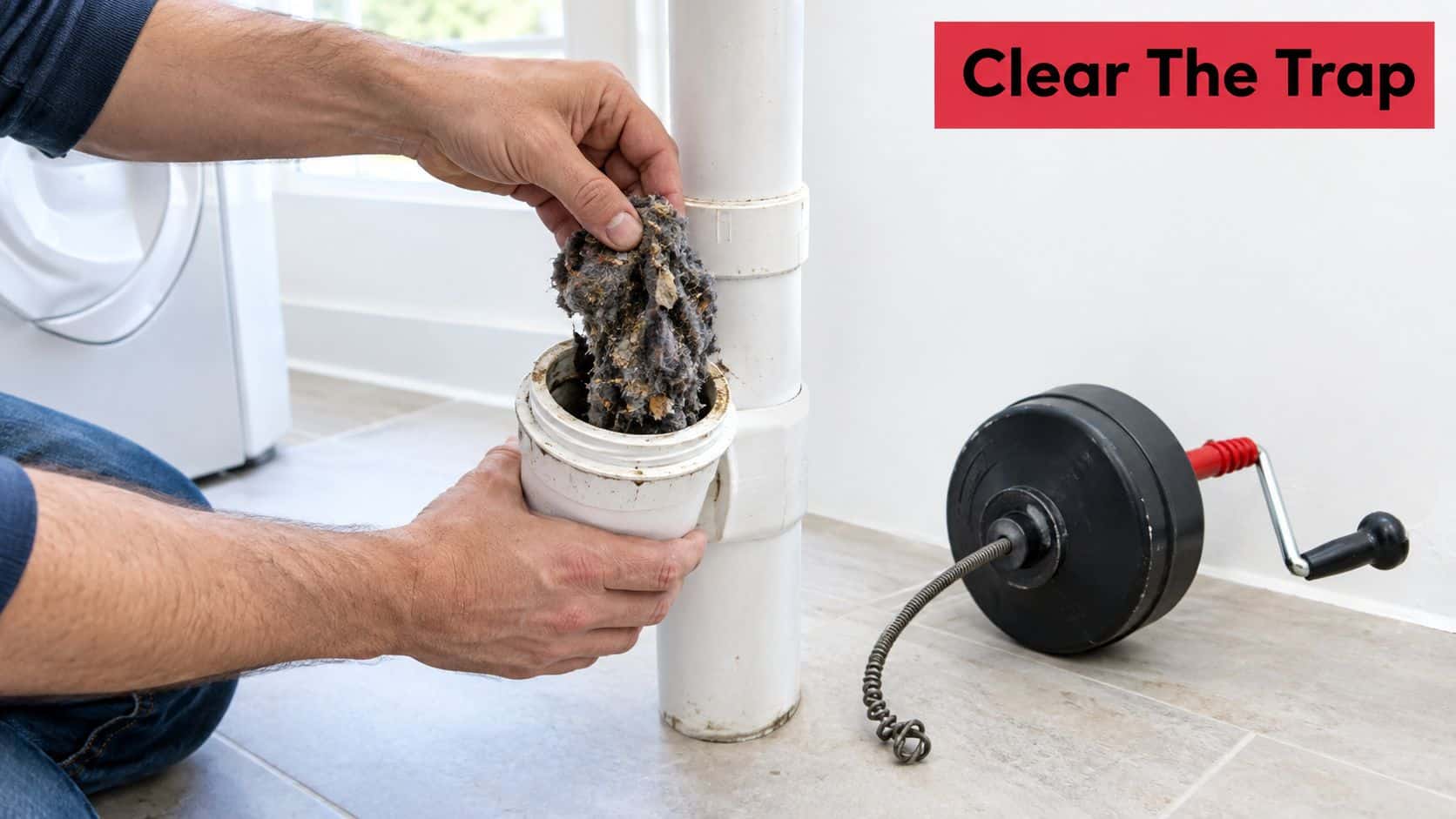
If you can reach lint or debris at the opening, remove it by hand while wearing gloves. Don't push material farther into the pipe. If the trap is accessible and you know how to remove and reseal it, place a container underneath first and be prepared for water to spill. Stop if the fittings are corroded, stuck, or inaccessible.
For a localized blockage, a properly sized hand or small drum auger may help. Feed the cable gently through the standpipe, keeping your hands clear of the opening and turning the handle as directed by the tool manufacturer. Don't force the cable around resistance. Laundry plumbing can include tight bends or weakened joints, and an aggressive push can damage a fitting rather than clear the blockage.
After mechanical clearing, test with a controlled amount of water while watching the standpipe. Don't immediately run a full wash cycle. A small amount of hot water with dish soap can help wash away loose residue after a mechanical clearing, but it won't correct a bad vent, undersized pipe, or downstream obstruction.
Here's an overview of washer-drain clearing and setup:
Skip chemical drain openers. They may not remove lint, detergent residue, grease, or mineral scale, and leftover chemicals can expose anyone who later opens the trap or works on the line to injury. Stop DIY if water backs up through another fixture, you smell sewage, or the blockage appears to be beyond the standpipe.
When DIY Stops and a Pro Should Take Over
A first, isolated standpipe overflow doesn't automatically call for major drain work. A second or third backup, a problem affecting multiple fixtures, or evidence of sewage contamination is different. At that point, repeated snaking may only punch a narrow path through the obstruction without showing why the line keeps closing.
A cable machine can open a passage through a blockage, but a camera can help identify what the cable encountered or passed through. A camera inspection may show roots, grease, sediment, cracks, or a sagging section of pipe. That distinction matters in older Las Vegas homes, where hard-water scale and aging pipe can contribute to recurring restrictions.
Hydro jetting can remove buildup from a drain line, but it isn't a safe default for every pipe. Technical guidance describes residential jetting pressures commonly in the 1,500–2,500 psi range, while stressing that pressure must suit the pipe's material, condition, diameter, and access point. (Drain-cleaning method guidance) A sealed blockage or weakened joints make blind high-pressure cleaning a gamble. Inspect first when the line is recurrent or its condition is uncertain.
A washer replacement is rarely the right first response to a recurring drain backup. Confirm the hose setup, pipe size, venting, and downstream condition before treating the appliance as the culprit.
MG Plumbing Services LLC provides residential clogged-drain cleaning in Las Vegas, including drain diagnosis and clearing. A plumber can select a cable, camera inspection, or other method based on where the symptoms point, rather than assuming every washer overflow needs the same tool.
What to Expect From a Professional Drain Service Call
A useful service call begins with questions, not a machine pushed into the nearest opening. The technician should ask when the backup occurs, which fixtures react, whether the water smells or looks contaminated, and what work has already been tried. Those details help determine whether to start at the laundry standpipe, a cleanout, or a shared drain.
The equipment depends on the suspected location and pipe condition. A properly sized cable machine can clear many obstructions. A sewer camera helps locate a recurring restriction or reveal defects that a cable alone won't identify. Hydro jetting may be appropriate for buildup such as grease, scale, or roots, but only when the pipe's condition and access make it a suitable choice.
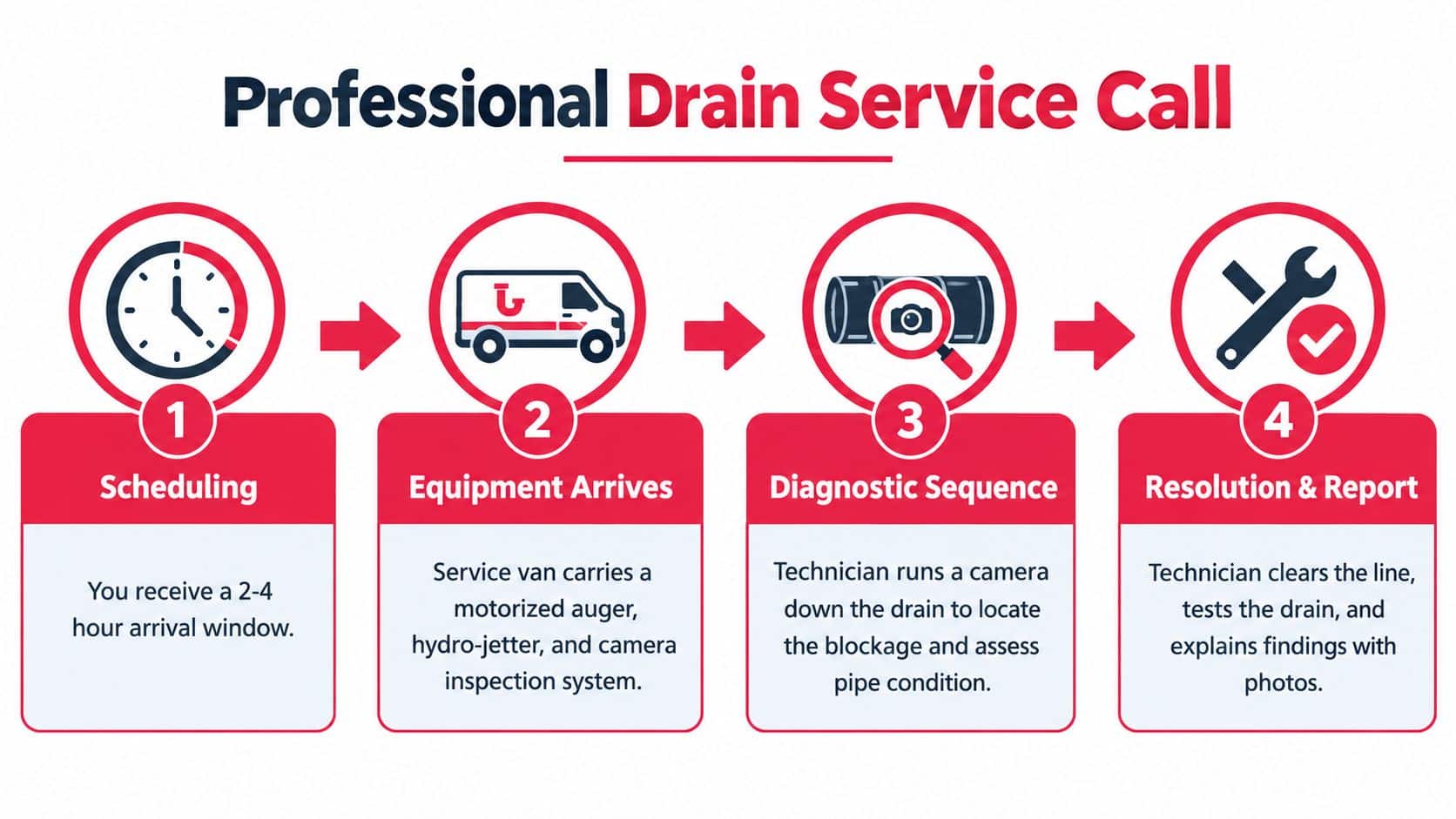
Ask the technician to explain what the proposed method should accomplish and how they'll verify flow afterward. A basic cable clearing and a jetting service aren't interchangeable: one may restore a passage through a localized clog, while the other may clean deposits along a suitable line. A camera inspection can help establish whether the recurring problem comes from buildup, a pipe defect, or a sag.
MG Plumbing Services offers residential hydro jetting when inspection and pipe condition support that approach. (Hydro-jetting service details) In a Las Vegas home with mineral buildup or older cast-iron piping, a one-time clearing may restore flow without addressing the reason the line narrowed. A camera can help make the next recommendation more specific.
Before agreeing to work, ask what access point the plumber will use, whether the estimate includes camera inspection, and what the technician will document. Compare written estimates by the work included, equipment used, and how the result will be tested, not just by the service name. Afterward, request the findings and any available camera images or video, along with an explanation of whether the restriction was cleared or a repair is still needed.
Preventative Maintenance and a Las Vegas-Specific Rhythm
Treat the washer drain as part of the home's plumbing system, not just an appliance connection. Check the standpipe opening and hose for lint, residue, kinks, or a loose fit as part of ordinary laundry-room upkeep. Use the detergent amount recommended for the washer, and keep any accessible washer filter clean.
Hard water makes mineral deposits a reasonable item to watch in the Las Vegas Valley, but it doesn't tell you where a blockage is or what caused it. If backups recur, don't rely on flushing or repeated DIY cabling as a substitute for identifying the restriction. A camera inspection is more informative when the symptoms suggest a shared drain or sewer-lateral issue.
For a recurring incident, keep a simple record:
- Date and cycle: Note when the backup happened and which part of the cycle was running.
- Affected fixtures: Record whether only the standpipe reacted or whether a sink, tub, toilet, or floor drain changed too.
- Water appearance and odor: Describe whether it looked like washer discharge or appeared dark or sewage-contaminated.
- Photos and observations: Photograph the standpipe and floor, and note how quickly the water rose and whether other drains gurgled.
That record can help a plumber, landlord, property manager, or insurance representative understand the pattern. It also keeps the next decision grounded in what the drain did, rather than guesswork about the washer.
MG Plumbing Services LLC provides residential drain cleaning, sewer-camera inspections, hydro jetting, and sewer and drain diagnosis for homes across Las Vegas, Henderson, North Las Vegas, Summerlin, and nearby communities. If your washer drain keeps backing up or other fixtures react during pump-out, call 702-480-8070 or visit MG Plumbing Services LLC to request service. Se habla español.