A typical water heater lasts about 10 to 15 years, and a standard replacement in Las Vegas commonly falls around $800 to $2,500 or more. Hard water, equipment choices, installation conditions, and permit requirements can shift both the timing and the final price.
The warning often arrives at the worst possible moment. You turn on the shower before work and get lukewarm water, find a puddle beneath the tank, or hear a deep rumble from the utility room while the rest of the house is still quiet. In the Las Vegas Valley, that failure may be predictable long before the cold shower.
A replacement isn't just a matter of choosing a tank from a store shelf. Southern Nevada's mineral-rich water, seismic installation requirements, separate local jurisdictions, fuel options, and household demand all affect what works. The right decision restores hot water, protects the home, and avoids paying for an installation that doesn't fit the property.
Table of Contents
- Why Timing Matters for Las Vegas Homeowners
- Identifying the Need for a New Unit
- Choosing Between Tank and Tankless Systems
- Local Codes and Permit Requirements
- Getting an Accurate Replacement Estimate
- Maintaining Your New Water Heater
Why Timing Matters for Las Vegas Homeowners
A heater can fail between the first and second shower. You may notice slower recovery, lukewarm water, or a wet patch near the tank that keeps spreading. In Las Vegas, those warnings deserve attention before a small fault becomes a weekend emergency.
Conventional storage heaters generally operate within an approximately 10-to-15-year range, while tankless units can last about 20 years under suitable conditions, according to federal energy guidance summarized for residential water heaters. These are planning ranges, not expiration dates. Hard water, maintenance, installation quality, and operating conditions can shorten or extend service life.
Age is a planning signal
The 10-year mark is a sensible time to inspect the unit closely and begin budgeting. Federal rulemaking material estimates the average storage-heater lifetime at approximately 15 years, while AHRI uses an estimated range of 10 to 13 years. A separate Department of Energy emergency-replacement document places typical life around 12 to 14 years. Review that underlying material in the Department of Energy emergency-replacement guidance.
Waiting creates practical problems. An emergency replacement may limit you to whatever model is available, leave little time to compare fuel types, and expose piping, venting, access, or seismic-strap issues only after the work begins. Permit requirements can also differ between jurisdictions in the Las Vegas Valley, so an installation that looks simple may still require local coordination. Landlords and property managers face added disruption when a loss of hot water affects occupancy.
Know the difference between age and failure
Rumbling, reduced hot-water volume, slow recovery, temperature swings, rusty hot water, or moisture around the base all warrant diagnosis. Controls, valves, thermostats, and heating elements may be replaceable. Water escaping from the tank body usually indicates tank failure, making replacement the practical choice.
Practical rule: Do not wait for a leak before comparing options. A working but aging unit gives you time to check capacity, fuel, access, permits, seismic requirements, and installation quality.
A sudden outage may justify same-day plumbing service in Las Vegas when availability permits. Planned work allows a closer review of the manufacture date, shutoffs, fittings, venting, and heating-cycle sounds. It also gives the installer time to assess whether a heat-pump system fits the property. Desert heat can support efficient operation, but equipment location, airflow, noise, condensate drainage, and available electrical service still matter.
Water heating represents roughly 18% of typical home energy consumption and commonly costs about $400 to $600 per year, according to U.S. Department of Energy data. Replacement therefore affects operating cost as well as immediate comfort. In Southern Nevada, the right timing also leaves room to address mineral buildup and install the equipment to local requirements rather than paying more under pressure.
Identifying the Need for a New Unit
Three questions usually settle the repair-versus-replacement discussion: How old is the heater? How is it performing? What has the local water done to it? Looking at only one of these gives an incomplete answer.
Southern Nevada water is very hard. Local water-quality summaries report approximately 16 to 18 grains per gallon, equivalent to about 275 to 304 parts per million of dissolved calcium and magnesium, and describe the water as roughly two to four times harder than the national average in the Las Vegas water-hardness guide. Hardness isn't itself a safety violation, but it changes how heating equipment ages.
Age, output, and mineral buildup
Calcium carbonate scale can settle on heating surfaces and inside tanks. That layer interferes with heat transfer, reduces usable capacity, and makes components work harder. The result may appear as a tank that still produces hot water but takes longer to recover or provides less usable volume during busy periods.
A field assessment should distinguish these symptoms:
- Rumbling or popping: Sediment may be collecting at the bottom of a storage tank and disturbing the heating cycle.
- Temperature instability: A thermostat, heating element, burner, dip tube, or heavy scale buildup may be involved.
- Reduced capacity: The tank's nameplate size may not have changed, but sediment and poor recovery can reduce the hot water available to the household.
- Water at the base: A loose connection or relief-valve issue may be repairable. A leak from the tank itself generally calls for replacement.
- Rust-colored hot water: Corrosion inside the tank or a depleted anode rod needs prompt evaluation.
A water leak isn't something to monitor casually. If you see moisture, use professional water leak detection in Las Vegas to identify whether the source is the tank, a connection, a relief valve, or concealed piping.
Match the replacement to demand
Household behavior matters as much as household size. Several showers close together, simultaneous laundry and bathing, or a large soaking tub can expose an undersized unit even when the existing heater isn't defective. Compare peak demand and first-hour recovery with the proposed replacement rather than choosing only by tank volume.
The same diagnosis applies to tankless systems. A unit must deliver the required flow at the needed temperature rise, and multiple fixtures may compete for output. A professional should examine fuel availability, electrical service, venting, water pressure, installation clearances, and the route from the heater to remote fixtures before recommending a model.
For an older tank with recurring performance loss, internal corrosion, or a repair that won't address the underlying condition, replacement usually makes more sense than repeated component work. For a younger heater with a clearly isolated control or valve failure, repair may be the better choice.
Choosing Between Tank and Tankless Systems
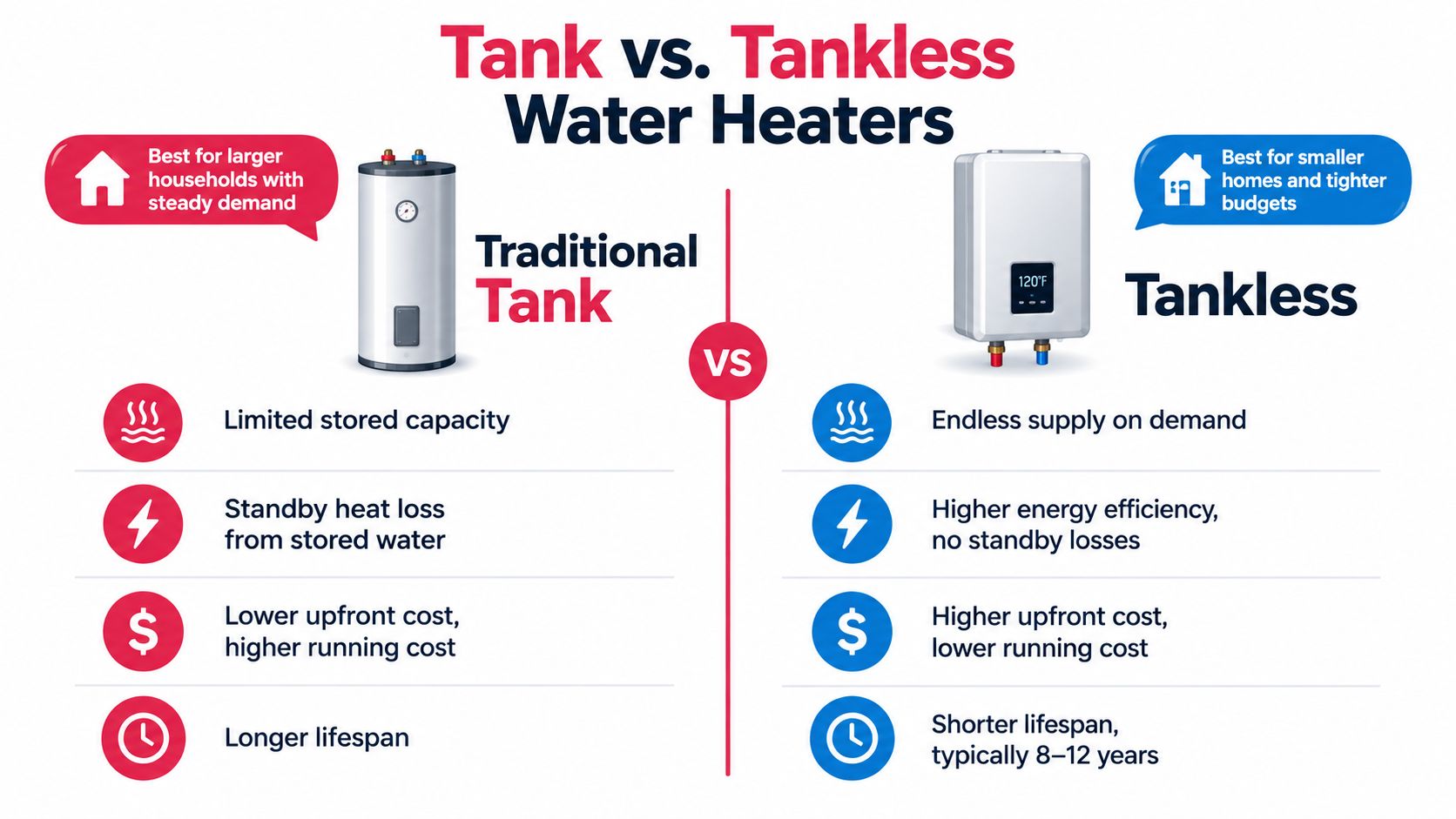
A conventional tank is often the most predictable replacement in a Las Vegas home. It uses familiar connections, offers stored capacity, and tends to work well when the existing gas or electrical setup is suitable. The downside is standby heat loss, floor-space requirements, and exposure to the same hard-water conditions that affected the previous unit.
Tankless equipment changes the operating pattern. It heats water as it flows, so it doesn't store a large volume between uses. That can provide a strong fit for households with sustained demand or limited floor space, but the installation may require electrical, gas, venting, piping, or water-treatment changes. The equipment choice should follow the home's conditions, not a generic promise of “endless hot water.”
Compare the real trade-offs
| System | Where it fits | Main compromises |
|---|---|---|
| Conventional gas tank | Homes with existing gas service, familiar layouts, and predictable demand | Stored-water standby loss, tank footprint, sediment exposure |
| Standard electric tank | Properties without gas where panel capacity and recovery needs are acceptable | Slower recovery in some applications and standby loss |
| Tankless | Households wanting on-demand heating and compact wall-mounted equipment | Higher installation complexity, flow limitations, and scale-sensitive maintenance |
| Heat-pump water heater | Suitable electric homes with adequate air volume, drainage, and electrical capacity | Higher planning demands, noise, condensate, and site-specific recovery behavior |
Qualifying heat-pump units have UEF ratings of about 3.3 to 4.1 and can use roughly 70% less energy than standard electric resistance heaters, with estimated savings of about $550 annually for a family of four, according to ENERGY STAR data summarized by Consumer Reports in this Nevada plumbing-code and water-heater guide. That comparison primarily applies to electric resistance equipment. It doesn't automatically make a heat pump the right replacement for a gas-tank household.
Heat pumps need a suitable room
A heat-pump water heater moves heat from surrounding air into the water. A tight closet may not provide enough air volume, and a garage or utility room may receive a noticeable cool-air discharge during operation. The installer also needs a reliable condensate-drain route, suitable clearances, acceptable operating noise, and enough electrical capacity.
A 120-volt model may be feasible in some homes, but that depends on the specific equipment and existing circuit conditions. Rental properties deserve separate consideration. Maximum efficiency may be attractive to an owner, while predictable recovery, simple servicing, and minimal tenant disruption may carry greater practical value.
Tankless units face their own desert-home questions. Hard-water scale can restrict heat exchangers and reduce performance if maintenance is neglected. Long pipe runs can also make an on-demand heater feel slow at a distant fixture, because the equipment can't eliminate the cooled water already sitting in the line.
EPA WaterSense guidance recommends keeping stored hot-water volume in piping low, using approximately 0.5 gallons or less between the heater and each fixture as a design benchmark, and sizing pipes for peak demand rather than oversizing every branch. You can consult the EPA WaterSense efficient hot-water guide for the distribution principles. A demand-initiated recirculation system can help with long runs, but it should be considered after correcting oversized or poorly routed piping. A continuously heated loop can waste energy.
Local Codes and Permit Requirements
The equipment can be perfectly functional and the installation can still be incomplete if the permit and inspection process is wrong. The City of Las Vegas requires a permit to install, move, remove, or replace a water heater, and requires a final inspection, according to the City of Las Vegas online permit information.
The first step is identifying the jurisdiction. An address may fall within the City of Las Vegas, unincorporated Clark County, Henderson, or North Las Vegas. Each location has its own building department and administrative process. A like-for-like replacement isn't automatically exempt from local requirements.
Clarify who handles the permit
For an owner-occupied primary residence in the City of Las Vegas, the homeowner may obtain the permit. For a rental property or secondary home, the city guideline requires a contractor. Owners, landlords, sellers, and escrow coordinators should retain the permit record and final inspection documentation rather than relying on an invoice alone.
Ask these questions before work begins:
- Which jurisdiction governs the address?
- Who is legally responsible for pulling the permit?
- Is a final inspection required after a direct replacement?
- Will the contractor document corrections if the installation fails inspection?
- What records should remain with the property for a future sale or tenant file?
Verify physical safety details
The City installation guideline requires two seismic straps attached to framing, one in the upper third and one in the lower third of the tank. The lower strap must remain at least 4 inches above the controls. For a gas unit, the gas shutoff must be within 6 feet of the appliance and installed ahead of the connector. The official residential water-heater installation guideline explains these requirements.
Straps need proper anchorage, not just visible metal wrapped around the tank. The Nevada residential-code benchmark calls for anchoring that can resist a horizontal force equal to one-third of the heater's operating weight, unless the manufacturer's method is more stringent. The inspection should also cover the temperature-and-pressure relief discharge, drain-pan requirements where applicable, clearances, venting, and access to controls.
Getting an Accurate Replacement Estimate
A useful estimate starts with diagnosis, not a model number. The plumber should identify the current fuel type, tank condition, installation location, venting, shutoffs, seismic anchoring, drain path, water pressure, and access for removal. If a quote lists only “replace water heater” without describing those conditions, it leaves too much room for surprises.
The common $800 to $2,500 or more range for a standard replacement is a planning spectrum, not a guaranteed price. The final figure changes with tank size, gas or electric configuration, disposal, code corrections, permit handling, access, piping alterations, venting, pan and drain work, and whether the home needs a different technology.
Read the estimate line by line
A written estimate should identify the proposed equipment and the work included. Look for:
- Equipment details: Manufacturer, model, capacity, fuel type, warranty terms, and whether the unit is tank, tankless, or heat pump.
- Installation scope: Removal, disposal, connections, valves, seismic straps, relief discharge, pan, venting, and startup.
- Administrative work: Permit responsibility, inspection coordination, and correction visits if required.
- Possible exclusions: Electrical upgrades, gas-line changes, inaccessible piping, drywall repair, slab work, or pressure-regulating-valve service.
- Payment terms: The amount due before work and what triggers any remaining balance.
A low estimate can become expensive when the contractor discovers that the old straps aren't anchored to framing, the gas shutoff is inaccessible, the relief discharge is wrong, or the existing venting doesn't suit the replacement. Those are not arbitrary add-ons. They are installation conditions that should be identified before the old heater is removed.
Use the estimate as a diagnostic document
Ask why repair is or isn't appropriate. If the tank is sound and the fault is a replaceable component, a repair may restore service. If the tank leaks, corrosion is extensive, or repeated repairs have reduced reliability, replacement is the more defensible recommendation.
MG Plumbing Services LLC is a local, family-owned and owner-operated residential plumbing company serving Las Vegas, Henderson, North Las Vegas, Summerlin, and nearby communities. Its services include water-heater repair and replacement, leak detection, water treatment, drain work, sewer camera inspections, hydro jetting, and general residential plumbing. Owner Miguel Garcia is a Nevada-licensed C-1d plumbing contractor and journeyman plumber with more than 25 years of plumbing experience, and the company provides written pricing through its cost estimate request page.
Maintaining Your New Water Heater
A new heater still needs a maintenance plan, particularly in a valley where SNWA reports hardness of approximately 280 parts per million, or 16 grains per gallon, caused primarily by calcium and magnesium from the Colorado River. The Southern Nevada Water Authority water-quality facts also explain that white particles may be dislodged mineral deposits or scale from plumbing and fixtures.
Follow a practical schedule
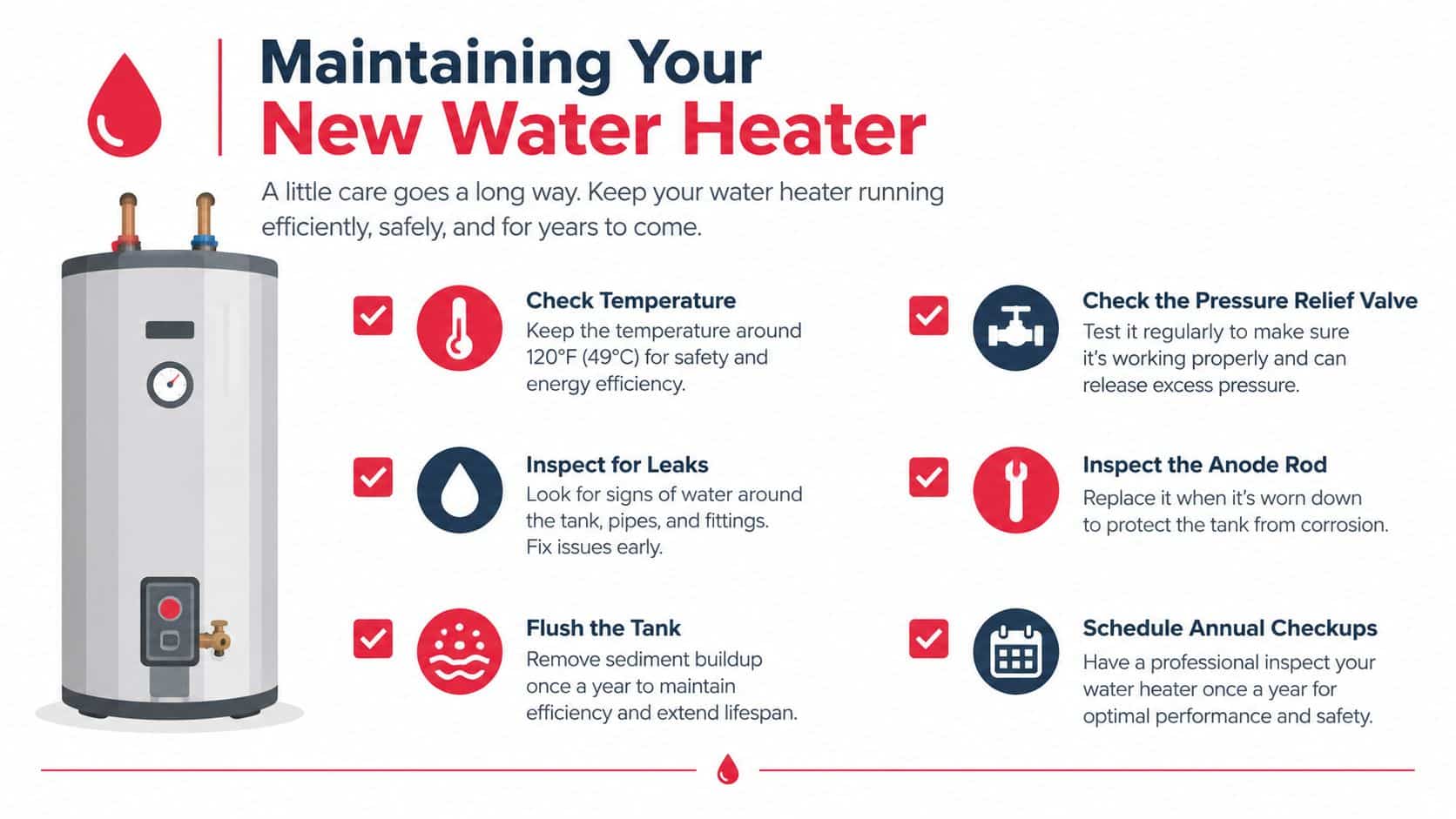
Each month, look at the tank base, fittings, shutoff, relief-valve discharge, and nearby floor. A small change in moisture is easier to address before it reaches drywall, cabinets, or flooring.
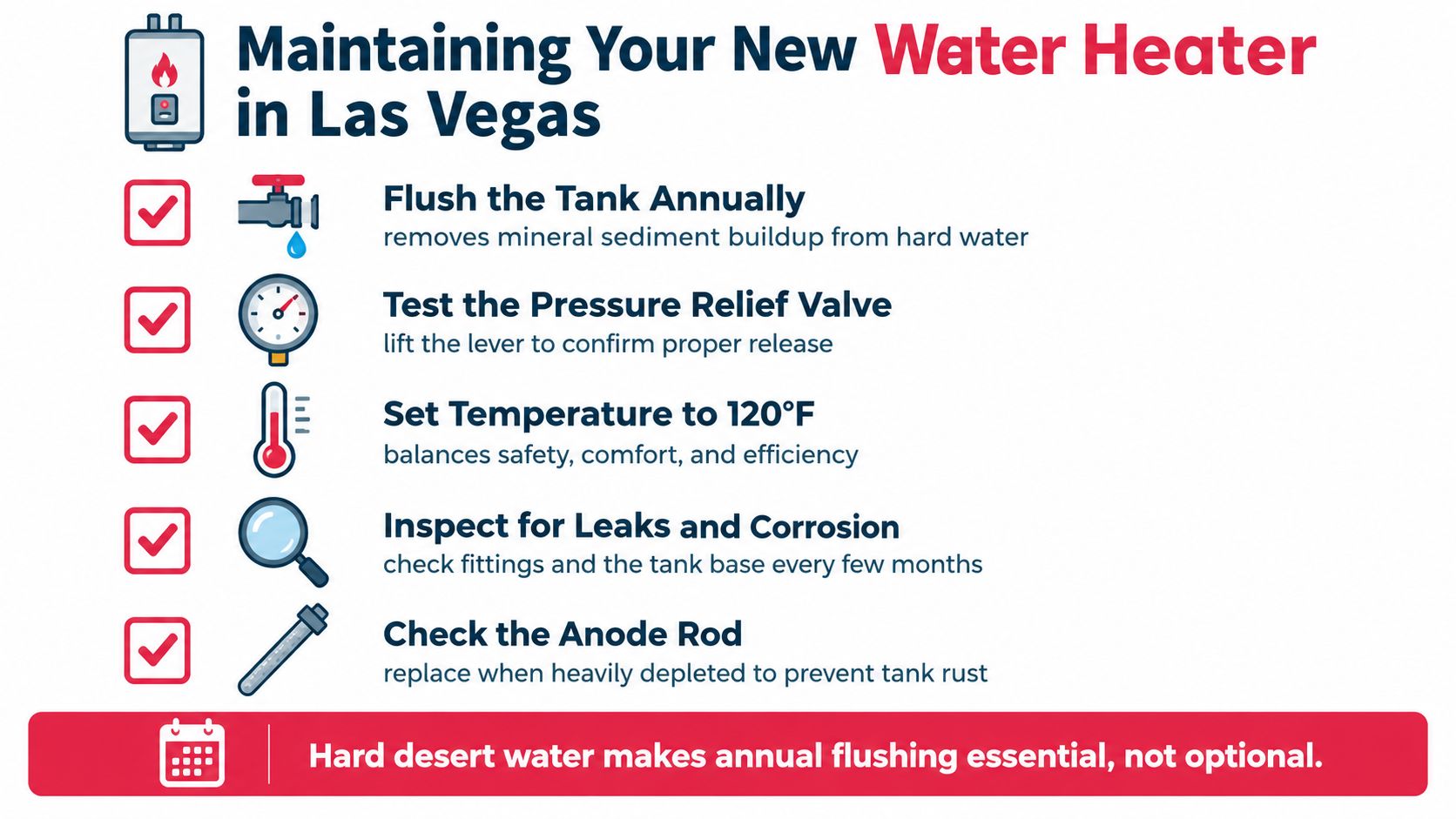
Once each year, flush a storage water heater to reduce sediment buildup. EPA WaterSense recommends annual flushing because sediment can reduce efficiency, and the EPA home-maintenance guidance also recommends checking fixtures for scale and cleaning deposits with an appropriate product or white vinegar. Annual flushing doesn't prove that a tank will last longer, and it won't repair a corroded tank, but it addresses a preventable source of performance loss.
During periodic service, have the anode rod assessed, especially if the heater is in a hard-water area. The rod protects the tank by corroding before the tank does. A depleted rod may be replaceable, while corrosion that has reached the tank body generally isn't.
Test the temperature-and-pressure relief valve only when you understand the discharge path and the valve's condition. If it drips afterward or fails to operate correctly, don't cap or obstruct it. Have the valve and discharge piping inspected.
Check pressure before blaming the heater
Water pressure can make a heater seem defective when the problem is upstream or throughout the home's plumbing. EPA recommends incoming residential service pressure between 45 and 60 pounds per square inch, and explains that most U.S. plumbing codes require a pressure-regulating valve when supplied pressure exceeds 80 psi because excessive pressure can damage piping, fixtures, and appliances and increase leak risk. The EPA service-water-pressure technical sheet describes testing with a gauge attached to a hose bibb after water-using fixtures are shut off.
If pressure is inconsistent, test it at different times and inspect the pressure-regulating valve. Don't compensate for poor distribution by installing a larger heater. Long, oversized hot-water runs can increase wait time and waste water before hot water arrives, while poorly controlled recirculation can add heat loss.
MG Plumbing Services LLC provides residential water-heater replacement, leak detection, water-pressure service, water treatment, drain cleaning, sewer diagnostics, and general plumbing repairs across the Las Vegas Valley. Call 702-480-8070 for service during business hours, or visit MG Plumbing Services LLC to request an evaluation and written recommendation. Se habla español.