The shower turns lukewarm before you're finished, and the water heater makes a low rumbling sound when it starts heating again. You haven't changed your routine, so you're wondering whether the tank needs flushing or whether it's about to fail.
Water heater sediment buildup can cause those symptoms, but flushing isn't always the answer. Loose mineral debris may wash out through the drain valve. Hardened scale, a failing heating component, or a deteriorated tank needs a different diagnosis, and opening a neglected heater can create a leak you didn't have before.
Table of Contents
- Warning Signs of Sediment Buildup and What They Mean
- How Hard Water Turns Into Tank Sediment
- What Buildup Costs in Energy, Recovery and Tank Life
- Who Should Flush Their Water Heater and How Often
- How to Flush a Water Heater Tank Safely
- When Flushing Will Not Fix the Problem
Warning Signs of Sediment Buildup and What They Mean
| Symptom | Likely cause | Next step |
|---|---|---|
| Popping or rumbling while heating | Water boiling beneath sediment on the inside tank bottom | Flush the tank if it's safe, then inspect if the noise continues |
| Hot water runs out sooner than usual | Less usable volume and heat transfer lost to deposits | Check recovery time, then flush if loose sediment is suspected |
| Slow recovery after showers or laundry | Scale on heating surfaces slowing heat transfer | Inspect the element or burner and the tank |
| Gritty or cloudy water at taps or drain | Loose sediment in the tank, although cloudiness can also be air | Flush until discharge is clear, then investigate persistent cloudiness |
| Higher energy bills with the same use | Possible efficiency loss from insulating deposits | Inspect and flush where appropriate, then plan a service visit |
| Symptoms return after a full flush | Bonded scale, blocked drain valve, tank damage, or another mechanical fault | Stop repeating the flush and have a plumber evaluate |
Sediment is mineral residue and other debris that settles inside the tank, while scale is the harder mineral coating that bonds to heating surfaces. Most homeowners notice changes in sound, temperature, or water appearance before they see an actual deposit.
Match the symptom before choosing the repair
Rumbling usually comes from water heating beneath deposits resting inside the tank, above the bottom, not sediment underneath the appliance. Grit discharged through the drain valve is a stronger sign of loose material that flushing may remove.
Don't diagnose the heater from noise alone. A failed electric element can reduce available hot water, and a mixing-valve problem can produce lukewarm water even when the tank is heating properly.
Check whether the problem affects every hot-water fixture or only one shower. Also note whether cloudy water clears after standing in a glass, which can indicate entrained air rather than mineral grit.
Practical rule: Symptoms that persist or return after a complete flush call for inspection, not repeated draining.
Record what changed, when it happens, and whether the heater has a maintenance history. That gives the plumber something more useful than “the hot water isn't working right.”
How Hard Water Turns Into Tank Sediment
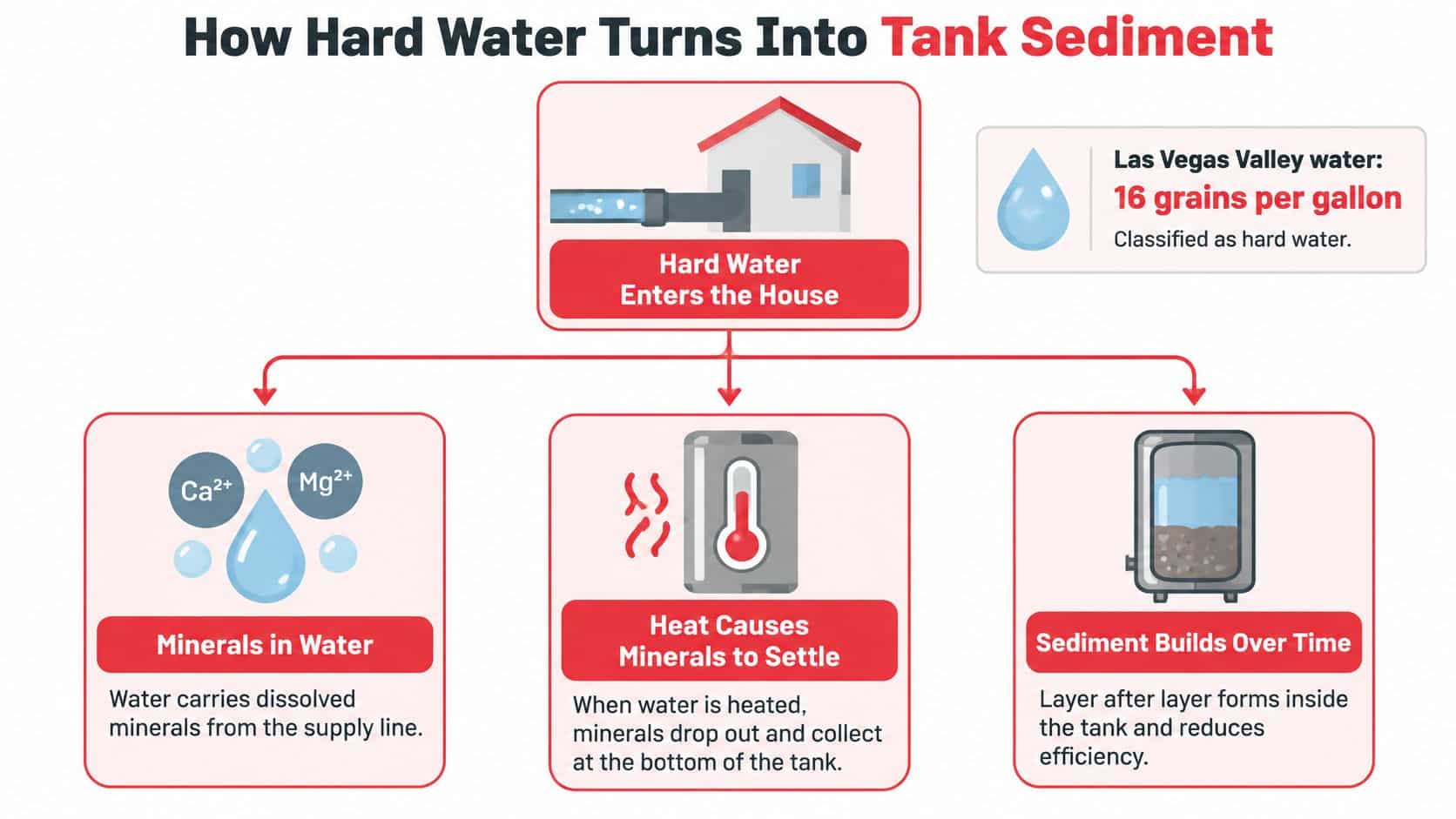
Water enters the house carrying dissolved minerals. In the Las Vegas Valley, water runs roughly 16 grains per gallon, which the Las Vegas Valley Water District classifies as hard, and mineral scale can plate onto pipe walls over time.
Heating changes how those minerals behave. Calcium-bearing deposits can come out of solution, collect as loose crystals, and gradually form a harder coating on hot surfaces.
The diagram shows how incoming minerals become deposits inside a storage heater.
Loose sediment and bonded scale behave differently
Think of the white crust inside a kettle. A loose flake can rinse away, but the coating attached to the heated surface needs a different cleaning method.
A water heater develops a similar barrier between the heat source and the water. The federal technical publication available through GovInfo distinguishes loose deposits from adherent scale and explains how larger deposits and thicker insulating layers can reduce recovery performance.
Location matters as much as appearance. A handful of grit at the drain opening doesn't reveal how much scale remains attached elsewhere inside the heater.
The heating surface determines the problem
- Electric storage tanks: Elements extend into the water. Scale can coat those elements, so removing bottom sediment doesn't necessarily clean the component doing the heating.
- Gas storage tanks: Sediment settles over the heated tank bottom above the burner. That surface can be difficult to clean thoroughly through a small drain opening.
- Tankless heaters: Water moves through a heat exchanger instead of sitting in a storage tank. Scale control involves the exchanger and an appropriate descaling procedure, not just draining a tank.
These differences explain why the same maintenance recommendation won't fit every heater. A tank flush moves loose material with flowing water; it isn't a universal method for stripping attached mineral deposits.
Buildup is a heat-transfer problem first and a cosmetic problem second. Clear-looking tap water doesn't prove that the heating surfaces are clean, and visible grit doesn't establish that the tank needs replacement.
What Buildup Costs in Energy, Recovery and Tank Life
A heater can still deliver hot water while scale makes it use more energy or take longer to recover between uses. The size of the effect depends on the heater and the buildup.
Reported effects of scale and sediment on water heaters
| Scale or sediment condition | Reported effect | Source context |
|---|---|---|
| About 1/16 inch of scale | About 11% more energy use | Engineering benchmark discussed in Plumbing & Mechanical's technical coverage of hard-water scale, not a universal prediction |
| About 1/4 inch of scale | Up to 40% lower efficiency | Study-specific estimate reported in the same technical coverage |
| Untreated hard water | Nearly 26% more energy than comparable units without significant scale | Water Quality Association study cited in the same technical coverage |
These figures come from different tests and conditions. They are not interchangeable estimates of a household's utility bill, and the percentages should not be added together.
Why your heater won't match every benchmark
Heater type, fuel, thermostat setting, water chemistry, deposit location, and household use all affect performance. For example, a family with an electric storage heater might keep the same shower and laundry routine but notice the heater takes longer to recover between uses. That change merits an inspection, not an assumption that sediment is the only cause. Utility rates, incoming water temperature, leaks, and changes in usage can also affect the bill.
Compare recovery under similar household conditions. A slower return to usable hot water may be more informative than an isolated utility bill.
Plan maintenance before replacement becomes urgent
Buildup does not guarantee early failure, but it can contribute to overheating and component wear. Keep the heater's model information and maintenance records together, along with a brief record of recovery problems. If a repair or replacement is being considered, ask for a written diagnosis and review plumbing cost estimates rather than treating an efficiency benchmark as a promise of savings.
Focus on what is preventing the heater from delivering hot water normally, and whether that condition can be corrected.
Who Should Flush Their Water Heater and How Often
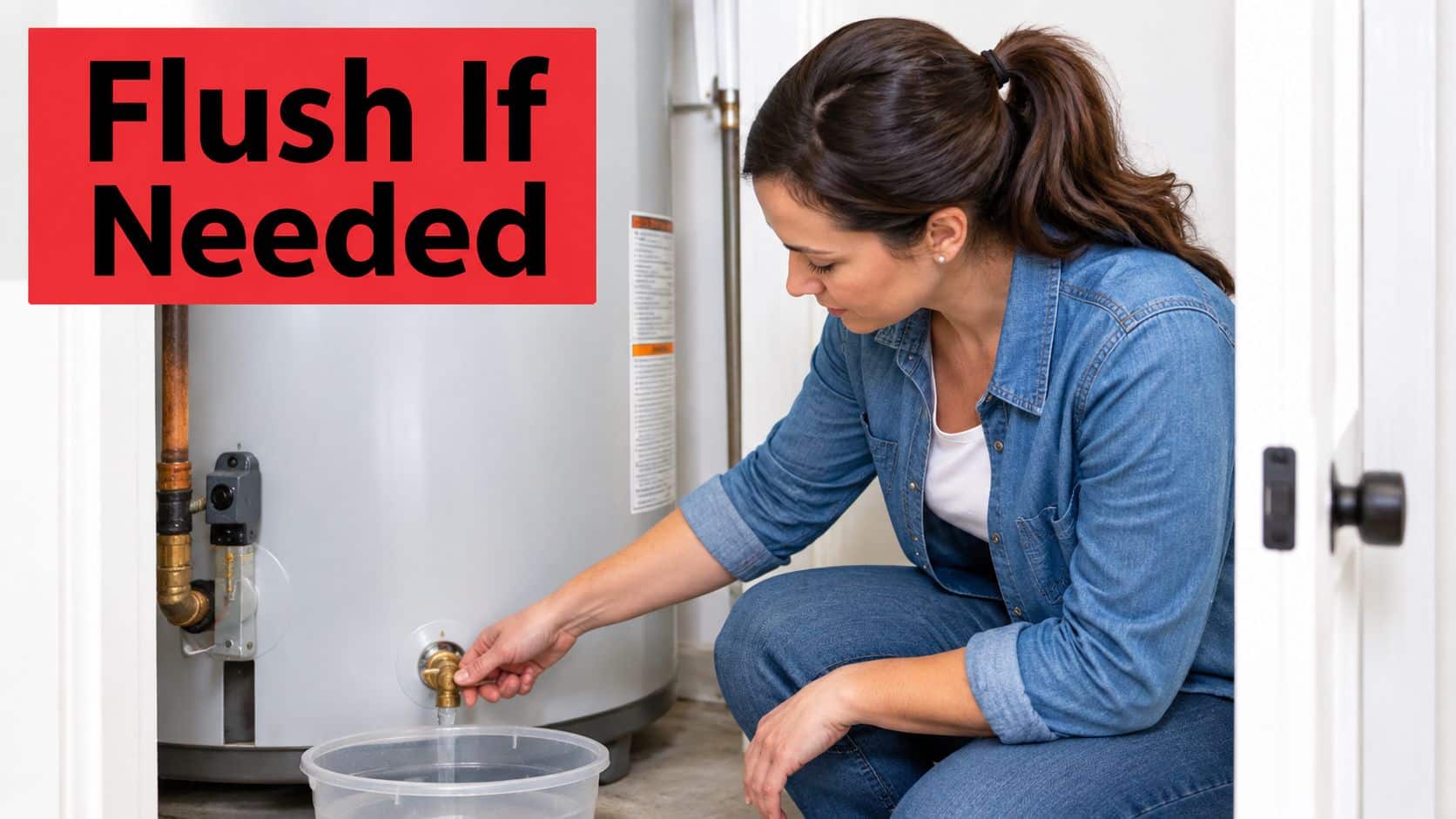
A working drain valve, a tank in sound condition, and a safe place to send the water make a routine flush more suitable for a capable homeowner. A neglected or corroded tank, a stuck valve, or health concerns in the household are reasons to arrange qualified help instead.
The California Energy Commission's water-heating guidance reports that manufacturers commonly recommend draining storage tanks every six months to once a year. In Las Vegas, hard water can make regular maintenance useful, but follow the heater manual and adjust the schedule based on what comes out and how the unit performs.
A bucket under the drain valve is not enough. The tank holds hot water, and a restricted or deteriorated valve can make draining unsafe or difficult.
Screen for health risks before opening the drain
The New Jersey Department of Health's water-heater guidance cautions that draining can expose people to aerosolized water droplets and recommends that a licensed or qualified professional handle the work. Older adults and people with weakened immune systems should not do the draining themselves. Keep children and other vulnerable occupants away from the work and discharge area.
A flush removes loose material; it is not a disinfection program. Clear drain water does not establish that a building's hot-water hygiene needs have been met.
Temperature settings also involve trade-offs. University of Maryland Extension guidance identifies 120°F as sufficient for most households and says that setting can reduce water-heating energy use by 6% to 10% while slowing mineral buildup. Household vulnerability and building hygiene procedures still matter, so have temperature and mixing controls checked rather than changing the setting to address noise or suspected bacteria.
Use the video as a visual supplement, not a substitute for the appliance manual or a health-risk assessment.
Keep a property-specific maintenance record
For rental and HOA-managed properties, arrange qualified service and record the work:
- Inspection and flush dates: Note what came out and whether performance improved.
- Valve condition: Record restrictions, seepage, and any replacement.
- Temperature verification: Note the setting and measured delivery temperature.
- Occupant-risk screening: Plan the work to limit exposure without collecting unnecessary medical details.
- Professional identification: Keep the contractor's information with the appliance records.
MG Plumbing Services LLC is a licensed, owner-operated residential plumbing company serving Las Vegas, Henderson, North Las Vegas, Summerlin, and nearby communities. Founded in 2015 and led by Miguel Garcia, a plumber in the trade since 2000, the company offers tank and tankless water heater repair and replacement, along with residential plumbing services including drain cleaning, leak detection, and water and sewer line repair or replacement.
How to Flush a Water Heater Tank Safely
Tank water can scald, and initial drain water may be very hot. Turn off heating and allow the water to cool before draining; wear eye protection, gloves suitable for the task, and closed shoes, and keep occupants away from the discharge route.
The EPA's home-maintenance guidance recommends annual flushing, turning off the heater's power supply, and directing a garden hose to a location capable of handling very hot water. Your appliance manual controls the exact shutdown and restart procedure.
Prepare the work area first
Identify the cold-water shutoff, energy disconnect, drain valve, and safe drain destination before touching anything. A bucket can overflow quickly, so it isn't a substitute for a controlled discharge route.
Don't proceed if the heater is leaking from its shell, the valve is badly corroded, or you can't positively shut off its energy source. If you smell gas, leave the area and contact the gas utility rather than attempting maintenance.
The sequence below applies to a conventional storage tank, not a tankless descaling procedure.
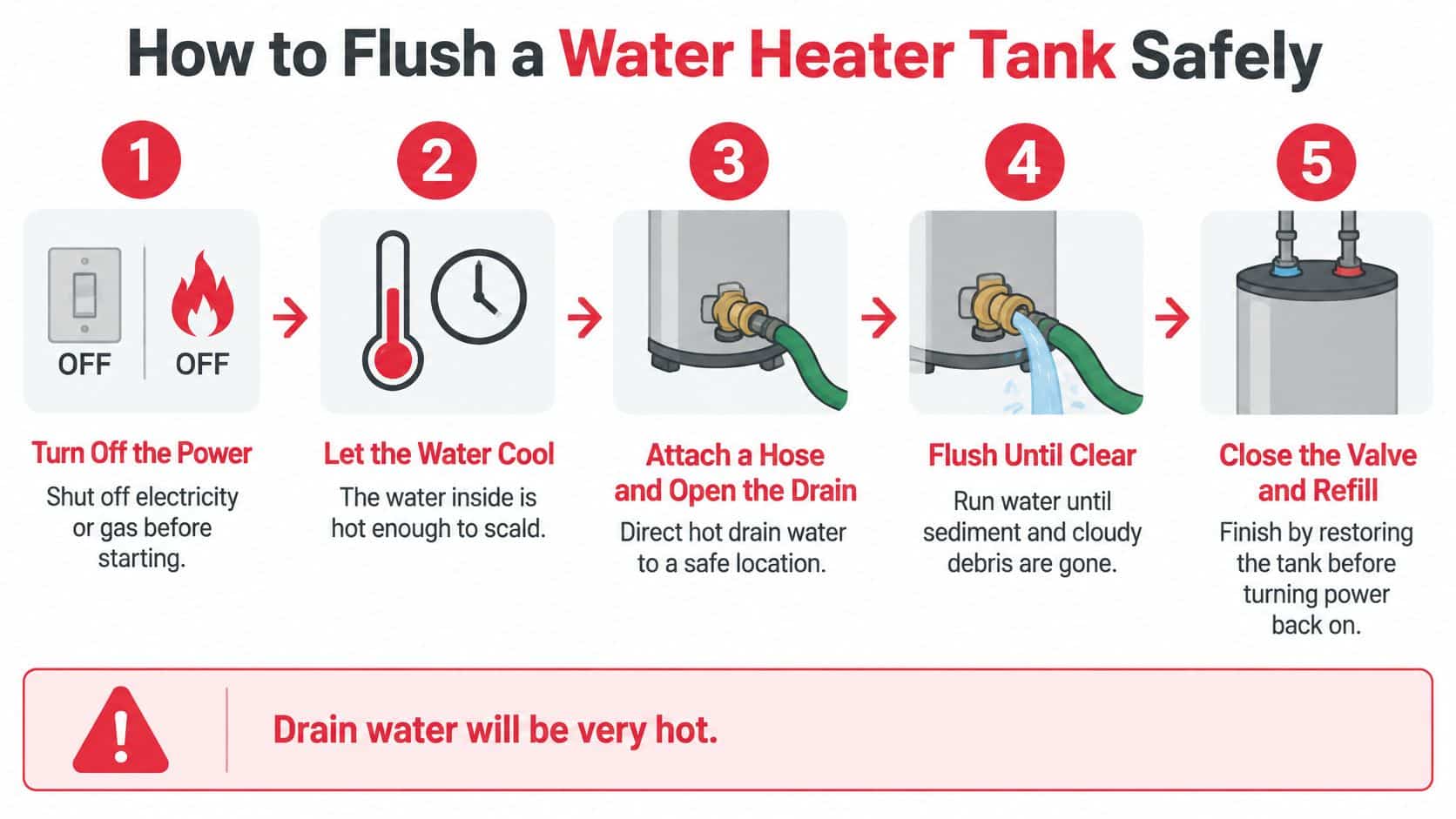
Drain, rinse, and refill in order
Turn off the heat source and let the water cool. For an electric heater, shut off the dedicated breaker. For gas, use the manufacturer's prescribed pilot or off setting and shutdown procedure; an empty or partly empty tank must never heat.
Close the cold-water inlet, then open a hot tap. Use a nearby hot-water faucet to relieve pressure and admit air as the tank drains. Don't use the temperature-and-pressure relief valve as a routine vent unless the manufacturer specifically directs it.
Secure a garden hose to the bottom drain valve. Route it to a suitable floor drain or an outdoor destination that can safely accept the discharge. Keep the hose end secure, avoid trip hazards, and don't send water onto people, plants, walkways, or surfaces vulnerable to heat damage.
Open the drain valve slowly. Watch the hose connection and discharge, keeping clear of splashes. Let the tank drain and observe whether grit comes out; if flow stops unexpectedly, don't probe the valve with a screwdriver or force a blockage through under pressure.
Rinse loose deposits from the bottom. With the drain open and hose secured, briefly open the cold inlet to agitate remaining debris, then close it and allow the water to drain again. Continue only while the valve and discharge remain controlled, aiming for clear water without visible grit.
Close the drain and refill completely. Remove the hose once discharge has stopped safely, reopen the cold inlet, and leave the hot tap open until water flows steadily without sputtering. Check the drain valve and surrounding connections for leakage.
Restore heating only after confirming the tank is full. Close the hot tap, follow the manufacturer's restart instructions, and return the thermostat to its appropriate setting. Energizing an exposed electric element can damage it.
Never restore power because the tank merely sounds full. Confirm steady water flow from the open hot tap first.
A successful flush leaves clear discharge without grit, a dry drain valve, and normal hot-water recovery after the heater has reheated. Recheck the valve after the appliance returns to operating temperature.
Stop if the drain valve is stuck, won't reseal, or leaks. Don't use extra wrench force on a fragile valve or leave a hose attached as a permanent workaround; shut the heater down and call a plumber.
When Flushing Will Not Fix the Problem
A heater can still rumble or recover slowly after a flush, even when the water runs clear. Flushing removes loose sediment from the tank bottom; it cannot repair a damaged tank, replace a failed component, or guarantee that bonded scale has come away.
Separate cleaning from repair
Loose sediment is the material most likely to drain out. Scale bonded to heating surfaces may remain, and a clean-looking discharge does not confirm that those surfaces are clear.
A restricted or failing drain valve can prevent an effective flush or start leaking when operated. A deteriorated tank may also show seepage during maintenance. Draining it will not restore the tank's structural integrity.
A neglected heater deserves extra caution. Compacted deposits may not move, and an old valve may fail to close after it has been opened. If the valve is stuck or leaking, stop rather than forcing it.
Tankless heaters need a different service procedure. Their heat exchangers may require manufacturer-approved descaling and water treatment suited to the incoming supply, rather than the storage-tank flushing method.
Diagnosis should come before a replacement decision
Professional diagnosis can distinguish loose sediment from bonded scale, a failing component, or a deteriorated tank. Depending on the symptoms, a plumber may use equipment such as a camera, drain-cleaning tools, hydro jetting, or leak-detection equipment to investigate the cause.
In a documented MG Plumbing Services job, Miguel arrived prepared to replace a water heater after another plumber recommended replacement. Inspection showed that only the internal rod needed replacing. He drained the tank, replaced the rod, and left the area clean.
That result does not mean every struggling heater can be repaired. The tank and its components need to be assessed before deciding between repair and replacement.
Arrange an evaluation rather than repeating a flush if you notice:
- Returning symptoms: Noise or poor performance continues after a complete flush.
- Drain-valve trouble: The valve will not open, will not drain, or leaks.
- Advanced equipment age: The heater has passed its expected service period for its model and condition.
- Increasing gas-heater noise: Rumbling grows louder or more frequent.
- Declining output: Hot-water supply keeps falling despite maintenance.
For diagnosis and repair options, see residential water heater repair in Las Vegas. Before an appointment, shut off the main water supply and the heater, and clear the area around it if you can do so safely.
If a sewer backup is also occurring, stop using drains and toilets. Call 702-480-8070 or use the MG Plumbing Services request page to arrange assistance.
MG Plumbing Services LLC offers residential water heater diagnosis, repair, and replacement. If your heater is rumbling, recovering slowly, or still struggling after a flush, contact the company for an assessment and recommendations. Se habla español.