
Two showers, a load of laundry and the dishwasher, all inside the same hour, and the fourth person into the bathroom gets a lukewarm dribble. Nothing has failed. The tank on the wall is too small for the way your household draws hot water, and the number on its label, usually 40 or 50 gallons, has never told anyone whether it was the right unit.
Tank gallons describe how much the heater holds. They say nothing about how fast it refills, and the refill rate is what decides whether the last shower stays hot. So what size water heater do I need? The honest answer starts with the gallons your home uses during its busiest hour, then compares that figure to the gallons the unit can deliver in the same window.
Get that number and the rest becomes a shopping exercise. Match the rating, then check whether the house can physically support the unit you picked. Both steps matter more in Southern Nevada than most sizing guides admit.
Table of Contents
- Start With a Household Size Chart
- Why First-Hour Rating Matters More Than Tank Size
- How to Calculate Your Busiest-Hour Demand
- When Short, Clustered Peaks Change the Answer
- Sizing a Tankless Unit by Flow Rate
- Las Vegas Site Checks Before You Buy
- Confirm Your Size With a Licensed Plumber Before You Buy
Start With a Household Size Chart
Use this chart to narrow the options, not to choose a heater by bedroom count alone. Treat its figures as a first screen; the home's actual peak demand and the unit's First-Hour Rating determine whether the size will work.
| Home layout | Minimum tank volume | Minimum FHR (GPH) |
|---|---|---|
| 1 bedroom, 1 to 1.5 bathrooms | 36 gallons | 38 |
| Multiple 2- or 3-bedroom layouts | 36 gallons | 49 |
| Several 4-bedroom layouts | 36 gallons | 62 |
| Larger homes, up to 6 bedrooms, 3 to 3.5 bathrooms | 72 gallons | 74 |
ENERGY STAR's heat-pump water heater design guidance pairs these minimum tank volumes with Uniform Plumbing Code first-hour benchmarks. The middle layouts share a 36-gallon minimum, but their FHR benchmarks rise from 49 to 62 gallons per hour. That difference is why tank volume alone can mislead.
Use the middle rows as a rating target. A 49-gallon FHR may come from a 40-gallon tank with strong recovery or a 50-gallon tank with slower recovery.
Bedroom count is only a rough proxy for hot-water use. A five-person household with a soaking tub may exceed its chart benchmark, while a couple in a larger home may use much less. Use the closest row to shortlist models, then compare its FHR figure with your household's busiest-hour demand.
Why First-Hour Rating Matters More Than Tank Size
A 50-gallon tank can still run cold halfway through a busy morning. Storage only covers what was already hot. The burner or element has to replace that water while the house is drawing it.
A storage heater works as a full tank and a heat source running together. The tank is the stored supply. The burner or heating element is the refill during the draw.
The figure that combines both is printed on the yellow EnergyGuide label. I shop by that number, not by the gallons in the model name.
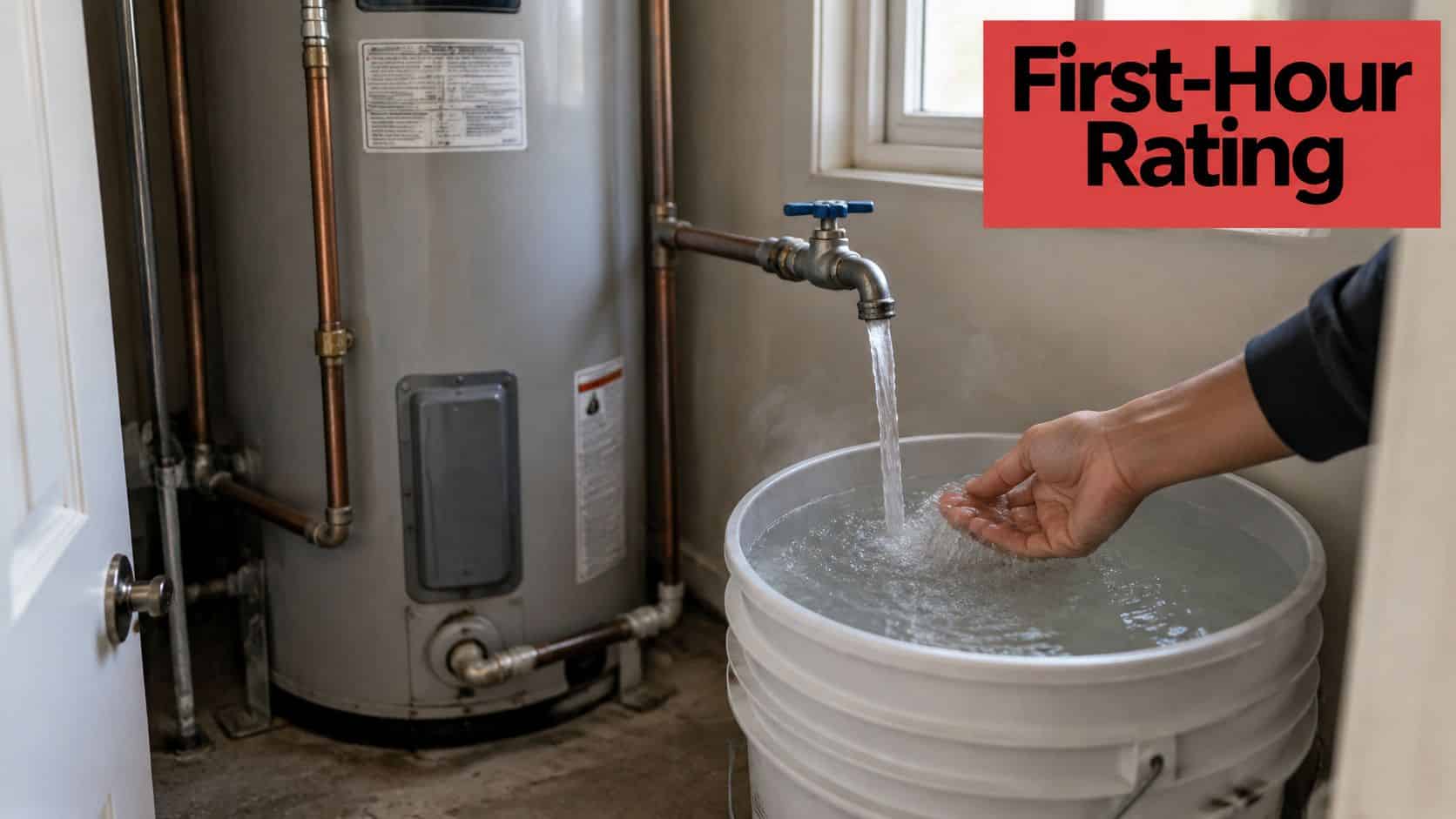
The First-Hour Rating (FHR) measures how many gallons of hot water a unit can deliver during its first hour of use, starting with a full, heated tank. ENERGY STAR's water heater industry guidelines treat that figure, not nominal tank gallons, as the basis for sizing a storage heater.
Why Two 50-Gallon Heaters Aren't the Same
The older estimate is straightforward: about 85% of tank capacity plus one hour of recovery. A 40-gallon electric tank with a 4,500-watt element supplies roughly 34 gallons from storage and recovers about 20 gallons in that hour, which works out to an estimated 54-gallon FHR.
Change the element, the burner size, or the fuel type and the same tank produces a different number. Recovery capacity, not volume, is what separates a unit that keeps up from one that quits halfway through the morning. Two heaters with the same tank size can land far apart on first-hour delivery.
Listings show that spread in practice. One certified heat-pump water heater is listed at a 55-gallon first-hour rating. That rating is the shopping spec. The tank gallons in the name are not.
The comparison that matters. Read the FHR on the label, never the tank size in the model name.
Published first-hour tests use the same method across gas, electric, and heat-pump equipment, so they beat older rules of thumb when you compare brands. In Las Vegas I want a rating at or slightly above the household's worst hour. A tank that looks generous on the jacket still fails if recovery cannot cover that hour.
How to Calculate Your Busiest-Hour Demand
A family of four can empty the morning's hot water before the coffee is poured. Two showers and a washer start inside the same hour, and that hour is what the heater has to cover. In Las Vegas I treat a bedroom chart as a first screen only. The busiest hour is the number I size to.
Worked Example for a Family of Four
Two 10-minute showers at 2.0 gallons per minute draw 40 gallons. A laundry load adds 18 gallons of hot water. That's a 58-gallon busiest hour, so the specification to compare across gas, electric and heat-pump models is a first-hour rating near 58, not a 58-gallon tank.
I use that 40-gallon shower total. Back-to-back showers add up quickly, and a round screening guess for "one or two showers" will not match the math. Flow times minutes is the figure to keep.
| Consecutive showers | How to count the gallons |
|---|---|
| One to two showers | Two 10-minute showers at 2.0 gpm equal 40 gallons. Build from that total. |
| Three showers | Add the third shower the same way: rated flow times the minutes it actually runs. |
| Four or more showers | Keep adding each shower. Do not swap in a flat gallon allowance. |
A large tank with a slow element still fails a 58-gallon hour. An oversized tank that clears the hour costs more up front and loses more heat sitting full. Match the rating, then stop.
Work your own house through the same addition.
- List every hot-water fixture. Showers, tubs, bathroom sinks, kitchen sink, dishwasher, washing machine, and any hose bib or utility sink used hot. Leave one out and the total comes up short.
- Find the overlap window. For most households that is the weekday morning or the hour after dinner. Watch when showers and appliances run.
- Count draws inside that same sixty minutes. Three showers back to back are not three showers at once. Only uses inside the hour count.
- Estimate gallons per use. Multiply showerhead flow by minutes. Use the tub's fill volume for a bath, and the machine's hot-water use for laundry and dishes.
- Add the hour. The sum is peak demand in gallons.
- Match first-hour delivery to the sum. Choose a model that meets or slightly exceeds it.
A U.S. Department of Energy Building America guide recommends picking a model within about 2 gallons of the calculated peak, which keeps you from buying far more capacity than you'll use, per DOE's heat-pump sizing decision guidance.
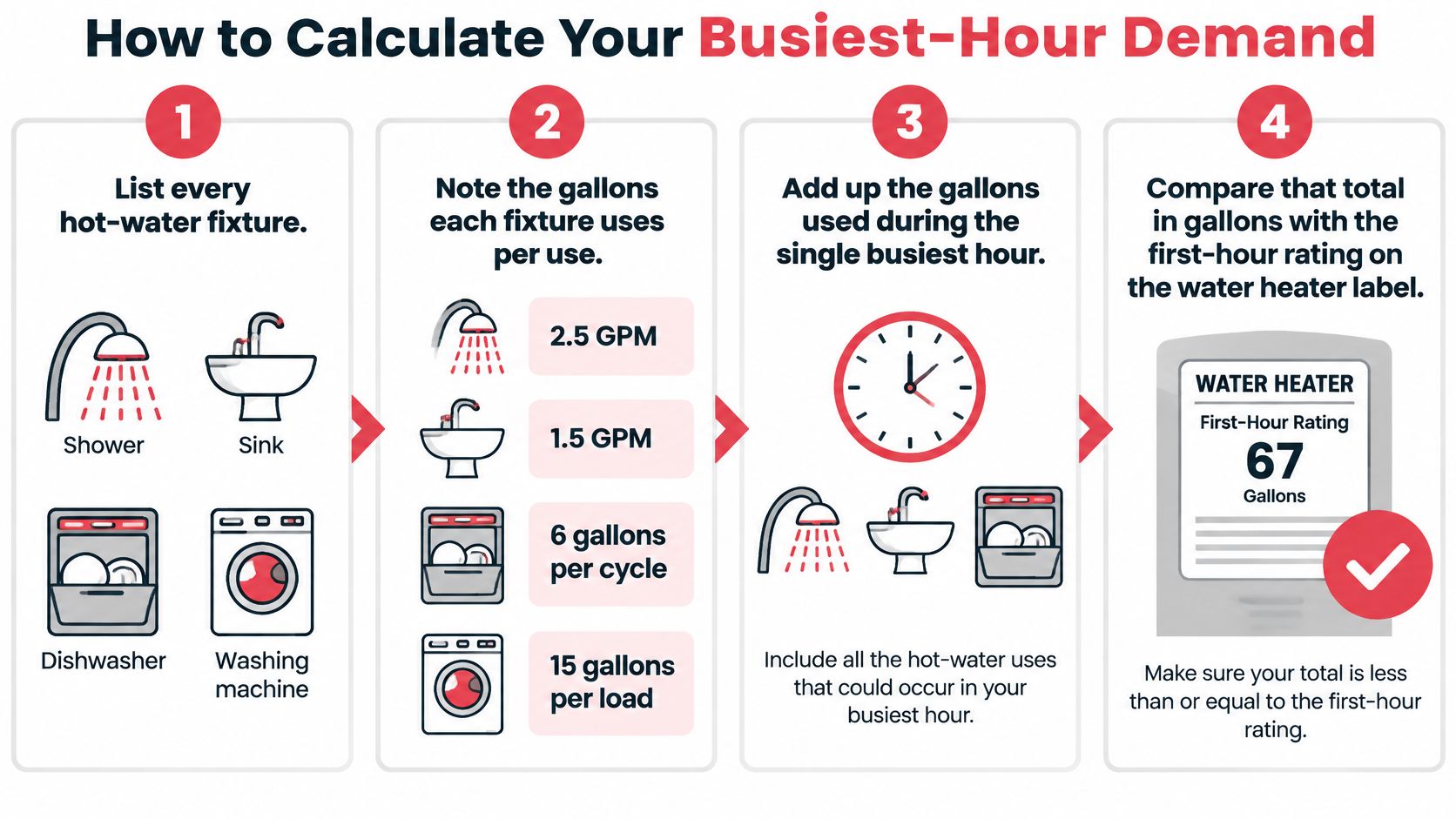
Incoming temperature and setpoint still move recovery, so the data plate on the unit you buy is the number to trust after the hour is added up.
When Short, Clustered Peaks Change the Answer
The reflex when hot water runs out is to buy a bigger tank. That reflex is wrong often enough to argue with, and the reason lies in how households behave.
The ASHRAE Handbook chapter on service water heating notes that residential demand often concentrates in periods much shorter than an hour, sometimes around 15 minutes, and cautions that first-hour rating alone shouldn't determine equipment size. A single hourly figure averages away the tight cluster that empties a tank.
Check your household against these patterns:
- Staggered start times: showers beginning within a few minutes of each other, so the heater never gets a recovery window.
- Shower plus tub fill: a soaking tub drawing its full volume while someone else is rinsing off.
- Laundry during showers: the washing machine pulling hot water at the worst possible moment.
- Guests and multigenerational occupancy: extra bodies for a week, all showering before the same dinner reservation.
Here's the contrarian part. A smaller tank with substantially higher recovery can outperform a larger, slow-recovery unit during repeated short draws, because it refills between waves instead of draining a big reserve once. Tank volume is a buffer, not a guarantee. Las Vegas homes with large tubs, several bathrooms or a full house at the holidays are exactly where a gallons-per-person estimate understates what the fixtures demand.
A bigger tank is not automatically the fix. Delivery rate is what keeps the third shower hot.
Heat-pump water heaters need a closer look for the same reason. Their recovery is generally slower than high-input gas equipment even when the first-hour rating looks adequate, so a household with clustered showers should weight recovery capability heavily and a lightly used home should not.
A thermostatic mixing valve is the other lever people ask about. It stretches usable mixed water by blending stored hot water with cold at the outlet, which adds shower-minutes from the same tank. It does not add heating energy or remove a recovery limit, so it buys comfort rather than capacity.
Sizing a Tankless Unit by Flow Rate
Tankless equipment doesn't get sized by first-hour gallons at all. California's water-heating standards separate the two: storage heaters are evaluated on design first-hour rating, while instantaneous units are evaluated in gallons per minute (GPM), as set out in the California Energy Commission's water-heating standards.
That changes the question from "how much in an hour" to "how much at once." A tankless unit has no reserve, so the test is whether it can supply every fixture likely to run simultaneously, at the temperature rise your incoming water requires.
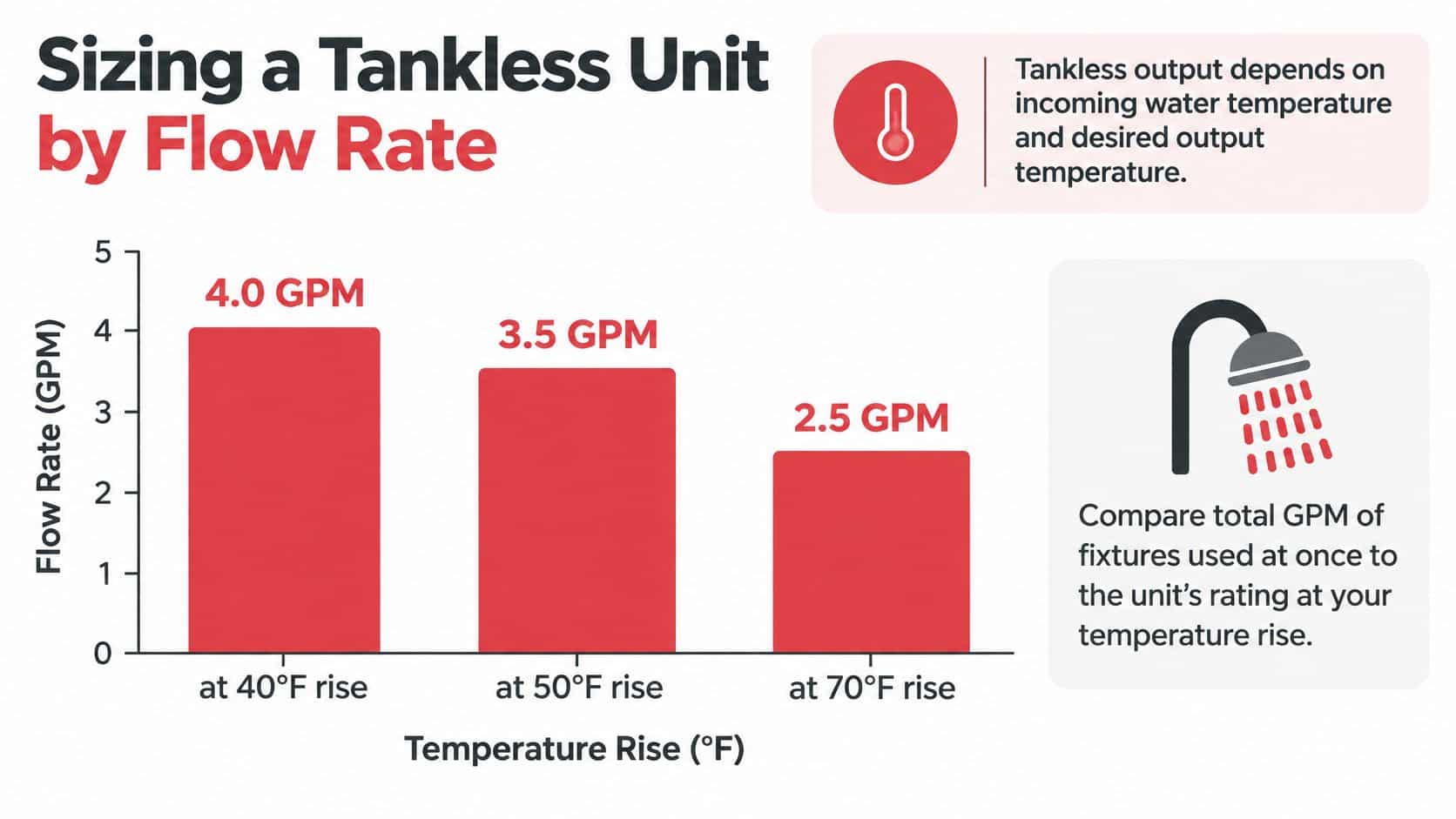
Add the fixtures that overlap: a 2.0 GPM showerhead plus a 1.5 GPM kitchen faucet is a 3.5 GPM load before anyone starts a second shower. Then pick a band that clears the total with margin.
| Maximum flow band (GPM) | Sizing check |
|---|---|
| Below 1.7 | Confirm the single largest draw |
| 1.7 to 2.8 | Add any second fixture to the total |
| 2.8 to 4.0 | Check winter temperature rise |
| At least 4.0 | Confirm electrical and gas capacity |
The bands come from the California Energy Commission's 2025 water-heating guide, which sorts gas-fired instantaneous units into below 1.7 GPM, 1.7 to 2.8 GPM, 2.8 to 4.0 GPM and at least 4.0 GPM. The lowest band suits a single-fixture draw such as one remote bathroom. The middle bands handle a shower plus a faucet. The top band is where whole-home overlap lives, and where the gas line and electrical panel usually decide the project.
Winter inlet temperature is the trap. A unit that looks adequate on a summer day delivers less hot water when the incoming main is colder, because the same burner has to raise the water further. Size against the coldest month, not the mildest.
Sum the peak simultaneous flow, add a margin for the second fixture someone will open, and choose the band that clears it at winter temperatures.
Las Vegas Site Checks Before You Buy
Capacity, delivery rate and site readiness are three separate decisions, and a house can fail the third one after you've solved the first two. Guidance on sizing water heaters draws the same line: matching a peak figure means nothing if the installation can't support the equipment.
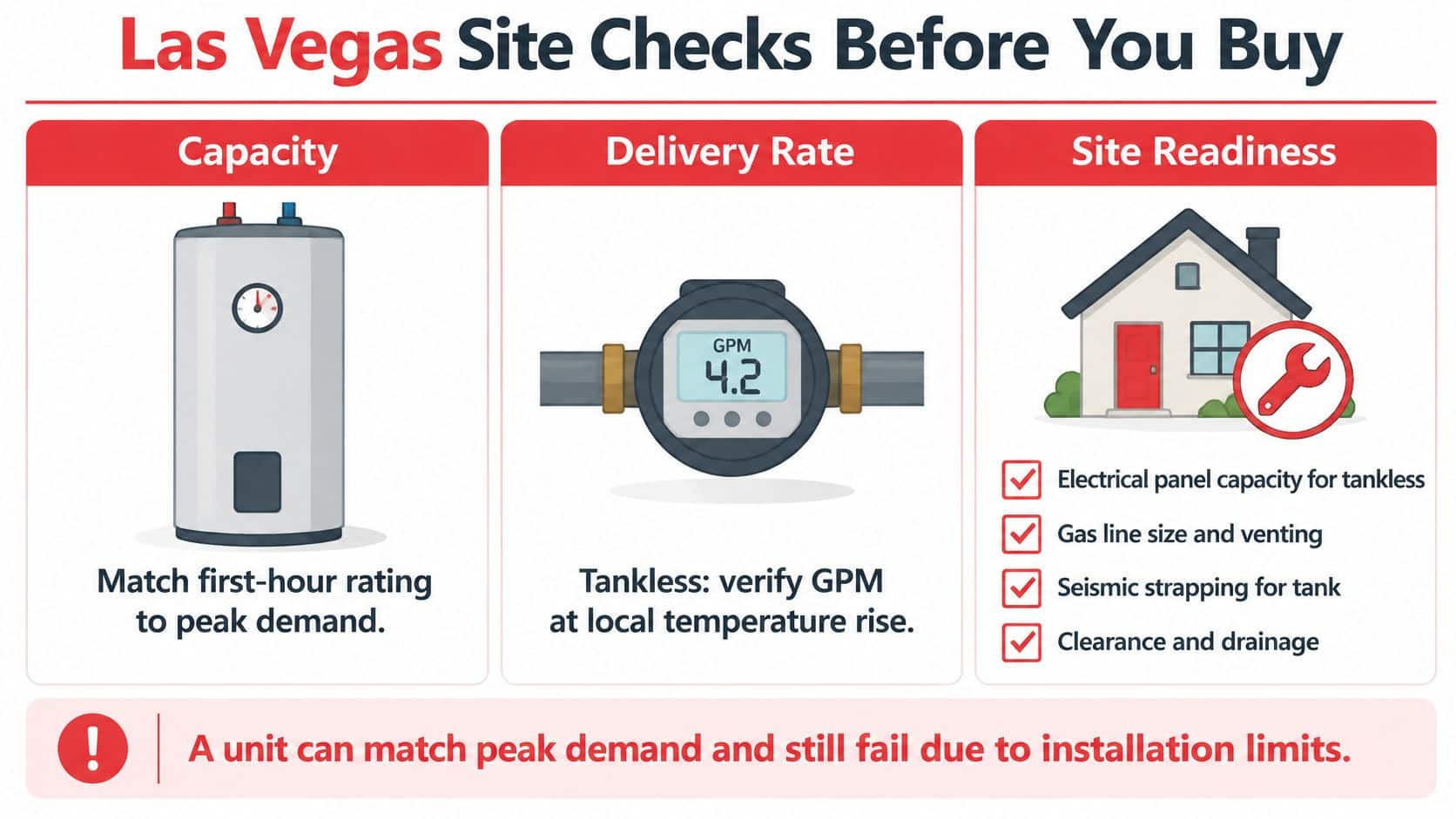
Start with what the water does. Measure incoming pressure and temperature rather than assuming them, because valley inlet temperatures swing with the season, and that swing changes how much hot water each shower draws. Low household pressure makes a fixture feel weak and also skews any flow-based calculation.
Then the utility side. A tankless swap often needs a larger gas line or a dedicated electrical circuit, and a heat-pump unit needs panel capacity plus somewhere to drain condensate. Heat pumps also need air. A closet that stays sealed and hot will drag performance down, and the compressor noise has to go somewhere a bedroom won't hear it.
What Southern Nevada Does to a Heater
Hard water is the local wildcard. Mineral scale builds on heating elements and tank bottoms across the valley, and it eats capacity over time. A heater rated for your peak hour on day one delivers less of it in year five, so build maintenance into the sizing decision rather than assuming a new-unit number holds forever.
- Scale: plan for periodic service or softening, not just a bigger tank.
- Space and clearance: confirm the replacement physically fits, with room to service it.
- Venting: gas units need a compliant flue path, and high-efficiency models may need different venting than the old unit.
- Permits: replacement work has to be code-compliant and permitted when required.
Write these conditions down next to your peak-hour number. If the budget side of the decision is fuzzy, our cost estimates for common plumbing work give you a starting frame before anyone quotes a job.
Confirm Your Size With a Licensed Plumber Before You Buy
A bedroom chart only screens the field. The number that should decide the purchase is your busiest-hour demand: first-hour rating on a tank, or gallons per minute on a tankless unit. I recommend an in-person check before you buy when that figure sits near the edge of two sizes, when the house runs short of hot water in a way a bedroom count cannot explain, or when the heater failed early and you are not sure a replacement is what you need.
Bring the peak-hour figure you already calculated, plus notes on clearance, fuel, and where the unit sits. A licensed plumber reads the data plate first, first-hour rating or GPM on the existing heater, then measures flow and temperature at the fixtures and checks whether the replacement needs a permit. That visit catches a chart that oversizes a small household, or undersizes a house where showers, laundry, and the dishwasher land in the same hour.
Sometimes the right call is no new heater. Miguel Garcia has arrived equipped to replace a unit another plumber had already condemned, inspected it, and found the anode rod was the only failed part. He drained the tank, replaced the rod, and left the area clean. The repair cost a fraction of a new water heater, and the existing unit kept working.
MG Plumbing Services LLC handles water heater repair and installation in Las Vegas for tank and tankless units, with tank replacement that is code-compliant and permitted when required. Garcia owns and operates the company as a Nevada-licensed C-1d plumbing contractor and has been in the trade since 2000. Service is residential only, with Spanish available on the call, the written estimate, and the work. You can also start from MG Plumbing Services LLC.
Contact MG Plumbing Services LLC at 5725 S Valley View Blvd., Suite 5, Las Vegas, NV 89118, for same-day appointments Monday through Saturday, 7:00 AM to 5:00 PM. Have your peak-hour number ready so the recommendation is repair or replacement, checked against your fixtures rather than a bedroom count.