Your toilet is overflowing right now, and the water is spreading. You've got a plunger in one hand and a towel in the other, and neither one stops the inflow.
This isn't a rare event. In 2025, 26% of surveyed U.S. homeowners reported a clogged or overflowing toilet among their recent home-repair emergencies, according to HomeServe's State of the Home Survey of 2,333 homeowners.
What to do when your toilet overflows comes down to two questions and a strict order of operations. Where is the water coming from, the supply line and tank, or the bowl and drain? And how far has it traveled? A bowl that stops rising is not the same as a problem that's solved, and the small spill with a blocked branch drain behind it is the one that comes back next week.
Table of Contents
- Stop the Water Before Anything Else
- Plunge or Call? Reading the Signs of a Deeper Clog
- Cleaning Up Safely and Deciding What to Throw Away
- Why Overflows Keep Coming Back
- Habits That Prevent the Next Overflow
- When to Call a Licensed Plumber Today
Stop the Water Before Anything Else
Water climbing in the bowl while the tank keeps refilling can turn a contained spill into floor damage. The EPA's leak flow guide reports that a stuck toilet fill valve can waste as much as 4,300 gallons per day and cost up to $1,400 per month in water charges. Stop the incoming water first, then check whether the bowl is still rising.
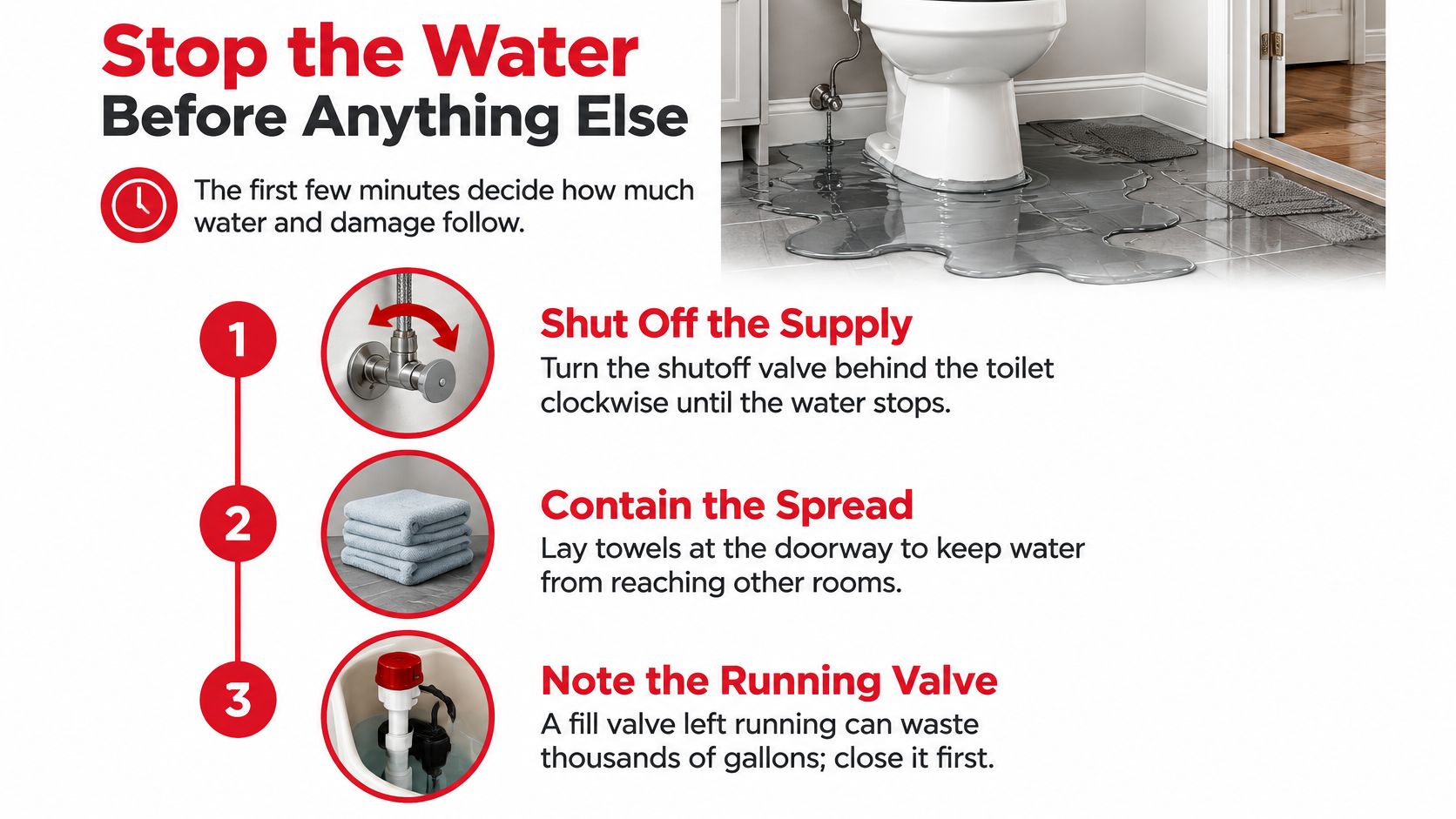
Don't flush again. A second flush sends a full tank into a line that has already shown it cannot drain. It is a common reason a manageable overflow spreads across the room.
Stop the fill valve at the tank. Lift the lid and press the flapper down until it seals. Then raise or secure the float to stop the valve from refilling. This can slow the flow while you reach the shutoff.
Close the fixture shutoff valve. Find the small oval handle or slotted screw on the wall or floor behind and beside the bowl. Turn it clockwise until it stops. If it is seized, painted shut, or leaking, do not force it.
Use the main shutoff if needed. If the fixture valve is stuck or missing, shut off the water where it enters the house. MG Plumbing Services will walk you through locating and operating the main shutoff while an appointment is being scheduled.
Keep people clear of contaminated water. Put on waterproof gloves and eye protection, and keep children and pets out of the room. Move cords and electrical items away from wet areas. If sewage is in the water, avoid contact with bare hands or feet.
Check whether the bowl stops rising. A stable level means the inflow has stopped; a falling level is a useful sign, but it does not prove the drain is clear. The water source and contamination matter: a tank or supply leak calls for a different response than sewage backing out of a drain. If sewage is backing up, stop using all drains and toilets and call as early in the day as possible.
Tank level check: The float should shut off the fill valve at the manufacturer's mark, usually about an inch below the top of the overflow tube. If set too high, the tank can trickle into the bowl continuously. The bowl may appear calm while water keeps entering, so confirm that the fill has stopped before moving on.
Plunge or Call? Reading the Signs of a Deeper Clog
A toilet that fills and then drains slowly may have a clog in its trap. If careful plunging does not lower the water, or another fixture gurgles or backs up, the problem may be farther down the drain. The water's response helps narrow down the cause, but a bowl that stops rising can still hide a deeper drain problem.
Once the inflow is off, let the water level fall on its own. Then test with a small amount of clean water from a pitcher or bucket. Do not flush: a full tank can add more water to a restricted line and cause the bowl to rise again.
The five-minute rule
If careful plunging with a flanged plunger has not lowered the water in about five minutes, stop. More force can splash contaminated water and may disturb the wax seal at the toilet base, causing it to leak. Repeated flushing is not a useful test.
For a clog in the toilet trap, the next tool is a closet auger, not a general drain cable. Its short, guided cable feeds through the trap and can help retrieve an obstruction. Use it gently. Do not substitute wire or a metal rod, which can scratch porcelain or damage the trap. Toilet clog clearing with a closet auger is a flat $107 with MG Plumbing Services.
| Symptom | Likely cause | Next move |
|---|---|---|
| Water drops within a few minutes of gentle plunging | Local toilet trap clog | Test with a small amount of clean water, then use a closet auger if it slows again |
| Water stays high after about five minutes of careful plunging | Possible obstruction beyond the toilet trap | Stop plunging and do not flush; call a drain professional |
| Tub, shower, or floor drain gurgles or backs up when the toilet overflows | Possible branch-drain or sewer-line clog | Stop using water throughout the home and arrange an inspection |
| Sewage returns after a sink or shower drains | Possible sewer-line clog | Stop running water and call for service to locate the cause |
A sewer-line clog can back up multiple fixtures at once, while a drain clog may affect only one fixture. A nearby floor drain can limit spill damage if it is reachable and clear. The 2024 International Plumbing Code defines an emergency floor drain as one that protects against damage from fixture overflows and leakage. It will not remove water already on the floor.
If sewage is coming back through a drain, stop running water and call as early in the day as possible. Avoid using toilets and drains while the sewer is backing up. MG Plumbing Services' Las Vegas drain and sewer service starts with the least invasive method and moves to camera inspection when the cause needs to be located.
Cleaning Up Safely and Deciding What to Throw Away
The cleanup plan starts with a question most overflow advice skips. Did the water come from the supply line and tank, from a backed-up bowl, or from a sewer connection that failed? Water that came out of the tank is close to clean. Water that came up through the bowl or the drain is not, and it should be treated as contaminated until you know otherwise. Public health guidance on sewage backups in the home treats it that way because sewage carries bacteria, viruses, and other pathogens, with risk rising with exposure time and with how much of the house the water reached.
Speed is the second variable. FEMA's mold guidance puts a deadline on the decision. Materials that can't be properly cleaned and dried within 24 to 48 hours should be discarded, because mold colonies can begin growing on damp surfaces inside that same window. That deadline isn't a prediction, it's a practical cutoff for deciding what's worth saving.
The rule I'd apply: if a porous item can't be washed and dried inside two days, it doesn't get saved. That covers the bath mat, the cardboard box under the sink, and the upholstered bench nobody wants to throw out.
| Material | Action | Time limit |
|---|---|---|
| Hard floors such as tile, sealed vinyl or sealed concrete | Wash with water and detergent, disinfect, then dry promptly | Clean and dry within 24-48 hours |
| Rugs, cardboard, upholstery or mattresses | Remove and discard if they cannot be fully cleaned and dried | Decide within 24-48 hours |
| Drywall, insulation or baseboards | Remove wet sections; get an assessment if sewage soaked in | Assess the same day |
| Cabinets, subflooring or HVAC components | Keep power off near water and call a plumber or restoration company | Before drying begins |
| Bathroom outlets or electrical fixtures | Do not touch while wet; have an electrician check them | Before anyone uses the room |
The cleanup order that holds up
- Remove standing water with towels or a wet vacuum, but only where there's no electrical risk.
- Strip the porous items so they aren't re-wetting the floor as it dries.
- Wash hard surfaces with water and detergent, working the base of the toilet, grout lines, and caulk seams.
- Disinfect afterward, then dry with fans or a dehumidifier once the power is safe and no visible mold has appeared.
Never mix bleach with another cleaner. Bleach plus ammonia or an acid product produces a gas hazard in a small bathroom, and the combination is easy to create when you're grabbing whatever is under the sink. In slab-on-grade Las Vegas homes, water wicks under tile and vinyl and can sit against the slab or a wall cavity long after the surface feels dry, which is why the two-day clock starts when the water landed, not when you finished mopping.
If wastewater reached under the flooring, into drywall, cabinetry, outlets, or more than one room, bring in water remediation and a plumbing assessment rather than managing it room by room.
Why Overflows Keep Coming Back
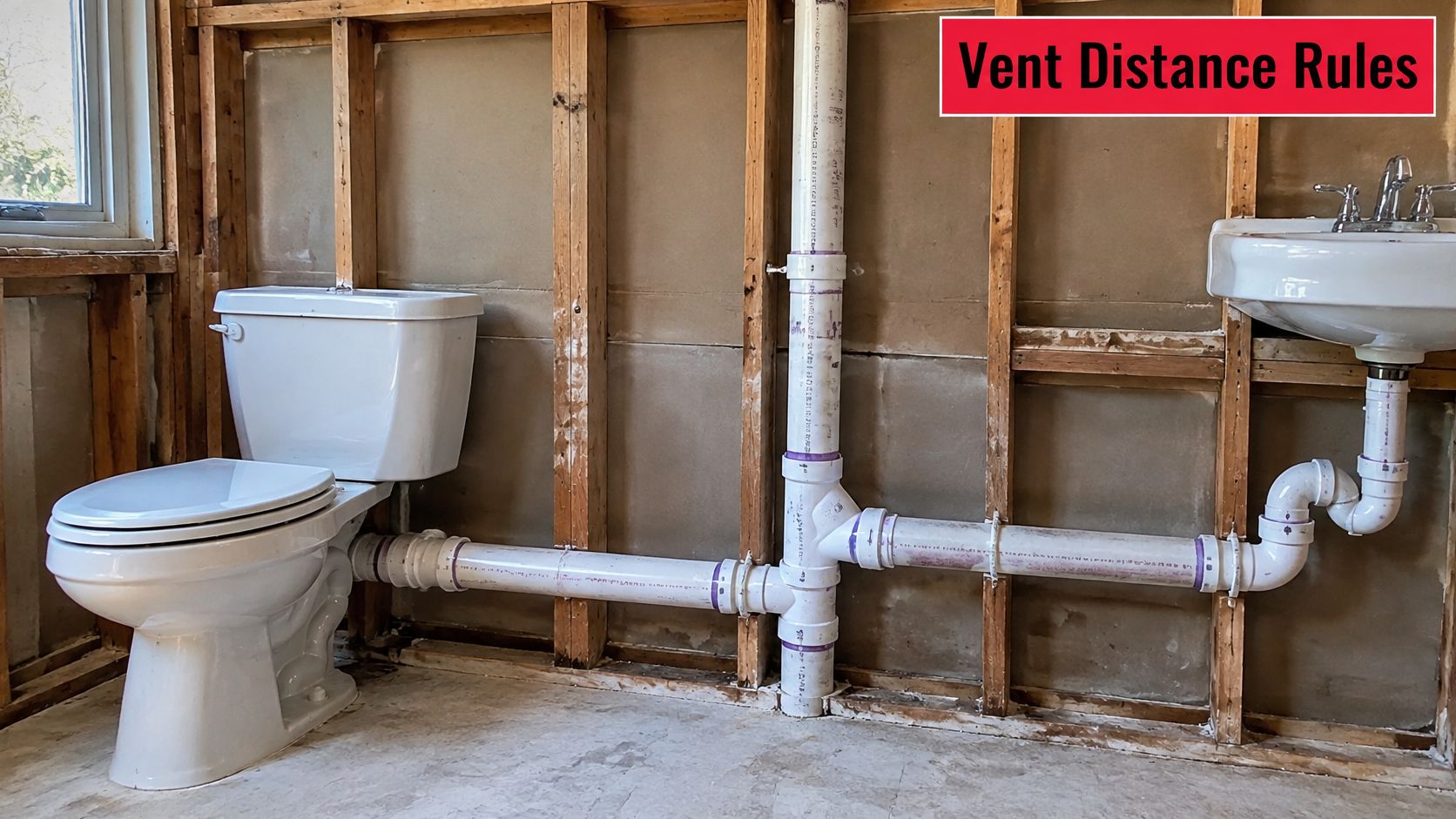
A toilet isn't plumbed like the rest of the house. The International Plumbing Code classifies it as a self-siphoning fixture, which means the run from the trap weir to the vent fitting isn't governed by the maximum-distance table applied to every other trap. Chapter 9 of the International Plumbing Code sets those limits for the other fixtures, and they're tighter than most homeowners expect.
| Trap size | Maximum distance to vent |
|---|---|
| 1¼-inch trap | 5 feet |
| 1½-inch trap | 6 feet |
| 2-inch trap | 8 feet |
| 3-inch trap | 12 feet |
| 4-inch trap | 16 feet |
| Toilet (self-siphoning) | Not subject to this table |
Vents aren't odor control. They admit and release air so the drain can move water without pressure pulling a trap seal dry or forcing water through it. The same code caps the pressure difference acting on a trap seal at 1 inch of water column, about 249 pascals, above or below atmospheric pressure, according to the IPC vent requirements. A blocked vent or a partial blockage downstream produces the symptoms homeowners describe as mystery plumbing: gurgling, slow drains, and a bowl that rises when nothing at the fixture looks wrong.
For a short walkthrough of how the parts fit together, this video is worth two minutes before you decide the toilet itself is the problem.
Flush volume puts a calculable load on the pipe too. The code assigns a private toilet flushing at 1.6 gallons 3 drainage fixture units, and one flushing more than 1.6 gallons 4 units, per the IPC drainage fixture unit table. Fixture units are how pipe sizing accounts for demand, so a line that's undersized, bellying, or scaled shut can fail to carry what the toilet sends it, even when the bowl and trap are clear.
A repeat overflow at the same fixture within days means the restriction was never cleared. Jetting strips the buildup, but where the line has a belly or back-pitch, the slope returns the clog, and that's when sewer line repair in Las Vegas becomes the honest conversation instead of another cleaning.
Habits That Prevent the Next Overflow
Most overflows are self-inflicted, and the numbers make the case. In 2025, 64% of homeowners surveyed said they had flushed items they knew were unsafe to flush and that this caused a plumbing issue, according to a Guardian Service survey summarized by GOBankingRates.
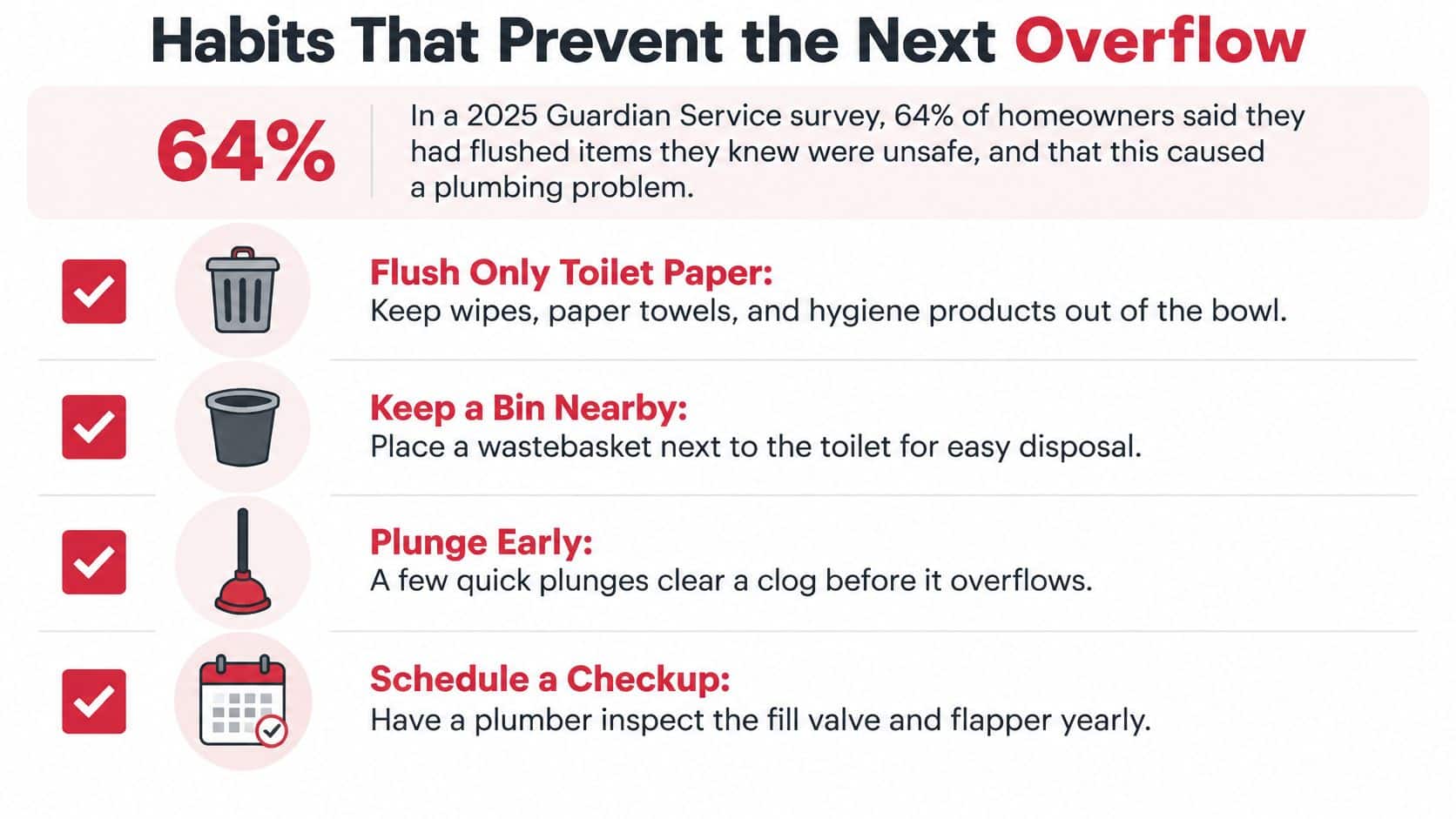
- Flush human waste and toilet paper, nothing else. Wipes, paper towels, dental floss, and cotton products don't break down in water. They catch on scale in cast iron and on roots at a joint, then build into a plug over months.
- Treat "flushable" as marketing. A wipe that clears the bowl has only left the building. It snags further down and waits.
- Put a lined bin beside the toilet. It removes the decision in the moment, which is when the wrong item goes in the bowl.
- Keep a flanged plunger in the bathroom. A flat sink plunger can't seal the outlet, so it swirls water instead of moving it through the trap.
- Check the tank each season. The float should shut off the fill valve at the mark or about an inch below the overflow tube, and the flapper should seat so the tank doesn't run between flushes.
- Replace a flapper that no longer seals. Chasing the same worn rubber with repeated adjustments is a monthly chore; a new flapper ends it.
Chemical drain cleaners don't belong in this routine either. They generate heat that damages PVC joints, corrode cast iron, rarely remove the full clog, and leave caustic water sitting in the line for whoever opens it next. A habit costs far less than a cleanup, and a blockage that returns after a proper clear needs diagnosis rather than another bottle.
When to Call a Licensed Plumber Today
Call a plumber today if sewage is backing up through more than one fixture, a closet auger does not restore drainage, the same toilet overflows again, or water has reached drywall, subfloor, cabinets, outlets, or HVAC equipment. Sewage backing out of a drain can point to a sewer-line problem rather than a toilet-only clog. Stop running water and call as early in the day as possible. Laundry, showers, and flushing add water to a line that may already be full.
Prepare the house before the technician arrives
Shut off the main water supply, turn off the water heater, and clear the area of children and pets. If the sewer is backing up, stop using all drains and toilets. Keep the bathroom door closed and avoid handling contaminated water. When scheduling, have these details ready: when the overflow started, which fixtures are affected, and whether the water came from the tank, bowl, or sewer. If you cannot find the main shutoff, MG Plumbing Services can walk you through locating and operating it while arranging an appointment.
MG Plumbing Services LLC is a licensed, owner-operated residential plumbing company serving the Las Vegas Valley. Miguel Garcia is a Nevada-licensed C-1d plumbing contractor and has been in the trade since 2000. Same-day appointments are available during business hours for sewage backups, burst pipes, and major leaks. The response starts with the least invasive method, stepping up only when needed. Sewer cameras and electronic detection equipment help identify the cause, so the next step can address more than the visible overflow. For an active backup or major leak, request same-day plumbing in Las Vegas.
Call 702-480-8070 to schedule. Se habla español.
A toilet that stops overflowing may still have a deeper drain or venting problem, especially if the blockage returns. MG Plumbing Services LLC can clear the clog, inspect a recurring problem with a sewer camera, explain the findings, and provide a written estimate before repair or replacement work begins. Service is available in English or Spanish. Call 702-480-8070 to request service.