You're standing at the kitchen sink when the washing machine drains in the next room. Suddenly, the sink makes a hollow gulp, even though you haven't turned on its faucet. Nothing has overflowed, but you're wondering whether you've got a clog or a bigger plumbing problem.
Why do drains gurgle? Usually, air is moving through water in a fixture's trap because pressure inside the drainage system isn't balancing properly. The useful clues are which fixtures react, what's draining when the noise starts, and whether slow flow, odor, or rising wastewater accompanies it.
Table of Contents
- The Air Pressure Behind a Gurgling Drain
- Reading the Gurgle Pattern and Spotting a Main Sewer Problem
- Venting Faults That Make Drains Gurgle
- Partial Clogs and Buildup Behind the Sound
- Is a Gurgling Drain Dangerous Without an Odor
- How to Check a Gurgling Drain Safely
- When to Call a Plumber for a Gurgling Drain
The Air Pressure Behind a Gurgling Drain
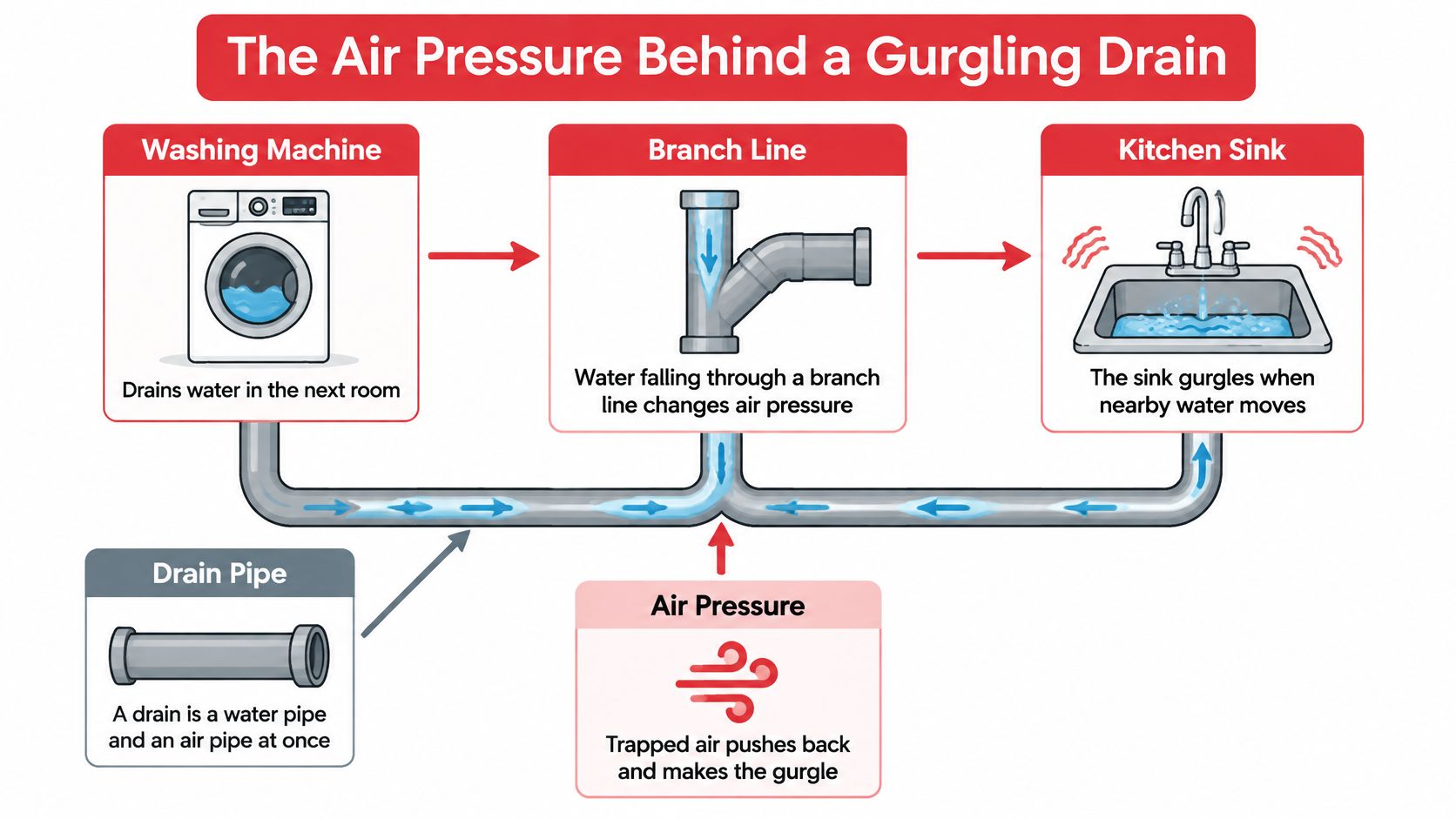
A kitchen sink that gurgles during a laundry discharge isn't necessarily clogged itself. The washer sends wastewater into a connected drain, changing pressure along the shared piping. The sink is often where you hear that pressure change.
A drain is a water pipe and an air pipe at once. Wastewater occupies part of the pipe, while air needs room to move around it. Vents provide a route for that air to enter or escape without passing through the fixtures inside your home.
Think about pouring water from a bottle without letting air enter freely. The water glugs as air squeezes past it. A plumbing vent serves a similar purpose to an air opening that lets the bottle pour smoothly, although a home's drainage network is more complex.
The Water Barrier Under the Fixture
The curved pipe beneath a sink holds water intentionally. This trap seal separates the room from sewer air while allowing wastewater to pass through; toilets have an integral trap rather than an exposed bend beneath them.
King County's waste and vent pipe guidance explains that fixtures need traps and that the trap seal should be between 2 and 4 inches. That measurement describes the water seal, not how deep you should fill the sink.
When a vent is blocked, undersized, missing, or incorrectly connected, pressure can push or pull air through that standing water. Bubbles break through, the water oscillates, and you hear the gurgle. A downstream restriction can produce a similar disturbance, so the noise alone doesn't prove the roof vent is clogged.
The diagram shows how a washer's discharge can affect a neighboring sink.
What to Notice Before Choosing a Repair
A pressure disturbance can leave less water in the trap, weakening its protective barrier. That's why silencing the sound isn't enough if the underlying problem remains.
Carry these questions into your checks:
- Which fixtures react? Separate an isolated sink from a bathroom group or whole-house pattern.
- What starts the sound? Note whether it follows a toilet flush, bathtub discharge, or laundry cycle elsewhere.
- Does the trap retain water? Watch for changing toilet levels and odors around seldom-used drains.
Reading the Gurgle Pattern and Spotting a Main Sewer Problem
| Pattern | Most likely cause | First check | Urgency |
|---|---|---|---|
| Only one fixture gurgles and drains slowly | Hair, soap or grease in that fixture's trap arm | Remove the trap cover and inspect for debris | Low |
| Gurgles when a nearby toilet, tub or washer drains | Shared branch drain or restricted vent airflow | Listen at adjacent traps during a controlled discharge | Medium |
| Several fixtures gurgle together with slow drainage | Restriction in the building drain or sewer line | Note which fixtures react and schedule a camera inspection | High |
| Sewage odor from a rarely used floor drain or sink | Dry trap seal from evaporation | Pour water into the trap to refill the seal and watch for the odor to stop | Low |
| Gurgling after heavy rain, with nearby drains bubbling | Water entering the sewer or a blocked vent | Check the roof vent for debris from the ground and watch for repeats | Medium to high |
| Sewage rising into a tub or floor drain | Main sewer blockage | Stop running water and call a plumber promptly | Urgent |
Treat each row as a diagnostic clue, not a confirmed cause. For the trap-cover check, use only an accessible, removable component you recognize. Don't loosen concealed piping or open a sewer cleanout that may be holding backed-up wastewater.
Local Drain Trouble Versus a Shared Restriction
Say the shower drains while the toilet bubbles. Air is passing through the toilet's water seal along a shared drainage path. That doesn't establish that the toilet itself needs snaking.
The 2024 International Plumbing Code's vent provisions limit pressure differential across a trap seal to 1 inch of water column, equivalent to 249 Pa. Homeowners don't need to measure that pressure themselves, but visible bubbling and water-level movement help identify where a plumber should investigate.
A local drain clog generally affects the fixture connected to that branch. A sewer restriction can affect several fixtures and often becomes apparent at a low tub or floor drain. Gurgling in the tub during a toilet flush, sewage odor, or symptoms returning after cleaning deserves closer attention.
When the Sewer Line Needs Inspection
Older clay or cast iron piping, deteriorated interiors, and mature tree roots make buried-line condition especially relevant. Wet ground or unusually lush grass along the sewer route is another clue to investigate, although irrigation leaks can produce similar changes.
The U.S. Environmental Protection Agency's sanitary sewer overflow materials attribute approximately 50% of causes in an overflow summary to blockages. That describes sewer-system failures, not the probability that your particular sink has a sewer clog.
An isolated noise during municipal sewer flushing may be temporary. Repeated cross-fixture symptoms during ordinary use justify a sewer camera inspection, especially when cleaning hasn't lasted.
Practical rule: The more fixtures involved, the farther downstream the investigation usually needs to extend.
Venting Faults That Make Drains Gurgle
The vent system supplies the airflow that drainage depends on. A fault can involve an obvious obstruction, but it can also involve pipe routing or insufficient capacity. An opening that looks clear from outside doesn't establish that the entire vent works properly.
Location and Routing Problems
A poorly positioned terminal can be vulnerable to debris or allow foul air to return near building openings. For example, a short terminal near a roof edge can collect windblown material. A terminal under or near a window also needs professional review for placement, not merely cleaning.
An incorrectly routed vent may hold condensation instead of draining it back into the drainage piping. A sagging horizontal section can retain water and collect debris, reducing the available air passage even though the roof opening appears unobstructed.
The 2024 vent provisions reproduced by UpCodes require dry vents to rise vertically to at least 6 inches above the flood-level rim of the highest fixture they serve and require vent piping to drain back by gravity. That rise is a fixture-related routing requirement, not a roof-terminal height measurement.
Damage, Blockages, and Capacity
Physical damage or an obstruction can close an otherwise suitable vent. A crushed pipe, a section cut during remodeling, leaves, or nesting material can prevent free airflow. The resulting symptom may appear at a fixture far from the actual defect.
Insufficient capacity becomes more noticeable during overlapping use. A bathroom might drain acceptably when used alone but gurgle when someone flushes while the shower runs. Because a vent arrangement can serve several fixtures, a missing or undersized connection can affect the whole group.
An air admittance valve is a passive device that opens to admit air under negative pressure. It's an option only where local code permits, must remain accessible, and isn't a universal substitute for outdoor venting or a repair for downstream blockages.
From ground level, you can note visible damage or material around a roof terminal. A licensed plumber should confirm concealed routing, sizing, valve operation, and safe access.
A clear-looking roof opening doesn't rule out a vent defect inside the house.
Partial Clogs and Buildup Behind the Sound
A partially blocked pipe can still carry wastewater. That's why a homeowner may hear gulping well before seeing a backup. Water squeezes through the restricted opening while air is intermittently displaced through connected traps.
Consider a bathroom sink with a clump of hair near its trap. It empties slowly, and you hear a gurgle around the next toilet flush. The hair explains the sink's slow drainage, but the timing means you should also check whether shared piping is involved rather than assuming the visible debris explains everything.
Where Restrictions Develop
Different materials collect in different places:
- Near fixtures: Hair and soap collect in bathroom drains, while grease can coat kitchen piping.
- Along pipe walls: Mineral scale reduces the usable opening and provides rough surfaces where debris can catch.
- At buried joints: Roots can enter defective connections and trap additional solids.
- In sagging sections: A belly retains standing water and sediment instead of allowing the line to drain properly.
HUD's residential plumbing rehabilitation guidance identifies approximately 2 feet per second as a generally accepted target velocity for transporting solids efficiently. You can't infer that velocity from how quickly a sink empties, but persistent slow drainage is a useful reason to investigate resistance in the line.
A narrowing pipe can temporarily run fuller during discharge. The reduced air space and interrupted water movement produce the alternating gulps you hear at nearby fixtures.
Match the Tool to the Pipe Condition
Mechanical cabling is appropriate for many soft plugs and localized obstructions. A cable can restore a passage without removing every deposit from the pipe wall, so immediate improvement doesn't always establish that the full problem is gone.
Hydro jetting can remove grease, sludge, and scale from suitable piping. The line's structural condition matters: damaged pipe needs evaluation before aggressive cleaning, and a recurring symptom may justify camera inspection before choosing another cleaning method.
A camera can reveal separated joints, corrosion, root intrusion, or a sag that a cable won't correct. Cleaning a belly removes accumulated material, but it doesn't restore the pipe's slope, so debris can collect again.
Repair decision: Choose the method that addresses what's inside the pipe and whether the pipe itself is sound.
Use checklist step 3 to discharge a fixture and listen at the others, distinguishing an isolated restriction from a shared drainage or airflow problem.
Is a Gurgling Drain Dangerous Without an Odor
A gurgling drain without odor or backup usually isn't an immediate emergency, but the absence of smell doesn't prove the system is safe or working correctly. The trap may still contain enough water to block sewer air even while pressure disturbances affect it.
The sound can precede a visible backup or noticeable odor. Don't use smell alone to decide whether recurring gurgling needs attention, particularly when toilet water moves or neighboring drains react.
Check an Unused Trap Before Assuming a Vent Fault
A rarely used floor drain, guest bathroom sink, or tub can lose its water seal through evaporation. That can create odor without establishing that the roof vent is blocked. The Uniform Code Spotlight on trap protection and venting explains the relationship between retained trap water, venting, and protection against sewer-gas entry.
Add water to the unused drain and observe what changes. If the odor disappears and doesn't return during normal household use, evaporation was a plausible cause. Improvement after adding water doesn't establish that every gurgling symptom had the same source.
For vacant homes and intermittently occupied rentals, include unused fixtures in routine property checks. A floor drain hidden behind stored items can be easy to overlook.
When Monitoring Is No Longer Enough
Use the response after refilling as your guide:
- Odor stops and stays away: Monitor the fixture and keep the trap supplied with water.
- Gurgling continues with other fixtures in use: Arrange an airflow and drainage evaluation.
- Odor returns despite regular use: Have the trap and connected piping inspected rather than repeatedly adding water.
- Strong sewage odor or wastewater appears: Stop testing and contact a plumber promptly.
Don't dismantle a trap just to measure its retained water depth. For a homeowner, the useful observations are whether it receives water, whether odors stop, and whether discharge elsewhere disturbs it.
How to Check a Gurgling Drain Safely
Begin with observation, not chemicals or roof access. Only perform discharge checks if wastewater isn't already rising and the drains can accept water without overflowing.
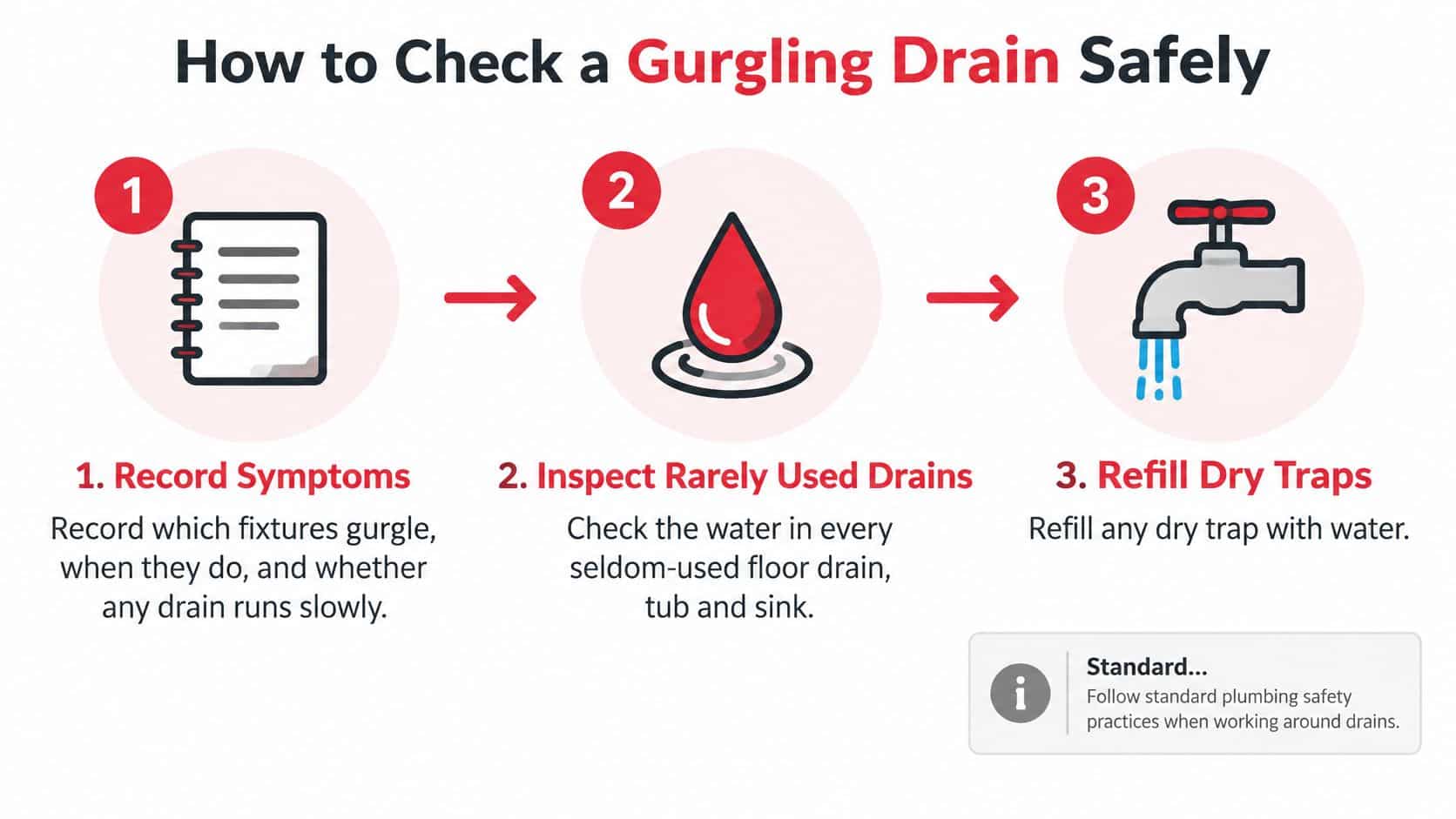
This visual summarizes the initial symptom-recording and trap checks.
An Indoor and Ground-Level Checklist
Record which fixtures react and when. Note the fixture making noise, the fixture discharging, any slow drainage, and whether the problem follows rain or laundry use. Healthy operation means wastewater leaves without disturbing nearby fixtures; a brief phone recording can help explain an intermittent symptom.
Check seldom-used drains and refill dry traps. Add water to unused floor drains, tubs, and sinks because evaporation can remove their protective seal. The expected result is an odor-free drain that remains quiet during ordinary use, not a temporary improvement followed by the same smell.
Test a controlled discharge. Run a fixture briefly while listening at a neighboring sink and toilet, then repeat with a different fixture, stopping if water begins collecting. This tests whether the restriction is isolated or shared; a healthy result is no bubbling or sloshing in adjacent traps.
Watch toilet bowl water during normal discharge. Observe it while a shower drains or the washer discharges, without deliberately running every fixture together. The bowl should remain stable apart from ordinary minor movement; pronounced bubbling, surging, or a falling level needs evaluation.
Look at the roof vent from the ground. Note visible leaves, nesting material, ice, or damaged piping, using binoculars if helpful, but don't climb onto the roof. An apparently open terminal is reassuring only about what you can see, not proof that the concealed vent is clear.
Remove only an accessible, visible hair plug. Before opening a removable sink trap, shut off the fixture's water supply, prevent anyone from using it, and place a bucket underneath; leave corroded or unfamiliar connections alone. After reassembly, the healthy result is faster drainage with dry joints, so check carefully for leaks while water runs.
Stop when the symptoms indicate shared or sewage-related trouble. Call a plumber if sewage rises, the odor is strong, or multiple fixtures react together, and don't keep flushing to see whether the problem clears. Further water use can turn a contained restriction into an indoor overflow.
Avoid Making Diagnosis Harder
Don't pour chemical drain cleaner into a gurgling fixture as a diagnostic test. It won't establish whether the cause is venting, buildup, or damaged piping, and it can leave hazardous liquid behind for whoever opens the drain.
If you've already used a chemical product, tell the plumber before work begins. Keep children and pets away from affected fixtures and any wastewater.
The accompanying video provides another visual reference for drain troubleshooting.
When to Call a Plumber for a Gurgling Drain
A gurgle from one fixture may point to a local drain restriction. If several fixtures react together, drainage slows, odors appear, or the sound returns after a trap check, call a plumber. If sewage is backing out of a drain, stop running water and call as early in the day as possible.
Expect a Diagnosis, Not Just a Quieter Drain
Tell the plumber which fixtures gurgle and what happens when water runs. That pattern helps distinguish a single-fixture drain clog from a sewer line clog, which can affect several fixtures at once. Depending on the symptoms, diagnosis may include a flow test or sewer camera inspection.
After clearing a line, MG Plumbing Services LLC tests the flow at full volume and provides written notes on the drain condition. If a line has a belly or back-pitch, cleaning alone may not solve the recurring problem, so repair may be recommended.
MG Plumbing Services LLC is an owner-operated residential plumbing company serving the Las Vegas Valley. Owner Miguel Garcia is a licensed plumber who has been in the trade since 2000. The company handles drain cleaning, leak detection, water heaters, and water and sewer line repair or replacement.
Call 702-480-8070 to ask about same-day plumbing availability in Las Vegas. Availability can be confirmed when you call.
MG Plumbing Services LLC provides residential drain cleaning, sewer cleaning, hydro jetting, and sewer camera inspections. Call 702-480-8070 or visit MG Plumbing Services LLC to describe which fixtures are reacting. Spanish-speaking service is available.