You turn the shower handle toward warm and the stream weakens to a disappointing trickle. At the kitchen sink, cold water still comes out with plenty of force, so the city supply seems fine. You may blame the showerhead, soak the aerator, or suspect the faucet cartridge, but the pattern points somewhere more specific.
The practical question isn't why is hot water pressure lower than cold. It's where the hot-water flow begins to slow down. In Las Vegas Valley homes, the answer often involves hard-water scale, sediment, a valve, an aging fixture, or a restriction near the water heater. The fastest diagnosis follows the clues from fixture to heater instead of replacing parts at random.
Table of Contents
- The Shower Moment That Tips You Off
- Why Hot and Cold Water Behave Differently
- The Five Most Common Causes in Hard-Water Homes
- A Simple Diagnostic Path Before Calling a Plumber
- Fix Options From Quick DIYs to Professional Repairs
- A Real Las Vegas Service Call Example
- When to Call a Licensed Plumber and What to Expect
The Shower Moment That Tips You Off
A homeowner usually notices this problem during a routine shower. Cold water feels strong, but as the handle moves toward hot, the flow fades. The temperature may still be acceptable, yet the shower no longer rinses properly, and filling a bathtub takes much longer than it should.
That first observation matters because it separates a hot-side problem from a whole-house pressure problem. If both hot and cold water are weak at multiple fixtures, the main supply, pressure regulator, or broader piping system deserves attention. If cold water remains normal while hot water is weak, the restriction usually sits in the hot-water path after the lines split near the water heater, as practical plumbing guidance explains in this diagnostic discussion of low hot-water pressure.
Don't start by replacing the showerhead
The showerhead may be clogged, especially in a mineral-heavy service area, but it shouldn't be your first conclusion when every hot fixture has the same symptom. A clogged showerhead affects one outlet. A weak stream at the shower, kitchen faucet, bathroom sink, and laundry connection points toward a shared component.
The faucet cartridge can also create a local restriction. Pressure-balancing and mixing components may collect scale, but they can't explain weak hot flow at fixtures that don't share that cartridge.
Practical rule: Compare hot and cold water at more than one fixture before buying parts.
The next clue is whether the problem appeared suddenly or developed gradually. A sudden drop can follow plumbing work, a valve being moved, or sediment shifting near an outlet. A gradual decline fits mineral accumulation, corrosion, or an aging heater and hot-water branch.
The homeowner's role is to narrow the location safely. Check what you can see, avoid opening a pressurized or heated system, and record which fixtures are affected. That information gives a licensed plumber a useful starting point and prevents a simple valve issue from turning into an unnecessary heater replacement.
Why Hot and Cold Water Behave Differently
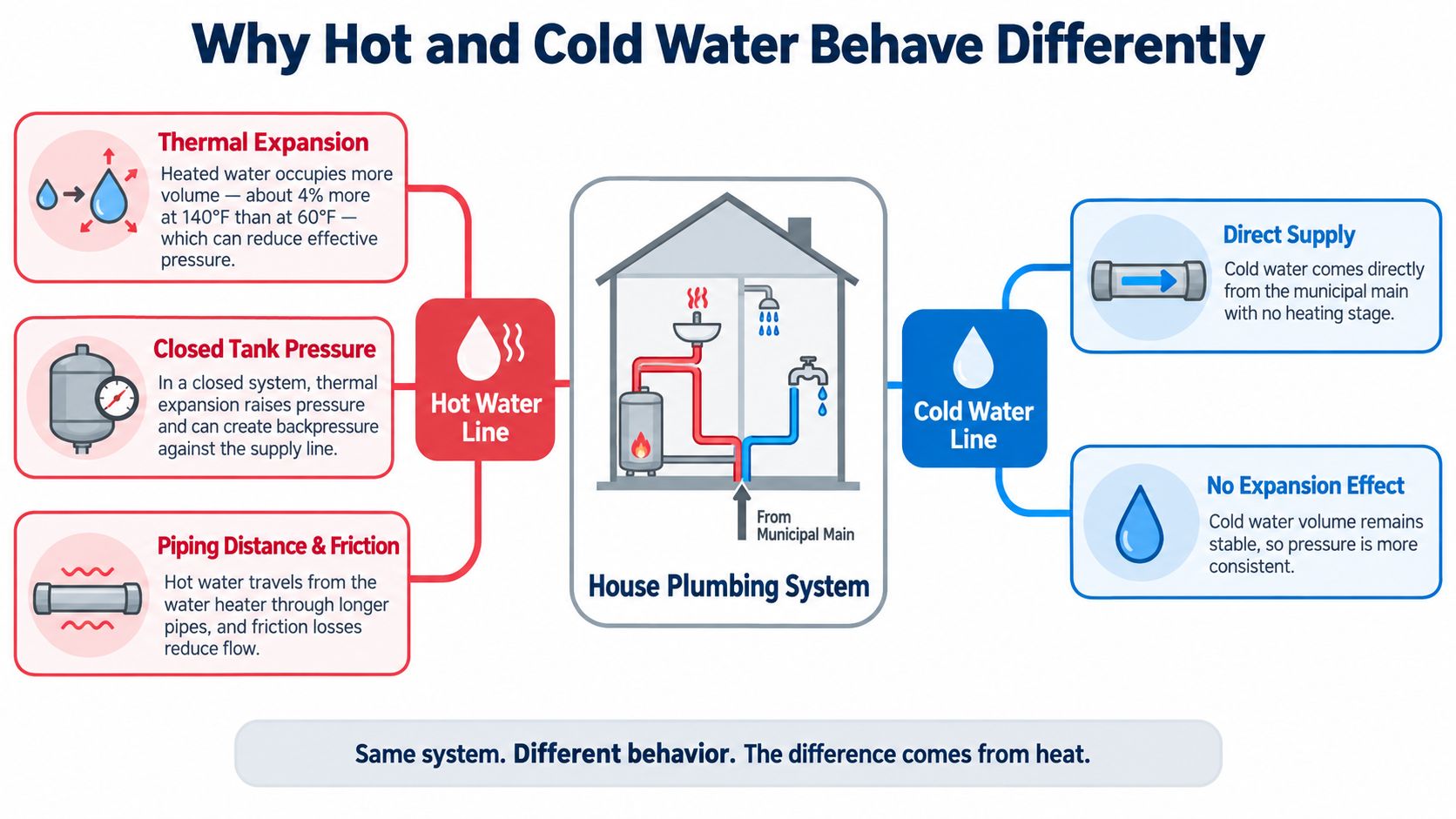
Hot and cold water share the incoming supply, but they don't follow identical routes. Cold water generally travels from the main or meter to the fixture. Hot water passes through a dedicated inlet, the water heater, an outlet connection, additional valves, and the hot-water branch before it reaches the tap.
Heating also changes the water's behavior. When water in a 40-gallon heater is heated from 90°F to 140°F, it expands by almost one-half gallon, according to this thermal expansion bulletin from American Water. In an open system, that added volume can move back toward the supply. A pressure-reducing valve, check valve, or backflow preventer can block that path and turn the plumbing into a closed system.
Thermal expansion adds another pressure variable
Pressure can rise sharply inside a closed tank as water heats. One A. O. Smith technical bulletin explains that water in a closed tank at 50 psi can reach 250 psi after a 10°F temperature increase. The bulletin also discusses using a correctly sized expansion tank and keeping supply pressure typically at or below the 60 to 70 psi range for stable operation. Review the A. O. Smith thermal expansion guidance before adjusting or replacing pressure-control equipment.
This doesn't mean thermal expansion automatically causes a weak shower. It means hot-water systems have pressure changes and protective devices that cold branches don't experience in the same way. Pressure-limiting devices, valve chatter, and unstable flow can make a restriction more noticeable.
Heat makes deposits more troublesome
The heater is also where minerals get a repeated dose of heat. Calcium carbonate scale forms more readily as temperature rises, and utility guidance notes that deposits can significantly reduce the effective diameter of a pipe. The result is straightforward. A hot branch with deposits has less usable passage and more friction, while the cold branch may still have a relatively open route.
Plumbing codes generally require pressure-reducing valves when supply pressure exceeds 80 psi, another point identified in the American Water material. The valve protects fixtures, but it can also prevent thermal expansion from moving backward into the supply. That combination makes the water heater, its valves, and its nearby piping important inspection points.
The Five Most Common Causes in Hard-Water Homes
Southern Nevada homes deal with mineral-heavy water, aging fixtures, and repeated heating cycles. Those conditions don't create one universal failure, but they make hot-side restrictions more likely to appear first. The ranking below reflects practical diagnostic priority in hard-water homes, not a claim that every property has the same fault.
1. Sediment and calcium scale inside the heater
Sediment settles inside tank-style heaters, while scale can build around the outlet, heat-transfer surfaces, and nearby fittings. Deposits narrow flow paths and can restrict the hot outlet even when the cold inlet remains strong. The hard-water scale guidance from Crystal Quest explains why calcium and magnesium precipitation accelerates on heated surfaces.
2. A deteriorated dip tube
The dip tube directs incoming cold water toward the bottom of a tank. In an older heater, a deteriorated tube can break apart and send plastic fragments into the hot-water system. Those pieces may collect at faucet screens, valves, or branch restrictions, creating scattered symptoms instead of one obvious blockage.
3. A partly closed or failing heater valve
A cold inlet shutoff valve that isn't fully open can restrict the water entering the heater. A hot outlet valve can create the same kind of bottleneck after the tank. Either one affects hot flow while leaving cold taps supplied from the main unchanged.
4. Scale in fixtures and hot-side piping
A hot-water branch can accumulate calcium, rust, and debris inside pipes, angle stops, cartridges, and aerators. Heat accelerates mineral deposition, so a shower or faucet may show poor hot flow before cold flow changes. If only one fixture is affected, start at that fixture. If all hot fixtures are weak, look upstream.
5. Old valves and restrictive connectors
Older gate valves may fail internally even when the handle appears open. Aging flex connectors, undersized heater piping, and restrictive replacement fittings can also limit output to a distant bathroom. A line that worked adequately when clean may become noticeably weaker after scale reduces its remaining opening.
| Rank | Cause | Typical Symptom | Local Driver |
|---|---|---|---|
| 1 | Heater sediment and scale | Weak hot flow at several fixtures | Repeated heating of mineral-heavy water |
| 2 | Deteriorated dip tube | Debris at hot fixtures or uneven flow | Aging tank component |
| 3 | Partly closed heater valve | Sudden hot-side reduction | Previous service or valve movement |
| 4 | Fixture or branch scale | One fixture, or one hot branch, performs poorly | Heated-water mineral deposits |
| 5 | Aging or restrictive piping | Persistent weakness, often at a distant fixture | Older components and accumulated friction |
A homeowner can screen for an accessible valve, a clogged aerator, or a problem limited to one fixture. Tank internals, dip tubes, corroded piping, and pressure-control devices need a licensed plumber. A slow drain or fixture restriction may also coexist with hot-water symptoms, but it should be diagnosed separately through residential drain cleaning in Las Vegas, not assumed to be a pressure problem.
A Simple Diagnostic Path Before Calling a Plumber
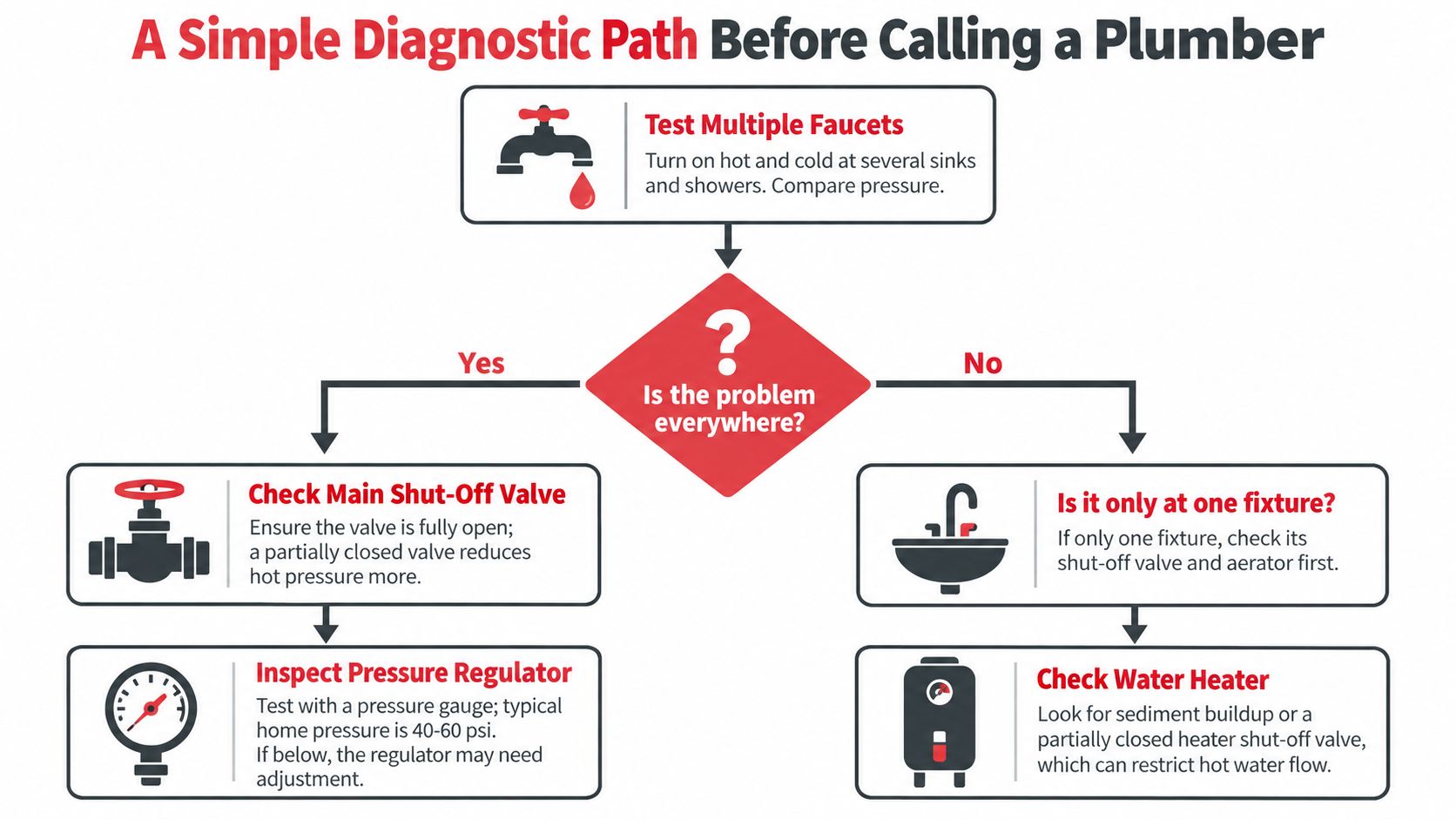
Start with a question, not a tool. Is hot flow weak everywhere, or only at one outlet? Test a kitchen faucet, a bathroom sink, a shower, and the laundry connection. Turn each side on separately and compare hot with cold at the same fixture.
If only one faucet or shower is weak, remove the aerator or showerhead and inspect for mineral debris. Don't assume cleaning it fixes the whole system. If several hot fixtures are affected, the shared path near the water heater becomes the logical target.
Follow the water toward the heater
Look at the valves above or beside the heater. A lever valve should generally align with the pipe when open, but don't force a stiff, corroded, or damaged valve. If the handle turns without changing the internal position, the valve may have failed.
Inspect visible piping for a crushed flex connector, corrosion, unusual fittings, or evidence of previous repair. The laundry tap is especially useful because it often has no faucet aerator and may avoid some fixture-level mixing components. Strong cold flow and weak laundry-side hot flow place the restriction before the laundry fixture.
A pressure gauge attached to the heater drain valve can help distinguish static supply pressure from a restriction farther along the hot circuit. This is a measurement, not a repair. Hot water can burn, and the drain valve may leak after being disturbed, so stop if the connection is corroded or the water is hot.
Record the pattern before scheduling service
Write down the heater type, visible age, fuel source, and whether the issue began suddenly or gradually. Note recent valve work, fixture replacement, water-treatment changes, leaks, rusty water, unusual noises, or sediment at aerators.
Good information saves diagnostic time: Tell the plumber whether every hot fixture is weak, whether cold flow is normal, and whether the change happened after plumbing work.
Don't repeatedly open and close old valves just to test them. A brittle valve can begin leaking at the stem, and a neglected heater drain can fail to reseal. The goal is to isolate the likely area without creating a second repair.
Fix Options From Quick DIYs to Professional Repairs
The right repair depends on where flow drops. A homeowner can handle a few low-risk checks, but hot-water equipment combines pressure, heat, electricity, gas, and stored water. If you're not comfortable identifying the correct valve or shutting down the heater, stop there.
| Cause | Recommended Fix | DIY or Pro |
|---|---|---|
| Partly closed valve | Confirm the correct valve and open it carefully | DIY only if accessible and operating normally |
| Clogged aerator or showerhead | Remove, clean, and reinstall the fixture screen | Usually DIY |
| Loose sediment | Evaluate a heater flush based on heater condition | Caution, often pro in an older system |
| Tankless scale | Descale the heat exchanger with an approved circulation method | Pro recommended |
| Failed dip tube | Drain and disassemble the heater, then replace the tube | Licensed plumber |
| Corroded pipe or connector | Replace the restricted section with compatible materials | Licensed plumber |
| Mixing or pressure-balancing valve | Diagnose and rebuild or replace the valve | Usually pro |
A clean aerator may restore one faucet's flow, but it won't correct weak hot water throughout the home. Opening a valve may solve a sudden restriction, but it won't remove scale inside a heater. Flushing can clear loose material, yet an older tank with substantial corrosion may need an inspection before anyone starts draining it.
Tankless heaters deserve a different maintenance approach. In the hard-water environment of the Las Vegas Valley, technicians commonly use vinegar or citric-acid circulation to remove scale from the heat exchanger. That procedure requires isolation valves, a circulation pump, the correct cleaning solution, and careful reconnection. It isn't the same operation as flushing a tank.
A deteriorated dip tube is a more involved repair. The tank must be drained, the inlet connection opened, and fragments removed from affected lines or fixtures. A corroded valve, pressure-balancing cartridge, restrictive connector, or undersized branch may also require parts and access behind walls or ceilings.
For diagnosis, repair, or replacement of a residential heater, homeowners can review MG Plumbing Services water-heater repair in Las Vegas. The practical standard is to identify the restriction first, then choose between cleaning, component replacement, pipe repair, or complete heater replacement.
A Real Las Vegas Service Call Example
A representative call came from a single-story home in the Summerlin area. The homeowner had strong cold pressure at the kitchen sink, bathroom fixtures, and shower, but every hot tap produced a weak stream. Because the complaint was confined to hot water, the plumber began at the water heater rather than replacing shower parts.
The laundry tap provided a useful test point. Its hot flow was also weak, which ruled out the kitchen aerator and shower valve as the primary cause. The plumber then inspected the visible heater connections and found the cold inlet valve turned roughly three-quarters closed after earlier plumbing work.
That valve was starving the heater's inlet and contributing to uneven sediment conditions inside the tank. The plumber opened it fully, flushed several gallons through the drain valve to clear loose mineral buildup, and checked flow again at the laundry connection.
The result supported the simplest explanation
Hot flow improved at the kitchen and master-bath fixtures after the valve was corrected and the loose material was cleared. No replacement parts were needed, and the visit took under an hour.
That outcome isn't universal. A damaged valve may not open internally, scale may be packed inside the outlet, or an older dip tube may have already broken apart. The useful lesson is the order of operations: confirm the symptom at multiple fixtures, test the shared heater-side path, and verify the result before assuming the tank has failed.
When to Call a Licensed Plumber and What to Expect
Move the job into professional territory when opening an accessible valve or cleaning one fixture changes nothing. Call promptly for a visible tank leak, rusty or cloudy hot water, pressure that falls during a long shower, recurring debris, or signs that a dip tube, mixing valve, or pressure-balancing valve is failing.
A licensed plumber should measure more than the pressure you feel at one faucet. The inspection may include static and flowing pressure on hot and cold sides, heater inlet and outlet checks, valve operation, sediment condition, anode-rod inspection where accessible, and a flow comparison at several fixtures. If the hot side is weak only after the heater, the technician can isolate the heater from the rest of the system and narrow the restriction.
Possible outcomes range from a same-day sediment service to valve replacement, pipe repair, or heater replacement. A tankless conversion may be discussed when an existing system has severe scale damage or no longer suits the home's demand, but it isn't an automatic solution to a blocked branch line.
The useful takeaway: Hot-only pressure loss usually points to the heater or hot-water plumbing, not the municipal supply.
MG Plumbing Services LLC is a local, family-owned and owner-operated residential plumbing company serving Las Vegas, Henderson, North Las Vegas, Summerlin, and nearby communities. Owner Miguel Garcia is a Nevada-licensed C-1d plumbing contractor and journeyman plumber with more than 25 years of experience. The company provides water-heater repair and replacement, leak detection, pressure troubleshooting, fixture repairs, drain and sewer services, and professional diagnostic work. For a local appointment, homeowners can review same-day plumbing service in Las Vegas.
If hot water is weak at multiple fixtures in your Las Vegas Valley home, call 702-480-8070 for help checking the heater, valves, scale, and hot-side piping before choosing a repair. Visit MG Plumbing Services LLC to request residential plumbing service, and ask about water-heater diagnosis, leak detection, or pressure troubleshooting. Se habla español.